When the market is good, people focus on profits; when a security incident occurs, what people care about often boils down to one question:
Is my asset still safe?
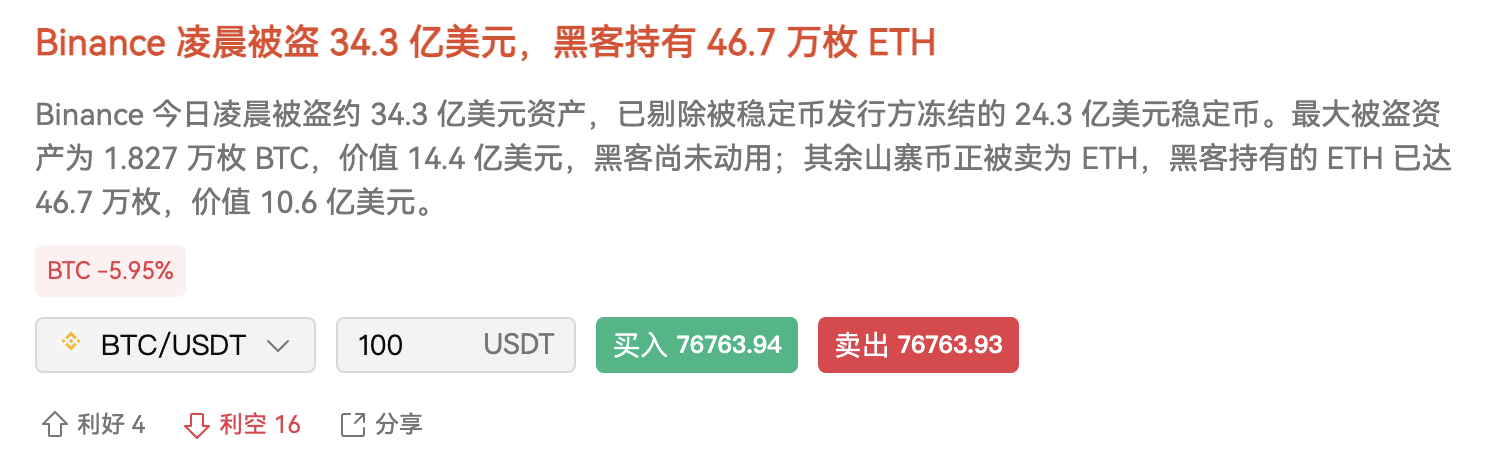
In the early hours of October 30th, UTC+8, news regarding abnormal fund transfers from Binance wallets and potential security issues sparked market attention. The details of the incident and the final loss still need further confirmation, but it has once again reminded everyone: asset security should not be a concern that arises only after an incident occurs.
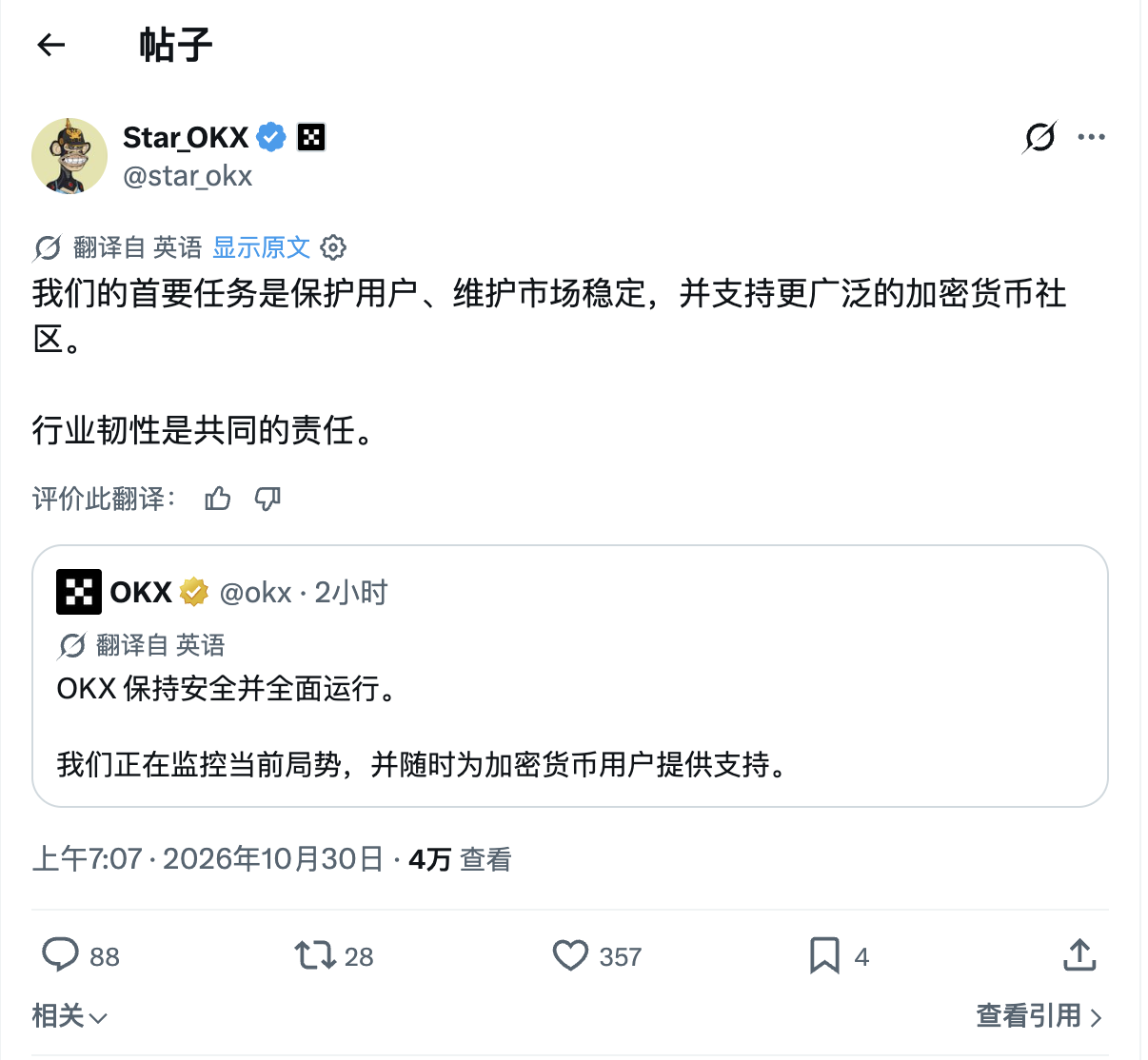
In a screenshot from the social media platform that day, OKX officially stated that the platform remains secure and fully operational, and they are monitoring the situation; Star subsequently emphasized that protecting users, maintaining market stability, and industry resilience is a joint responsibility.
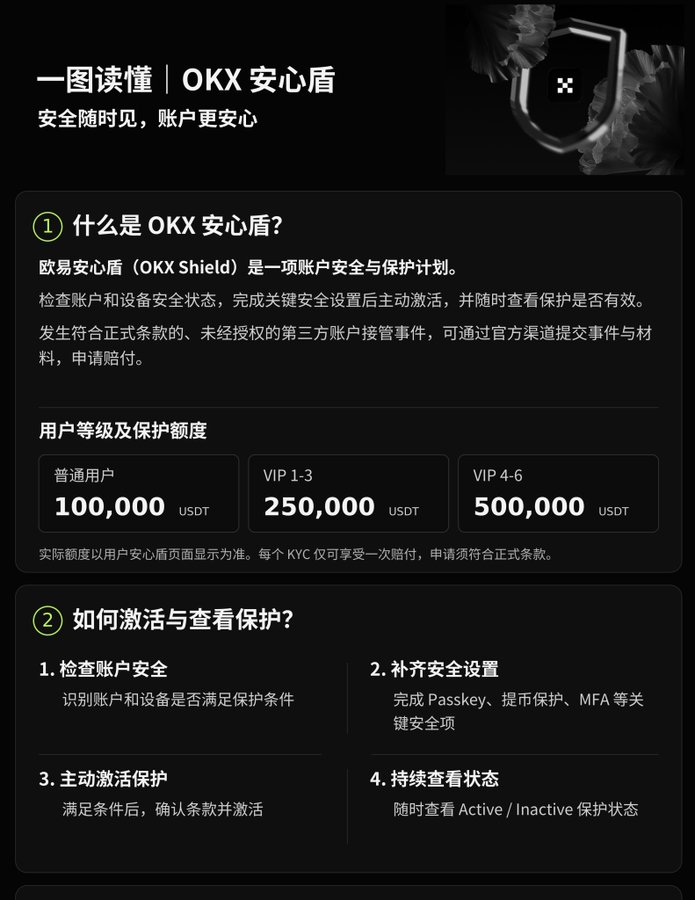
A function that has already been launched is also worth reevaluating—OKX Safety Shield.
Its significance lies not only in a noticeable coverage amount but also in turning account security into a series of specific actions that users can check, complete, and maintain continuously.
1. Why is the clause that emerged about seven weeks ago worth rereading today?
The official terms page for OKX Safety Shield is dated September 9, 2026, with the latest update on October 21.
From the initial public unveiling of the terms to this wave of security incidents, about seven weeks have passed.
This time gap easily suggests "advance planning." However, when evaluating a security product, it's more worthwhile to focus on what it addresses in advance, rather than to speculate whether the platform foresaw a particular attack.
For the average user, security settings often occupy an awkward position: knowing they are important but feeling they can always wait a little longer.
Setting it up after the trading is done, checking when the market stabilizes, cleaning old devices only when changing phones. Over time, security becomes a task that is never completed.
The noteworthy aspect of Safety Shield is that it provides users with a clear entry point for action: checking eligibility, completing settings, confirming status, and maintaining it continuously.
Implementing risk awareness into operations is more valuable than an abstract "stay safe."

2. What does Safety Shield actually protect?
First, let's talk about the most important distinction: Safety Shield focuses on unauthorized takeover of personal exchange accounts, which does not equate to covering all risks to crypto assets.
It can be understood as: after completing necessary security settings for eligible accounts, it provides the possibility of compensation for specific account theft incidents that have been reviewed.
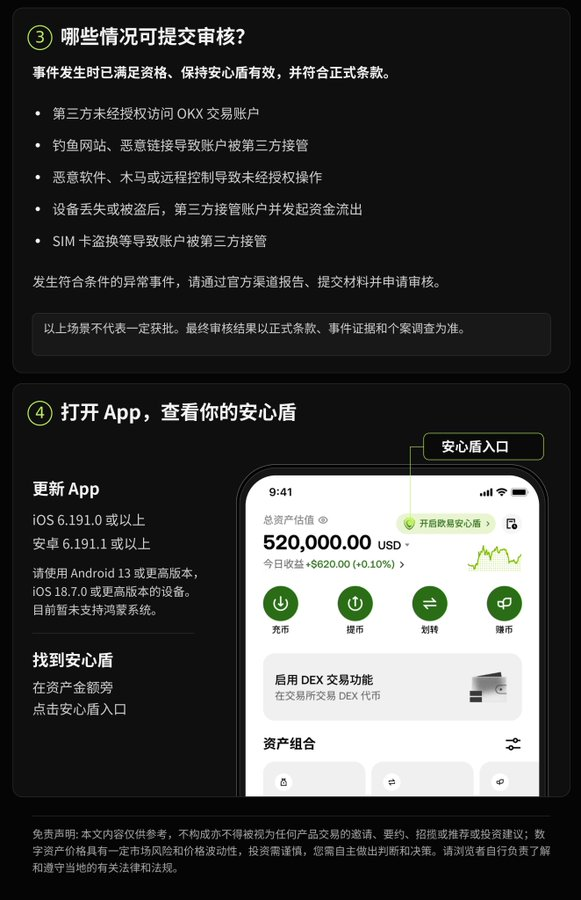
For example, if an attacker obtains login credentials, logs into the account abnormally, and unilaterally transfers assets, this may fall under circumstances that require investigation and assessment.
But this is not the same as when a user confirms a transfer according to a scammer's instructions.
The key factors to assess are not only whether "money has been lost," but also "who controlled the account, who completed the authorization, and how the loss occurred."
Additionally, personal account protection and the security of the exchange’s underlying wallets are at different levels. One cannot deduce from OKX's indication of current safe operations that "it was all thanks to the Safety Shield blocking the attack."
The value of Safety Shield needs to be understood within the actual scope it covers.
3. Up to $500,000, first understand which tier applies to you
According to the official documents, eligible users correspond to the following maximum compensation amounts:
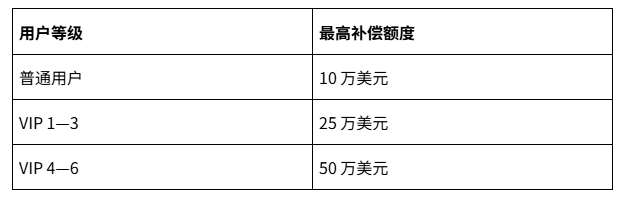
The maximum amount does not equate to a guarantee of payout, nor does it mean that every user is entitled to $500,000.
The actual applicable amount needs to be checked on the Safety Shield page and is subject to conditions such as service entities, account status, and verification results.
There is also an easy-to-overlook limitation: based on verified identity, each user can receive approved compensation only once in their lifetime across all OKX entities.
Therefore, when considering this set of numbers, the logical order should be:
First check the eligibility criteria, then the coverage area, and finally the amount.
The official statement also clarifies that the Safety Shield is a voluntary, discretionary goodwill protection program, not an insurance, deposit protection, or unconditional compensation promise.
Knowing these boundaries will not diminish the value of the function; instead, it can prevent misunderstandings when help is truly needed.
4. More worthy of attention than the amount is the security check before activation
Safety Shield does not automatically activate just because you have an OKX account.
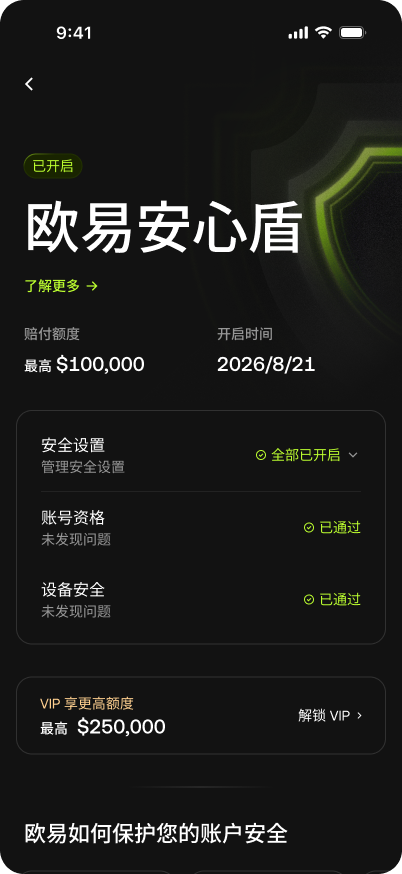
Users need to enter the relevant portals of the official app or website, complete checks and settings, accept applicable terms, and manually activate it.
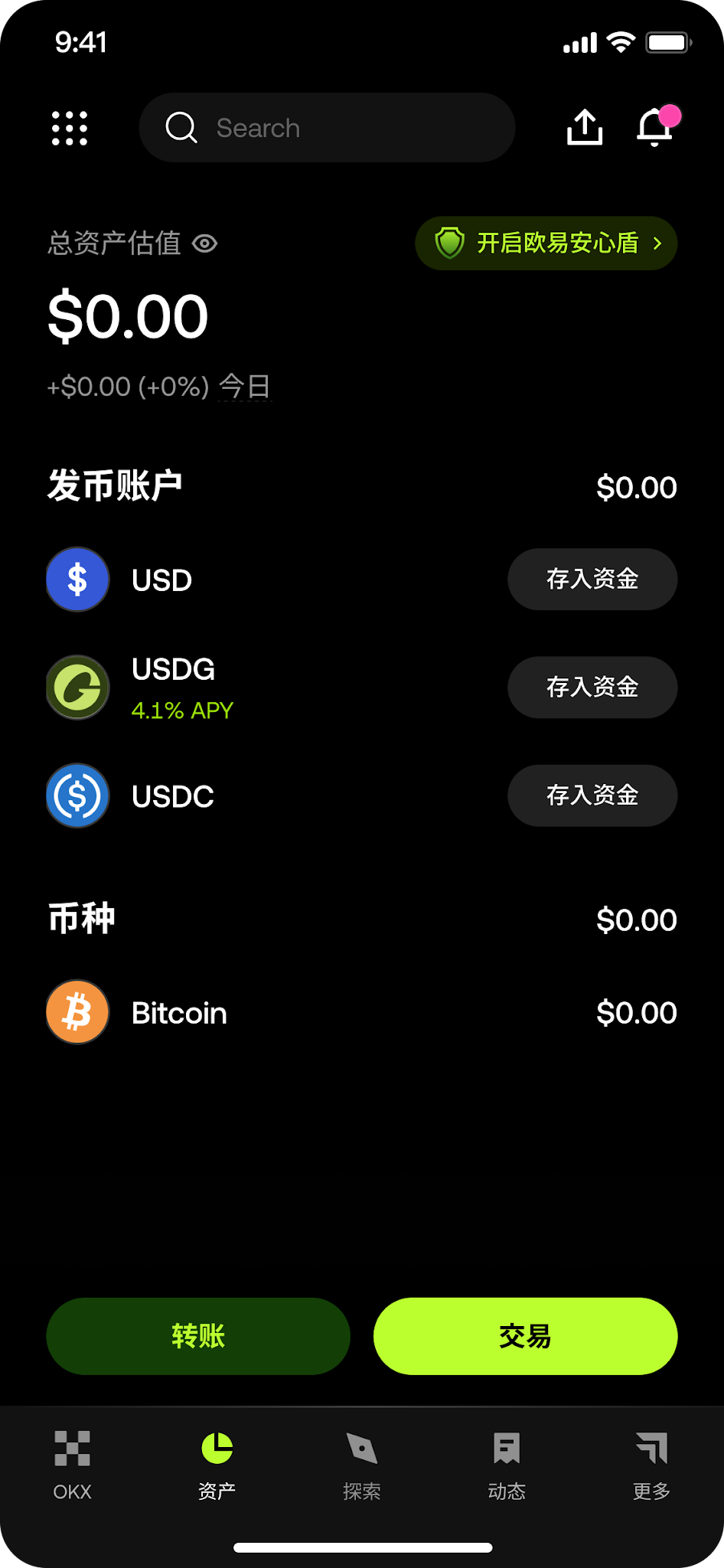
This set of preparatory actions mainly involves six aspects:
- Account Eligibility: Complete identity verification and ensure account meets requirements.
- Device Health: Current and associated devices pass security assessment.
- Passkey: Enable Passkey.
- High Withdrawal Protection: Complete necessary facial verification settings.
- Web Withdrawal Protection: Restrict completing withdrawals directly on the web.
- Multi-Factor Authentication: Enable necessary verifications for related operations as per the page requirements.
It's noteworthy here that "associated devices" are mentioned.
Many people diligently protect the phone they are using but forget about computers, old phones, or devices that are still trusted by the account that were logged into previously.
From a user's habit perspective, the value of a comprehensive check lies in bringing those often-forgotten security aspects into view.
After completing all requirements, users still need to accept terms and manually activate based on page prompts.
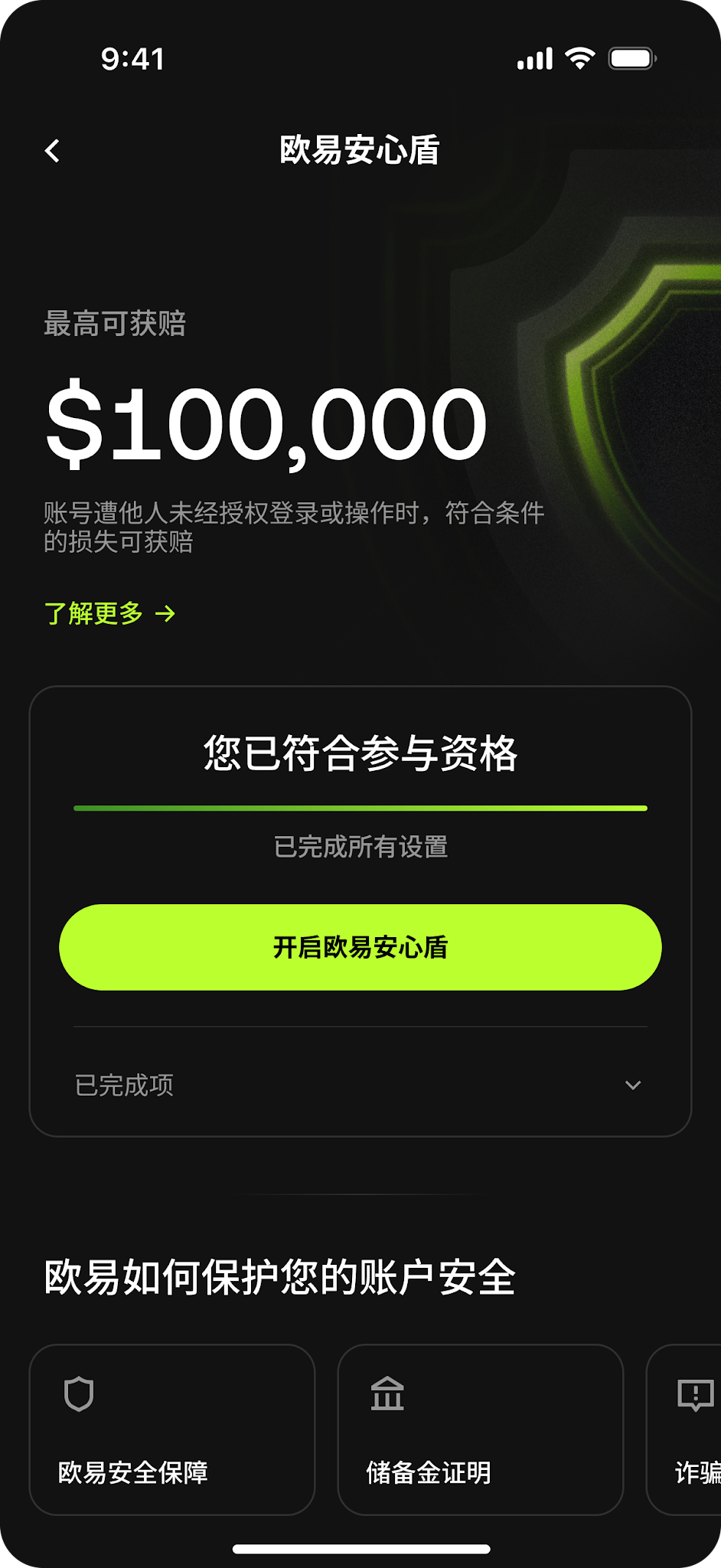
However, initial activation does not mean it is permanently valid.
If necessary security settings are turned off or the account or device no longer meets the conditions, Safety Shield may revert to an inactive status. Therefore, after changing devices or adjusting verification methods, it's worth checking the page status again.
5. What situations should not expect Safety Shield to cover?
To understand the scope of protection, we can look at three everyday scenarios.
First: Someone impersonates customer service and asks you to confirm a "safe transfer."
If the transfer is initiated by you or you complete key authorization, even if deceived, it cannot simply be treated as an unauthorized takeover of a third-party account.
Second: Assets kept in a Web3 wallet or DeFi protocol suffer losses.
Safety Shield is aimed at eligible OKX exchange accounts and does not extend to OKX Wallet, self-custody wallets, or external DeFi services.
Third: Trading losses or API key leaks.
Market losses, investment losses, and losses caused by API key or third-party tool authorizations cannot be understood as the regular subjects of Safety Shield's protection.
These examples illustrate the same issue:
Security features can enhance protection but cannot replace judgment before each authorization.
Especially when confronted with phrases like “customer service requires a verification code” or “you need to transfer funds first to lift restrictions,” the more urgent the situation, the more one should return to official channels for independent verification.
6. What to do first when encountering abnormal account activity?
Rather than frantically looking for so-called "recovery experts," it's more important to quickly report through official channels and maintain complete records.
According to existing rules, one generally needs to notify OKX within 72 hours after the last unauthorized transaction and submit a formal application, followed by providing the required documents within 7 days after the formal application.
Timelines, abnormal transaction records, screenshots, communication content, and device information can all affect the investigation.
Therefore, upon noticing anomalies, one should follow official guidelines to protect the account, cooperate with processing, and properly retain evidence. Do not hastily delete records related to the event in a rush to “clean your phone.”
Whether compensation is approved, the specific amount, and processing time still need to be determined based on applicable terms and individual case reviews.
7. Where should OKX's foresight be reflected?
Security incidents can easily lead discussions to two extremes: either believing that no platform can be trusted or imagining that a certain platform will never encounter issues.
What is more helpful for users is to raise more specific questions:
Can I check my security status? Are necessary settings sufficiently clear? After an anomaly occurs, do I know where to report it and what to prepare?
From this perspective, Safety Shield is worth studying for its integration of account protection, eligibility checks, and post-incident application arrangements into a process that users can practically use.
Transforming security from a slogan into actionable steps is what ordinary users can truly feel as proactive preparation.
This incident will continue to develop, and the industry still awaits more confirmed information.
However, one thing does not need to wait until the investigation is completed: open your own account and check those postponed security settings.
If your account supports Safety Shield, take the time to understand and evaluate whether to activate it.
The market determines how assets fluctuate; security preparations determine whether you have seriously protected them.
🎁 AiCoin exclusive registration benefits are here!
Register for OKX through AiCoin's exclusive link and get a permanent 20% rebate
👉 Register for OKX now:
https://jump.do/zh-Hans/xlink?checkProxy=true&proxyId=2
📢 Join the AiCoin community for more information on new cryptocurrencies and earning opportunities
Official Telegram community: https://t.me/aicoincn
AiCoin Chinese Twitter: https://x.com/AiCoinzh
OKX benefits group: https://aicoin.com/link/chat?cid=l61eM4owQ

This article is based on public information reviewed by October 30, 2026, and is meant solely for functional introduction; it does not constitute investment advice, insurance explanation, or compensation promise. The progress of events, availability of functions, eligibility, and compensation arrangements are subject to the latest official information and applicable terms.
免责声明:本文章仅代表作者个人观点,不代表本平台的立场和观点。本文章仅供信息分享,不构成对任何人的任何投资建议。用户与作者之间的任何争议,与本平台无关。如网页中刊载的文章或图片涉及侵权,请提供相关的权利证明和身份证明发送邮件到support@aicoin.com,本平台相关工作人员将会进行核查。