How to Stake ETH with OKX
Rule Verification: November 2, 2026
If you are already planning to hold ETH without any selling plans for a period of time, besides waiting for price changes, you can also learn about a way to participate in network operations and earn rewards: ETH staking.
OKX's ETH staking allows the platform to handle node deployment and maintenance, enabling users to participate with a smaller amount. The public product page and the newer official FAQ indicate that the minimum participation amount is 0.001 ETH; actual qualification and amount requirements should still be based on the page after logging in.
Where do the earnings come from?
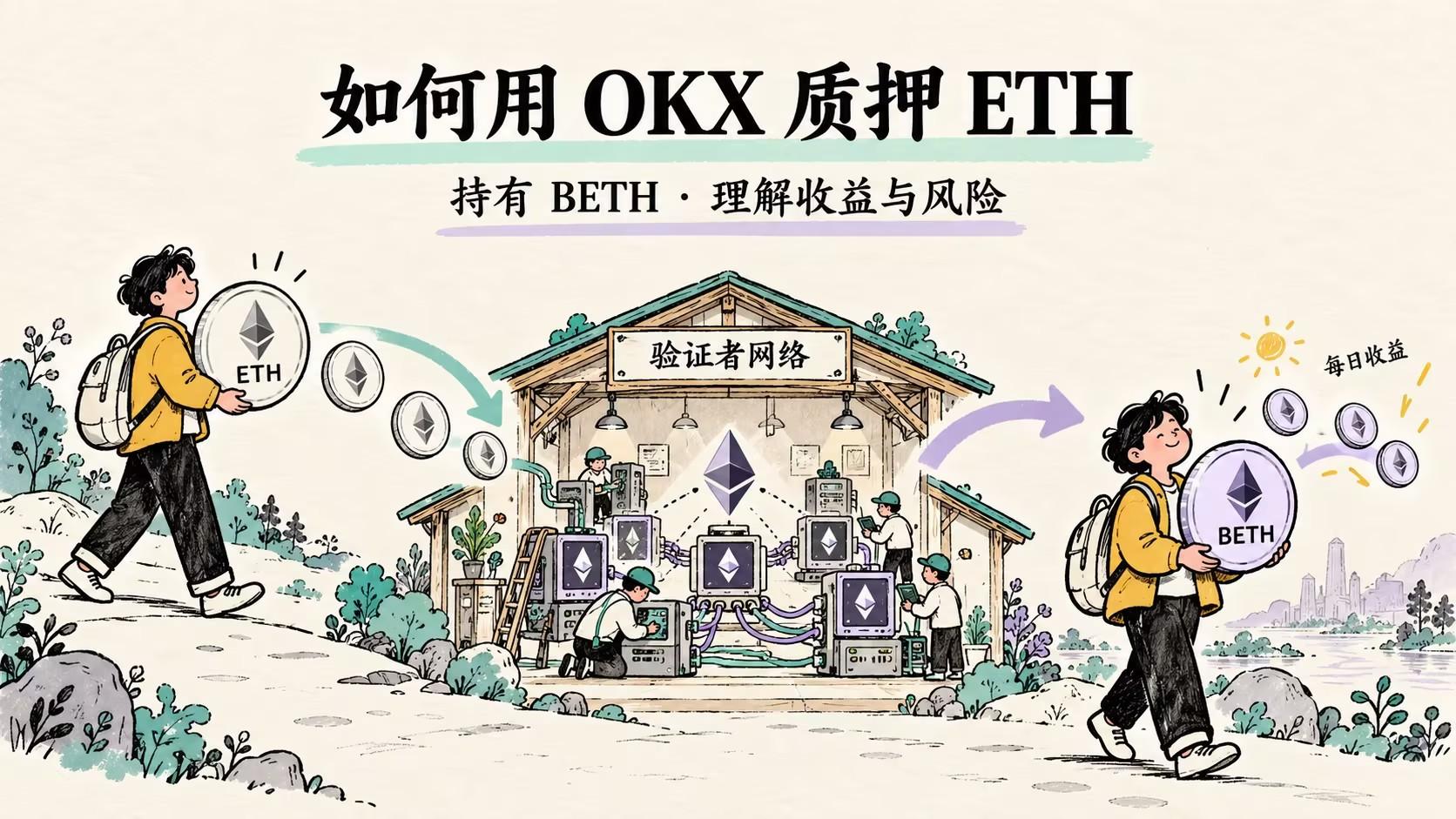
Ethereum relies on validators to confirm transactions and maintain the ledger. Validators receive rewards for completing network tasks, and those participating in staking share these rewards. You can understand it as: allowing ETH to participate in maintaining the network and receiving corresponding remuneration.
This earnings vary with network conditions and are not a fixed interest promised by the platform. The convenience of participating through OKX eliminates the need to operate your own node; however, you also need to bear the risks of the platform's custody and staking itself.
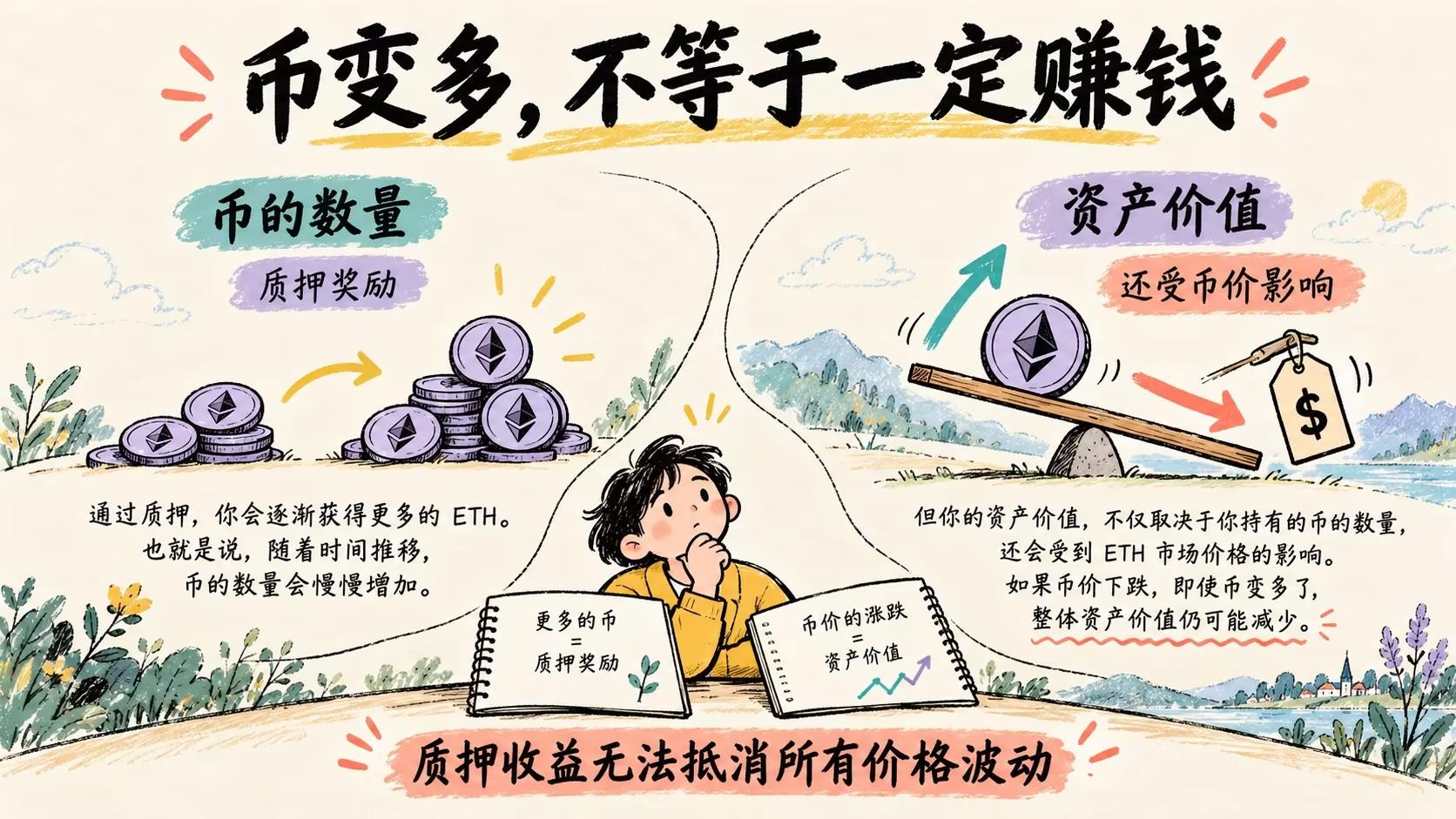
Remember this sentence: Staking can increase the number of your holdings, but it cannot guarantee the increase in asset value.
01|What Does Receiving BETH Mean?
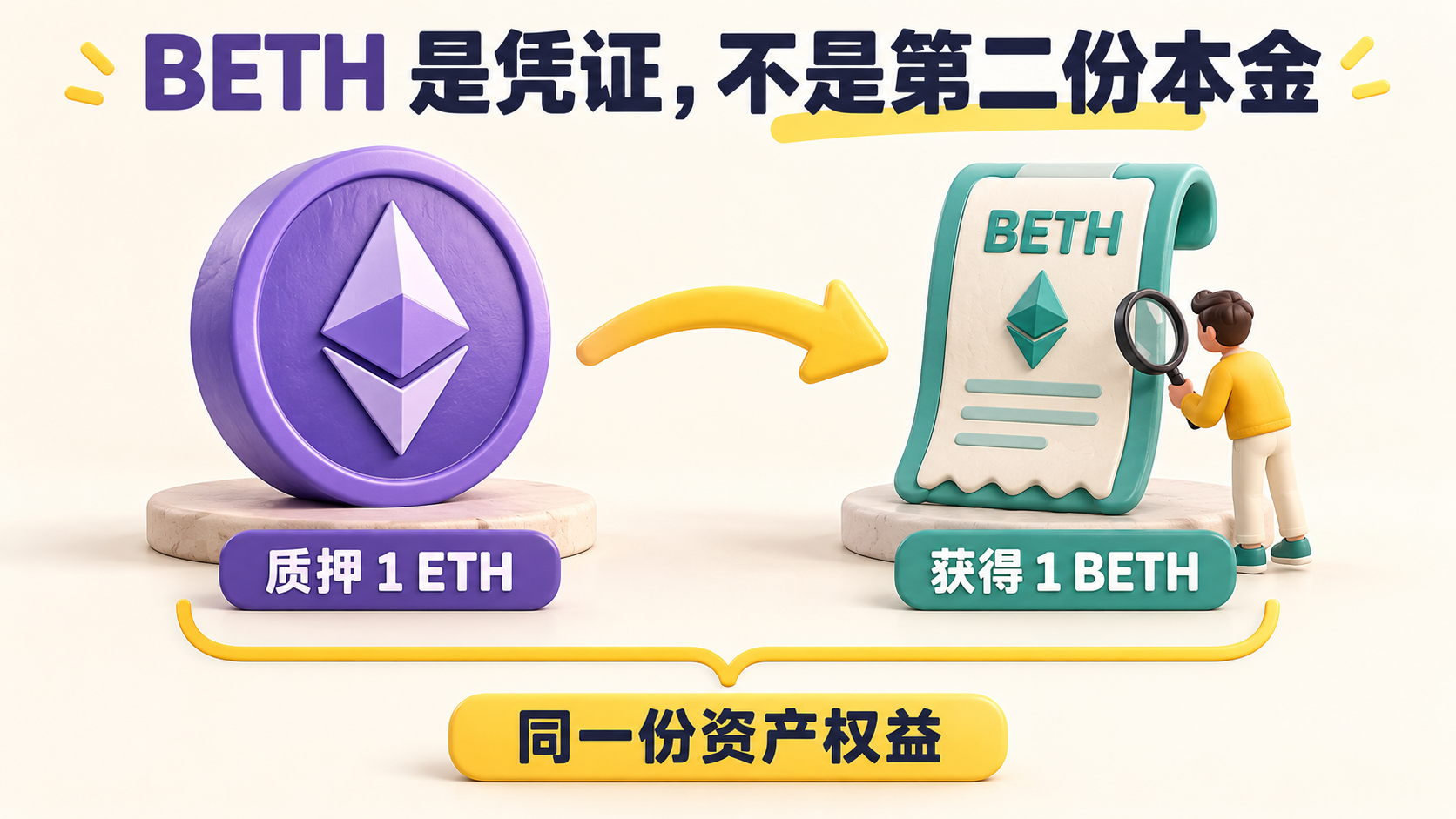
After staking ETH, you will receive BETH at a 1:1 ratio. For example, staking 1 ETH corresponds to receiving 1 BETH. BETH is a certificate representing the staked assets, not an additional principal given to you by the platform.
Therefore, you cannot add "1 ETH that has already been staked" and "1 BETH in your account" together and think you have 2 ETH. They correspond to the same asset rights.
When holding BETH, eligible positions can receive BETH rewards. The newer official FAQ uses hourly position snapshots and adjusts for asset outflows; rewards are credited to the funding account daily at 11:00 (UTC+8). The actual first reward and counting positions depend on orders and bills.
Understanding Earnings, First Look at Fees
The official FAQ states: the platform charges a 5% service fee from the earnings, including network fees; the annualized figure displayed on the product has already deducted this service fee. It does not mean that 5% is directly deducted from your total principal.
For example, if a certain on-chain gross reward is 0.01 ETH, the fee calculated at 5% is 0.0005 ETH, leaving a remainder of 0.0095 ETH as equivalent rewards. This is just a fee demonstration and not a prediction of earnings.
If you directly use the post-fee annualized estimate for earnings, do not multiply it by 95% again. However, costs such as spot trading fees, spreads, and taxes still need to be considered separately.
How Does It Differ from Bank Deposits?
Bank deposits are typically denominated in fiat currency and are subject to the deposit protection rules of the respective location. ETH staking involves holding a volatile digital asset, and exiting may require a wait; just because both display "annualized" does not mean they are of the same risk profile.
Compared to simply holding ETH, you are striving for additional coin-based rewards while also increasing custody, staking, and exit processes. To determine if it is worth it, these costs need to be taken into account.
02|How Much Can You Earn by Staking 1 ETH for a Month?
For convenience in recalculation, assume: principal is 1 ETH, receiving BETH at a 1:1 ratio; continuously meeting award conditions for 30 days; post-fee annualized return remains at 3%; calculated using simple interest, not accounting for reinvestment, taxes, or exit costs. 3% is merely a teaching assumption and does not represent current quotes.
30 days reward ≈ 1 × 3% × 30 ÷ 365
≈ 0.002466 BETH
30-day holding period yield ≈ 0.2466%. Assuming final redemption is completed at a 1:1 ratio, the principal plus rewards would be approximately 1.002466 ETH. The actual settlement is also influenced by the daily annualized rate, effective holdings, rounding, and other rules.
Let’s Look at It Again in USD
Assuming ETH starts at $3,000, the investment value is $3,000. If after 30 days it remains at $3,000, the aforementioned assets would be worth approximately $3,007.40, resulting in about $7.40 more than the starting point.
If ETH drops to $2,700, the asset would be valued at approximately $2,706.66, which would still result in a loss of about $293.34 or about 9.78%. These figures do not account for exit costs and taxes, nor do they include price changes during the redemption waiting period.
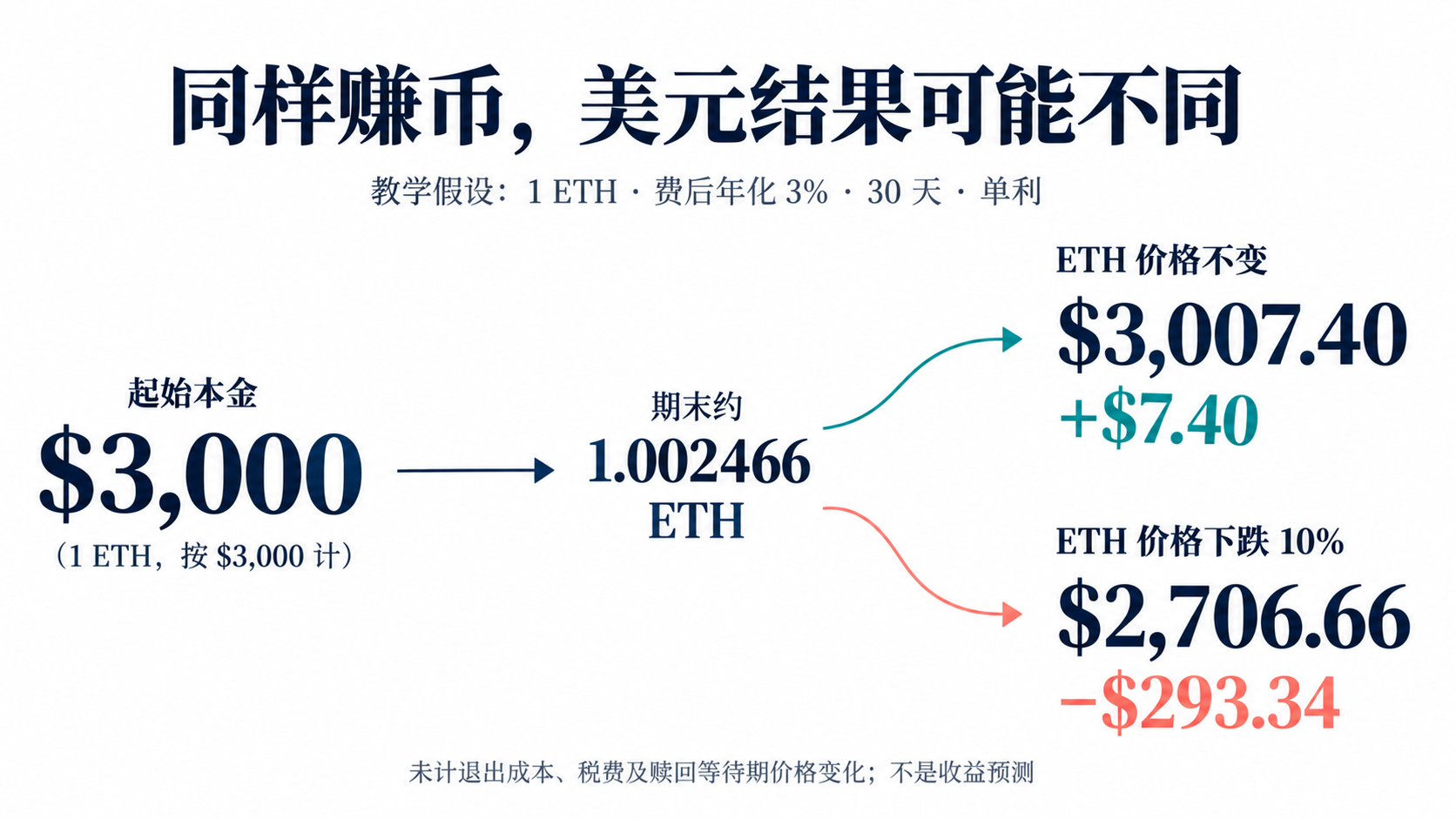
Thus, the annualized yield, actual holding period yield, and final net earnings are three different matters. A single price fluctuation can exceed months of staking rewards.
03|To Get Back ETH, Choose the Right Withdrawal Method First
After holding BETH, you can consider redemption or trading through supported spot markets. The key difference between the two approaches is whether to wait for an exchange according to product rules or to accept the market price at that time.

Standard Redemption: Exchange BETH back to ETH according to product rules. The time required depends on network processing conditions, and you should check the expected credit time before submitting. Once the redemption is submitted, the corresponding BETH will be locked and will stop earning interest.
Fast Redemption: Funds are returned in batches when available, subject to personal limits, platform dynamic limits, and queuing situation. This can shorten the waiting time for some funds, but cannot be understood as any amount can be credited instantly.
Spot Selling: Execute trades through supported trading pairs such as BETH/ETH. The speed depends on transaction conditions; prices may deviate from 1:1, and fees and slippage need to be considered. The product supports 1:1 redemption, which does not mean that market buyers are always willing to take 1 BETH at 1 ETH.
A Small Account that is Easy to Overlook
Assuming you are in a hurry to exit, if 1 BETH can only be sold for 0.995 ETH. This results in a discount loss of 0.5%, not counting fees; this already exceeds the approximately 0.2466% reward from the previous 30 days. The price given here is for scenario demonstration purposes only.
If you have a specific timeframe for fund usage, remember to leave a redemption margin. Positions that require you to sell coins at any time are not suitable for placing all funds into staking just because of annualized numbers.
04|What to Check Before and After Operation?
First confirm whether your location and account support the service, complete the identity verification required by the platform, and read the user agreement displayed after logging in. Do not bypass regional restrictions just to use the product.
Find the Product Entry
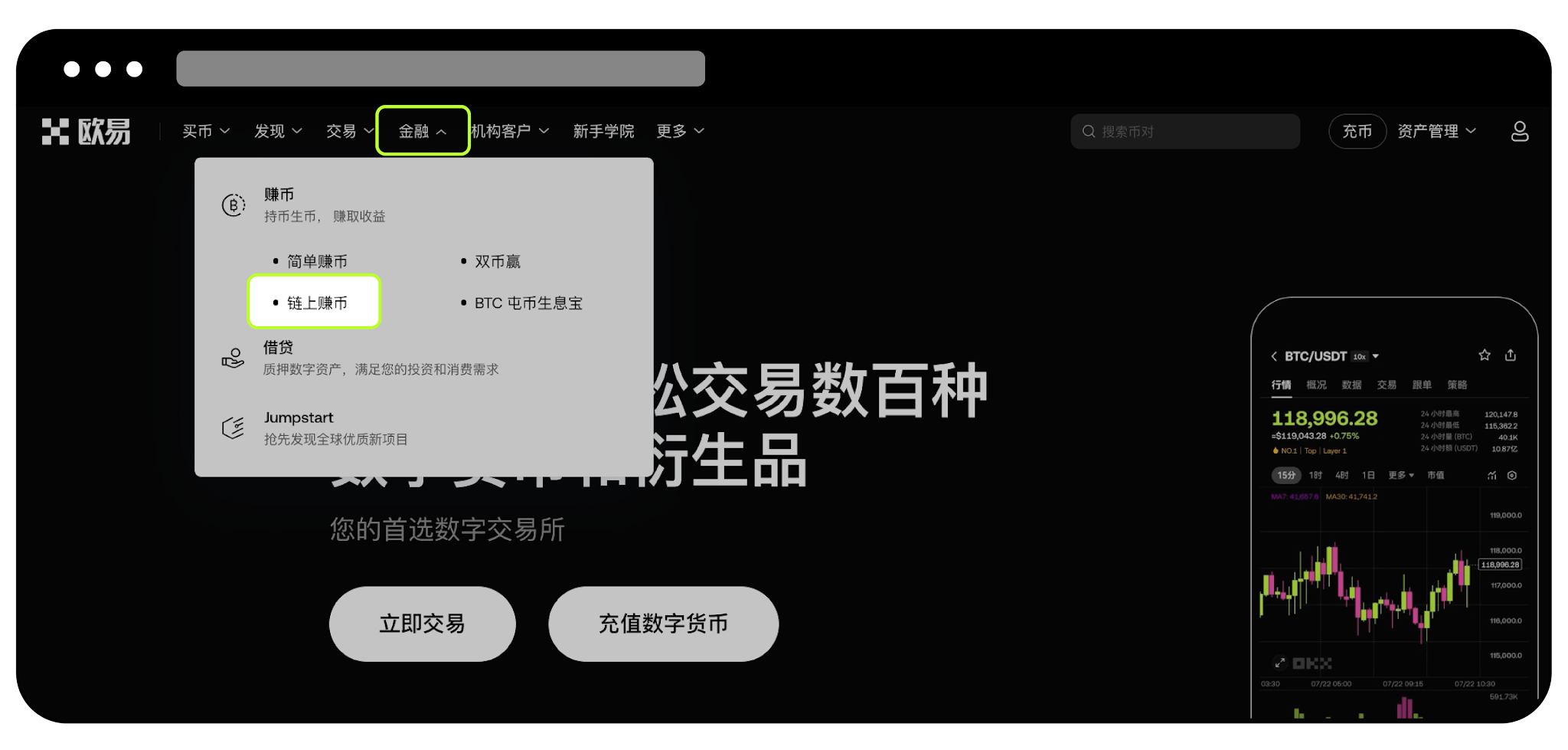
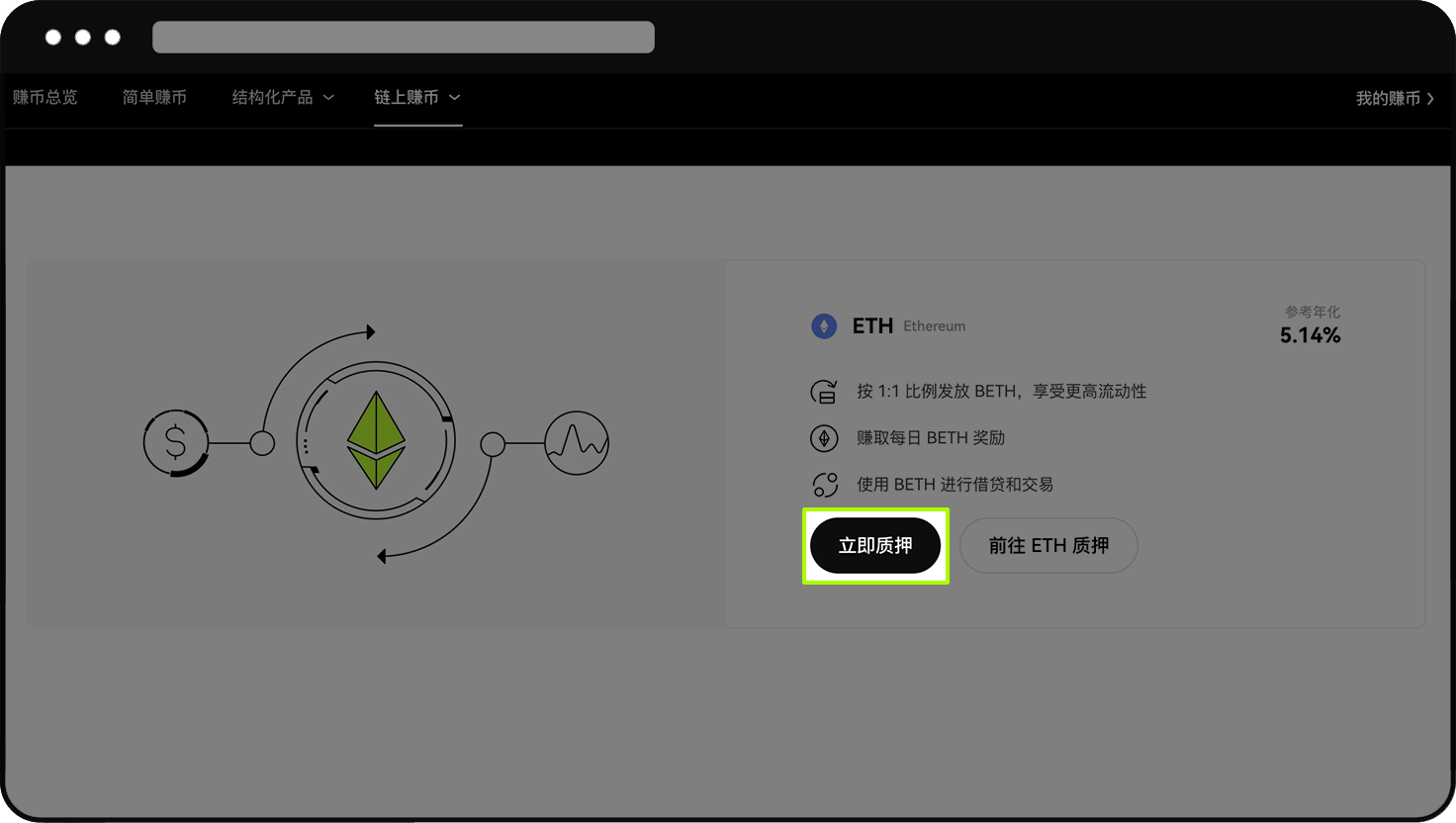
According to the official operating instructions, the App can access "Earn Coins on Chain" from "Explore", then select "ETH Staking"; the webpage can enter "Earn Coins on Chain" from "Finance" and select ETH. The entry names may vary depending on version and region.
Confirm the Order, Not Just the Amount
Enter the "Stake Now" or subscription page, input the amount, and focus on the minimum amount, reference annualized rate, fees, reward arrangements, and redemption rules before confirming the agreement. Below is a sample interface from the official help documents; the values in the picture should not be taken as real-time earned quotes.
Check Two Things After Subscription
First, check whether ETH has been converted to BETH as per order; second, check the actual issuance in the reward record. If you do not see the rewards yet, first check the timing of the position count, if the assets have been withdrawn, and whether redemption has been submitted.
When using for the first time, you can start with a small amount that meets the threshold to complete the “Subscribe—Check Rewards—Understand Redemption” process. After getting familiar with the operation, decide whether to increase the amount based on your financial arrangement.
05|Suitable for Long-Term Holders, But Keep an Exit Route
ETH staking is worth understanding for those who have decided to hold ETH, can accept price fluctuations, and do not need to use these funds urgently in the near term. Its attractiveness lies in allowing holders to earn additional rewards, rather than solving the issues of timing for entry and market direction for you.
If you merely want to preserve your principal in RMB or USD, or need to use the money within a few days, then "daily rewards" do not eliminate the gap between the product and your needs.
Before Participating, Keep These Four Risks in Mind
Price Risk: Rewards are denominated in digital assets, and a drop in ETH may reduce the total asset value.
Staking Risk: Abnormal validator operation, network failures, or penalty mechanisms may affect rewards and staked assets. The platform handling node operations does not mean that the underlying risks disappear.
Custody and Withdrawal Risk: Assets depend on the platform's service and processing capabilities; system failures, account restrictions, insufficient liquidity, or redemption delays may all affect the timing of use of funds.
Layered Operation Risk: Using BETH for loans, leverage, or participating in DeFi increases risks such as liquidation, contracts, and liquidity. Even if you can still earn staking rewards, it does not mean the entire operation is safer.

Newbies Do Not Need to Rush to “Stack Earnings on Earnings”
Some regions support transferring BETH to X Layer in the form of xBETH. The official explanation is that its on-chain rewards will manifest in the exchange rate. This already involves different holding and usage methods, so don’t directly apply the observation methods for daily BETH credits in exchanges.
When first encountering this, understanding the BETH in your account, actual rewards, and withdrawal rules is usually more valuable than rushing into the next layer of products.
Before deciding whether to participate, ask yourself: Would I still want to hold ETH without staking rewards? Can I bear the price drop? Will I have available funds during the waiting period for redemption? The answers to these three questions are more helpful for making a decision than a pretty annualized number.
🎁 Exclusive Registration Benefits from AiCoin Are Here!
Register with OKX through AiCoin’s exclusive link for a permanent 20% rebate
👉 Register with OKX Now:
https://jump.do/zh-Hans/xlink?checkProxy=true&proxyId=2
📢 Join the AiCoin community to follow more new tokens and earning information from exchanges
Official Telegram community: https://t.me/aicoincn
AiCoin Chinese Twitter: https://x.com/AiCoinzh
OKX Welfare Group: https://aicoin.com/link/chat?cid=l61eM4owQ
Disclaimer: This article is for educational purposes regarding product mechanisms and operations and does not constitute investment advice or a commitment to earnings. Digital assets and staking services carry the risk of principal loss. Product availability, fees, earnings, and redemption arrangements may change, please refer to the latest pages and agreements applicable to your account.
免责声明:本文章仅代表作者个人观点,不代表本平台的立场和观点。本文章仅供信息分享,不构成对任何人的任何投资建议。用户与作者之间的任何争议,与本平台无关。如网页中刊载的文章或图片涉及侵权,请提供相关的权利证明和身份证明发送邮件到support@aicoin.com,本平台相关工作人员将会进行核查。