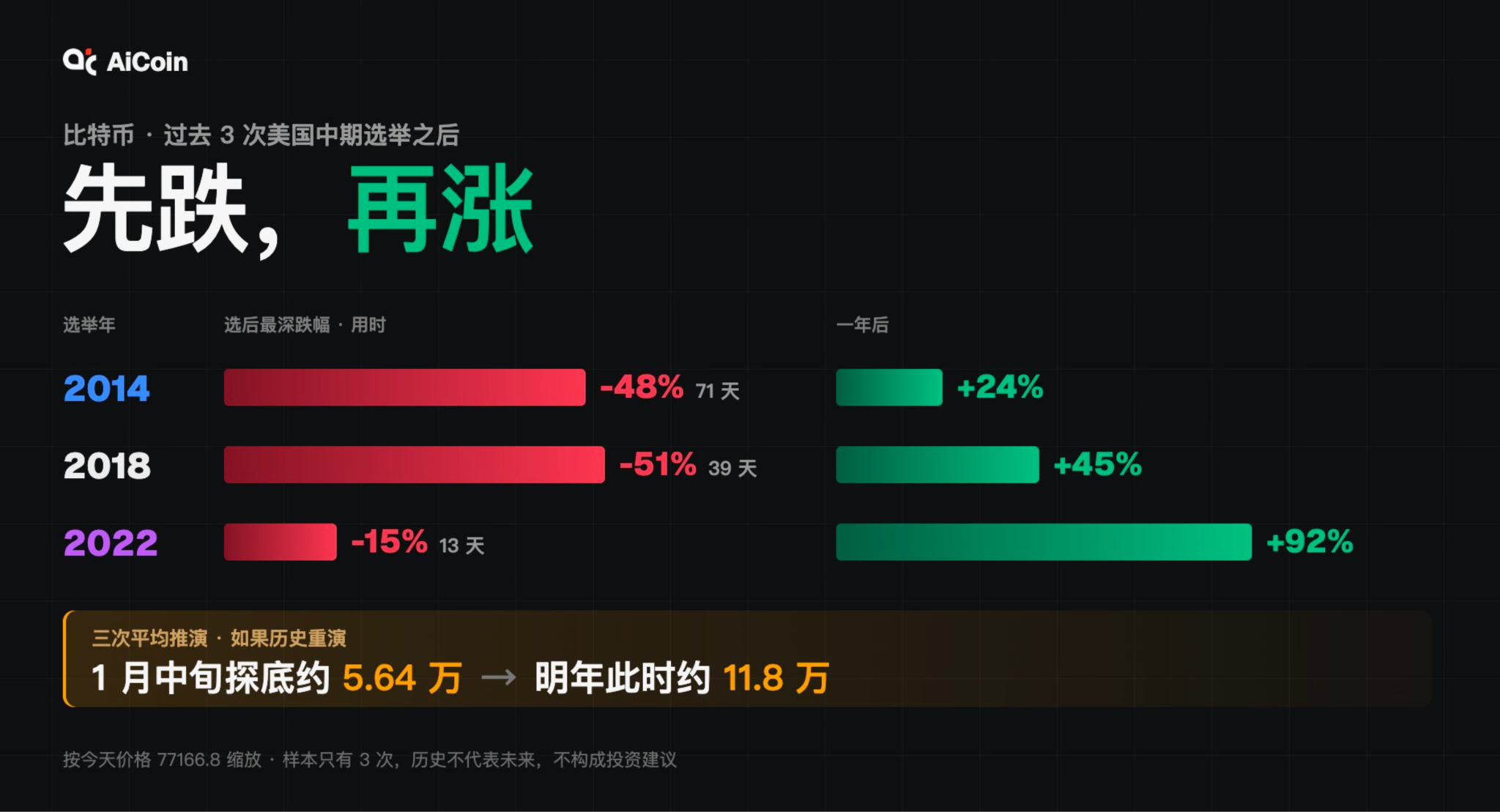
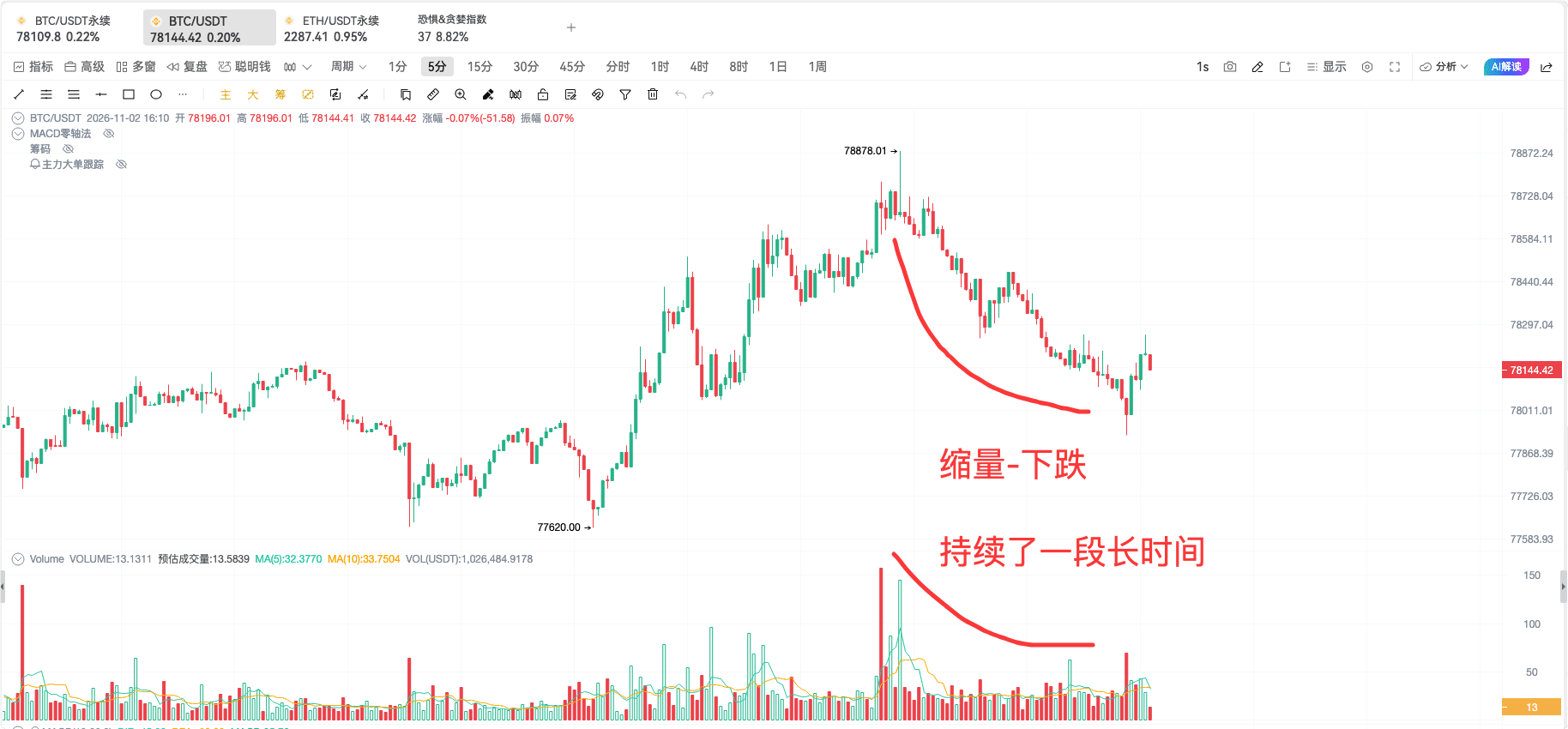
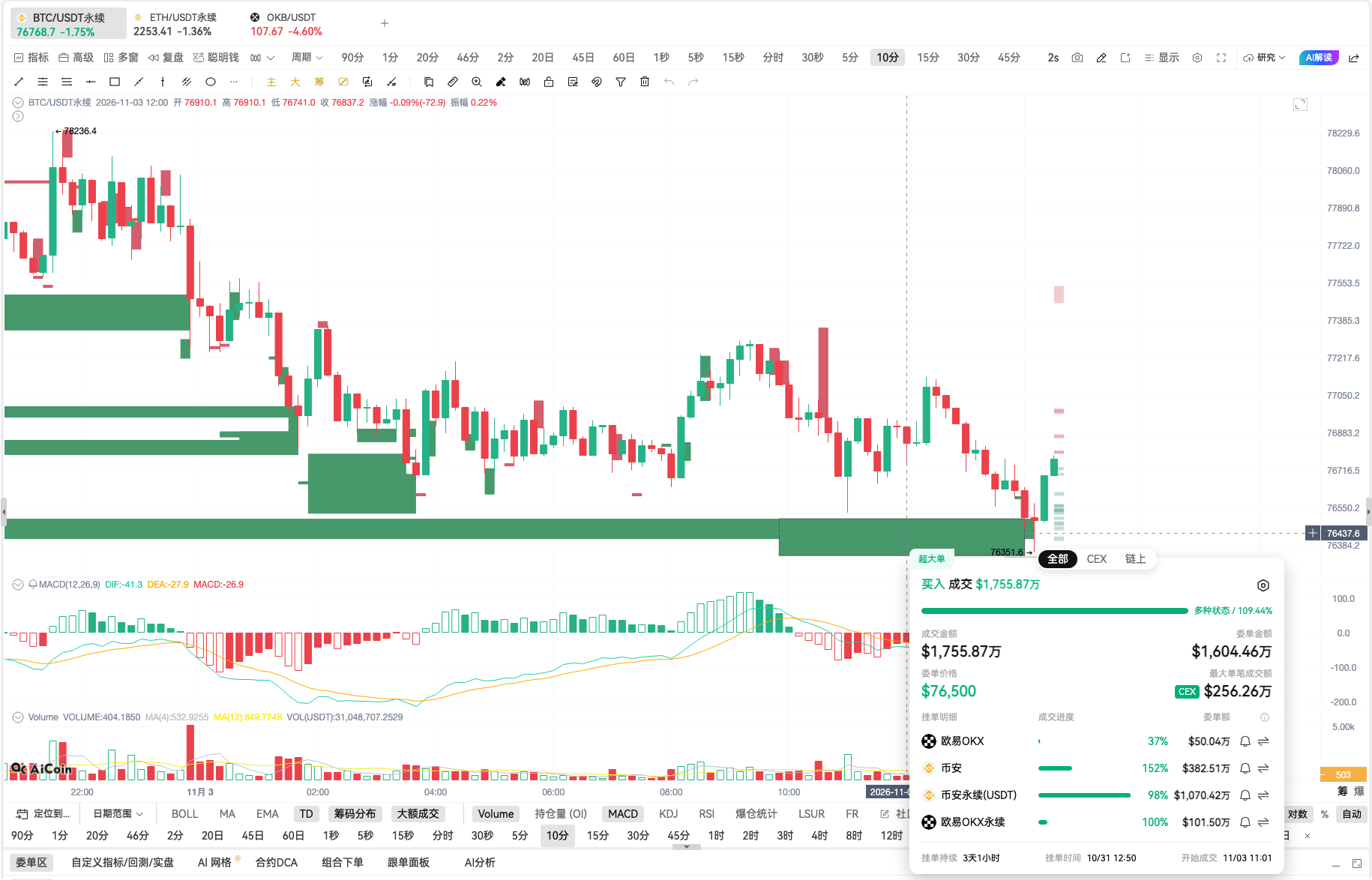
During the BTC rebound process, there has been a continuous large amount of buying transactions around $76,500. According to AiCoin data, the perpetual quote for BTC/USDT is approximately $76,768.7, with a daily decline of about 1.75%; ETH/USDT has a drop of about 1.36%, while OKB/USDT is down about 4.60%. The major orders in the same view show: the buying transaction amount is about $17.5587 million, the order amount is about $16.0446 million, and the execution progress is approximately 109.44%.
The current focus is no longer just on the potential selling pressure above, but rather on the buying support that appears near the lows, and whether this support can change the short-term structure. However, the large buying data is an important clue, not a conclusion of reversal. To determine whether the market is truly turning strong, it is still necessary to see if the price can stabilize, whether buying transactions continue, and whether the supply above is absorbed.
First look at the price structure: The rebound after the decline is still in the verification phase
The 10-minute chart shows that BTC fell from around $78,236, marking a low of about $76,351.6, then rebounded to around $76,768.7. The price has indeed recovered from the lows, but the current quote is still below the previous chart highs, and the short-term downward structure has not been reversed based solely on a single rebound.
Short-term analysis needs to distinguish between "buy orders appearing" and "trend turning strong." Whether a buying order can form effective support depends firstly on whether it holds around $76,500 during the pullback and the low areas marked in the chart; secondly, whether the rebound can reclaim key price levels from the previous decline; and thirdly, observing whether higher lows appear after the rebound, rather than quickly breaking previous lows again. Only when the price structure gradually improves can buying transactions be seen as effective support, rather than just a short-lived counterparty in a downtrend.
The MACD in the chart is still below the zero axis, and the short-term momentum has yet to turn clearly strong. This does not mean that the price will necessarily continue to fall, but it indicates that the current recovery alone is not sufficient to confirm a trend reversal. A more cautious judgment is: BTC shows signs of support near $76,500, short-term repair is occurring, but whether it can continue still needs verification.
Pay attention to large buying orders, but understand its three boundaries
First, resonance occurs when large orders across multiple platforms buy at the same price level. The panel in the chart shows a summary of orders and transaction information across trading platforms over a period of time, and should not be simply understood as one order from a single account, nor should it be concluded from aggregated data that the same "whale" is continuing to buy. The panel lists the amounts and progress from accounts/markets such as OKX, Binance, which can help observe the distribution of buying activities.
Second, order amount and transaction amount are not the same thing. The order amount in the chart is about $16.0446 million, while the buying transaction amount is about $17.5587 million, with an execution progress of 109.44%. It should be described according to the product panel as "monitored buying transactions and order progress." The buying in perpetual contracts may also involve opening long positions, closing shorts, or adjusting positions, and cannot be differentiated solely by direction.
Third, large transactions reflect trading activity that has already occurred or been recognized by the system, but cannot independently indicate the subsequent price direction. Even if there are many buyer transactions, the price may still fall due to stronger selling pressure; conversely, if after buying transactions, the price does not continue to weaken and is quickly supported on the pullback, it would better support the judgment that "selling pressure is being absorbed." The important thing is not just to look at the amount, but to observe how the price reacts after the transactions.
Thus, a verifiable bullish clue can currently be proposed: there is significant buying activity around $76,500, and the price has rebounded from a low; if the price continues to hold that area on subsequent pullbacks, and buying transactions continue to appear, the short-term support logic will strengthen. Conversely, if the price breaks below the lows, buying transactions do not continue, or if the price continues to weaken after large buying, it indicates that this batch of transactions has not yet converted into effective support.
Next, focus on three verification signals
First, check if the price holds the support area. $76,500 is the reference price corresponding to the large buying activity in the chart, while the low around $76,351.6 can also serve as a monitoring clue. They do not guarantee effective support; if the price repeatedly falls below and cannot recover, buyer support will need to be reassessed.
Second, check if the transaction and price move in the same direction. If subsequent buying transactions continue to increase and the price gradually rises, it indicates that buyer activity may be converting into price support; if the buying amount is large but the price remains stagnant or falls, it may mean that selling supply is still strong, or that the buying is merely part of the counterparty liquidity.
Third, check if different assets and markets resonate. The declines in BTC, ETH, and OKB in the chart are not the same, especially OKB showing a larger decline. One should not directly equate the weakness of a single platform token with the direction of the entire cryptocurrency market, nor conclude that all assets are synchronously turning strong just because BTC shows large buying. A wider observation that includes spot and contract trends, trading volume, and market structure should be combined.
Multi-account placing orders: Transforming analytical conclusions into a consistent execution process
Market analysis addresses "what signals are currently present in the market, and what conditions still need to be verified"; multi-account placing orders address "how to reduce repeated operations across multiple accounts once a trader has formulated an execution plan." These two matters cannot be inverted. Seeing buying transactions near $76,500 does not mean all accounts should immediately synchronize to go long; only when the individual's or team's strategy conditions are met should consideration be given to how to execute efficiently.
The advantages of AiCoin's multi-account ordering lie first in centralized management of multiple API accounts, reducing the need to switch accounts and input repeatedly; secondly, it supports organizing orders by account proportion, allowing different accounts to execute in sync according to pre-planned scales; for teams that need to manage multiple exchange accounts, they can also unify the dispersed order operations into a consistent process. Official materials describe ways such as copy trading, sub-accounts, and multi-account synchronous placing orders and batch trading scenarios.
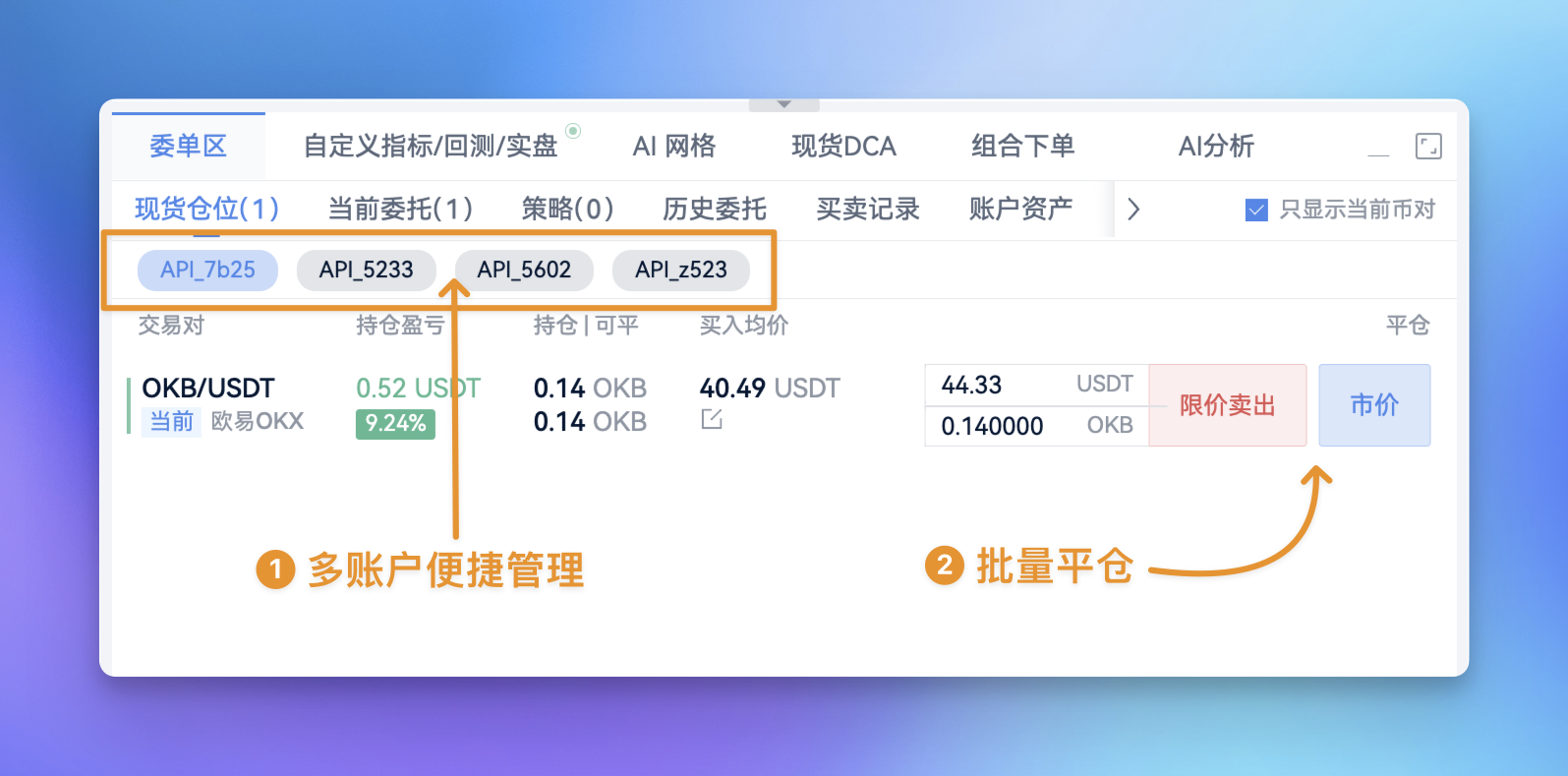
Copy trading mode is suitable for arrangements where "base quantities are entered first, and then other accounts execute according to set ratios or multiples." For example, if accounts need to follow the same strategy but differ in order scales, ratios can be pre-configured to reduce the need to recalculate for each account individually.
Sub-account mode is suitable for arrangements where "the total delegated amount for multiple accounts is first determined, and then split according to proportions." For example, traders may first define the total delegating quantity for this time, and then allocate it based on account weight, making it easier to control the share borne by each account. In simple terms, copy trading focuses on how accounts follow the input quantity; sub-account focuses on how the total amount is distributed to the accounts.
Operation process: From account selection to order verification
1. Enable the "Multi-account ordering" function on the AiCoin order panel.
2. Select the API accounts involved in this plan and confirm the exchange and account identities.
3. Choose either the copy trading or sub-account mode according to the plan, setting the ratios or multiples for each account; do not apply a uniform ratio directly without checking account funds and existing positions.
4. Check trading pairs, direction, order types, and quantities. Combine with the current market situation to confirm personal triggering conditions and risk boundaries, rather than treating large buying itself as an automatic order signal.
5. After submission, check the order status, transaction situation, and position changes for each account. If the strategy needs adjustment, then process modifications, order cancellations, or position management according to actual transaction results. AiCoin's materials also describe scenarios for batch order cancellations and other multi-account operations, with specific functions subject to client version, exchange support, and account permissions.
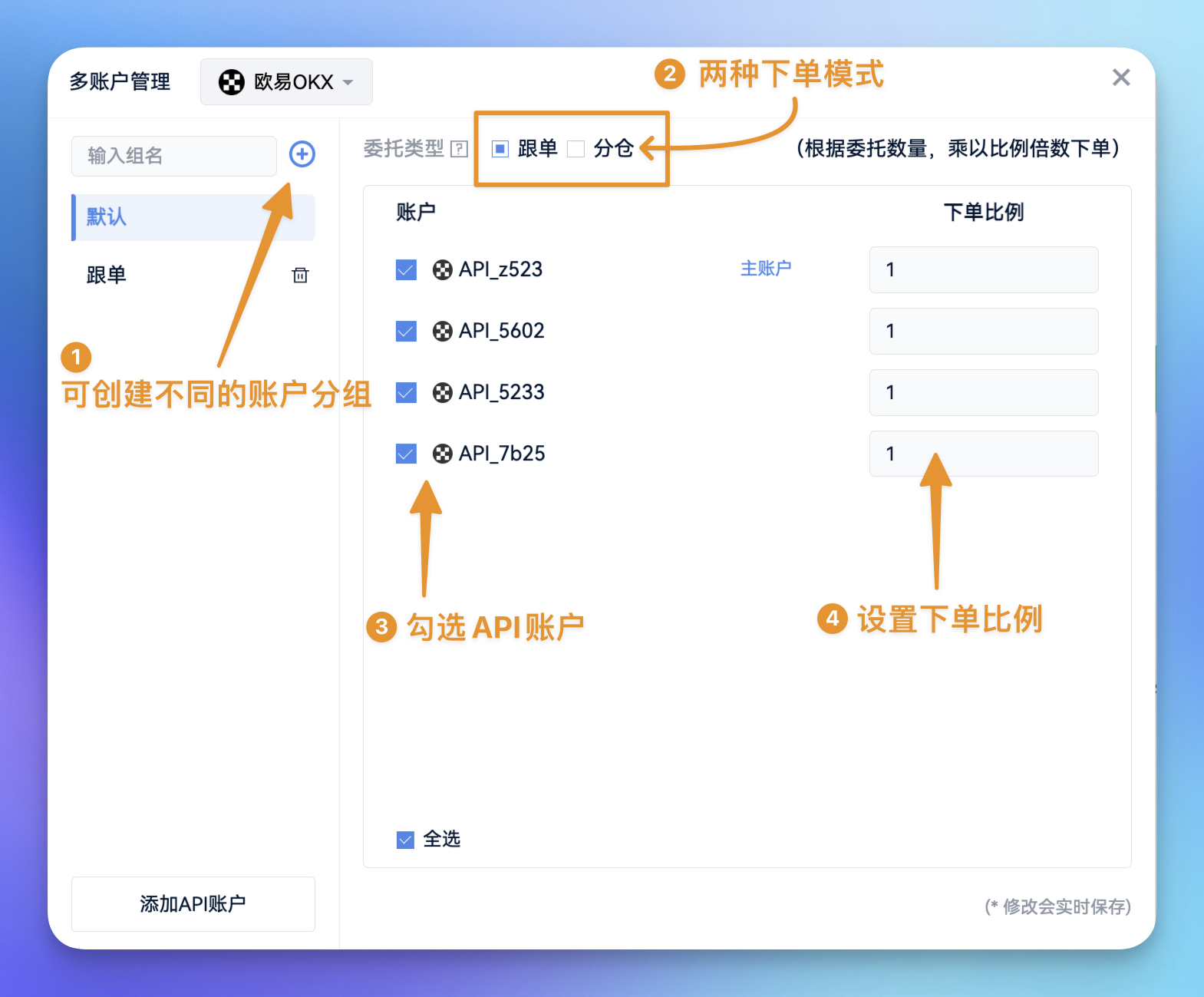
The reasonable use of multi-account ordering is: if a trading team has formulated a phased participation plan based on the price structure, it can use the sub-account mode to control the total delegated amount and distribute it across accounts; if each account needs to follow the main account with different multiples, then the copy trading mode can be used. The tool reduces repeated operations and enhances execution consistency, but it will not determine whether $76,500 will definitely hold, nor guarantee that every account will transact at the expected price.
Conclusion: Buying activity has appeared, but the market must continue to prove the reversal
Latest data shows that significant buying activity occurred around $76,500 for BTC, with the buying transaction amount around $17.5587 million and panel execution progress around 109.44%; the price subsequently rebounded from the low area of about $76,351.6 to around $76,768.7.
However, the price is still in the repair phase after the decline, with MACD still below the zero axis. To upgrade "appearance of buying" to "trend reversal," it is still necessary to wait for the price to hold the support area, the rebound structure to improve, and transactions and prices to confirm each other. If verification fails, the judgment should also be promptly corrected.
Exclusive "Multi-account ordering" super tool for AiCoin users
Synchronize multi-account orders with one click, realizing multi-operation in seconds using AiCoin; also supports multi-account orders across exchanges:
https://www.aicoin.com/zh-Hans/tg/multi-account

Don't wait, let’s use it; make batch bottom buying or shorting faster!
免责声明:本文章仅代表作者个人观点,不代表本平台的立场和观点。本文章仅供信息分享,不构成对任何人的任何投资建议。用户与作者之间的任何争议,与本平台无关。如网页中刊载的文章或图片涉及侵权,请提供相关的权利证明和身份证明发送邮件到support@aicoin.com,本平台相关工作人员将会进行核查。