On November 3, CFTC Chairman Michael Selig announced that individual stock perpetual futures can begin trading for the first time on eligible U.S. registered exchanges.
On the same day, a market response occurred: after the news was released, HYPE rose by 3.23% within an hour, reaching $87.62 at one point; however, Coin Bureau also specifically reminded that the CFTC announcement did not explicitly approve the Hyperliquid U.S. market planned by Payward.
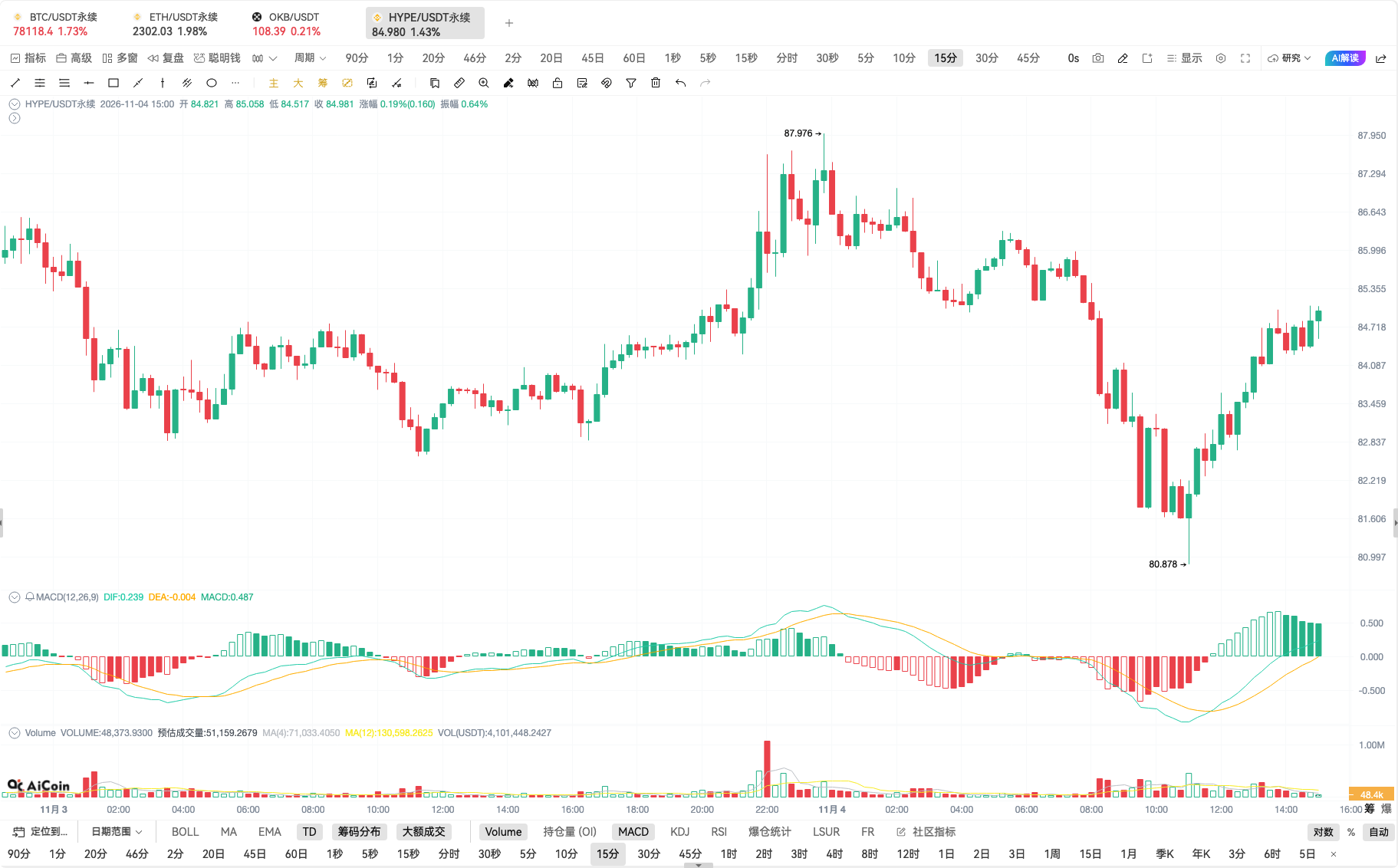
These two details should be viewed together.
The U.S. regulation is not just opening a door for Hyperliquid. It is also providing a legitimate pathway for traditional exchanges to issue individual stock perpetuals. In other words, Hyperliquid's past lead in RWA and round-the-clock trading is starting to be replicated by traditional markets.
However, another piece of news is even more worth noting.
ICE, the parent company of the New York Stock Exchange, has reached an agreement with TradeXYZ to bring a perpetual market built on Hyperliquid into the United States. ICE will also make a strategic investment in TradeXYZ and plans to become the exclusive operator of its regulated market.
This creates an interesting contrast:
On one hand, traditional exchanges may become competitors of Hyperliquid, while on the other hand, they choose to treat Hyperliquid as their underlying trading infrastructure.
This means that Hyperliquid's true competitiveness may never have been about "traditional exchanges being unable to create perpetuals," but rather that it has already developed an on-chain market structure that institutions are willing to access.
1. CFTC's approval of individual stocks signifies the beginning of U.S. market acceptance of this product form
The official CFTC statement indicates that this individual stock perpetual futures are regarded as securities futures products, approved under Regulation 40.3, and simultaneously bound by the Commodity Exchange Act, U.S. federal securities laws, as well as the regulatory frameworks of the CFTC and SEC.
There is an easily oversimplified aspect here.
This is not "CFTC approved all U.S. stock perpetuals," nor is it "any platform can immediately launch individual stock perpetuals." The CFTC statement points to eligible registered exchanges. Its footnote further clarifies that the CFTC-registered exchanges are designated contract markets that have notified the SEC, enabling them to trade securities futures products.
The product itself is also not the underlying stock.
Traders gain exposure to individual stock prices but do not obtain ownership of the stock. It does not automatically confer voting rights, dividend rights, or shareholder relationships in traditional securities accounts. The essence of perpetual contracts remains price risk management and trading leverage, not the transition of stock registration systems.
Yet, this policy remains significant because it addresses a long-standing market issue: U.S. traders have previously been able to access similar products on overseas platforms but lacked a clear domestic regulatory entry.
The CFTC Chairman described individual stock perpetuals as risk management and price discovery tools in the statement, emphasizing that offering these products through regulated markets would allow U.S. traders to participate under CFTC and SEC regulatory frameworks, rather than being forced to turn to overseas platforms.
This is also why Coin Bureau considers it as "U.S. perpetual contracts obtaining a passport."
2. This is not simply a positive or negative development for Hyperliquid
After the market saw the CFTC news, HYPE experienced a short-term rise, making it easy to conclude, "U.S. regulation approved individual stock perpetuals, so Hyperliquid benefits."
However, a more complete judgment should be divided into two layers.
The first layer is that product demand has been confirmed by regulation.
U.S. regulatory agencies are now not viewing perpetual contracts as merely gray products that can only exist abroad, but are attempting to integrate products like Bitcoin perpetuals and individual stock perpetuals into the local market structure. This will increase the attention of institutions, brokerages, clearing houses, and trading platforms toward perpetual products, forming industry-level validation for Hyperliquid's RWA and HIP-3 direction.
The second layer is the lowering of competitive barriers.
When CME, ICE, Coinbase, Kalshi, or other regulated trading platforms can offer individual stock perpetuals under permissible rules, Hyperliquid can no longer rely solely on "the U.S. traditional market doesn't have 24/7 individual stock exposure" to build its valuation logic.
Traditional exchanges can provide compliance, clearing, customer protection, and brand trust. They can also replicate product structures to attract market makers and institutional clients.
Thus, the CFTC's actions resemble efforts to expand the market pie while also allowing more competitors to enter the arena.
The real question becomes: Why would institutions still use Hyperliquid when others can also offer individual stock perpetuals?
3. ICE's choice provides an important answer
The official announcement between ICE and TradeXYZ gives the most weighty answer at the moment.
ICE is not simply announcing, "We also want to create a stock perpetual platform." It plans to partner with TradeXYZ to establish a new regulated market and clearing structure focused on retail traders, and to bring the RWA perpetual market running on Hyperliquid into the U.S.
In this structure, roles are clearly delineated:
- TradeXYZ is responsible for the RWA perpetual market and product experience;
- Hyperliquid provides the underlying on-chain infrastructure;
- ICE is responsible for the operation of the regulated market and clearing capability;
- In the future, reaching customers through FCMs, brokers, and partner platforms;
- U.S. users need to go through KYC and AML processes, and the overall plan still requires regulatory approval.
This is not ICE moving its traditional futures order book to Hyperliquid, nor is it Hyperliquid obtaining a U.S. exchange license directly.
It resembles a kind of "infrastructure leasing" relationship: traditional institutions retain customer access, regulatory responsibilities, market operations, and clearing capabilities, while utilizing an already operational on-chain perpetual market infrastructure.
ICE officials also emphasized that the new business will operate separately from its core institutional futures and clearing business.
The reason is straightforward.
Traditional institutional clients use futures for hedging over months or even years; retail clients may prefer short cycle, round-the-clock, and leveraged exposure. The trading behaviors, product structures, risk management, and regulatory arrangements of the two are not entirely the same.
ICE has not forced these two businesses into the same system; instead, it plans to build an independent retail perpetual market structure.
This in turn proves Hyperliquid's product logic: it does not necessarily need to replace ICE's existing institutional futures business; it only needs to serve as the underlying execution layer for the new retail perpetual market.
4. Jeff Yan says Hyperliquid is not an exchange but a layer that exchanges can deploy on
In a Bloomberg interview with Hyperliquid co-founder Jeff Yan, a very key statement was mentioned: Jeff Yan is unwilling to simply call Hyperliquid an exchange, but instead describes it as "a layer that exchanges can deploy on."
This definition has become more concrete following the collaboration between ICE and TradeXYZ.
If Hyperliquid is merely a trading page aimed at retail, then ICE's involvement would make it one of the competitors; but if Hyperliquid is a market infrastructure that can be called upon by different institutions, ICE’s involvement means traditional financial institutions are becoming its users.
These two positioning valuations are entirely different.
The core metrics for trading platforms typically include users, transaction volume, fees, and market share. For an infrastructure layer, in addition to trading volume, it must also consider how many markets are deployed on it, how many institutions are willing to use it, how many third-party applications are developed around it, and whether the underlying liquidity and risk engine can be reused.
The design of HIP-3 by Hyperliquid is precisely to allow external deployers to build their own perpetual DEX. Deployers are responsible for market definition, oracle, contract specifications, leverage limits, and market settlement when necessary; HIP-3 inherits HyperCore's margin and order book capabilities, but each DEX has an independent margin, order book, and deployer settings.
Therefore, ICE and TradeXYZ are not transferring all regulatory and product responsibilities to Hyperliquid, but are deploying a new market structure on top of Hyperliquid's foundation.
5. RWA transactions are catching up to crypto assets, indicating Hyperliquid has transformed from a "crypto derivatives platform" to a multi-asset trading experiment
Hyperliquid’s revenue reached $713 million over the past 12 months, with RWA trading volume matching that of crypto assets; meanwhile, traditional institutions are gradually accepting this technology and may apply it to their own markets.
The significance of this information does not lie in the $713 million figure itself but rather in the changing sources of income and trades.
If the platform’s revenue primarily comes from native crypto assets like BTC and ETH, the market may still perceive Hyperliquid as a high-performance crypto derivatives trading venue.
However, as crude oil, stocks, indices, foreign exchange, and other real-world assets gradually enter the perpetual market, Hyperliquid's competitive landscape will no longer be limited to other Perp DEXs, but will extend to the trading and distribution systems of traditional financial markets.
During the Iran conflict in February of this year, while traditional crude oil markets were closed, perpetual trading of oil on Hyperliquid significantly increased. Related contracts saw daily trading volumes reach billions of dollars; daily trading volume for relevant oil contracts jumped from around $21 million before the conflict to over $1.2 billion.
Such events cannot be simply interpreted as “Hyperliquid has become the real crude oil market.” The oil perpetual remains a price exposure product, not equivalent to physical delivery of crude oil futures or the inventory and transport systems of traditional energy markets.
But it proves one thing: when traditional markets are closed, geopolitical issues arise over the weekend, or investors need to manage risks immediately, a round-the-clock on-chain perpetual market will achieve genuine price discovery and hedging demand.
This is also the most convincing scenario for RWA perpetuals, not repackaging on-chain products as "stock spot," but rather offering continuous price exposure and trading access when traditional market hours, regions, and access are constrained.
6. Hyperliquid's competitive edge is shifting from "what others cannot do" to "what others are willing to access"
In the past, market evaluations of Hyperliquid often employed several familiar keywords: high performance, public chain order book, low latency, low slippage, self-custody, and round-the-clock trading.
These capabilities remain important, but they may not be permanently unreplicable.
The CFTC has provided traditional exchanges with a regulatory pathway for individual stock perpetuals. ICE possesses the capabilities for exchange, clearing, and market operations. Major brokerages and trading platforms can also build their own product interfaces.
If Hyperliquid relies solely on product functionality, its competitive advantage may narrow as the industry matures.
The more valuable change is that institutions are beginning to be willing to directly utilize its underlying capabilities.
The collaboration between ICE and TradeXYZ signifies that traditional institutions do not necessarily have to completely transform into "on-chain native companies"; they can retain their KYC, AML, brokerage, clearing, and customer management systems, while integrating Hyperliquid as their trading execution layer.
This kind of institutional usage will generate network effects:
More market deployers bring more assets and trading scenarios; more trading scenarios attract market makers and arbitrageurs; deeper liquidity enhances the appeal of the underlying infrastructure to the next institution.
Of course, network effects do not occur automatically. HIP-3 markets possess independent order books, and deployers are responsible for oracles, market operations, and settlements.
A brand and customers from a traditional institution does not automatically translate into solid market depth. The market still needs market-making, risk control, and ongoing trading activity.
Therefore, the next stage should not focus on "whether ICE invested in TradeXYZ," but rather whether this investment and regulatory cooperation can be transformed into:
- New markets continuously launched;
- Real customers continuously trading;
- Improved market depth;
- Open interest and trading volume independent of short-term incentives;
- Sustainable cross-market arbitrage and price correlation emerging among RWA markets;
- Institutional users willing to repeatedly use Hyperliquid's foundation, rather than just doing a one-off proof of concept.
7. After HYPE's short-term rise, what should we really observe
This price reaction indicates that the market has linked regulatory news, RWA products, and Hyperliquid's infrastructure positioning together, but it does not directly demonstrate that long-term value has been realized.
A more useful observation framework is to break the price reaction into three groups of data.
First, observe whether HYPE spot trading and perpetual open interest increase in sync. If price rises quickly while open interest and spot trading do not maintain follow-up, it might indicate more short-term trading driven by news.
Second, observe the trading structure of Hyperliquid's native market and HIP-3 market. If RWA trading volume increases alongside deeper order books and more stable funding rates, it suggests that product demand might be improving; if trading is concentrated in a few markets, liquidity concentration risks still need to be cautioned against.
Third, observe whether institutional cooperation leads to actual market deployments. Announcements, investments, and regulatory applications are all pre-signal indicators; only market launches, account openings, trading, positions, and ongoing costs constitute verifiable usage results.
The value of the AiCoin mobile app lies in helping users observe these layers separately. Users can track policy news, HYPE market trends, RWA market transactions, open interest, funding rates, large order fluctuations, and smart money behaviors simultaneously, rather than merely chasing price trends based on a headline of "traditional institutions entering."
If data judgment necessitates executing trades on Hyperliquid, you can use the exclusive entry:
https://app.hyperliquid.xyz/join/AICOIN88
Invitation code: AICOIN88. Qualified trades may receive a 4% fee rebate, with specific qualifications, calculation methods, and payout times subject to activity rules.
The rebate can only reduce part of the trading costs and cannot offset leverage, funding rates, slippage, oracle, and clearing risks.
Conclusion: The strongest signal is not that traditional exchanges fear Hyperliquid, but that they are starting to use Hyperliquid
The CFTC's approval of individual stocks means that the traditional financial market in the U.S. is beginning to accept a product form that used to mainly exist abroad and on-chain.
ICE's investment in TradeXYZ and plans to integrate Hyperliquid's infrastructure into the U.S. further illustrate that traditional institutions are seeking a new division of labor: handling regulation, clearing, customers, and distribution themselves, while considering on-chain protocols as their trading and market deployment layer.
Therefore, Hyperliquid's future should not just be described as "aiming to defeat CME or ICE."
A more realistic path might be: it allows CME, ICE, brokerages, wallets, trading terminals, and new market deployers all to operate their products on the same set of on-chain liquidity infrastructure.
Competition will not disappear; in fact, it will become more intense.
When traditional exchanges can also issue individual stock perpetuals, Hyperliquid must prove that it is not just earlier in launching the product but possesses a more repeatable order book, margin, market deployment, and data transparency capabilities that institutions value.
True institutionalization is not Wall Street being forced to leave its own system, but rather Wall Street discovering that integrating Hyperliquid into its system might be more efficient than building a new one.
Exclusive Benefits for AiCoin Users
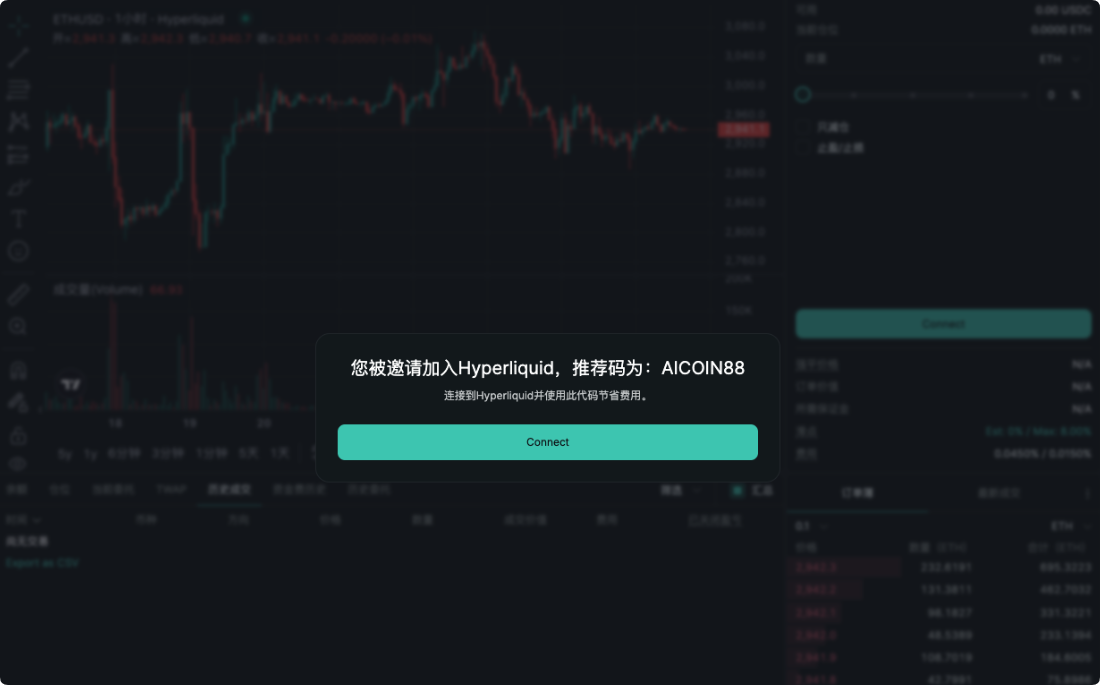
👉 Enter the invitation code AICOIN88 when linking your Hyperliquid account to enjoy a 4% fee rebate
🔗 Exclusive registration link:
https://app.hyperliquid.xyz/join/AICOIN88
📖 Beginner Guide:
"AiCoin PC Hyperliquid Authorization Trading Tutorial":
https://www.aicoin.com/zh-Hans/article/514197
"AiCoin Mobile Hyperliquid Authorization Trading Tutorial":
https://www.aicoin.com/zh-Hans/article/541383
"Zero-base entry! Hyperliquid First Trade Ultra-detailed Illustrated Tutorial":
https://www.aicoin.com/zh-Hans/article/510225
📖 Community Communication:
Telegram:
Discord:
AiCoin-Group chat:
https://www.aicoin.com/link/chat?cid=N6OVMor5g
The content of this article only represents the author's personal views and does not reflect the position of this platform. The opinions, conclusions, and suggestions in the text are for investors’ reference only and do not constitute any investment advice related to this platform. Investing in U.S. stocks still requires self-assessment of market risks, regulatory risks, and compliance with local laws and regulations (especially foreign exchange controls, overseas investment declarations, etc.).
免责声明:本文章仅代表作者个人观点,不代表本平台的立场和观点。本文章仅供信息分享,不构成对任何人的任何投资建议。用户与作者之间的任何争议,与本平台无关。如网页中刊载的文章或图片涉及侵权,请提供相关的权利证明和身份证明发送邮件到support@aicoin.com,本平台相关工作人员将会进行核查。