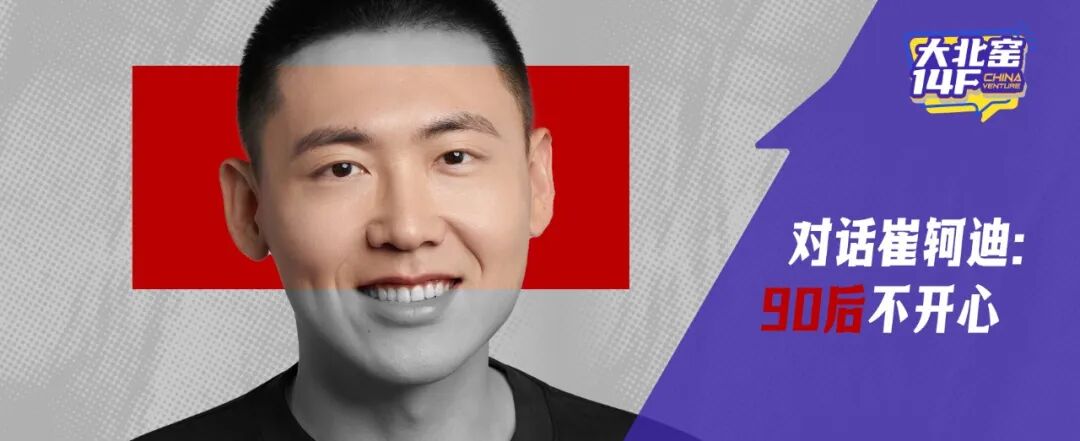
“Probably the most formidable investor of embodied intelligence.” — But he hates this label.

Author Pu Fan
Hand-made Quantity | 100%
I still remember the first time I met Ke Di. One early morning, at Tsinghua's South Gate, not too cold and not too hot, I could see someone far away who wasn’t coming to work: short hair, lean, big black glasses, and a denim jacket, lounging in a camping chair. I plopped down next to him, and he didn’t kick off the conversation with any startup or VC topics. The first topic was hip-hop, discussing GAI's "Super Society" and what being an underdog means. I countered with a rock topic, telling him that punk has no specific form of presentation; for instance, Tuvan folk songs can be “stubborn punk.”
In the heat of the conversation, he randomly waved and called over a passing young man. I thought he wanted to introduce me to a "little genius," someone whose ARR had topped one billion within a few months. Instead, he raised an eyebrow and said, “This guy does arrangements.” I just stood next to him, grinning, thinking a single word: so “unrestrained.”
Of course, he deserves “unrestrained.”
Ke Di is the Executive Director of BV Baidu Venture Capital and a member of its investment committee. Over the past few years, they have been very prominent in the frontier technology field, from embodied intelligence to physical AI, significantly supporting many early-stage star projects. To survive in such a highly competitive field over these years, Ke Di has worked hard; projects like Star Sea Map, Simple Intelligence Robots, Qisuan Guangqi, Deep Principles, Differential Intelligence Flying, and Guanyu Chip Computing are all investments he has led — and he is still a post-95, just starting to make a name at the age of 30.
As an editor, I have a hundred reasons to love people like him. In fact, I had already thought of the title on my way here. Once, Teacher Qu Kai and Zhang Jinjian from Oasis Capital did a podcast, where they called Old Zhang “the fiercest investor in AI.” I always felt that Ke Di might also qualify to compete for the title of “the fiercest investor in embodied intelligence,” even though he hates this label.
Unfortunately, I am just a venture capital editor, and I cannot stay at “kitsch.” However, Ke Di’s so-called professional storyline precisely fits this:
Ke Di joined Baidu Venture Capital in the fall of 2022. This was his first attempt at early-stage investment, full of ambition, ready to make a big impact. But by June 2023 — which was about six months later — he felt he “wasn’t doing well.” The direct reason was that his performance was very poor, consistently ranking last. The deeper reason was that he was very “execution-oriented.” Considering he was a newcomer, he spent those months desperately seeking advice from many seniors and constantly reading books.
Those experiences that corresponded to “big results” turned into a “negative halo” entirely when applied to himself, making it very easy to self-doubt. Thus, desperate Ke Di decided to start a “cheat study,” researching projects that Zhang Yutong had invested in when he was still at GSR Ventures, trying to figure out what made them tick. There wasn’t any complex reason; it was just that he happened to enjoy a roundtable discussion by Zhang Yutong during a conference.
It really was “not serious,” just “following one’s heart,” but the story starts to reverse here. Over three years, he achieved results in the tech field that made his peers envious, possessing those portfolios that shone with the light of the era mentioned above.
This makes no sense. And it’s this Ke Di who started to feel “bored.”
This is even more nonsensical. Three years ago, he was still worried about being fired by his boss, but now he has invested in so many star projects, which in itself is a “miracle.” Moreover, the work scenarios he casually describes seem to be like this: drawn into a WeChat group of entrepreneurs one afternoon, that evening he rushes from Beijing to Shanghai, chatting into the late night. Reflecting on the Ke Di at Tsinghua's South Gate, chatting about hip-hop and punk, ready to share a bunch of bizarre stories, could such a person truly feel bored?
After thinking it over, I feel it might have something to do with being a post-90s generation. Ke Di and I are about the same age. People of our generation have an awkward position: the post-80s have their own narrative of the age, and then there are the millennials and Gen Z, while the post-90s are often caught in the middle, used to being overlooked and not taken seriously. By the time we finally had the ability to express ourselves, we often found that our voices echoed back with silence. So, many times, it seems we are always struggling against something, needing to achieve results to prove that we truly deserve to stand here.
Ke Di does indeed have a fondness for post-90s entrepreneurs, probably hiding such a thought. He often mentions that today’s resourceholders are mostly older than the current crop of young entrepreneurs, and their initial reaction upon meeting is to treat them like children. He believes that careers in embodied intelligence require a group of sufficiently young individuals willing to stake their careers on it; he is also a post-95, and after finally gaining the “right to fire,” he naturally doesn’t want his peers to miss opportunities due to their youth.
Moreover, I often recall Nietzsche’s depiction of the “last man” in “Thus Spoke Zarathustra.” Nietzsche believed that the last man is one of the potential endings for humanity, or the “final destination” for most people: they are no longer poor, fully enjoying everything they have, even possessing a fairly complete happy life — without great danger and too much pain, everyone finds a small bit of happiness. They declare they have invented happiness, having felt these, and no longer attempt to “learn anything,” instead just blinking and asking, “What is love? What is creation? What is desire?”
Nietzsche was quite pessimistic about this end for humanity, expressing sympathy for the “last man.” Because the last man hasn’t experienced any earth-shattering failures, nor necessarily abandoned ideals actively. They simply become accustomed to the existing order, accustomed to being told what is worth pursuing, what constitutes success, and when to feel satisfied. Over time, even higher desires become redundant. Nietzsche said that man is a bridge, and should have the potential to continually transcend himself; yet the last man has turned the bridge into a home and even forgotten what is at the other end of the bridge.
In this light, Ke Di's dissatisfaction makes perfect sense. By venture capital standards, he has already attained enough. The industry has long prepared for his next chapter of life: continue investing projects, managing larger accounts, accumulating prestige, eventually becoming one of the investment seniors he used to look up to. Yet venture capital requires constantly reinterpreting the world, inevitably cycling through struggles and poignancy, naturally nurturing “supermen” — he needs to struggle out of it.
Of course, I don’t intend to elevate Ke Di to Nietzsche's “superman,” but he should at least be seen as a “phenomenon,” a phenomenon containing “epochal bewilderment”: a young man almost eliminated by the industry, breaking through with an unclear set of methods, was it due to his exceptional talent or perhaps a failure in the venture capital experience accumulated over more than half a century? Furthermore, might his success precisely signal a danger for the venture capital industry?
The following are text excerpts, with the complete dialogue available in the video, which I hope is helpful to you:
Participants of this seminar
Executive Director of BV Baidu Venture Capital, Cui Ke Di
Editor of 投中网, Pu Fan
Don’t call me an “investor”
Pu Fan: Why don’t you start with a self-introduction? Do you have an official version, or a personal version?
Cui Ke Di: You caught me off guard. I really don’t like self-introductions, I don’t know if you do.
Pu Fan: I’m not good at self-introducing either; I previously recorded a podcast titled "Since joining the investment circle, everyone calls me Director." When I was in media, people called me Teacher Pu, Brother Pu, or Brother Fan. After joining the investment circle, everyone started calling me “Director.” I always felt, once they call me this, it seems they expect me to leverage some resources to help, or to be a person of a certain class. I dislike this feeling, so I avoid self-introducing.
I naturally have a formal title, Vice Editor of 投中网, but every time I introduce myself that way, I can’t help but critically assess myself from the side: am I again falling into the narrative of officialdom? After all, “Vice Editor” sounds more like an administrative rank and doesn’t make clear what I specifically do. Later I thought, it’s more accurate to just say “editor.”
So where I can empathize with you is, if I were to introduce you to others, I probably wouldn’t first mention where you are from, that just adds a lot of preamble. I’d probably say you are into embodied intelligence investment.
Cui Ke Di: I previously told you that although we hadn’t known each other long at that time, I had already been observing you for a long time. I like to “observe.” Once I do a self-introduction, it becomes hard for me to quietly observe others.
Pu Fan: Because you start to need to observe yourself, to introspect.
Cui Ke Di: Yes. I really like hiding somewhere to observe everyone, and over time, I become even less likely to self-introduce. I even don’t like hearing others call my name. I’ve always been like this. Whether teachers calling roll during class or schools announcing awards, I really dislike hearing my name.
Pu Fan: But you are now an investor and have to attend various events. How others introduce you also implicitly carries their evaluation of you. If I say you are an embodied intelligence investor, it means that’s the work that best represents your abilities.
Cui Ke Di: I find it very hard to describe who I am in a few sentences. If you say I’m an “embodied investor,” I would feel…
Pu Fan: Unhappy?
Cui Ke Di: I curse under my breath. Because I don’t think “embodied intelligence investor” encapsulates me. Additionally, I never liked those three words "investor." I genuinely feel that, in many contexts, the term “investor” has already taken on a negative connotation.
Pu Fan: But your profession requires you to meet people as an investor. For example, when you first meet Gao Jiyang (founder of Star Sea Map), you can’t just say, “Hey, I’m here to give you money.”
Cui Ke Di: That’s a routine introduction for a work setting, everyone gets into their roles before discussing things. But if you’ve listened to my conversations with founders, you’d know I rarely start talking business right away. Sometimes it’s precisely the projects I’m not keen on discussing that I engage in serious business talk. Because if I genuinely want to invest, I would first spend a lot of time getting to know the person.
Projects with unanimous approval have often underperformed
Pu Fan: This raises a question — although you dislike the term “investor,” I still have to use it — you’re investing in hard tech, many industries might take ten or twenty years to realize their potential. An investor can’t possibly have more knowledge in every field than the founders they face, who happen to be the top figures in their respective domains. In such cases, how do you build judgment from scratch?
We’ve talked before; if you only catch a few tags about entrepreneurs, such as education, experience, whether they are reliable, it’s easy to become just clever. But as an institutional investor, you also have to be accountable to LPs and returns; you must form a certain judgment method. Quantum, world models, physical AI — how do you learn these things?
Cui Ke Di: Our biggest divergence is here: when a track is already clearly defined and everyone is talking about it, I often feel that the best early opportunities have passed. This idea is something I slowly figured out after starting early-stage investments in August 2022.
In the first six months, I invested in some projects. Internally, in the investment committee, these projects often passed with high votes, even unanimously. I was quite happy, thinking everyone recognized my judgment. After some time reviewing, I discovered that these projects with the strongest consensus didn’t perform well. Later, I heard the insights from Sequoia Capital’s American team, who mentioned: if everyone agrees on a case, it’s actually a point of caution.
Pu Fan: So there needs to be a contrarian, specifically to argue what might go wrong. Sometimes clear opposing opinions are valuable signals.
Cui Ke Di: When I first started, I didn’t really know how to do true VC investing. In the first six months of working, I heard a lot of theories and read many books, but executing according to those methods didn’t yield good results. I began to doubt whether many things I was taught were fundamentally flawed. At that time, my performance ranked last in the fund. By the first half of 2023, I often found myself thinking at home whether my boss would fire me.
Pu Fan: You’re too anxious. You only started in August 2022; by June 2023, you’re already reflecting on your poor performance?
Cui Ke Di: I don’t think it’s anxious. At that time, the team was also reviewing investment strategies. I am very execution-oriented; if given a goal, I will do everything to accomplish it. You asked me to study quantum computing, even if I completely didn’t understand before, I could spend a month to get quite familiar with that field.
The problem is, after meeting the targets, one must also bear the consequences of the results. So I began to wonder: is it my abilities or aesthetic that are flawed, or is the consensus formed by everyone problematic? Later, I genuinely found a method. Guess what that was?
Pu Fan: I don’t know.
Cui Ke Di: The answer is to imitate Zhang Yutong.
Zhang Yutong, my “reverse engineering problem”
Pu Fan: What kind of person do you see Zhang Yutong as?
Cui Ke Di: Let me first explain why I chose to imitate. I set a requirement for myself: “First invest right, then invest early.” The first step is to recalibrate my aesthetic standards. The criteria I previously judged by might have been wrong, and no one around could directly tell me what constitutes a good project. You need to first know what types of people might build a hundred-billion-level company. At that point, I lacked samples, so I turned to reading a lot of biographies, which is also the reason I rarely read science fiction thereafter.
As to why I chose Zhang Yutong, it was a coincidence.
In 2018 or 2019, after returning from university, I attended an investment交流 event at Peking University’s Stanford Center. On the stage were Yue Bin, Long Yu, Sang Wenfeng from Sensors Data, Lou Yun from Club Factory, the founder of Spark Learning, and Zhang Yutong. At that time, I didn’t actually know who she was, nor did I grasp how impressive GSR Ventures was. But after listening, I just felt she was remarkable, similar to knowing which student to learn from in class. Since then, I’ve followed what she’s been doing closely.
Pu Fan: But you find it hard to articulate what you actually felt. Chen Jianxing (founder of Simple Intelligence Robots), Gao Jiyang, and Zhang Yutong together are clearly three different people, three different paths, but in your judgment, there seems to be some connection.
Cui Ke Di: I used to question whether this mode of judgment was incorrect.
Pu Fan: To be honest, I also have doubts while listening.
Cui Ke Di: Many colleagues find communicating with me cumbersome because I can’t clearly express why I think someone is impressive. This resembles Ramanujan: some judgments come first from intuition, and rigorous proof tends to follow later.
Also, there’s Cao Xi, who has had a significant impact on me. When I read transcripts of his interviews, I remember two metaphors: one type of founder is like lightning, while another is like a giant sitting in a room, easily noticeable. If you ask me to accurately describe what lightning is, I can’t do it, but I have indeed experienced what being “struck by lightning” feels like.
That event from 2018 was similar. Years later, I still remember the people sitting next to me, the arrangement of the venue, and the subsequent WeChat group formed. Some details are vivid, but I can’t remember exactly what Zhang Yutong said. What remains is that strong feeling.
Pu Fan: Because her impression was too profound for you at that time.
Cui Ke Di: Exactly. That was one of the few offline interactions I had with Zhang Yutong; we never had a deep conversation. Later, I pulled out all the projects she had invested in one by one to study, making pattern recognition. I found a certain type of young entrepreneur that stands out: they might be from Stanford, Harvard, CMU, or Tsinghua, with distinct demeanor; as soon as you meet them, you can sense that they’re impressive. Of course, she’s invested in many types of people beyond just this category, and I also research investors of other types.
Around May 2023, I encountered a company founded by Chen Junbo, who came out of Damo Academy, named Youlu Robotics, and unexpectedly found out Zhang Yutong had also invested. I had chatted a few times with Chen Junbo, and one day he suddenly said: “Ke Di, sometimes I feel you and Yutong are quite similar.” At that moment, I felt that my imitation might indeed have left some traces because we had already decided to invest in Youlu, although it wasn’t just because Zhang Yutong had invested.
Pu Fan: I worry about two things. First, when facing an industry expert whose knowledge far surpasses yours, how do you judge whether they are sincerely explaining their research or overwhelming you with jargon? Especially since you have a bit of technical worship; encountering someone with strong academic authority, it’s likely you lack the confidence to question them, thinking whatever they say is right.
Cui Ke Di: You are asking whether imitating Yutong would feel like painting a skin without grasping the essence?
Pu Fan: That’s part of the question.
Cui Ke Di: Your understanding of imitation is somewhat different from mine. I imitate people I haven’t truly met. I more often reverse-engineer how they make judgments through content they’ve publicly left behind and through interactions I’ve had with them. I rarely specifically seek out investors like Zhang Yutong for them to teach me something in person. I prefer to observe first on my own.
Pu Fan: In other words, you might be imitating her method of judgment?
Cui Ke Di: Not quite.
Pu Fan: Is it a step higher?
Cui Ke Di: I am engaged in reverse engineering. During the reverse-engineering process, I incorporate many of my subjective judgments. For instance, if I were Zhang Yutong, how would I choose projects? If I were Zhu Xiaohu, how would I assess projects? I repeatedly project myself into those scenarios and then seek opportunities to verify. Predecessors like Wang Huadong and Cao Xi have significantly influenced me. They have been in the industry for a long time and left many interviews and case studies online. I usually read through these materials first, reconstructing that person's thinking in my mind before seeking opportunities to communicate with them. Thus, I often ask myself, how would Wang Huadong think? How would Cao Xi think?
I feel like I’m learning a martial art, consciously shaping a person. The materials come from observing role models I’ve seen, but in the end, it’s my subjective judgment pieced together. I later realized that rather than saying I imitated Zhang Yutong to invest in a project, it’s more accurate to say… I found what I liked, which just happened to resemble her approach.
After Youlu, it continued with Star Sea Map, which gave me a very strong sense of “doing angel investing.” I was the first shareholder in the company’s first round, so Gao Jiyang was very significant to me. You need to know, at that time, Star Sea Map wasn’t even called Star Sea Map; its original name was “Jindouyun.”
I invested in many professors, but I don’t inherently trust professors.
Pu Fan: This raises the second question: when a founder hasn’t yet been verified, how do you differentiate whether they will become a formidable entrepreneur or just someone academically solid but not suitable for entrepreneurship?
Cui Ke Di: I never ask.
Pu Fan: You don’t differentiate?
Cui Ke Di: I don’t.
Pu Fan: I’m just afraid I might encounter someone who is exceptionally strong academically and finally find out they’re only suitable for research.
Cui Ke Di: I wouldn’t invest in someone just because they’re a professor, nor would I exclude them for being a professor. Take Teacher Gao Fei as an example. Investing in the company he founded, Differential Intelligence Flying, faced significant internal resistance: first, he was a teacher at the time, and second, he intended to develop drones. During his first appearance at the investment committee, the project encountered a lot of opposition. Of course, when Star Sea Map first presented, it also didn’t get approval.
I remember once in 2024, during an internal discussion of investment strategies, I made a PPT listing seven individuals I found extraordinarily impressive. Among them were Wang Xingxing, Gao Jiyang, Xiao Tete, Tao Ye from Tuozhu, and Hou Xiaodi from TuSimple, as well as Gao Fei. These individuals had completely different professional backgrounds and entrepreneurial directions. Xiao Tete had previously conducted research related to Meta's Segment Anything and later started his own business.
I first consider what this person is actually like, then try my best to create opportunities to meet them. Tao Ye was very hard to meet; I finally managed to see him, and after listening to him speak, I found him very impressive. Gao Fei is the same; he was elected as a National Outstanding Youth at 33 years this year, which is obviously remarkable. However, when we first invested, we genuinely found him impressive without considering labels like “university professor” or “developing drones” as decisive factors.
Pu Fan: I think the era might be a crucial variable. In the past, when university professors left to start a business, just the courage to leave a stable environment indicated they had already figured out many things, allowing investors to worry less. However, today, it’s quite common for professors to start businesses. I still remember our first meeting at Tsinghua, when you pointed at that teaching building, saying you had probably chatted with almost all the teachers inside.
Cui Ke Di: Even when Teacher Gao Fei just started his business, I believed that scientists starting their ventures had a high probability of failing. I still think that. But impressive individuals have a chance to succeed in entrepreneurship, and being a professor doesn’t necessarily mean that person is exceptionally capable.
Pu Fan: So can you elaborate on what is meant by “impressive”? What kind of person gives you that lightning-like feeling?
Cui Ke Di: I can’t explain it well. I recommend you listen to the episode of “20VC” interviewing Sequoia partners. You will find that different partners have different ways of judging founders. Some ask who you’ve met that’s the most impressive and the least impressive; others care about what your driving force is. When it comes down to specifics, it might just be one or two sentences.
Pu Fan: But once these two sentences enter their judgment system, how they arrive at conclusions, others wouldn’t know, and maybe even they can’t articulate it clearly?
Cui Ke Di: For instance, Xu Xin often mentions “catching big fish.” But what constitutes a big fish? How do you catch a big fish? When I sat in the audience observing those experienced investors, I thought they were all amazing, especially Xu Xin. However, if you summarize all her interviews, the so-called methodology amounts to only a few principles.
Pu Fan: At least they have some input criteria. For example, Sequoia partners ask about vision and driving force. Let’s not discuss how that information is digested, but there is always a lever to grasp. Does Cao Xi enjoy discussing football, discussing a person's true interests? Do you have any such tricks?
Cui Ke Di: The question I love to ask founders is: “Who is your favorite person? Who is your least favorite person?” Later, I discovered this is somewhat similar to what a Sequoia partner asks regarding best reference and worst reference.
Pu Fan: What do you think this question can reveal?
Cui Ke Di: I can feel this person’s aesthetic from their answers, what they like, and what they dislike. Lei Jun emphasized the importance of a friend’s friend in early-stage investments; many investments came from his familiar network, which I think is also a form of judgment about people.
Technical aspects account for 99% of my decision-making.
Pu Fan: What percentage does technology occupy in your investment decision-making? Throughout your discussion, you’ve focused on that striking sensation, likening it to a giant in a room, which sounds very subjective.
Cui Ke Di: 99%. Technology accounts for 99% in my judgment.
Pu Fan: That’s quite unexpected. I thought your feelings about people would account for at least 99%, but you said technology accounts for 99%. Then why do you still spend so much time seeking that kind of “lightning”?
Cui Ke Di: Let me give you an example. Sister Xu Xin has invested in two embodied intelligence companies in which I participated in the angel round: one is Star Sea Map, and the other is Weita Power. After she discussed with Yu Yinan and Gao Jiyang, she quickly made investment decisions. Of course, she cares about technology and the industry landscape and has also done extensive pre-work, but she doesn’t necessarily need to sit down with founders to debate every technical detail.
I also trace a person’s research experience. A person’s past work doesn’t lie; the key is whether the investor is willing to look closely. For example, Zhu Yichen, from Current Robotics, doesn't have a particularly glamorous résumé. After graduating with a bachelor’s degree, he later researched embodied intelligence at Midea. I joked that he might be one of the undergraduate graduates with the highest H-index.
I reviewed his research work from the beginning, looking at why he shifted from one direction to another, and what issues he continued to study. I didn’t need to understand every module in VLA thoroughly, but I could see his research philosophy and research taste. His work in certain areas closely aligns with the research rhythm of foreign counterparts.
Later, when we sat down to chat, instead of discussing technical details, we talked about how he prepared to start his business. I told him for the first time that with his background, financing could be quite challenging. With a bachelor’s degree and coming from Midea, how many people in the embodied intelligence space would be willing to believe in him? I wasn’t suggesting that Midea was bad, but I wanted to remind him of the realities he would face.
Pu Fan: This also addresses my pre-set question. Investors are ultimately not specialists. In recent years, hard tech has become popular, and many VCs have started hiring industry PhDs in hopes of building judgment based on specialized backgrounds. You've repeatedly stated that investors don't need to become technical experts. So to what extent is it appropriate to understand?
Cui Ke Di: Especially in early-stage investments, it’s simply not feasible to understand all businesses and all technical details. If someone claims to know every industry well, I become somewhat skeptical. I frequently admit that there are many technologies I actually don’t understand.
Pu Fan: Would you say that to entrepreneurs?
Cui Ke Di: Yes, and I genuinely am not being modest. There are aspects of the algorithm structure and technical details within embodied intelligence that I indeed do not comprehend.
Pu Fan: What do you understand?
Cui Ke Di: I’m quite sensitive to judgment about people.
Pu Fan: Wait, didn’t you just say that technology accounts for 99%?
Cui Ke Di: Technology accounts for 99%, meaning I need to comprehend the person’s research taste and technical path, but it does not mean I must personally master every technical detail.
Pu Fan: Understanding it to that extent is sufficient.
Cui Ke Di: Yes. Even if you asked me to study archaeology tomorrow, I could first look for a few of the most knowledgeable people in that field. I might not know every technical aspect of drone control, but I can judge that Teacher Gao Fei is capable; I haven’t systematically studied college physics, yet I can form a judgment about Zhong Hansheng. I don’t understand quantum technology, but I can gradually evaluate who is competent in that direction. I might also need to invest in a quantum project soon, and I think the founder has great potential, even if I don’t grasp all of his technology.
Pu Fan: What moment of his gave you that “lightning” feeling?
Cui Ke Di: I’ll start with a subjective observation: the guy is quite handsome, in a particularly clean way.
Pu Fan: That’s a lightning feeling from a hormonal level.
Cui Ke Di: Not exactly. It’s difficult for me to use words to describe that feeling, but I believe he is a remarkable person, likely to become a youth leader of the next generation. He was born in 1998. I hope I can continue to identify such individuals across different fields.
Do investors really have the “incubation” ability?
Pu Fan: Earlier, we talked about who you like and how you judge people. Now let’s discuss some provocative topics. You said it's easy to know what you don’t like; in today’s bustling primary market, is there anything that particularly bothers you?
Cui Ke Di: I am very averse to FAs or investment institutions claiming they’ve “incubated” a project. I also reflect on myself; sometimes when I say a certain project is my incubation, upon careful thought, I realize I actually had no significant impact.
Pu Fan: In your view, what behavior qualifies as “incubation”?
Cui Ke Di: If you defined a company's direction, product, found customers, and built a team, then I acknowledge you’ve incubated it.
Pu Fan: What do you think a financial investor’s biggest role is in a project?
Cui Ke Di: Often it’s just introducing a few people, creating a group, and letting the entrepreneurs chat with other projects. Of course, it helps, but that’s about it.
Pu Fan: Could it be that perhaps your experiences are insufficient, or that you can’t do it yourself, leading you to feel others don’t contribute much?
Cui Ke Di: Over the past few years, I have invested in quite a number of angel rounds and first rounds, which should count among the more significant numbers in the industry. So you cannot say that I formed this judgment because I’ve never engaged in early-stage investments. Actually, it’s quite difficult to invest in a company’s first round. Many investors are unable to accomplish this themselves, yet aspire to that role, hence the terms FA incubation, networking, and so on arise. However, sometimes I find it hard to discern what exactly “networking” entails.
Pu Fan: Do you think investors have the impulse to want to play more roles in the entrepreneurial process?
Cui Ke Di: Yes, they wish to appear more accomplished than they are. I even feel the term “incubation” isn’t that significant; investors’ influence on project development isn’t as important as many believe. Only a few investors might truly be vital to a project. However, in the AI era, companies require increasingly more capital to obtain a substantial equity stake, and they either must invest very early or provide an enormous amount of money.
Pu Fan: But for a newly formed company, isn’t the first piece of funding incredibly important? It essentially determines whether the project can even start.
Cui Ke Di: Projects in AI are becoming increasingly capital-intensive; fewer and fewer investors can engage in this game. Previously, it might have been possible to invest tens of millions of dollars and expect the company to grow to a billion, but now it may take hundreds of millions to aim for two billion. The multiples might seem promising, but the game has fundamentally changed. Previously it was the 80-20 rule, but now it is increasingly resembling the 90-10 rule.
Pu Fan: The “incubation” I refer to might also imply this. Without the first piece of funding, many things simply cannot begin. Just like an egg, it needs to break free from its shell to be considered incubated. The growth into a chicken is already a stage of development.
Cui Ke Di: This is why I regard the period around 2022 as a watershed. The American people at Sequoia also talked about this; previously investing tens of millions of dollars and hoping to grow a company to a billion; now you might invest a billion, aiming for two billion. The capital logic of company growth has already changed.
Pu Fan: So you believe the role of VC in driving incubation has weakened significantly today.
Cui Ke Di: I have always believed that VC does not have such strong incubation capabilities. If you are to claim incubation, you should at least clarify what you’ve done and what responsibilities you’ve taken on. Is building a few groups, introducing a few investors, and pushing the valuation to Series A, B, C rounds considered incubation?
Pu Fan: The influence of money as a tool has also been diminishing. Following the path of money as a productive tool, will the VC's impact during the entrepreneurial process continue to decrease?
Cui Ke Di: It’s getting smaller. Nowadays, many projects see people offering high prices for shares or leveraging relationships to queue up, which indicates that money's influence on some hot projects has indeed diminished. I feel my role resembles a group of brothers preparing to row a boat; I just happened to encounter them, we clicked, and I helped push the boat into the water. Afterwards, as they rowed farther and the project developed, I may feel delighted, but I can’t claim that’s all my功劳. Some investors rush in early, waiting until the company is already well established, and are still trying to give instructions in the boardroom, which I find quite amusing. I often tell the companies I invest in: the greatest respect I can offer you is to manage you as little as possible.
I am a frog that continuously leaps out.
Cui Ke Di: Sometimes I even feel that the venture capital fund, as a company form, inherently operates under an unreasonable business model.
Pu Fan: How so?
Cui Ke Di: Because it’s challenging to establish a system that can continuously cultivate talent and even harder to crystallize methodologies that can be consistently passed down.
Pu Fan: So you don’t believe a VC can thrive for generations?
Cui Ke Di: Sequoia has been in business for decades, and I think they’ve achieved that. For domestic funds, we’ll have to wait until the first generation of founding partners retires to see. The issue is how to transition leadership. If a fund has been in operation for twenty years, who is the next in line? And the next after them? Should successors be adept at fundraising or investment? These things are not easy to answer.
Pu Fan: This might also be a past imagination of venture capital, thinking that with a set of methodologies passed down through generations, institutions could thrive indefinitely.
Cui Ke Di: Methodologies certainly exist; it’s just that many principles are quite simple. For instance, if you didn’t invest when a project was valued at two billion, would you dare to invest when it's valued at twenty billion? Sequoia and IDG have demonstrated such boldness. Heavy investment is also a skill, and I’m still learning this. Recently, a certain company went public, and I calculated the returns of several investment institutions that I previously considered not stylish; I was shocked. Some returns might exceed ten or twenty times my results from these past few years. What right do I have to look down on others? Maybe I’m the joke.
Pu Fan: But I still hold the viewpoint that your success might precisely signify a decline in the venture capital industry.
Cui Ke Di: I don’t feel I can claim success just yet.
Pu Fan: At the very least, you’ve emerged from it. The fact that those iconic unicorns are willing to accept your investment in their earliest stages speaks volumes about the situation.
Cui Ke Di: I feel like I’m a frog in a well. After years, I finally leaped up once, allowing those beside the well to see me. But what comes next? I might drop back into the well, or I could genuinely leap out and go further. Who knows?
Pu Fan: This metaphor is quite vivid. We, the media folks, are like those waiting by the well to see the frog jump out.
VC is even more “combative” than rap.
Pu Fan: Lastly, let’s touch on something lighter. Why do you love rap so much?
Cui Ke Di: I feel rap represents rebellion, akin to entrepreneurial spirit. Furthermore, rap relies heavily on narrative and storytelling, which I enjoy as well.
Pu Fan: It seems rap always leads with attitude, establishing one’s position first. Do you appreciate that vigor?
Cui Ke Di: I adore the underdog and underground culture. Many rappers initially perform underground, battle, write songs, and gradually emerge into public view. Their growth paths are entirely different from those packaged and pushed into the limelight by record companies from the get-go. GAI is a typical example. Some rappers who have lived abroad also speak of their wanderings in their works.
I feel venture capital closely resembles rap, containing elements of wandering and risk. In earlier years, I listened to GOSH and GAI’s music, and later saw these individuals, who emerged from the underground, on grander stages; that contrast was stunning. Nearly no one knew him before, and now he’s made it.
Pu Fan: But doesn’t hip-hop have excessive confrontation? It seems like VC isn’t as confrontational; investors sometimes need to understand mainstream narratives and search for consensus. Rock music seems more like expressing one’s inner world to others.
Cui Ke Di: I actually think VC is even more confrontational than rap. In these past years, I have almost continuously battled against various people and judgments; young founders I invest in are the same. Chinese society isn’t very friendly toward post-90s and post-00s entrepreneurs. Especially if you carefully observed around and after 2023, very few of the leading figures in the newly emerged embodied intelligence startups are post-90s. Later, as AI became popular, there seemed to be an expectation for the younger generation to step up. But they faced a lot of skepticism throughout, far from the ease imagined externally.
Pu Fan: From my standpoint, observing from the first round until now, I also don’t believe they have had a straightforward journey.
Cui Ke Di: Right, there are still many confrontational aspects. Entrepreneurs must fight for opportunities with customers and explain their choices to investors; investors also have to face the investment committee at their institutions. Now that I’m pushing projects and am also a member of the investment committee, I often have to challenge my judgment from two identities. Ultimately, my biggest opponent is myself; the questions others are preparing to ask me, I usually have already internally pondered.
Pu Fan: I understand the sense of confrontation you’re describing. We are about the same age, both post-90s. I’ve always believed that the post-90s are a generation long accustomed to being overlooked. The post-80s have their own narrative of the age, and then came the millennial and Gen Z. It seems like the post-90s are stuck in the middle, not thoroughly studied, nor taken seriously. By the time we finally have the ability to step out and express ourselves, we often find no echo in return. Thus, we may actively seek confrontation, trying to prove our existence and the value of what we do. This might also reflect an intergenerational sentiment.
Mechanically replicating methodologies is also irresponsible to the LPs.
Cui Ke Di: Looking back over the years, I initially didn’t know how to judge good projects, so I had to keep imitating and trying to make fewer mistakes. Later, I found that some projects everyone supported me in investing didn’t perform well; on the contrary, those that were quite controversial, which I hardly invested in, led to missed larger returns.
So, on one hand, I’m really grateful that my boss allowed me the space to make mistakes — he first accepted me during the Xiaomi era, gave me another chance later, and didn’t actually fire me in June 2023, allowing me to explore my own methods — such an environment is rare. On the other hand, now that I’m starting to lead a team, I find that cultivating investors and doing investments are completely different tasks.
This year, my biggest challenge is to help the younger colleagues in my team grow faster. I have my own ideas when hiring: there’s no need to prioritize those with computer science or business backgrounds; rather, I hope the team can bring in more diverse perspectives.
Pu Fan: Because you think that people with business backgrounds are too calculative?
Cui Ke Di: Not entirely. I worry that some people will too early adopt an elitist evaluation system and end up becoming constrained.
Currently, there are individuals in the team learning architecture, astronomy, and music. They have their drive and carry a bit of an underdog spirit. I think these people may not have received enough opportunities in the past, much like the chances my boss once offered me.
Pu Fan: But they are not entirely inexperienced rookies, right?
Cui Ke Di: Of course, they have had work experience. It’s just that they haven’t solidified a particular judgment method yet. I’m very worried that some young investors, just having achieved a bit, might think their methods are eternally correct. My colleagues are quite flexible, willing to adjust. I hope these few students born around 1998, 1999, 2000 in my team will develop better futures. They can continue investing or choose other professions. If they continue in this field, I hope they can outperform us in our generation.
Pu Fan: But you yourself can’t articulate that method clearly, how will you pass it on to them?
Cui Ke Di: My approach to leading people is somewhat like designing a training environment for AI. I will first set constraints. For example, projects recommended by FAs should not be pursued; or, I must strive to be the earliest shareholder in the first round of a startup.
In a sense, I am changing the rules of the game. Of course, making money is the goal, but I still have to meet these constraints. Colleagues practice their judgments in this environment. I will also provide them with many cases for them to solve. Some of these are not projects we are about to invest in; many problems do not have pre-formulated solutions. Recently, one colleague had nine questions on hand, with the direction given; the information and answers he had to find on his own, going through repeated trial and error, a bit like reinforcement learning.
Pu Fan: This training method also somewhat embodies the spirit of rap. You’re given a scenario, a set of limits, and see how you can find your expression within that, completing against opponents.
Cui Ke Di: I believe the growth of a rap artist and that of a VC investor indeed resembles each other. In rap, there are young individuals just getting started, as well as veterans like GAI and C-Block; the investment circle also has people from various generations. Some become famous early, while others accumulate for a long time before being noticed.
In both rap and investment, I sense a bit of a “jianghu” feeling. In this “jianghu,” there are prestigious schools, but there are also all sorts of folks. Yet characters like Zhang Wuji and Linghu Chong tend to carve out paths that aren’t entirely conventional.
Pu Fan: Linghu Chong is an interesting character. In “The Smiling, Proud Wanderer,” when others help him channel energy to heal wounds, his mental activity always is “it’s already like this, I might as well try.” The result is that he draws in one stream of true energy on the left, and another on the right, ultimately becoming an unparalleled talent in the martial world. This indeed resembles your approach of treating every day as the last day and trying things first before looking at the results.
Cui Ke Di: I also pondered whether this approach might be irresponsible to LPs and the fund’s money. But if you mechanically follow outdated methods knowing they no longer work, I think that is equally irresponsible.
Pu Fan: Might it also be because you have a bit of an outlier temperament? Conventional paths haven’t given you much positive feedback, so you're less concerned about the idea of “having to do things the right way.”
Cui Ke Di: I used to want to walk the conventional path. Yet if following the methods taught by others leads to failure, what else can be done? One cannot be suffocated by a drop of urine. Moreover, it was 2023, a bad market year. You say my investments are poor; but do those with ten more years of experience really invest better than me? I have also heard a real conversation: a senior asked an investment manager, “Why can’t we invest in Yang Zhiling?” I was quite surprised. Shouldn’t a novice investment manager inherently be able to invest in Yang Zhiling?
Pu Fan: It feels like a joke turned real.
Cui Ke Di: I don’t want to lead a team that way. Munger talked about an interesting thought: if you recognize something unreasonable, try flipping your perspective. I’ve heard a lot of seemingly correct yet ineffective principles, so I began attempting to do the opposite. Of course, I don’t know if this method can be sustained.
Pu Fan: And that market state in 2023 isn’t something that happens every year. The next opportunity may take a long time to come.
The busier the industry, the more I want to look elsewhere.
Cui Ke Di: Each cycle is different. Projects invested in 2023 or 2024 may only see valuation changes after six or seven months; in 2025, some that were invested in and appreciated in the same year; in 2026, it could slow down again. By 2027, it might appreciate even more slowly. Yet those truly running companies don’t just focus on valuations every day. Those genuinely managing companies often dislike bubbles. Bubbles disrupt their judgments and raise expectations.
Pu Fan: That’s exactly what I wanted to discuss.
Cui Ke Di: I believe those who genuinely enjoy investing likely also don’t favor bubbles.
Pu Fan: They arrive too suddenly and quickly. That’s also why I chose this book as a gift for you. This is a new novel by science fiction writer Qiyue, “In the Coming Night, Who Will Remain in This Body.” The story is set in 2069, where humans remotely control another body through a brain-machine interface to work, date, and complete various tasks.
I once attended a book club for this book, but the experience was quite peculiar. The host asked if anyone knew the term “distillation,” and someone said they did. I was looking forward to how he would explain it. Yet he said, distillation is copying co-workers into AI. I was a bit astonished because hosting a bestselling science fiction author’s book club indicates that this person has at least been exposed to some technological topics. But their understanding of distillation still remained at that level.
Thus, I have been pondering that the narrative of technology and capital markets has progressed too rapidly, while the public’s understanding of technology and what robots can truly do has not kept pace. We also haven’t clarified what it means for ordinary life. Many people’s doubts and hostility toward robots accumulate like this, which isn’t good for the industry’s long-term development.
Cui Ke Di: You earlier asked what my stance is when an industry has a bubble. I feel that once a track clearly forms a significant bubble, it usually falls outside my focus.
Why do I frequently discuss post-90s and post-00s entrepreneurs? Of course, I would never invest in someone solely based on age. The focus is that the development cycle for embodied intelligence is at least seven, ten, or even twenty years. Given this premise, Gao Jiyang and Chen Jianxing are both post-90s; they have the chance to invest a long segment of their careers into it. Conversely, if someone in their forties or fifties starts a business, they may need to persist until their sixties or seventies. I question whether they can maintain that passion consistently.
That’s why when I make early selections for founders, I don't emphasize whether they’ve done business or have entrepreneurial experience. I’m more interested in how they understand intelligence and how passionate they are about embodied intelligence. There are white horses and dark horses within this. Some individuals already have impressive resumes; others, like Zhu Yichen, may not have glamorous backgrounds but have conducted research that I deeply admire.
Moreover, the support young entrepreneurs receive is actually limited. Among those who control resources now, many happen to be of the age of their parents and instinctively see them as children. Yet some older entrepreneurs are willing to genuinely support these young individuals.
So I never considered concentrating on investing in post-90s. I simply adhered to my judgment and found that I had invested in quite a few post-90s founders in embodied intelligence.
Pu Fan: However, the rapid rise and fall of bubbles can easily ensnare people in such a short time frame.
Cui Ke Di: I succumbed to FOMO myself briefly toward the end of 2024. The valuations of embodied intelligence skyrocketed so rapidly; I encountered that kind of market for the first time and felt I had invested too little in the past, losing sleep at night. During that time, I would think that if I could invest an extra ten million in that round, it might yield an additional hundred million later.
Pu Fan: But if you could go back and alter your investment decisions from that time, maybe the entire story's development would be different.
Cui Ke Di: Previously, Lu Qi once told me that investment should support more entrepreneurs in realizing their dreams. I thought: shouldn’t we, as GPs, prioritize looking at IRR first? He seemed displeased after hearing that and said: “If you do the right thing, IRR will return back.” His meaning was that if you do the right things first, the returns will follow.
I thought to myself, what’s this old man talking about? But gradually I realized, what he said might indeed carry some truth.
You’re not even an outlier, how can you recognize an outlier?
Pu Fan: Finally, leave a piece of “dry goods” you find useful.
Cui Ke Di: A highly influential saying over the years for me is: you’re not even an outlier, how can you invest in outliers?
Pu Fan: But I perceive a paradox in this statement. If someone constantly claims to be very rock and roll, they usually aren’t that rock and roll; if someone always claims to be very fashionable, they might not be that fashionable. Is the notion of being an outlier similar? When you start deliberately pursuing that identity, you might have already deviated from it.
Cui Ke Di: Thus, I’ve never said I’m an outlier.
Pu Fan: But herein lies the issue. You just stated that an investor must be an outlier to recognize outliers. However, if I require myself to be an outlier first in order to invest, doesn’t that lead me to deliberately pursue being different?
Cui Ke Di: I have never considered myself an outlier. However, I do believe it’s quite challenging for a person to identify an outlier that is entirely different from themselves. You must resonate with them in some aspects to realize what makes them different from others.
Pu Fan: Then let me push further. How do you judge whether you are an outlier? How do you evaluate whether someone else is? You can’t just label someone an outlier simply because they behave oddly or think differently from the crowd, right?
Cui Ke Di: Perhaps it can only be judged by others. For example, some outsiders might find me abstract and like doing special things, yet I’ve never thought that way. I am merely doing things I believe are right, not seeing myself as particularly special or feeling aloof.
Pu Fan: Therefore, I prefer to interpret being an outlier as a choice of path. For instance, if there’s a ready-made path laid out, and everyone says it’s great, with many people succeeding through it, I might feel that path isn’t necessarily suitable for me and wish to try another. As for whether I will manage to walk out that path, I genuinely don’t know.
Cui Ke Di: Right. But if someone merely aims to appear different, deliberately trying to mimic the hippie lifestyle, modeling their attire and posturing in a rebellious manner, I find that rather meaningless.
Pu Fan: This is precisely what I intended to convey. Choosing another path should be based on believing it suits you better, rather than first assigning yourself an outlier identity and then seeking a different route. Perhaps you might not even have contemplated that term but have simply followed your judgment down that path. Years later, looking back, if you realize you genuinely traveled a route few others have, only then could others say you are an outlier.
Cui Ke Di: So I believe you are an outlier, and Master Dong definitely is an outlier.
免责声明:本文章仅代表作者个人观点,不代表本平台的立场和观点。本文章仅供信息分享,不构成对任何人的任何投资建议。用户与作者之间的任何争议,与本平台无关。如网页中刊载的文章或图片涉及侵权,请提供相关的权利证明和身份证明发送邮件到support@aicoin.com,本平台相关工作人员将会进行核查。


