Author: Tiger Research
Translation: Deep Tide TechFlow
Deep Tide Introduction: After the midterm elections, the biggest policy tailwind for the cryptocurrency industry over the past two years is fading. Tiger Research reviews the three factions of the Democratic Party in the new Congress, with a clear conclusion: In the short term, the market will not see new legislation but rather inquiries into the Trump family's World Liberty Financial and questions to the SEC, with the CLARITY bill likely to remain stalled. For investors, the already enacted GENIUS stablecoin bill is relatively safe; what truly needs to be repriced is the narrative betting on "comprehensive deregulation."
Key Points
The Democratic Party has gained a majority in both the Senate and House, securing 54 Senate seats and 228 House seats. After two years of Republican dominance, control of the digital asset legislative agenda will shift from the Republican Party to the Democratic Party.
Industry critics such as Elizabeth Warren, Sherrod Brown, and Maxine Waters are likely to preside over key committees. Their influence will make it more difficult for existing digital asset legislation to pass, and Congressional attention is expected to shift towards investigating the Trump family's digital assets business, World Liberty Financial (WLF).
Even moderate and pro-crypto Democrats wish to establish conflict-of-interest rules for public officials. Negotiations around these provisions may prolong the expected delay of the CLARITY bill (the Digital Asset Market Structure Act).
The Republican Party will focus on defending the GENIUS bill (the stablecoin bill) rather than pushing new legislation. They can still utilize the 60-vote threshold required to break a filibuster in the Senate, along with the deterrence of presidential veto power, to block Democratic proposals.
President Trump’s implementation of his crypto-friendly agenda will face greater constraints. The direction and pace of regulation will depend on how the Democrats pursue the Trump family's business interests and how the White House responds.
1. Current Status of the U.S. Midterm Election Results
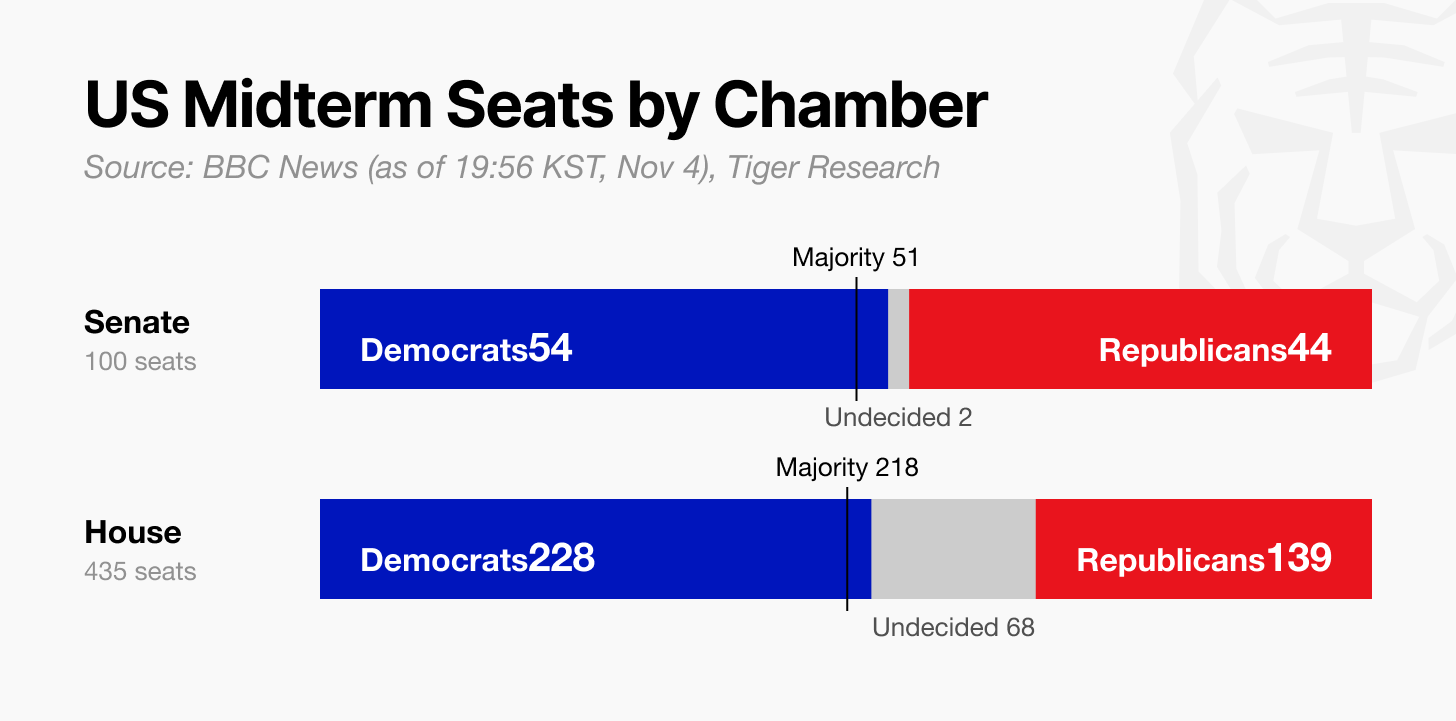
The Democratic Party has secured 54 of the 100 Senate seats and 228 of the 435 House seats, exceeding the majority thresholds of 51 and 218 seats, respectively. This means a net gain of 7 seats for Democrats in the Senate and 25 in the House. There are still 2 Senate races and 68 House races outstanding, but it is already certain that the Democrats will control both chambers.
After the new Congress convenes in January 2027, the Democrats will control the legislative agenda and committee chair positions.
This outcome is crucial for digital assets, as the two major legislative actions that shaped the market over the past two years—the GENIUS bill and the CLARITY bill—were both led by Republicans. Now the Democrats will have the ability to block subsequent legislation and reexamine the framework established by the Republicans, which will have broad implications for the market.
2. Positions of Elected Democrats on Digital Assets
Based on past statements and records, elected Democrats in Congress can be roughly divided into three categories:
Traditional Critics: View digital assets as an industry designed to evade regulation.
Moderates: Support clear rules but insist on establishing conflict-of-interest restrictions for public officials and enhancing consumer protection.
Smaller Pro-Crypto Faction: Hope to bring the industry into a regulated financial system through a clear legal framework.
The challenge for the industry is that critics are likely to secure chair positions that decide which bills can move forward.
Moderates and pro-crypto Democrats are not unconditional allies either. They also wish for Congress to address the Trump family's digital assets business, making it unlikely for existing bills to move forward unchanged.
2.1 Critics Likely to Chair Key Committees
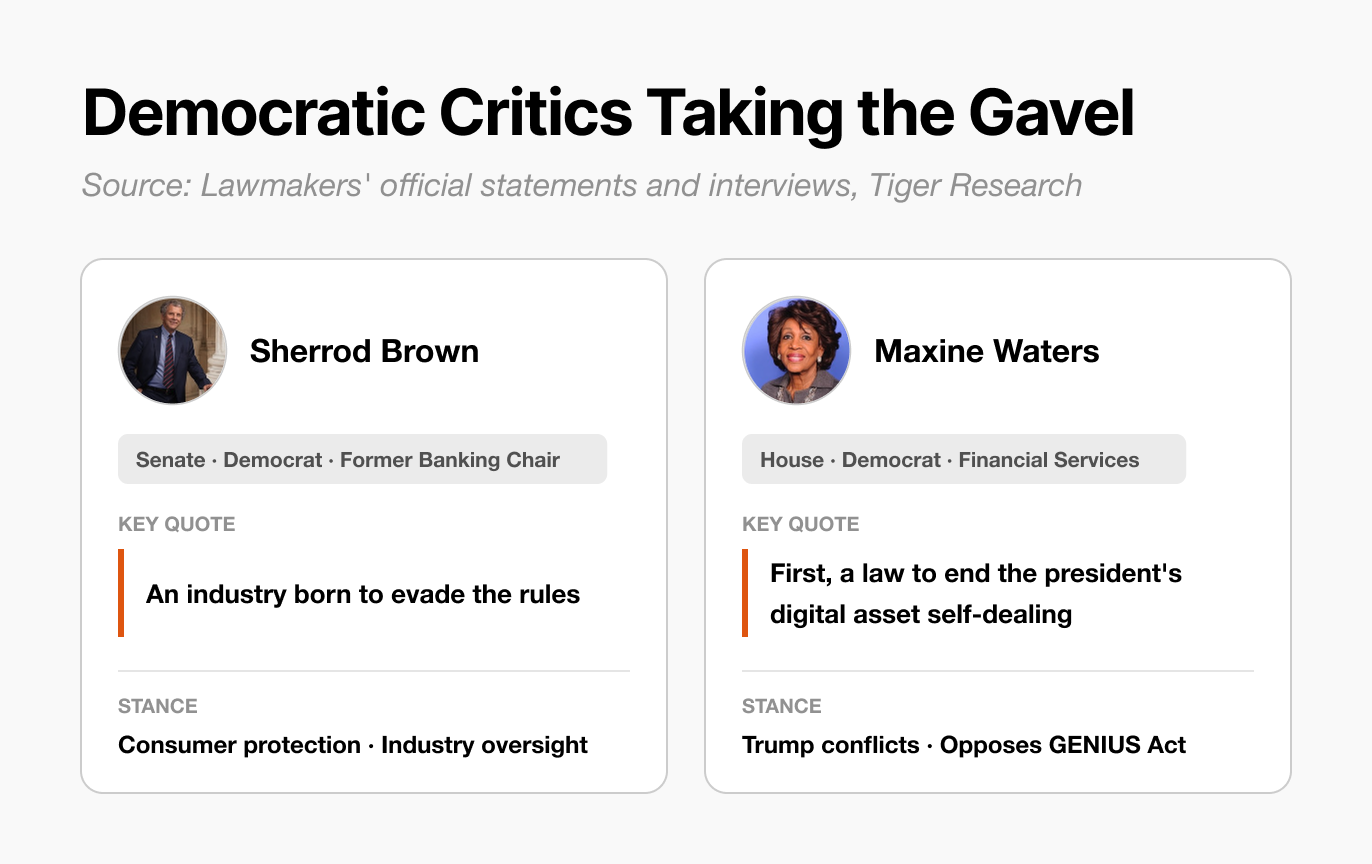
This election has strengthened the position of industry critics within the Democratic Party.
Represented by Senator Elizabeth Warren, who participated in the 2020 Democratic presidential primary, these critics view digital assets as an industry established to escape regulation and consistently oppose industry-friendly legislation. As the Democrats become the majority party, these lawmakers are more likely to chair committees responsible for digital asset legislation.
Incoming Senator Sherrod Brown has served three terms as a senator from Ohio and previously chaired the Senate Banking Committee, making him one of the industry’s most well-known critics. During his tenure as chair, he blocked the advancement of crypto legislation.
During a stablecoin hearing in 2021, Brown argued that stablecoins are neither decentralized nor transparent. Despite political groups supporting the crypto industry spending approximately $63 million to try to prevent his return to the Senate, he still won. This history gives the industry no reason to expect him to be more favorable.
Representative Maxine Waters, who has served in the House since 1991, is widely regarded as the leading candidate for chairman of the House Financial Services Committee.
Waters is currently the Democratic senior member of that committee. She served as chair from 2019 to 2023, becoming the first woman and the first Black individual to hold that position. With the Democrats regaining control of the House, she is expected to return to this position.
When the GENIUS bill passed in the Senate, Waters criticized it as full of flaws, stating that while the bill is named "Genius," it shows no brilliance. She also described the recent hacking incident involving Binance as a warning that the crypto industry cannot operate without robust accountability mechanisms.
With these lawmakers heading key committees, the digital asset agenda pushed by the Republicans over the past two years will face much greater resistance.
Their primary target is likely to be the Trump family's digital assets business, World Liberty Financial. Reports have indicated that an investor associated with the Abu Dhabi royal family purchased a 49% stake in WLF for approximately $500 million four days before Trump took office, prompting Democrats to call for Senate hearings.
Congress may also investigate why the SEC has withdrawn over a dozen digital asset enforcement cases, with Waters already calling for such an investigation. Senate Democrats may further pressure regulators by delaying the confirmation of key positions at the SEC and CFTC.
Therefore, headlines in the digital asset space in the first half of 2027 may focus on investigations of WLF affiliates and subpoenas for SEC chairs, while legislative progress will likely receive less attention.
2.2 Moderates Support Clear Rules, But with Conditions
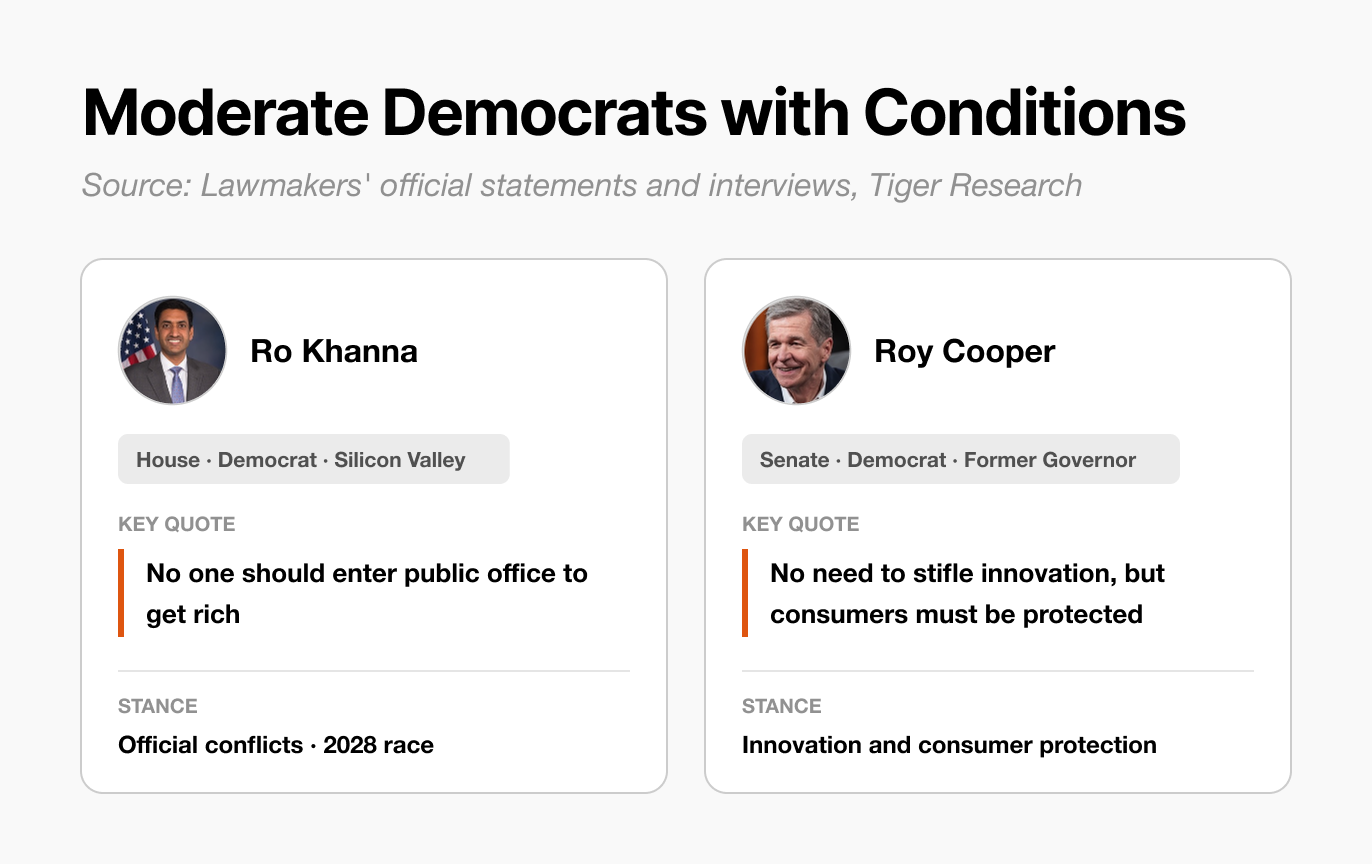
Moderate Democrats generally support digital asset legislation but also wish to strengthen consumer protection and establish conflict-of-interest limits for public officials. If the CLARITY bill is reintroduced in a Democrat-controlled Congress, their demands may shape the final form of the bill.
Representative Ro Khanna has long supported establishing clear rules for digital assets. In 2022, he co-introduced the Digital Commodity Exchange Act, which emphasizes consumer protection and transparency. In 2025, he stated that Congress could pass both stablecoin legislation and the CLARITY bill in the same year. However, in the same event, he also argued that elected officials should not hold memecoins.
Khanna is also seen as a potential candidate for the 2028 presidential election, which gives him more reason to emphasize issues of conflict of interest for public officials.
Incoming Senator and former North Carolina Governor Roy Cooper does not have a voting record at the federal level. However, during his campaign, he met with industry representatives and stated that the industry wants to comply with the law. He believes that businesses simply want to know what the rules are and are assured that these rules will not change frequently. His stance balances support for regulatory stability and a focus on consumer protection.
As these lawmakers join negotiations, they may likely seek to amend existing bills.
Moderates may condition their support for the bill on adding provisions to prevent public officials from profiting at the expense of digital assets, such as Khanna's Ban Crypto Corruption Act. He has also initiated an investigation requesting records related to WLF's dealings with the UAE.
Lawmakers like Cooper are likely to push for increased measures against illegal financial activities and bolster consumer protection. However, provisions targeting the president's family may prompt Trump to veto related legislation.
As a result, while legislators negotiate amendments to the existing text and the adjustments sought by moderate Democrats, the CLARITY bill may continue to remain stalled.
2.3 Pro-Crypto Democrats
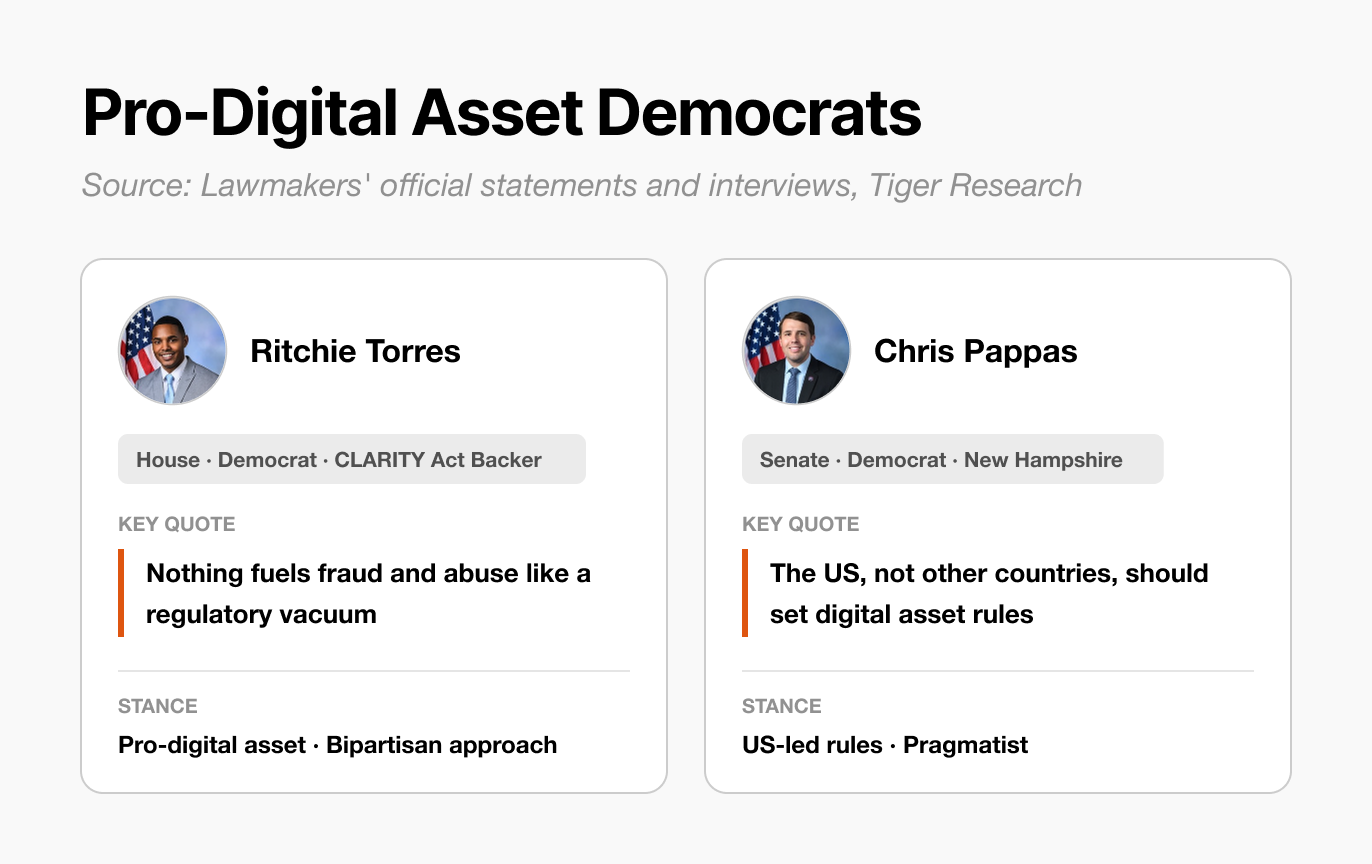
This group includes lawmakers who voted in favor of the CLARITY bill and GENIUS bill in the House, as well as those who advocated for establishing clear rules for digital assets during their campaigns. In a Democratic-controlled Congress, they are potential allies for the industry, though are currently not in a position to lead relevant committees.
Representative Ritchie Torres is one of the most active advocates for digital asset legislation within the Democratic Party. He co-introduced the CLARITY bill and the Blockchain Regulatory Certainty Act, leading efforts to urge his Democratic colleagues to support the CLARITY bill before the 2025 House vote, and voted in favor of the GENIUS bill.
During an SEC oversight hearing in February 2026, Torres stated that he has long been optimistic about emerging technologies like digital assets and blockchain. However, his support also has limits. After the suspicious Polymarket trade betting on the ousting of Venezuelan President Maduro was exposed, he and 30 other lawmakers jointly proposed legislation to prohibit public officials from trading in prediction markets using non-public information.
Incoming Senator Chris Pappas voted in favor of both the CLARITY bill and the GENIUS bill during his time in the House. After voting, he stated that for the U.S. to maintain its innovation leadership, it must embrace new technologies and establish clear rules and safeguards for digital assets. He described these two bills as the starting point for protecting consumers and supporting the growth of small businesses.
Meanwhile, Pappas has expressed deep concerns about President Trump's disregard for existing ethical standards and legal requirements, calling for stricter anti-corruption rules for public officials. In May 2026, he also called for the House to investigate corruption and insider trading issues in prediction markets.
These lawmakers are likely to seek to add conflict-of-interest provisions to the CLARITY bill to garner support from other Democrats.
Both Torres and Pappas support the bill, while also advocating for measures to prevent public officials from profiting from their positions. In the Senate vote in September, none of the Democrats voted in favor, and concerns regarding the Trump family's digital assets business were one of the main obstacles. Addressing these concerns would eliminate one of the primary reasons for Democratic opposition to the bill.
However, their ability to lead this process remains limited. Industry critics are likely to dominate key committees, and provisions targeting the president's family may be met with resistance from the White House. The future of the industry largely depends on whether pro-crypto Democrats can create a compromise that both sides can accept using ethical provisions.
3. Elected Republicans: Unchanged Agenda, Decreased Control
Elected Republicans in Congress still support privately issued stablecoins, viewing them as a means to maintain the global dominance of the dollar. They also oppose government-issued central bank digital currencies (CBDCs).
However, with several pro-industry Republicans losing their seats, including Senator Jon Husted and Representative Bryan Steil, who chairs the House Digital Assets Subcommittee, their influence has diminished.
3.1 Lawmakers Behind the GENIUS Bill and CLARITY Bill
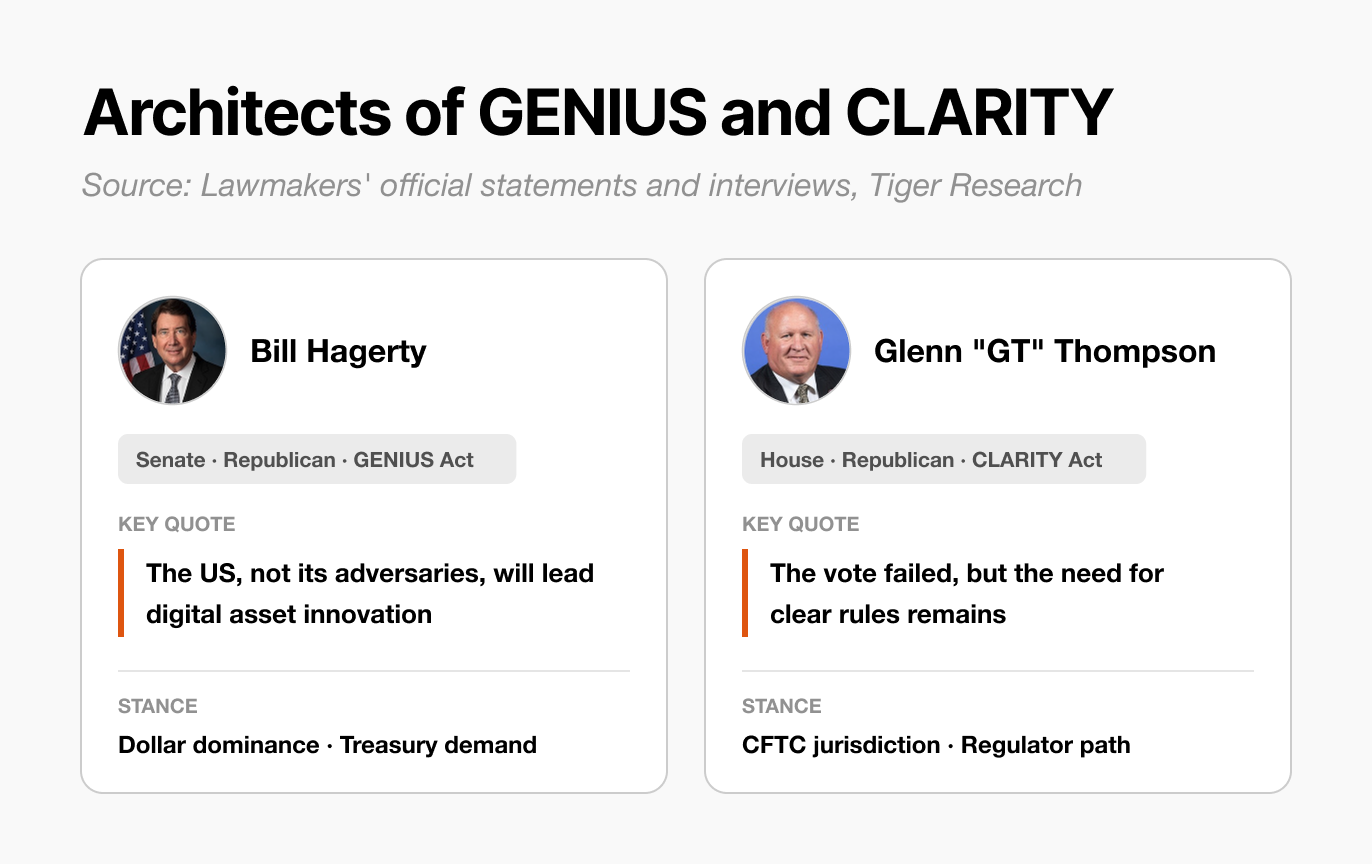
Senator Bill Hagerty and Representative Glenn Thompson have both been re-elected and were involved in drafting the frameworks for the stablecoin legislation and the CLARITY bill. With the Republicans losing their majority in both chambers, their main task will turn towards defending the legislative achievements already secured.
Republican lawmakers will spend more time defending existing policies going forward.
They are likely to focus on protecting the GENIUS bill, using the 60-vote threshold required to break filibusters in the Senate alongside Trump's veto power to block Democratic efforts to tighten regulation. They may also support the SEC and CFTC in implementing rules within their existing mandates to allow policy work to continue without new legislation.
3.2 Strong Opposition to CBDCs
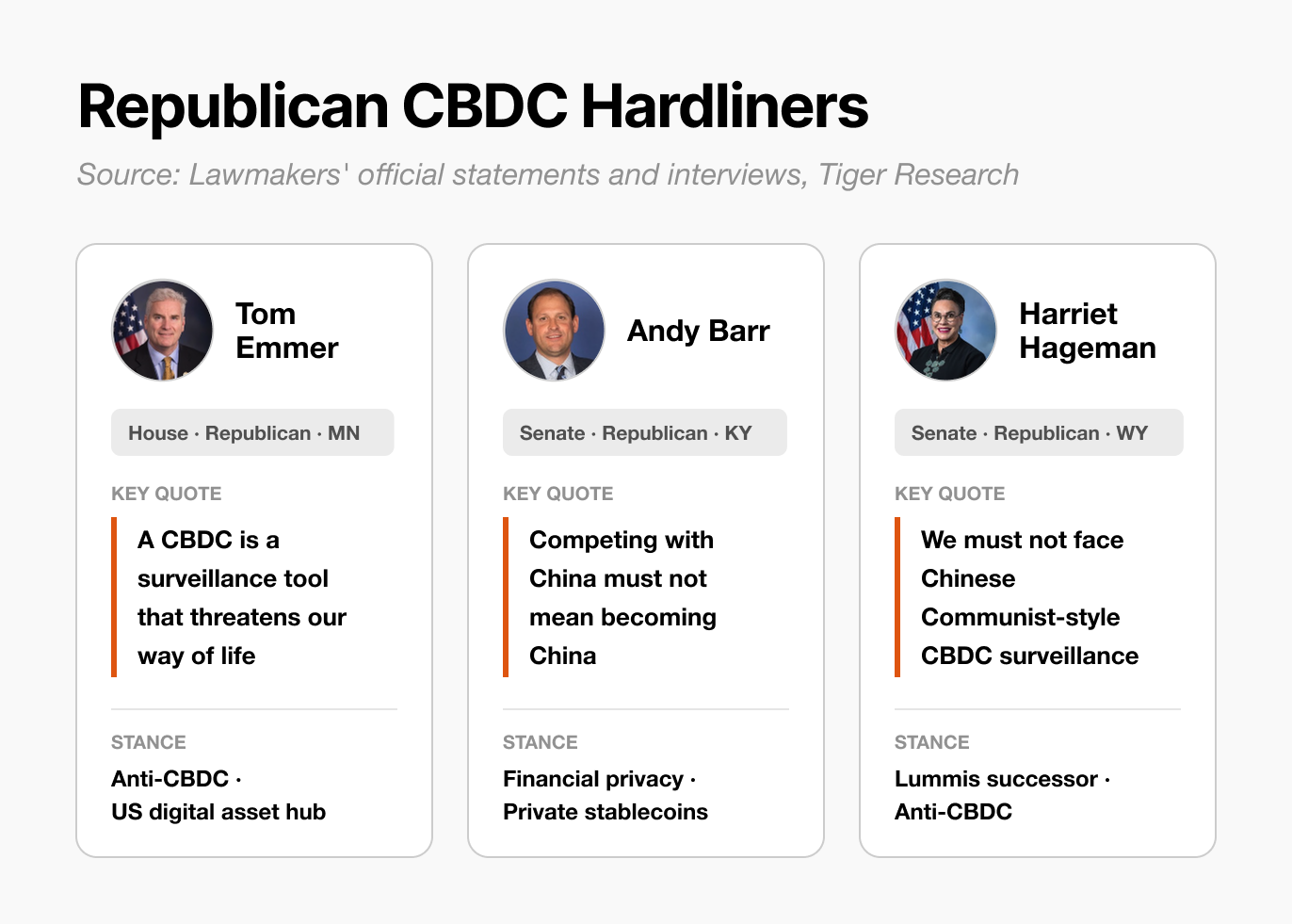
Opposition to CBDCs is one of the clearest consensus among elected Republicans. They view digital asset policies as a way to develop the industry while limiting government surveillance of financial activities.
These lawmakers support private sector digital assets but firmly oppose a government-issued digital dollar. They believe CBDCs could become tools for monitoring individual transactions, preferring private stablecoins as an alternative.
Their goal is to legislate to ban CBDCs. Under Democratic control of Congress, this route is virtually blocked for the next two years.
The executive order signed by President Trump in January 2025 remains the primary basis at the federal level for explicitly prohibiting U.S. CBDCs. As a future president may rescind this executive order, Republican lawmakers have consistently tried to embed the ban into law. Representative Tom Emmer's Anti-CBDC Surveillance State Act passed in the House in July 2025 but failed to clear the Senate. Under Democratic control of both chambers, the bill's prospects have further dimmed.
As a result, these lawmakers are likely to focus on overseeing the implementation of the GENIUS bill. For example, they may examine whether the Treasury's implementation guidelines introduce mechanisms that allow the government to monitor stablecoin transactions.
As long as this executive order remains in effect, the likelihood of launching a CBDC during Trump's remaining term (until January 2029) is very low. Therefore, their attention may shift towards protecting the privacy of stablecoin users.
4. The Congressional Agenda Now Dominated by Democrats
The Democratic Party has secured a majority in both chambers. The remaining election outcomes will determine the size of the majority, but control of Congress has changed hands.
From their current standpoint, investigating the Trump family's digital assets business will take precedence over passing new legislation. Democratic leaders in the relevant committees had already listed these businesses as a top priority for investigation before the elections. As the majority party, they will have the power to issue subpoenas.
Even if the Democrats reconsider the CLARITY bill, they are likely to demand stronger consumer protections and conflict-of-interest limits for public officials. In the Senate vote in September, the bill did not receive any support from Democrats, and concerns regarding the Trump family's digital assets business were one of the key obstacles.
The Republicans will focus on defending the GENIUS bill and blocking Democratic proposals to tighten regulation. Their minority status makes it difficult to pass new laws, but they still hold considerable power to obstruct legislation: most controversial bills require 60 votes to break a Senate filibuster, and Trump can veto any legislation that reaches his desk.
The path for the CLARITY bill to pass is now more difficult. As a major political force behind this administration’s crypto-friendly agenda, Trump’s room for maneuver will also shrink. The Republican policy objectives remain largely unchanged, but progress is likely to slow.
To gauge the direction and pace of regulation, the industry needs to pay attention to how Democratic leaders will pursue investigations of the Trump family's digital asset interests and how the White House will respond.
免责声明:本文章仅代表作者个人观点,不代表本平台的立场和观点。本文章仅供信息分享,不构成对任何人的任何投资建议。用户与作者之间的任何争议,与本平台无关。如网页中刊载的文章或图片涉及侵权,请提供相关的权利证明和身份证明发送邮件到support@aicoin.com,本平台相关工作人员将会进行核查。


