After the Democratic Party won the midterm elections, Musk's AI investments and business expansion plans face new regulatory risks.
Source: Jinshi Data
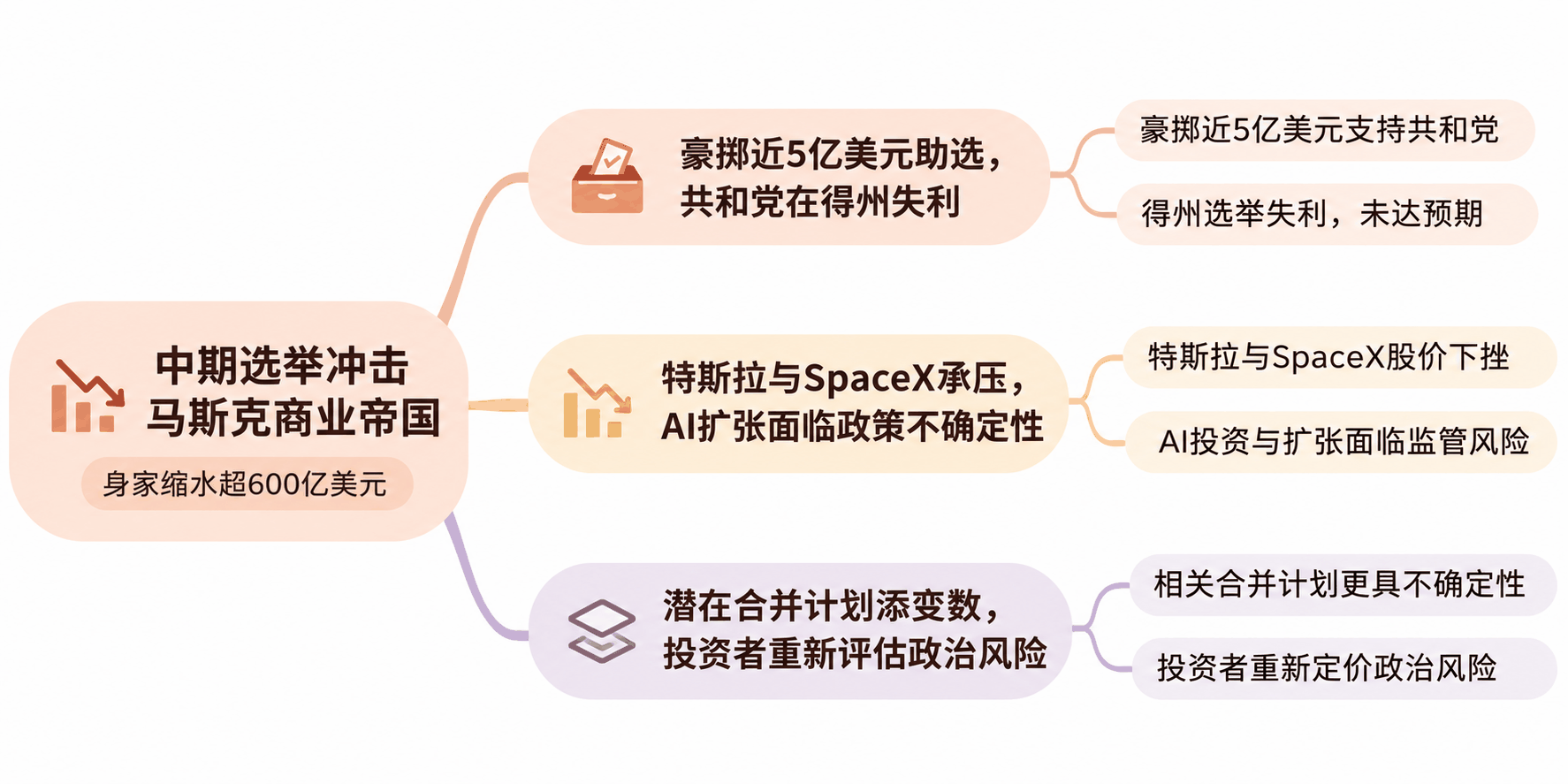
The U.S. midterm elections not only changed the power dynamics in Washington but also impacted the business empire of the world's richest man, Musk. Following the Democratic Party's control of both chambers of Congress and their victory in key elections in Texas, the stock prices of Tesla and SpaceX, which are owned by Musk, came under pressure, and his personal wealth reportedly shrank by more than $60 billion.
Tesla and SpaceX saw their shares drop by approximately 5.7% and 7.6%, respectively, in pre-market trading on Wednesday. Based on Musk's holdings in the companies, this market volatility resulted in a wealth reduction of over $60 billion. With fluctuations in stock prices, relevant valuations may continue to change.
Investing nearly $500 million in support, the Republican Party faced setbacks in Texas
In this midterm election, Musk was one of the most significant individual political donors to the Republican Party.
According to statistics compiled by CNBC based on filings with the U.S. Federal Election Commission, Musk invested at least $474 million in the 2026 election cycle, with approximately $224 million directed towards Texas-related campaign activities, close to half of the total.
Musk focused on supporting Republican Senate candidate Ken Paxton and hoped the Republican Party would maintain control of Congress and the Texas government. However, the final results did not meet his expectations.
Democratic candidate James Talarico won the Texas federal Senate election, while Gina Hinojosa defeated the current Republican governor Greg Abbott.
Texas has long been dominated by the Republican Party and has been a significant business base for Musk in recent years. Both Tesla and SpaceX have their headquarters in the state and have made substantial manufacturing and infrastructure investments locally.
Musk previously moved from California to Texas partly due to the state's relatively relaxed business regulatory environment.
As a result, this election not only meant that his political investments did not achieve the desired effect but may also change the operating environment for his two core businesses in the future.
Tesla and SpaceX under pressure, AI expansion faces policy uncertainty
Market concerns about the election results primarily focus on three areas: AI investments, government contracts, and corporate regulation.
First, newly elected Texas governor Hinojosa has a more cautious attitude towards large data center projects. She advocates pausing the approval of new data center construction projects until local governments improve oversight rules concerning electricity, water resource consumption, and community interest protection while opposing preferential tax treatment for large tech companies.
This could affect Musk's companies' expansion plans in Texas. Tesla is advancing AI computing, robotics, and autonomous driving operations locally, and SpaceX also plans to expand semiconductor and AI infrastructure investments.
According to Reuters, SpaceX is seeking to accelerate the expansion of its AI computing capabilities, which have become an important source of revenue growth. If data center construction approvals become more stringent, some projects may face delays, cost increases, and extended timelines for expected revenue realization.
Second, with the Democratic Party controlling Congress, Musk and his companies may face stricter scrutiny in their relations with the U.S. government.
Some Democratic lawmakers have previously called for investigations into government contracts awarded to SpaceX, federal staff reductions during Musk's leadership of efficiency departments, and national security controversies related to satellite communication services.
However, increased scrutiny from Congress does not automatically mean that the related contracts will be terminated. Trump still controls the executive branch and retains presidential veto power, while SpaceX's important position in the U.S. space launch sector may also limit the extent of policy adjustments.
Potential merger plans face uncertainties, investors reassess political risks
The election results may also affect Musk's previously discussed merger plans between Tesla and SpaceX. According to Bloomberg, the two companies have explored potential merger arrangements, but the transaction is still in its early stages.
This plan could combine Tesla's autonomous driving and robotics technologies with SpaceX's satellite communication and AI computing operations, forming a larger tech enterprise.
However, with the Democratic Party gaining control of both chambers of Congress, major transactions involving giant tech companies may face increased political scrutiny. Market participants point out that Congress may not be able to directly block corporate mergers but can increase uncertainty around the transaction through hearings, investigations, and policy oversight.
At the same time, investors are beginning to reevaluate Musk's substantial capital investment in AI businesses and whether these projects can deliver the expected returns in the future.
After the election, Musk responded humorously on social media, stating that space data centers now seem more attractive, indirectly referring to SpaceX's proposal for orbital computing facilities in the context of tightening regulations on ground data centers.
However, space data centers still face technical and commercial challenges related to heat dissipation, maintenance, and construction costs, making it difficult to directly replace ground facilities in the short term.
Overall, the impacts Musk faces are dual in nature.
On one hand, hundreds of millions of dollars in political investments failed to achieve the goal of maintaining Republican control; on the other hand, the decline in the stock prices of his two core publicly listed companies further amplified the fluctuations in his personal wealth.
For investors, what deserves more attention is not the daily shrinkage of wealth but the changes in Texas regulatory policies, the intensity of oversight by the U.S. Congress, and the outlook for AI capital expenditures.
These factors will determine whether the impact of the midterm elections remains confined to short-term market fluctuations or further transmits to the long-term valuations of Musk's business empire.
免责声明:本文章仅代表作者个人观点,不代表本平台的立场和观点。本文章仅供信息分享,不构成对任何人的任何投资建议。用户与作者之间的任何争议,与本平台无关。如网页中刊载的文章或图片涉及侵权,请提供相关的权利证明和身份证明发送邮件到support@aicoin.com,本平台相关工作人员将会进行核查。


