Author: Arthur Hayes
Translation: ShenChao TechFlow
ShenChao Introduction: Amid the intertwining of tech frenzy and capital bubbles, the market is focusing on SpaceX and AI leaders Anthropic and OpenAI, anticipating their upcoming super IPOs. However, veteran macro trader Arthur Hayes presents a harsh, almost mathematically inevitable reversal logic in this article: the current AI unicorns are heavily reliant on going public to secure qualification for corporate bond issuance to support astronomical capital expenditures for computing power; yet the extremely low initial circulation and the subsequent massive cashing out of insiders will subject these stocks to a severe dilution storm in the secondary market.
Hayes draws on the tragic history of early investors in Zcash from 2016, meticulously calculating Anthropic's shocking 83% dilution rate and OpenAI's fragile cash flow situation. He notes that once stocks dip below their IPO prices and market sentiment reverses, the credit spread for AI corporate bonds will suddenly soar, possibly even falling into junk status, thus obstructing the refinancing pathways in the upstream supply chain.
More critically, this credit cooling is directly impacting the balance sheets of American commercial banks. As bank credit and securities financing shrink, the liquidity of fiat currencies, particularly the US dollar, will be systematically drained, exerting suppressive effects on crypto assets. Hayes clearly outlines a trading defense strategy before the ultimate global central bank rescue arrives and highlights the structural dividends brought by excess computing power in the on-chain autonomous agent ecosystem.

(All views expressed in this article are those of the author and should not be used as a basis for investment decisions, nor should they be seen as recommendations or advice to participate in investment trading.)
I opened my eyes. It was the morning of Saturday, October 28, 2016, during Tokyo's Halloween weekend.
Our group gathered at the Wyndham Gay Hotel to board our flight, transforming into another bunch of foreign travelers spending a noisy single weekend in Tokyo. When I stumbled back to my comfortable hotel bed in Roppongi relatively unscathed, I felt immensely relieved.
The night before, we had wandered around the Minato district for quite a while. My current chief of staff and I took a ridiculous group photo at a "well-respected" establishment, both of us completely plastered, posing like a poster from the movie "Lethal Weapon."
Late that Friday night, the genesis block of Zcash was born, initiating one of the craziest trading days in cryptocurrency history.
Similar to Bitcoin, to buy spot ZEC, one had to purchase it directly from miners. At that time, as now, the privacy narrative was extremely hot, and everyone eagerly wanted a piece of the first scalable private digital cash network.
However, the crux of the issue was that the initial supply was entirely zero. The circulating supply could only increase slowly as miners continuously mined ZEC and sold it to cover operational costs, block by block.
The platform dominating altcoin trading at the time was Poloniex. I vividly remember my experience trading on Polo and coding against their ridiculously poor API.
If you were fortunate enough to receive a reply from customer service, it felt like hearing God's direct admonition. A few years later, Circle acquired Poloniex at an exorbitant price, only to mismanage it disastrously, ultimately leaving it to Justin Sun to clean up the mess. But that's beside the point. All players must remember: the price is what you pay, but the value is what you get.
Because the only place to purchase ZEC at that time was Poloniex, when a minuscule amount of ZEC was listed, impatient speculators would clear it out at an absurdly high price.
As shown in the chart, the vast majority of players who bought ZEC in the first few days and weeks of trading are still in deep losses today.
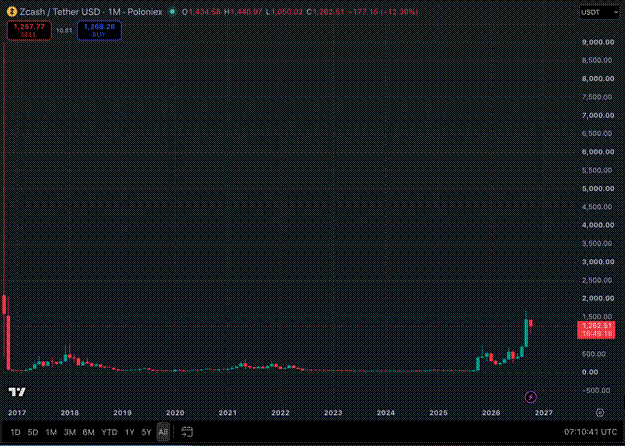
Figure: Historical price trend of Zcash since its launch in 2016
Traders might argue that adjustments need to be made based on circulating supply to assess ZEC's true performance.
While ZEC's total market cap is indeed at a historical high, as a trader, what you're buying and selling is never the total market cap but the actual price per token.
This is the key difference that many investors fail to fully understand. As the token supply rapidly expands, even if the total market cap rises, the price per token or share will be severely compressed, leading to extremely disappointing investment returns.
Shifting focus to the AI sector: the pair of SpaceX and the soon-to-be-listed Anthropic and OpenAI raises the question of whether their public stock issuance supply dynamics signal excess profits or poverty. The answer is clear: retail investors will only face poverty!
I believe, just like early ZEC investors, if you buy these companies' IPO stocks at the offering price, as insiders unlock and sell off in bulk, you are destined to suffer severe losses.
This will heavily impact the entire macro market environment, as the entire AI trading landscape is built on market vibes. Whether you believe in the lofty future profitability and ubiquitous penetration of AI determines your willingness to provide financing to the industry.
All these vibes stem from the only objective metric measuring AI success or failure: is the stock price going up or down? Therefore, setting aside whether the CEOs of SpaceX, Anthropic, and OpenAI are deceiving or committing financial fraud, I am quite clear that once the stock price falls below the IPO price due to massive insider selling, the market will conclude that they are all lying.
After presenting this brutal mathematical calculation that will lead to the complete disillusionment of investors, I will detail the macro trading strategies before the global liquidity deteriorates until the ultimate rescue arrives.
SpaceX and the Dual Strains of Computing Power
The three AI companies we are focusing on are SpaceX, Anthropic, and OpenAI. They consume the vast majority of computing resources in the production of intelligent tokens.
Once their demand for computing power slows, the entire AI macro narrative will collapse. Let’s delve into the supply dynamics of their freely circulating stocks to examine their current and future stock price performance. But before delving into calculations, I want to emphasize why stock prices are so crucial to the AI narrative.
These companies must invest hundreds of billions of dollars in gigantic capital expenditures (Capex) to drive the god-like silicon-based intelligence they create.
Since they were not previously publicly traded entities, it is almost impossible to issue corporate bonds at the required scale. They must rely on a publicly listed mega cloud service provider or semiconductor giant for endorsement or debt guarantees. In comparison to the sheer size of their debt issuance, the equity raise seems trivial.
However, once these labs become public companies, they gain the qualification to issue corporate bonds directly.
Although SpaceX is not a pure AI lab, going public has granted it an investment-grade credit rating, and it has successfully issued hundreds of billions of dollars in debt since the IPO. With these companies accessing institutional capital pools, credit spreads narrow and issuance scales continuously rise.
Whether institutional investors are willing to accept lower yields depends entirely on their expectations for the future viability of AI labs. Observing the prices of their publicly issued stocks is the most direct way to gauge whether the market believes the AI narrative and the profitability of specific labs.
If stock prices fall, and with the massive stock overhang this is almost mathematically inevitable, any debt investors willing to inject capital will certainly demand a higher yield premium.
This reflexive logic drives Elon Musk, Dario Amodei, and Sam Altman to push their companies toward public listings by all legal means. They will exhaust all lawful avenues to promote their IPO, as failing to go public would mean their high debt-driven capital-intensive businesses face total suffocation.
SpaceX Equity and Unlocking Model
The following chart shows the percentage change in SpaceX's stock price since its IPO compared to changes in the total number of shares issued.
Clearly, since its listing, the stock price has remained in a sideways trend, while the floating share capital has increased significantly by 50%.
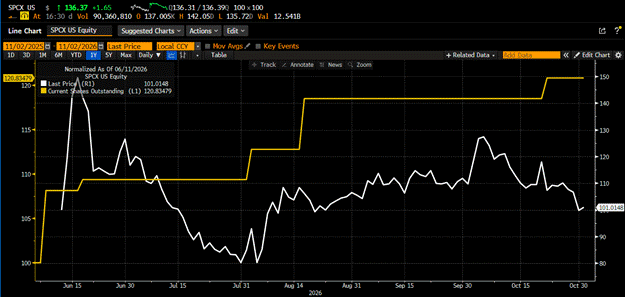
Figure: Comparison of SpaceX stock price movements and total shares issued
From now until June 2027, it is expected that approximately 8.6 billion additional shares will unlock, which means the circulating supply will face about a 50% dilution again, with the vast majority of the incremental shares coming from the release of Elon’s personal holdings.
Furthermore, if the rumored merger deal between SpaceX and Tesla materializes, it may lead to nearly an additional 50% equity dilution for Class A common stock shareholders.
The only thing that can save the bulls is the miraculous creation of massive free cash flow by the company. Simply showing accounting profitability is far from enough; Elon must clearly guide the market that this cash will be used for share buybacks or dividend distributions.
If this is not achieved, in the face of unavoidable massive dilution, investors will have no reasonable justification for holding the stock.
Having analyzed the first company, let’s look at the pure AI representative: Anthropic.
Anthropic Equity and Unlocking Model
Anthropic is a purely cutting-edge AI lab. It focuses on training proprietary large models and charges for intelligent access to them.
This is a once-consumed type of business. Historical expenditures on tokens do not guarantee continued future consumption. This is a key point that many investors fail to grasp. They attempt to apply the annual recurring revenue (ARR) metric from the SaaS industry but should really view Anthropic as an oil and gas company instead.
Setting profitability aside, what does its upcoming IPO face in terms of stock supply dynamics?
After thoroughly studying the recently submitted and updated S-1 filing (which was frankly done by my AI Agent), I calculated that investors participating in the IPO will face a staggering dilution of up to 83% before June 2027.
Speculators should carefully weigh this figure: an incredible 83% dilution! It’s truly staggering.
By next June, it is impossible for Anthropic to become profitable; even if they manage to turn a profit, the S-1 filing clearly states that there are no plans for dividend disbursement in the near future.
All available cash flows will be fully invested in the approximately $900 billion worth of computing expenditures and potential future data center constructions listed in the prospectus. Driven solely by this insane dilution schedule, mathematically, there is almost no chance for its stock price to increase from the date of listing until June 2027.
However, investors often blindly believe in supposed miracles when it comes to Anthropic. Assuming its market cap at IPO is $1.5 trillion, to keep the stock price from falling, the entire market would need to inject approximately $1.245 trillion in new external capital to fully absorb the potential insider selling wave.
This is not impossible, but the likelihood is extremely low.
Next, let’s examine the company in the most precarious position among the three: OpenAI.
OpenAI Valuation Dilemma
Before investors suffer painful lessons from the cash-burning AI super IPO, let’s assume that OpenAI manages to go public first; its performance is destined to be the worst among the three.
Compared to Anthropic, OpenAI has a more severe cash burn rate, worse product experience, and higher customer concentration risk. Yet even as the underdog, it still requires massive capital to build its god-like silicon-based infrastructure.
Recent reports indicate that OpenAI is currently trying to raise $20 billion at a valuation of $1.25 trillion, down from the previously communicated $1.5 trillion valuation and $30 billion funding target. If the Financial Times’ report is accurate, this financing round is facing significant obstacles.
If Anthropic successfully completes its IPO and the stock price remains strong post-listing, OpenAI’s passive position might receive temporary relief.
While we have not yet seen OpenAI's official S-1 document, it is reasonable to infer that its stock issuance structure will fully replicate the models of SpaceX and Anthropic.
They will likely offer about 5% of a low float for public sale and, in the subsequent six months, allow a significant number of employees and early-stage venture capital insiders to cash out and sell.
Given that there is a widespread blind valuation comparison among Silicon Valley giants, Sam Altman will likely strive to set OpenAI's pricing at around $1.5 trillion to compete with his old rival Dario.
Assuming their IPO is set to complete in January, by June 2027 they will face the same situation as Anthropic: needing hundreds of billions or even trillions in new external liquidity to barely keep the stock price from falling below the IPO price.
Sideways Means Down: The Mathematical Limits of Capital Acceptance
As I mentioned earlier, the core purpose of these companies choosing to go public is to open corporate debt financing channels, thereby breaking free from reliance on guarantees from mega cloud service providers and chip giants, and independently raising expansion capital.
However, to instill confidence in potential bond buyers, stock prices must go beyond merely languishing horizontally; they require a sustained upward trend. Yet it turns out that simply maintaining a sideways movement requires consuming an enormous volume of external market liquidity.
The most likely scenario is that secondary market investors are not as foolish as these CEOs imagine; they will not contentedly absorb the massive chips dumped by insiders endlessly.
Therefore, even if revenue barely meets expectations (accounting profits are out of the question), the continuous supply pressure will steadily erode stock prices, resulting in a slow decline.
Once these companies lose the external support to independently face the capital market, how much will the credit spreads of the corporate bonds they issued widen relative to high-yield bonds?
SpaceX will almost certainly not maintain its investment-grade credit rating, while Anthropic and OpenAI are bound to face the fate of becoming junk bonds.
The core crisis is that once the capital market sees through the real financing costs at the ultimate computing power consumption terminal, all participants upstream in the entire industry chain will be forced to issue Capex bonds at extremely punitive interest rates.
This will thoroughly shatter the last line of defense for the bull narrative surrounding AI stocks. The wider the credit spreads, the higher the interest expenses for infrastructure construction, which will entirely consume future potential profit margins.
It’s Too Late: Credit Ratings and Corporate Bonds Frozen
Those blindly bullish on AI must wake up. I do not care whether AI is currently practical, whether revenues will exceed expectations, or whether certain institutions fabricate statistics on corporate adoption rates.
Because I can now directly observe the real market pricing attitudes toward SpaceX, Anthropic, and OpenAI through live stock prices, which spells disaster for the bull narrative.
The root of the disaster lies in the sheer scale of the stock supply they have flooded the market with, which mathematically leaves no room for stock prices to continuously rise.
Bond investors will closely monitor the dreary performance of the stock market. Even if they are still willing to subscribe, they will demand extraordinarily harsh excess yield compensations.
Moreover, the terms of bond contracts will become exceedingly strict, such as requiring a significant cash cushion to be reserved on the balance sheet or triggering severe restrictions for premature debt repayment.
In short, when the faithful have long since fled the church, the supposed savior will arrive tardily.
This is undoubtedly significant bad news for all holders of AI-related debt. If a saturation of junk-level high-yield debt leads to a complete freeze in the credit markets, the entire vertical supply chain will suffer from liquidity shock, and downgrades by rating agencies will follow in quick succession.
Bank Balance Sheets Shrinking: The Transmission Path from AI to Crypto
As cryptocurrency investors, why should we closely monitor the burst of the AI bubble and the plummeting stock prices of the three giants? The core reason is that as AI credit spreads widen and bond issuance stagnates, liquidity for fiat currencies (especially dollar liquidity) will experience a systemic contraction.
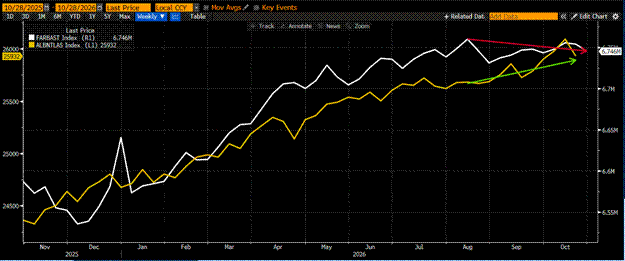
Figure: Trends in the scale changes of American commercial banks' balance sheets
The source of liquidity necessary to drive the rise of the crypto assets we hold essentially can only come from the expansion of the Federal Reserve or the balance sheets of American commercial banks.
But at least at this stage, the Federal Reserve is in a de facto strike state. Core decision-makers, including Kevin Warsh and Scott Bessent, consistently prefer that the commercial banking system create credit rather than the Federal Reserve injecting liquidity directly.
It is the phase of expansion of American commercial banks' balance sheets that provided critical liquidity support for the cryptocurrency rebound initiated in August. However, as of last week, the scale of American commercial banks' balance sheets has shown a significant contraction week-on-week.
While this is just one piece of data, under the shadow of widening AI credit spreads, the potential risks are alarming.
The expansion of commercial bank balance sheets has greatly fueled the AI bubble in the past: on the lending side, banks opened credit channels for various AI and their affiliate businesses; on the securities financing side, banks continually provided leverage financing for secondary market speculators; and on their proprietary trading side, banks themselves were aggressively buying tech stocks and bonds.
From a global perspective, unless you are involved in highly profitable defense industries, all capital is essentially betting on the AI bubble. If the stocks of these benchmark companies face a downturn, injuring the AI atmosphere and leading to a cooling freeze in the credit markets, the best-case scenario for commercial banks' balance sheet scale is merely maintaining a sideways trend, while the likelihood of entering a contraction path is high.
This is the key chain through which risks transmit from AI to the cryptocurrency market.
Penetrating Disguise: Keeping Patience Before the Ultimate Rescue
In the end, the core issue is not whether these companies are squandering investors' money to build silicon deities.
The real fatal hidden danger lies in the mathematically inevitable decline of secondary market liquidity prices caused by massive stock dilution, which has become a well-known catalyst in the market.
Faced with real-time plummeting stock prices, the market's belief in the unwavering rising nature of AI assets will be thoroughly shattered. The bleak market trend will compel the capital market to reexamine the absurd assumptions upon which the AI macro narrative is built.
Regardless of whether these labs eventually achieve GAAP-compliant accounting profitability, and whether AI can ultimately evolve into a general-purpose technology, the undeniable objective fact is that the only objective thermometer to measure AI commercial success is continuously falling to the lower right.
If these unicorns can continue to evade rigorous scrutiny from public markets for the next few years until the technology truly generates positive cash flow, they will undoubtedly choose to do so.
But the reality is harsh: without support from the corporate bond market, they simply cannot raise the hundreds of billions or even trillions needed to continue burning cash. To step into the arena of debt financing, going public is an unavoidable hard threshold.
Their time has completely run out. Under the high-pressure scrutiny and transparency of public markets, any speculative tricks relying on bluff will be exposed.
Before a dramatic reversal of fiat liquidity occurs, Maelstrom will opt to retreat to the sidelines and wait patiently for the collapse of the super AI IPO under the immense pressure of dilution.
The ultimate rescue will inevitably come. The core question is merely when and how the central banks will intervene, which we will explore further in future articles. It often requires a true alarm of a financial crisis to reverse the Federal Reserve's and other central banks' hardline policy stances.
The AI bubble is intricately tied to the lifeblood of the global economy: from underlying data center construction to raw material exports and advanced semiconductor manufacturing, the global supply chain has been deeply bound to AI development. Losing this infrastructure wave will plunge the global economy into severe recession.
Thus, major central banks and financial regulatory authorities will ultimately reopen the gates of money printing to stave off crisis. At that point, Bitcoin and cryptocurrency holders will face an incredibly prosperous liquidity feast, but the prerequisite is that you must maintain sufficient patience in the present.
During this waiting period, as more data centers gradually come online, computing power will continuously flow into the spot market. Even if training and reasoning for large models show negative returns in unit economics, Anthropic and OpenAI have no choice but to continue purchasing computing power.
The significant drop in computing power prices will provide extremely cheap raw materials for the exponential emergence of autonomous intelligent workflows for AI agents. Decentralized computing networks and projects within the eco-system guided by Maelstrom like the AI arbitration layer project Genlayer will significantly benefit from this, and investors can seize tokenized shares of the agency economic ruling layer in its upcoming TGE.
I wish all comrades to stay clear-headed in the trenches and face the storms with composure.
Note:
(1) ZEC: Zcash privacy cryptocurrency code;
(2) ARR: Annual Recurring Revenue.
免责声明:本文章仅代表作者个人观点,不代表本平台的立场和观点。本文章仅供信息分享,不构成对任何人的任何投资建议。用户与作者之间的任何争议,与本平台无关。如网页中刊载的文章或图片涉及侵权,请提供相关的权利证明和身份证明发送邮件到support@aicoin.com,本平台相关工作人员将会进行核查。


