Today, returning to November 4, 2026, let's discuss how to arrange 100,000 USDT that you are temporarily not using. The market conditions, product rules, and screenshots mentioned in the text correspond to that day, and the promotional interest rates should not be considered as an annual commitment.
Assuming you currently hold 100,000 USDT, do not wish to purchase BTC, and are not planning to enter the market urgently, how should you arrange this fund?
Should you continue to keep it in your account and quietly wait for a market turnaround, or allocate a portion to participate in flexible wealth management, allowing temporarily unused funds to generate some income?
Recently, many platforms have launched stablecoin wealth management activities, and the annualized returns advertised on promotional pages appear very attractive. However, what we need to weigh carefully is how much interest our own funds can actually earn, what benefits we can enjoy, and when this activity will end.
I will take 100,000 USDT as an example to clarify the differences in the USDC activities on Binance, Bitget, and OKX, and also calculate the earnings clearly.
First, let's discuss the market: why many people are choosing to hold USDT and observe.
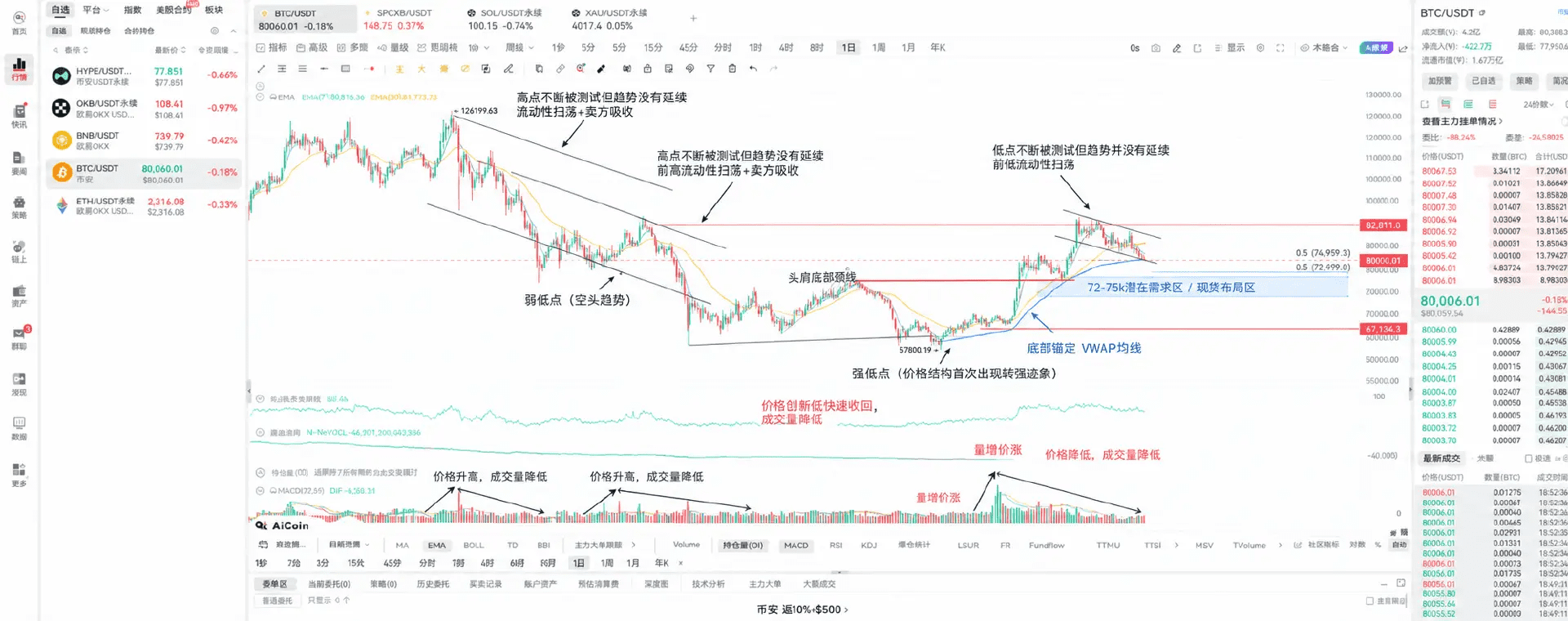
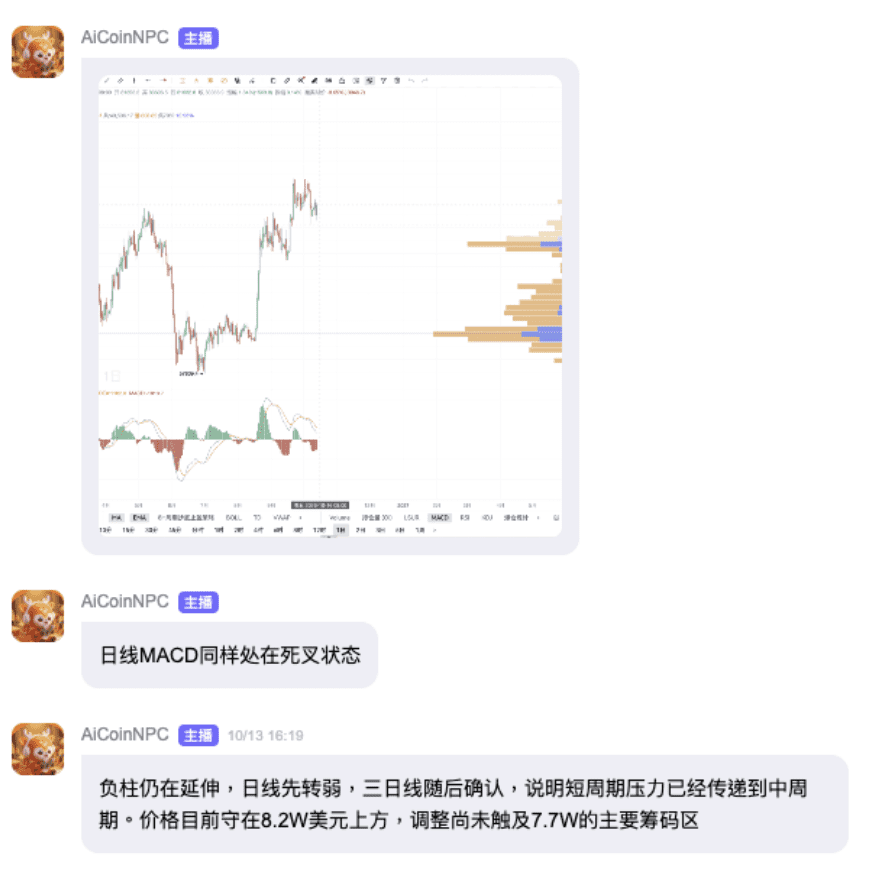
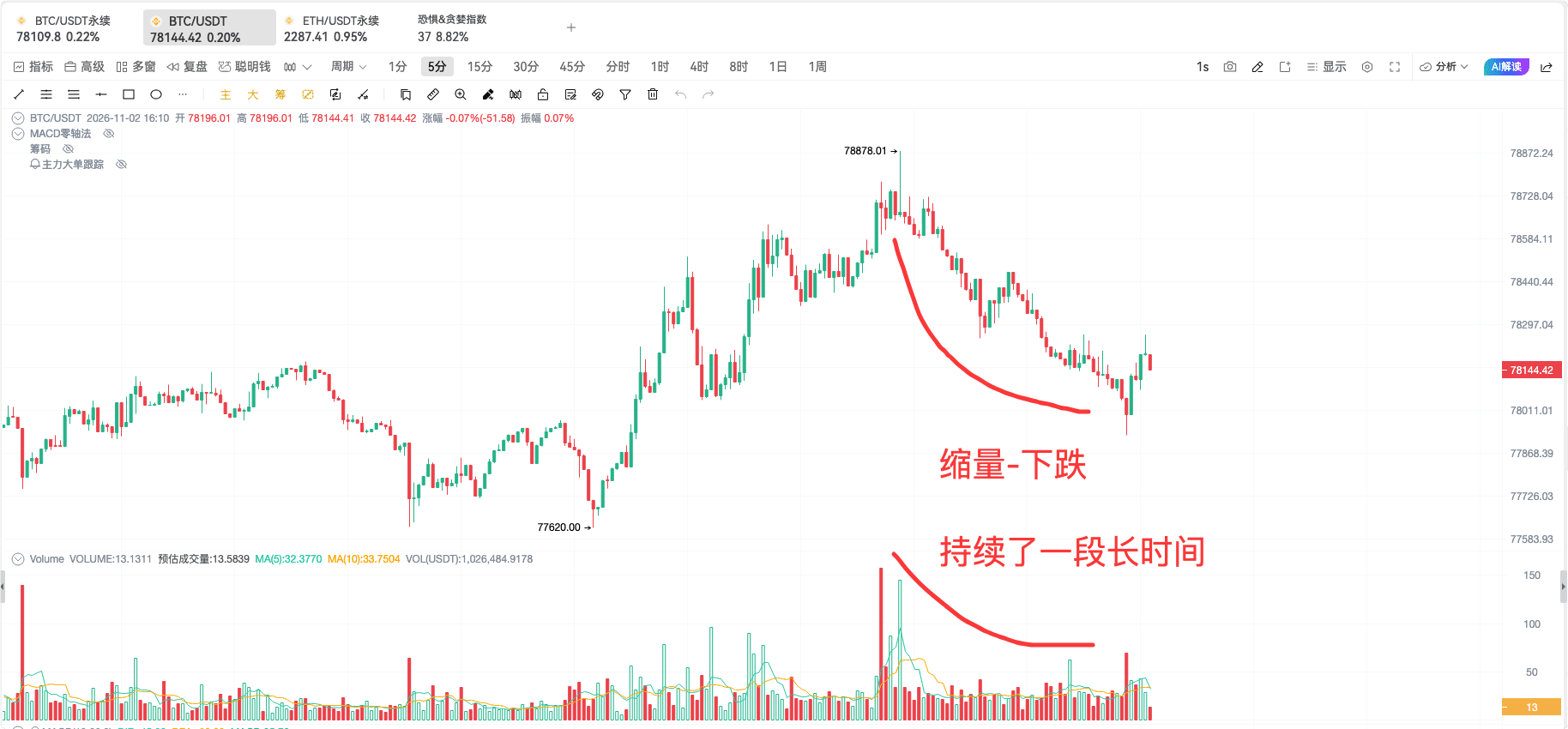
The recent trend of BTC should have caught everyone's attention.
The U.S. midterm elections, adjustments in the technology sector of the U.S. stock market, and the subsequent regulatory expectations for the crypto industry are factors that influence the overall market sentiment.
However, for those of us engaged in trading, various policy messages are merely the broader backdrop; the core issue is whether real funds are coming into the market.
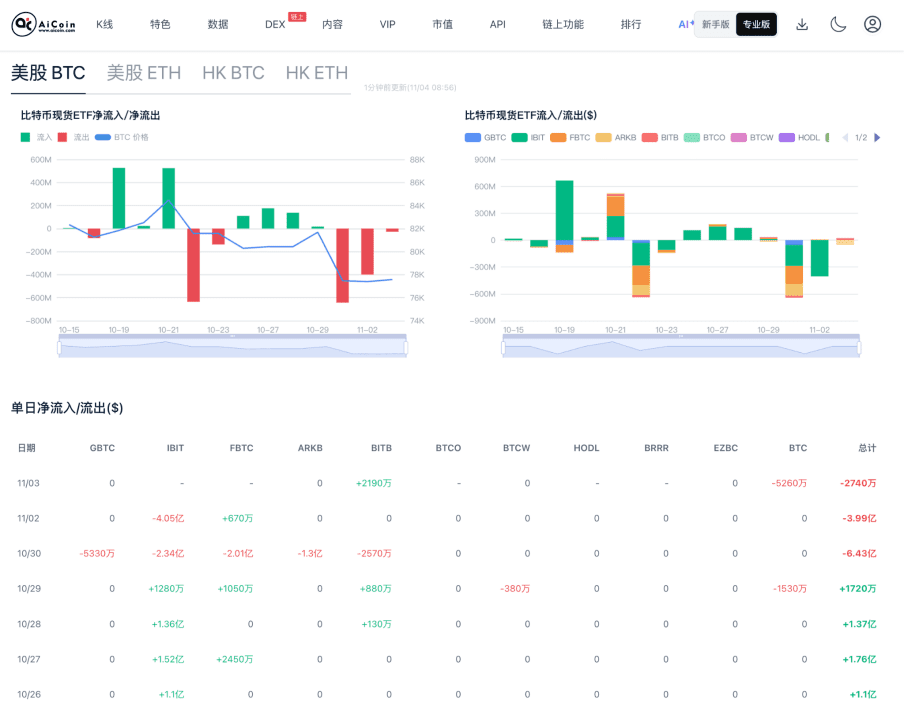
Let’s look at a set of ETF fund data:
From October 26 to 29, the cumulative net inflow of U.S. spot BTC ETFs was approximately 441 million dollars, but on October 30, there was a net outflow of approximately 643 million dollars in a single day, a scale that even surpassed the total inflow of the previous four days.
Data source: https://www.aicoin.com/zh-Hans/web3-etf/us-btc
From this, it can be seen that institutional buying power is currently unstable.
The flow of ETF funds can help us gauge the change in traditional market investors' demand for BTC, but single large outflows are not sufficient to determine that long-term funds are withdrawing from this track.
At the same time, the results of the elections could also influence the pace of advancing legislation related to the crypto industry.
If tech stocks in the U.S. continue to weaken, the overall risk appetite of the market will also be suppressed.
With multiple factors stacked together, it’s not hard to understand why many funds choose to remain on the sidelines.
Therefore, when we look at the market, we cannot just focus on whether BTC's price rebounds, but also need to pay attention to whether there is funding support for this rebound.
I will focus on three signals:
The market's feedback after the election outcome, whether regulatory expectations will change, and whether risk assets will receive a boost;
The direction of U.S. stocks and the dollar, whether tech stocks can stabilize, and whether the dollar and U.S. Treasury yields will continue to press the market;
The trend of actual buying for BTC, whether ETF funds can turn into net inflows again, and whether there’s sustained buying power when prices decline.
Looking back at past market records
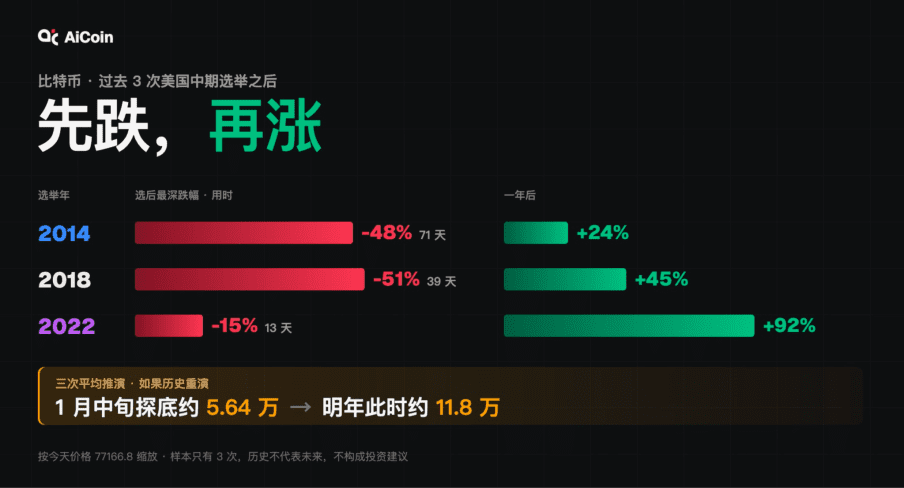
Before and after the 2018 and 2022 midterm elections, BTC experienced a noticeable decline. However, during those two time points, the market was respectively in a crypto bear market and a U.S. Federal Reserve rate hike cycle, so it cannot be simply concluded that the decline was solely due to the elections. Historical trends can only serve as a reference, and should not be directly applied to current market predictions. The predictions of subsequent prices in the chart are merely scenario simulations and should not be taken as conclusions.
Returning to the arrangement of funds, if you currently have no clear buying plan, is there a need to pour all 100,000 USDT into the market?
Personally, I prefer to manage the funds separately.
Keep the portion that is always ready for trading in the account, and consider putting the funds that are definitely not needed in the short term into flexible products. This way, when opportunities arise in the market, the money can still be adjusted flexibly; when the market is in turbulence with no direction, idle funds can still earn some income.
Let's first look at the situation on Binance.
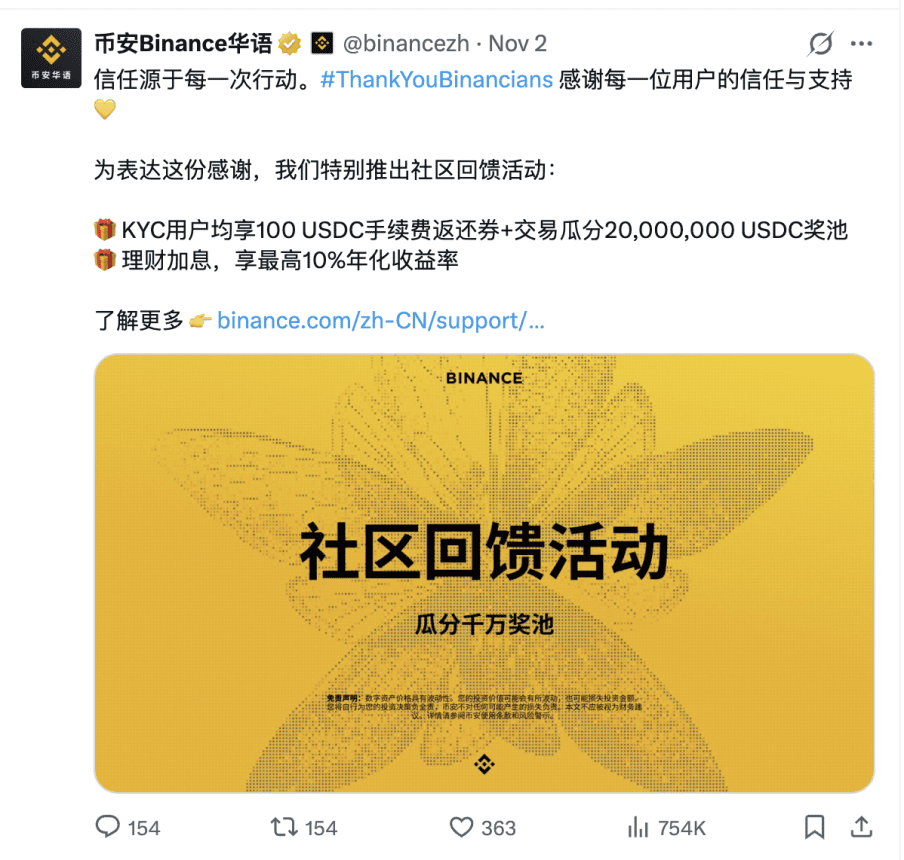
Binance's recent promotion claims a maximum of 10% APR, covering USDT, USDC wealth management interest rate promotions, as well as products like RWUSD and BFUSD.
 When looking solely at USDT flexibility, it is important to pay attention to the limits.
At that time, the basic APR for USDT was around 3%, and the additional 8% incentive provided by the activity only applied to the first 1,000 USDT.
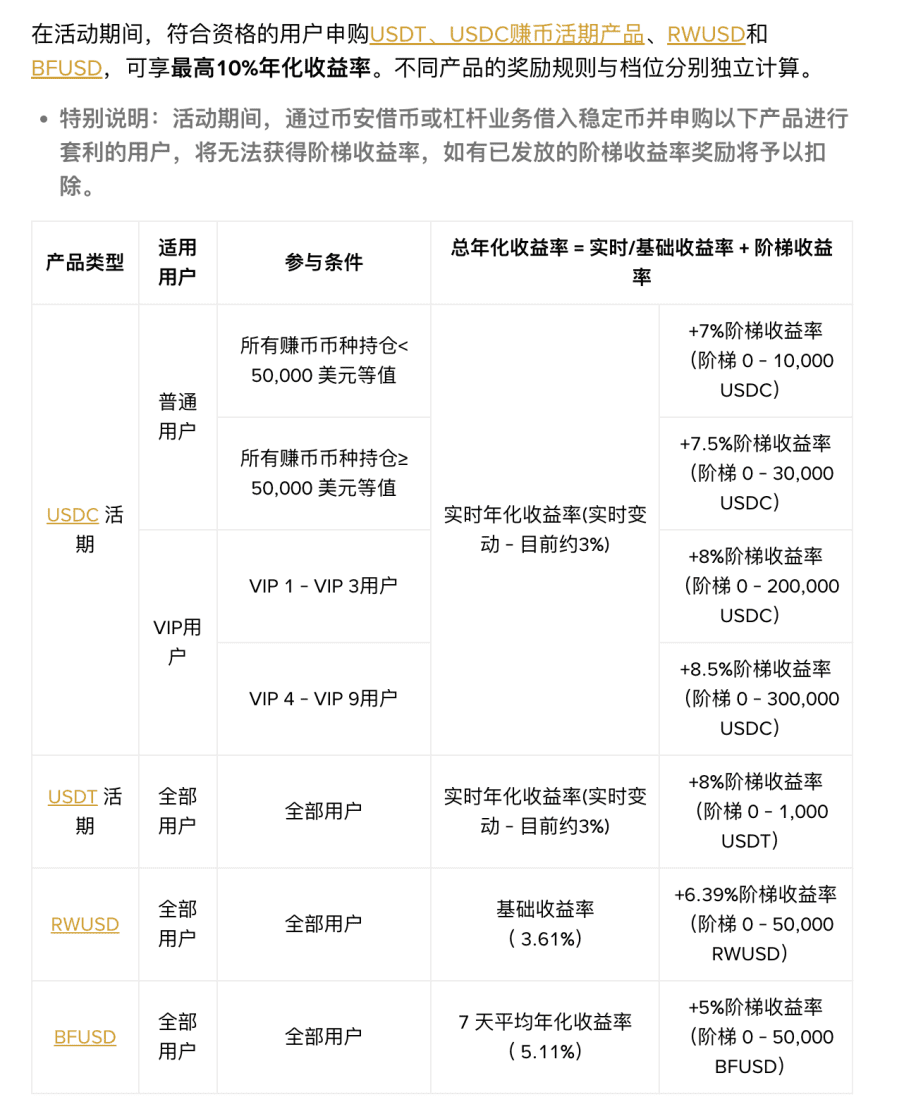
In a scenario involving 100,000 USDT:
The first 1,000 USDT combined with the basic interest rate and activity reward would yield approximately 11%;
The remaining 99,000 USDT could only earn interest at approximately 3% basic APR.
When participating with USDC, the rules are different.
The basic APR for USDC is also around 3%, and accounts that meet the activity qualifications can stack limited-time rewards, with the maximum advertised annualized rate being about 10%.

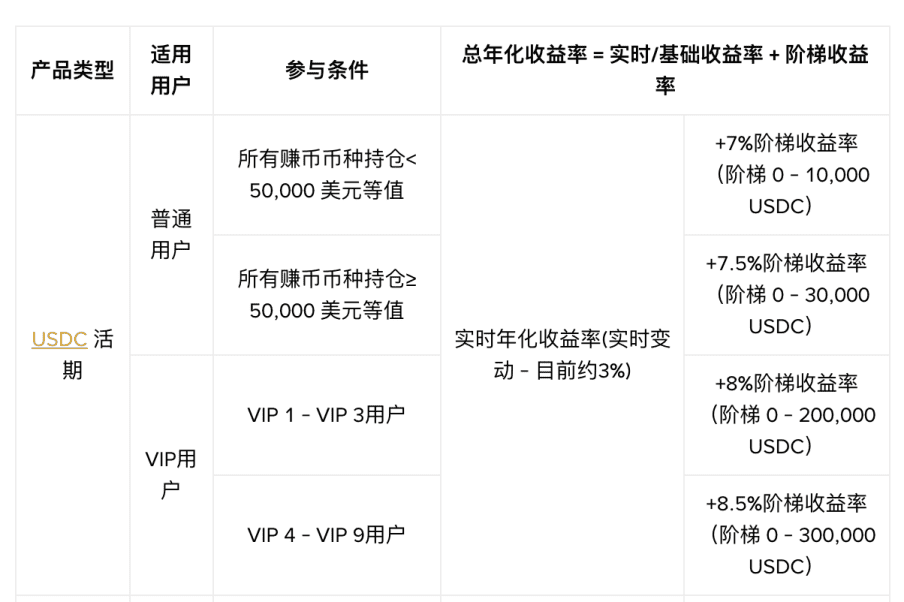
However, the additional rewards have quotas and limits; different account levels and qualifications can result in different benefits, and one should not assume that all USDC will qualify for the highest interest rate. The tier levels on Binance's page will differentiate the holding thresholds. When a regular user's total wealth management assets are below $50,000, the first 10,000 USDC receives an additional 7%; when reaching the $50,000 tier, the first 30,000 USDC gets an additional 7.5%; for VIP levels 1-3, the first 200,000 USDC earns 8%; and for VIP levels 4-9, the first 300,000 USDC gets 8.5%. My calculation using the first 1,000 USDC for 10% is a simplified assumption and does not equal the actual tiers on the page.
If you primarily trade on Binance, simply checking the USDC flexibility and remaining interest rate limits within your account will save you a lot of trouble in managing funds.
Next, let’s look at Bitget, where the 100,000 USDT can fit entirely within the limits of this promotional activity.
Bitget's activity rules are quite straightforward.
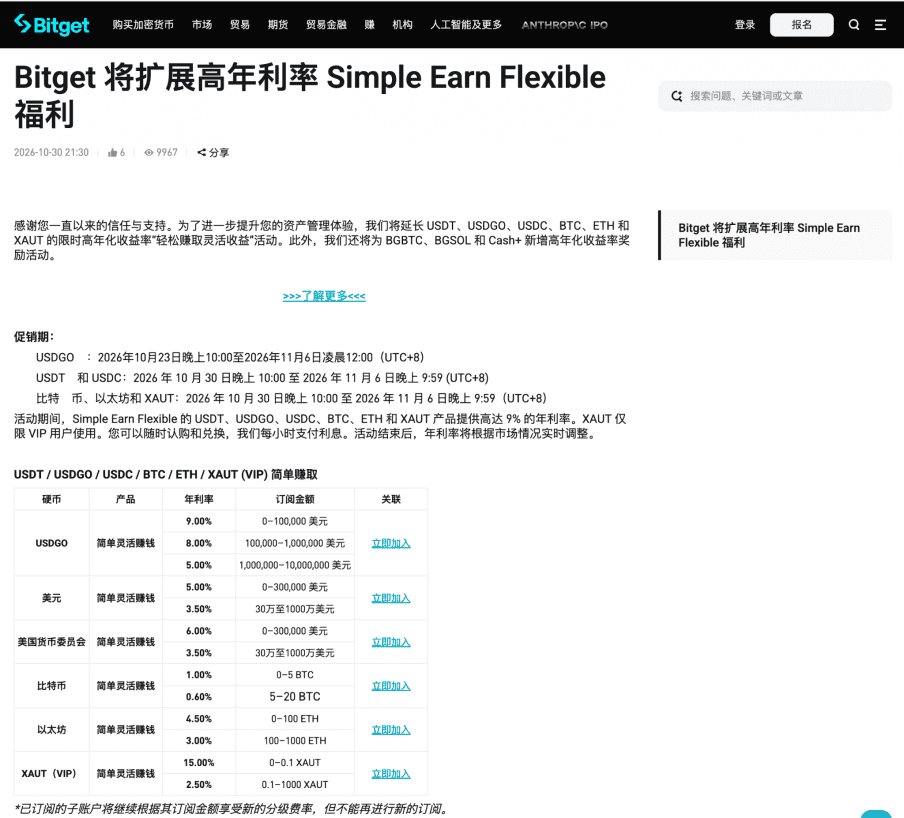
The announcement released on October 30 clearly states the rules during the activity period:
The first 300,000 USDT earns 5% APR;
The first 300,000 USDC earns 6% APR;
Amounts exceeding 300,000 will earn 3.5% APR.
These products are flexible, allowing for easy redemption, and interest is paid out hourly.
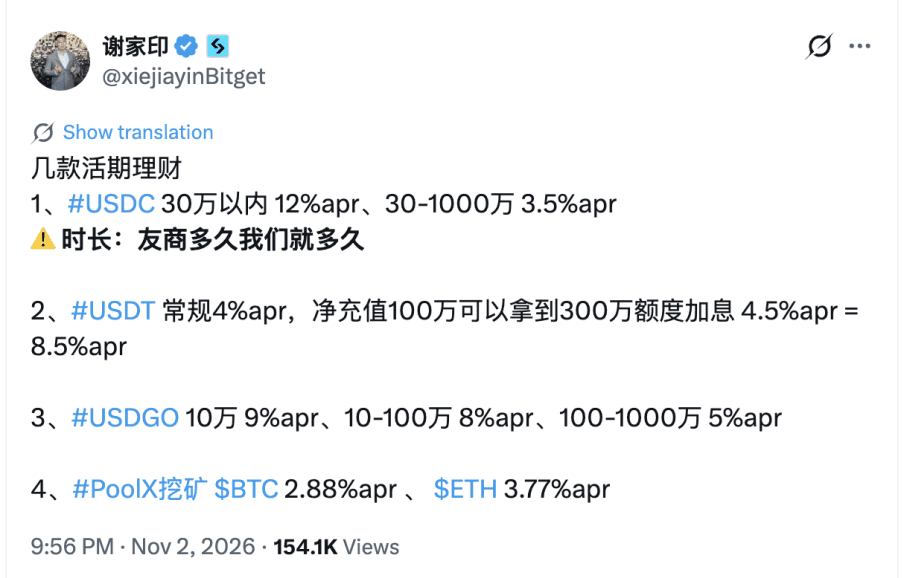
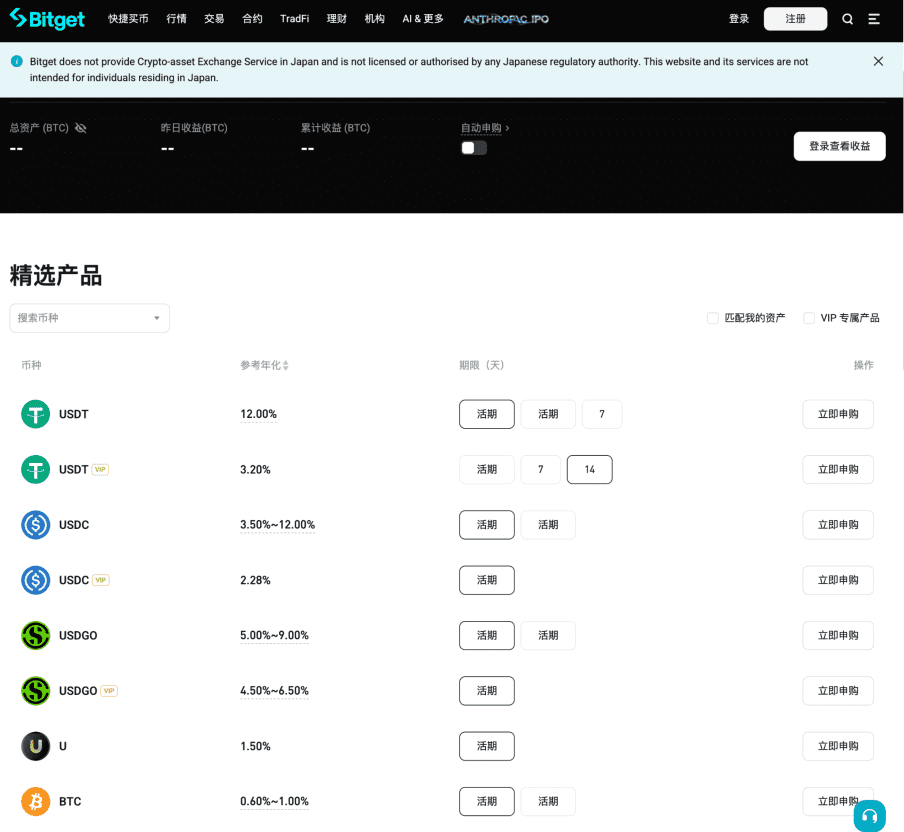
Online, you can also find promotions from Bitget claiming up to 12% annualized for USDC.
This 12% should be kept in mind, but the highest rate needs to be verified for applicable conditions; it does not mean that everyone and every holding amount can enjoy it. Ultimately, eligibility will depend on what your account product page shows. These rules are aligned with the live broadcast illustrations, but actual participation relies on the account page on that day.
Also, take note of the activity time; the current activity will end on November 6 at 21:59 (UTC+8), and the APR may adjust after the activity deadline. It is important to differentiate clearly that the 6% comes from an old announcement on October 30, while the 12% was released on November 2; as the release timings differ, so too may the applicable conditions, and they should not be mixed.
If you hold USDT and want to place a portion of funds that won't be used in the short term, Bitget's current activity is worth comparing.
Now looking at OKX, the model differs greatly from the previous two platforms.
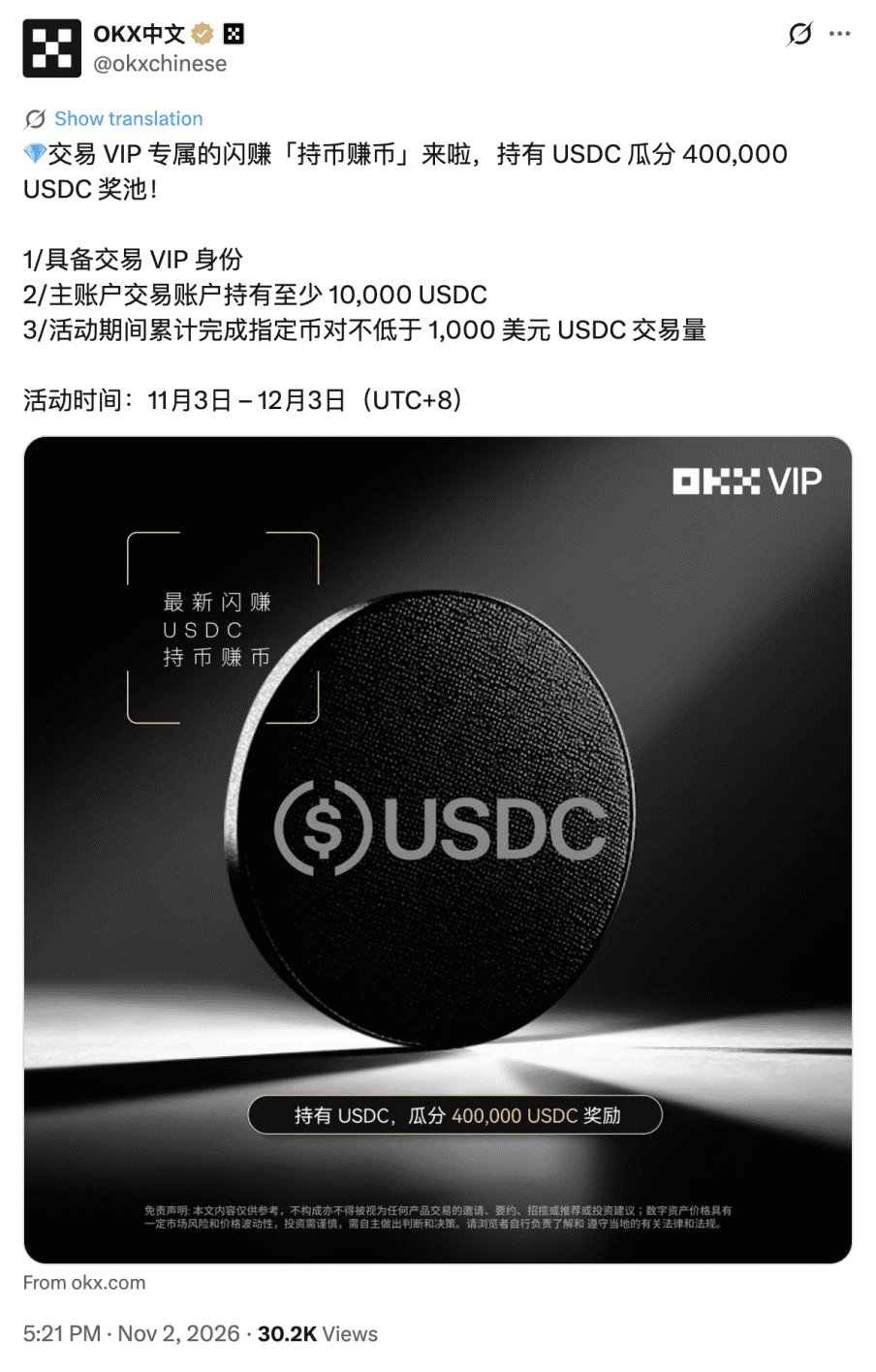
It does not provide a fixed annualized interest rate but instead offers a reward pool of 400,000 USDC, where qualifying users share the prize based on their qualifying holdings.
To participate, you must meet several criteria:
Hold at least 10,000 USDC daily, with reward shares calculated based on a maximum of 100,000 USDC;
Have a Trading VIP status achieved through meeting trading volume requirements;
Complete at least $1,000 of designated USDC transactions during the activity cycle;
Manually enter the Flash Earn's Hold to Earn page to register.
Simply holding USDC will not automatically qualify you for rewards, and the final earnings are uncertain, depending on the number of participants and their holding sizes.
If you happen to meet the participation criteria and also have a need for USDC trading, you can seek more information; but there’s no need to artificially increase trading volume just to get rewards.
Let’s do some calculations, converting the same 100,000 USDT into equivalent USDC to participate in each activity and see how much the earnings differ.
To clarify the premise: there will be price discrepancies and fees when actually converting to USDC, and the following will use the currently noted APR for annualized conversions, facilitating horizontal comparisons, not representing
The assurance of earning these returns throughout the activity period does not mean it can sustain a whole year.
Binance
Assuming the account meets the criteria to participate in the activity, using the previous simplified calculation method:
The first 1,000 USDC estimated at about 10% APR results in roughly 100 USDC for one year;
The remaining 99,000 USDC estimated at about 3% APR yields approximately 2,970 USDC for one year.
In total, about 3,070 USDC for the year, with a comprehensive annualized return of about 3.07%. Again, this is a simplified calculation and does not match the actual tier rules listed on the product page, and should not be seen as the actual return received in the account.
For Bitget, all 100,000 USDC fit within the limits of the activity, simply annualizing at 6% APR:
100,000 × 6% = 6,000 USDC / year
The activity only lasts until November 6, and the interest rate may change, so 6% cannot be treated as a fixed long-term return.
OKX uses a floating distribution model for its prize pool, so it cannot directly apply a fixed APR to estimate returns, and the final rewards depend on the proportion of qualifying holdings at that time.
Currently, there are live broadcasts every day; feel free to continuously follow the AiCoin partners! Pre-register here👇
https://www.aicoin.com/zh-Hans/live/list?tab=upcoming
Join our community to discuss and grow stronger together!
Official Telegram community:
AiCoin Chinese Twitter:
Hype rebates:
https://app.hyperliquid.xyz/join/AICOIN88
Binance rebates [Invitation code: aicoin668]:
https://jump.do/zh-Hans/xlink-proxy?id=3
Coinbase rebates [Invitation code: Y8L23JL]:
https://jump.do/xlink?checkProxy=true&proxyId=25
Now, looking at the data from the three platforms side by side
Comparing all aspects, each platform serves different scenarios
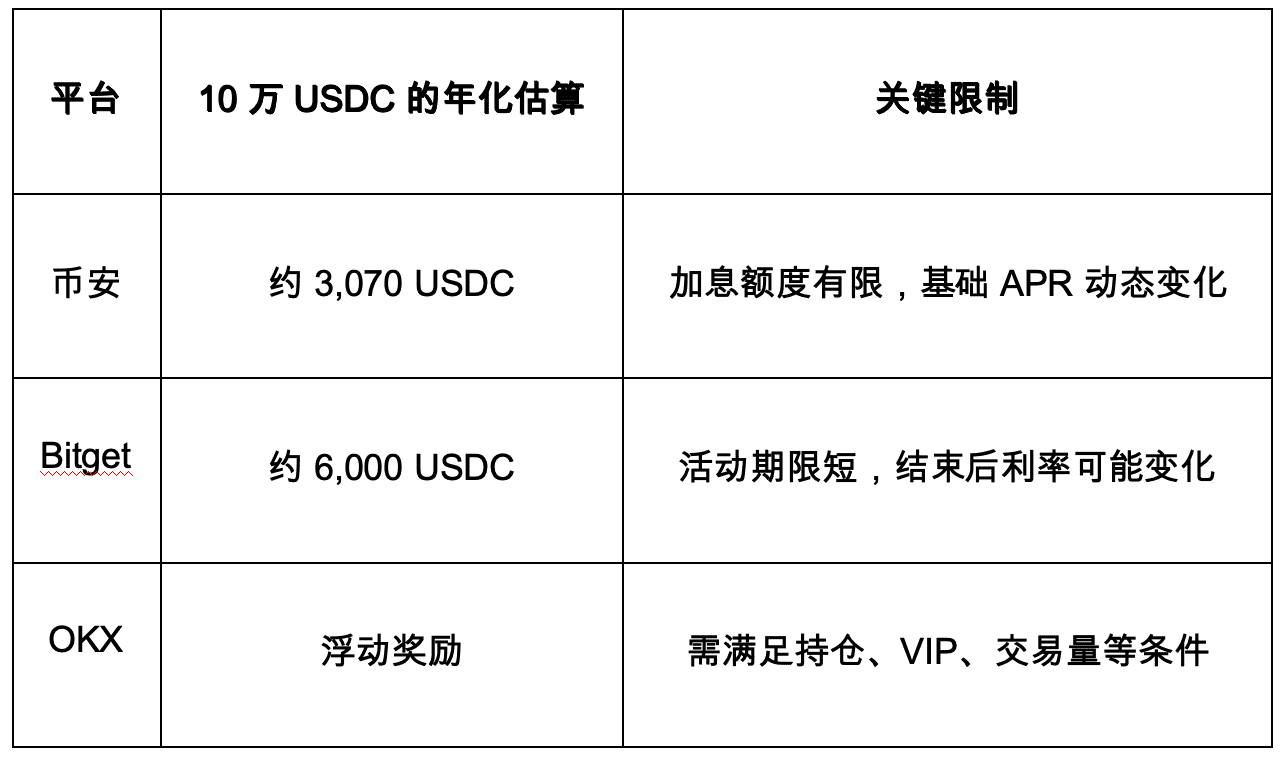
If you want to compare fixed interest promotional rates and limits, you can focus on Bitget;
If you meet the holding, VIP qualifications, and trading requirements, and are willing to accept variable returns, you can learn about OKX's prize pool activity;
If daily trading is mainly on Binance and you value the convenience of centralized fund management, consider Binance's flexible wealth management.
Before participating, it's important to reiterate that stablecoin wealth management can also pose risks of de-pegging and platform failures; make sure to carefully verify your account's activity limits, validity periods, eligibility for participation, and redemption rules beforehand.
While utilizing idle funds, also leave yourself enough room to respond to market fluctuations.
免责声明:本文章仅代表作者个人观点,不代表本平台的立场和观点。本文章仅供信息分享,不构成对任何人的任何投资建议。用户与作者之间的任何争议,与本平台无关。如网页中刊载的文章或图片涉及侵权,请提供相关的权利证明和身份证明发送邮件到support@aicoin.com,本平台相关工作人员将会进行核查。