Today we return to the market on November 4, 2026. BTC once fell below $77,000, and those who have positions and cash on hand can't help but ponder: is this a chance, or is there still a test ahead? The prices and screenshots in the text correspond to that day.
My current thinking on BTC is to gradually add on dips.
If the pullback is deep, I would consider opening contracts. At the time, I tended to believe that the chance of an extreme drop might be decreasing, but this is just a judgment and cannot rule out further declines.
Slow down the pace and don’t rush to put all the funds in at once.
This round of declines feels different from before; each pullback's depth is narrowing. Earlier, when the market dropped suddenly, panic would spread immediately; now, seeing a drop does not cause much emotional fluctuation.
This week, there are important events to keep an eye on. The midterm elections are still counting votes, and the results will be hyped for several days. The information about the counting showed that the Democratic Party was temporarily in a leading position.
These are just observations of the election situation at that time; I am not verifying the official counting results here.
The circulating narrative is that some districts originally belonging to the Republican Party have shown signs of flipping, and there are claims that media like CNBC have marked the control of the House of Representatives as leaning towards the Democrats. The media affiliations and electoral judgments need to be verified against the original reports.
Everyone should set aside enough funds and gradually enter the market; there's no need to fear missing out.
I was more inclined to believe that the Democratic Party could take the House of Representatives; this is a personal prediction and cannot be taken as a result in advance.
The final complete results may take another day or two, as the vote counting progress in several key states will be slower.
Next, there are a batch of employment data to track:
I listed the ADP employment on Wednesday, initial unemployment claims on Thursday, and non-farm payrolls and unemployment rate on Friday. The original records noted 9:15, 9:30 but did not specify a time zone; these dates and times need to be checked against the official calendar, and cannot be directly considered as Beijing time reminders.
Let's also talk about the widely circulated Binance hack incident; the relevant details are all unverified information, and I am just整理ing the rumors circulating in the market at that time, which should not be solely relied upon for judgments.
I worry that rumors of such security incidents will slow down emotional recovery. At that time, it was even guessed that it might take about six months, but that was just my estimation and there is no fixed recovery period.
When the market surged to 82,000, the market sentiment was still very high. The circulating narrative referred to it as a large-scale hacker attack, with the amount around $6.3 billion; the amount and the incident itself have not been independently verified here.
The attack time was reported as October 29 at 20:05 UTC, which converts to around 4 AM Beijing time the next day.
The circulated attack process claims that the attackers first extracted small amounts of ETH from Tornado Cash as gas fees, then deployed a cleaning contract, rehearsed the EIP-7702 delegation and asset cleanup process in a test wallet, and the targets included assets like USDT and USDC.
The narrative I saw in the morning said that Binance’s internal personnel were compromised because malicious programs were implanted in the devices during the interview process.
After this incident, many people around me chose to observe temporarily and no longer frequently monitor the market, and many have a layer of concern about the security of exchange funds.
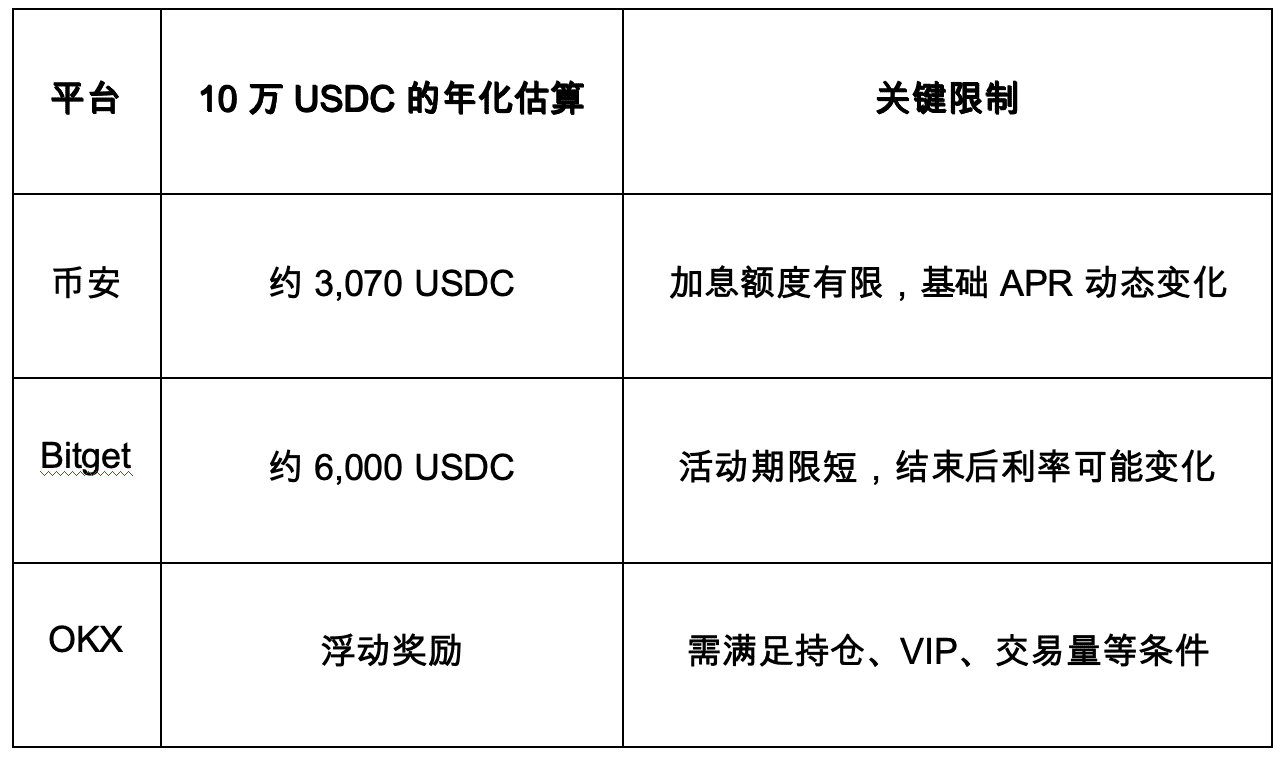
It can also be observed that major exchanges are now gradually launching wealth management activities, and the advertised annualized returns look attractive.
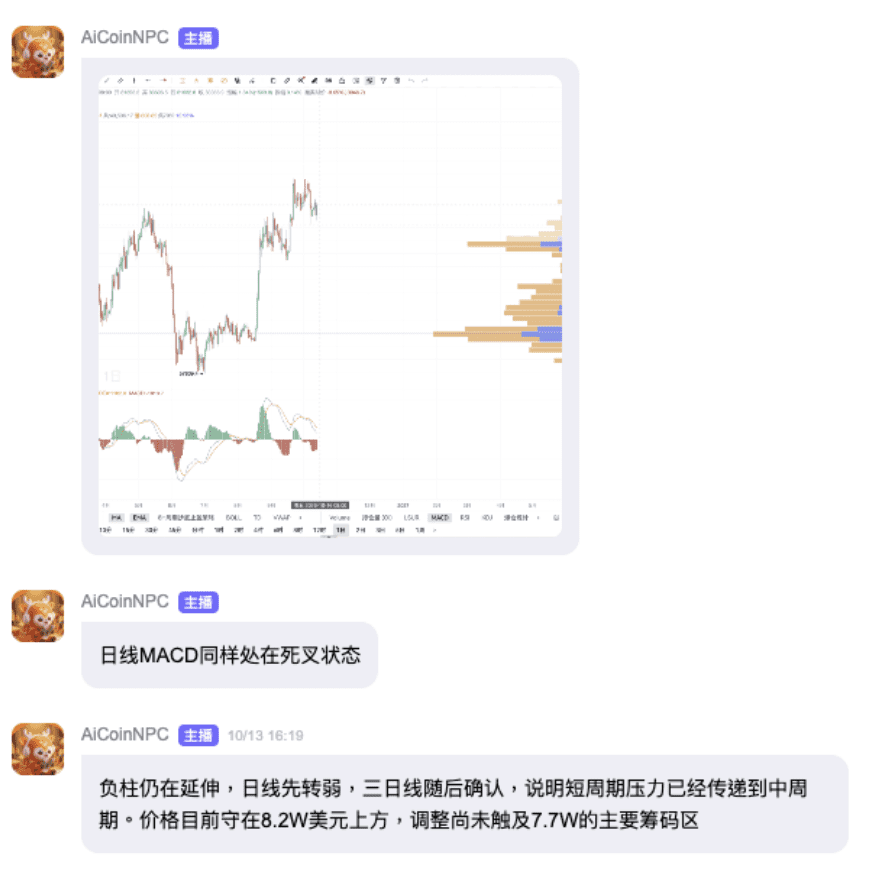
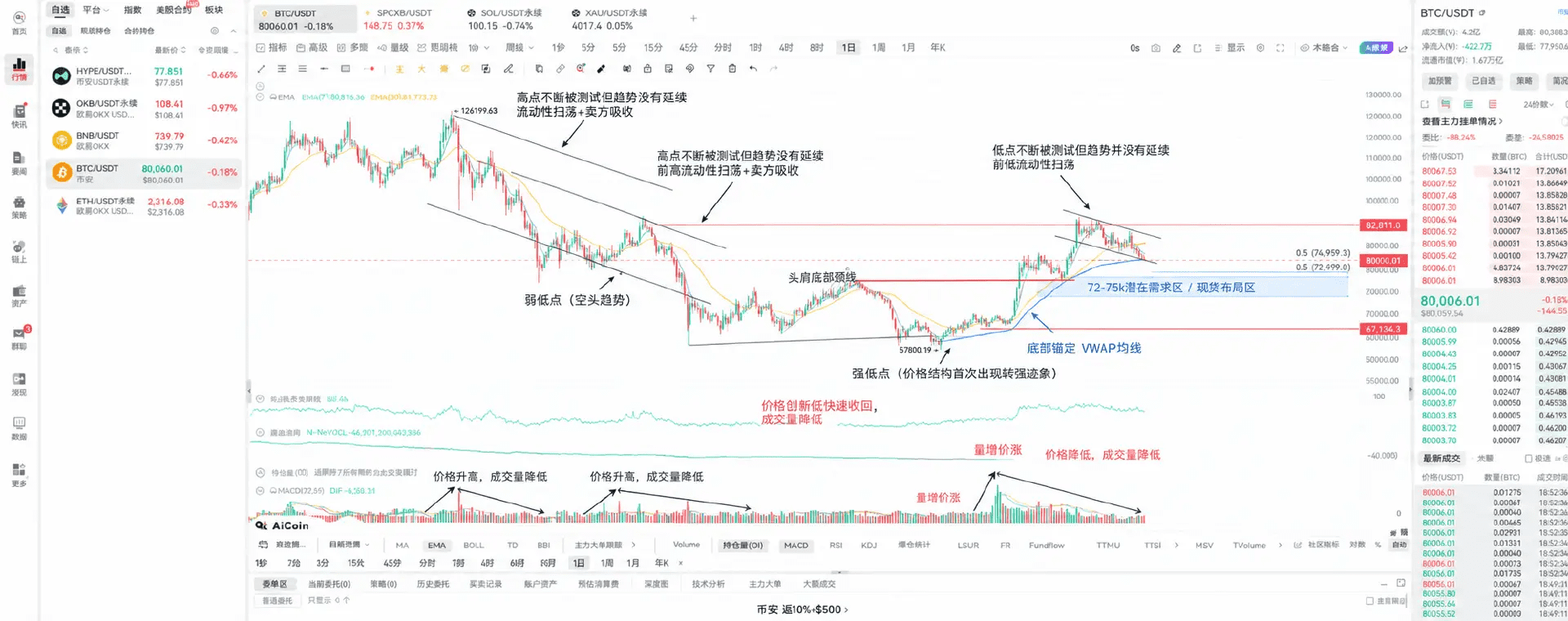
Last week, we were still discussing the 365-day moving average, which was around 78,500, along with the bull-bear conversion zone around 76,000.
The market directly broke below this range, with BTC falling to a low of around $75,725. At that time, the 365-day moving average was around $76,929, and the upper edge of the weekly bull market support was $76,719, with both support lines almost touching each other, but the price had dropped below the moving average.
Previously, everyone was worried about the risks of hardware wallets, and now the security issues of exchanges are back in focus.
The macro environment itself is weak, and the rumors of security incidents add another layer of unease. I fear these factors will collectively suppress risk appetite.
First, patiently observe the market's support strength; there’s no need to rush into the market.
For the positions already held, I was inclined to observe first and not hastily adjust due to a single bearish candlestick; this decision also depends on each person's position and risk tolerance.
At that time, the 128-day moving average was around $73,786, and the 200-day moving average was about $73,157, with BTC price still standing above these two averages.
I just spoke with a friend who mentioned the level of 72,000, which is quite close to the moving average support zone.
We should keep in mind two possible scenarios moving forward: if it breaks the support but can quickly recover, it indicates decent buying strength below; however, if it rebounds and then falls back under pressure near the moving averages, we need to be cautious that the original support may become resistance.
Even if it strengthens later, it might have to go through a lengthy process of chip turnover; it won’t take off instantly like flipping a switch. I won’t directly consider the current rebound as confirmation of a bull market.
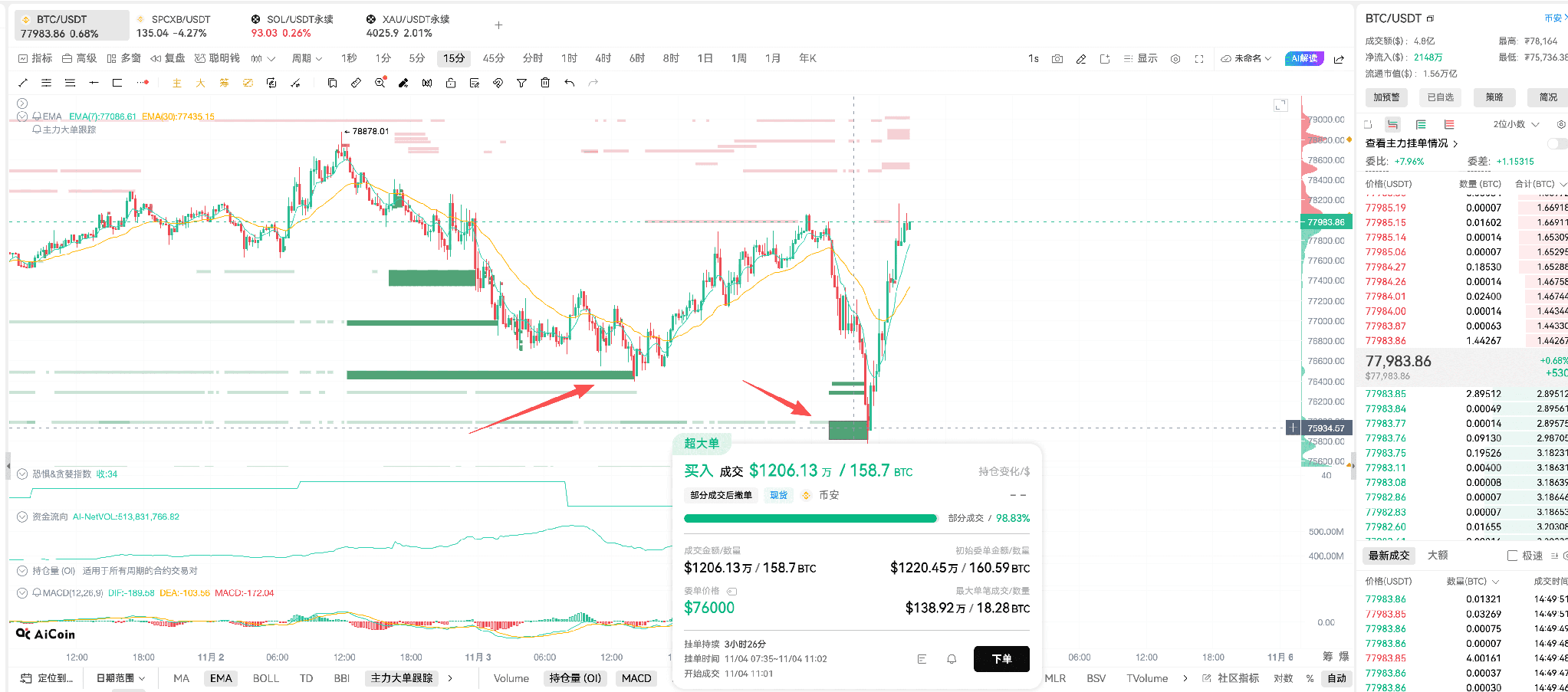
I just saw a large order being executed, with a transaction size reaching 12 million.
Such large orders and smart money flows can only be used as a reference dimension and cannot be directly used as trading basis.
The distribution of chip cost is not an unbreakable iron bottom; what determines the depth of pullback is not merely the support lines drawn on the candlestick chart, but the market sentiment hidden behind the chips, which carries greater weight.
Gold prices are around 4000, and I feel there are long opportunities in gold; I regret not waiting for the 3900 price level during live streaming earlier.
I recognize the logic of spot trading, and I will only consider contracts during black-swan-style sharp declines or deep pullbacks, but this does not mean that using leverage then is safer, as margin and liquidation risks cannot be overlooked.
Looking back at gold's previous trends, prices stabilized above 4200 before pulling back to around 3880.
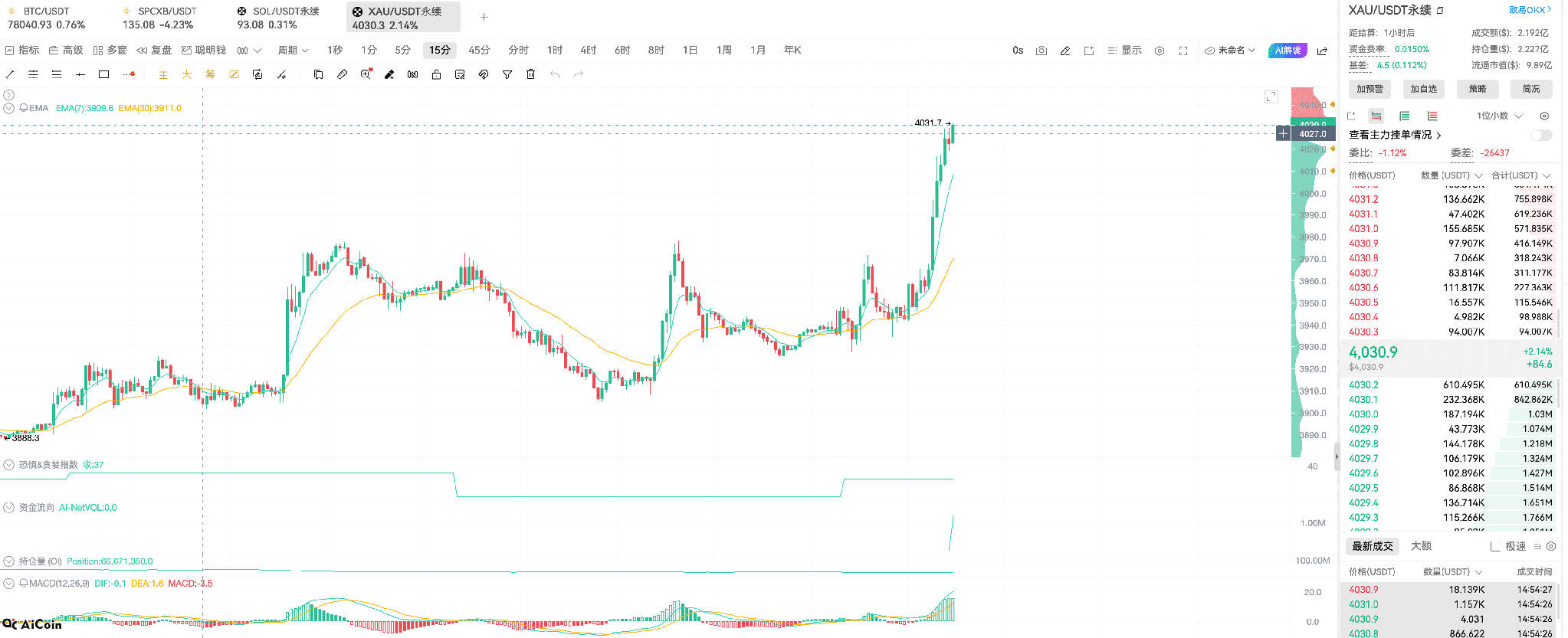
On the 2nd, I saw new news coming from Hong Kong, and the relevant content also falls under unverified information.
This news made me refocus on the tokenized gold direction in Hong Kong. Gold is the oldest store of value asset, and now, combined with technology, it is giving rise to a new form of digital assets in Hong Kong.
It is said that the Hong Kong Gold Exchange and CITIC Bank (International) have completed a pilot project under the Ensemble framework to support tokenized deposits for gold trading, enabling currency and gold transactions, with settlements completed in as fast as 5 minutes. It is planned for official commercialization in 2027, with traditional deposits and tokenized deposits running in parallel, supporting 24/7 instant settlement.
It was also because of this Hong Kong news that I allocated part of my gold at the two positions of 4000 and 3900; this is my personal allocation record at that time and cannot be used to prove that these price levels are suitable, nor can it be used to predict returns.
Other planning statements I saw at the time included the following, and whether they will be implemented still needs formal announcements to verify:
In 2026, a draft for regulatory amendments related to virtual assets is planned to be submitted to the Legislative Council;
In 2027, a Hong Kong Gold Central Clearing System is expected to be launched, and institutions like CITIC Bank (International) will offer commercialized tokenized deposit gold trading services, supporting 24/7 instant settlement;
The Monetary Authority anticipates at the Financial Technology 2030 conference that the rollout speed of tokenized applications will continue to accelerate.
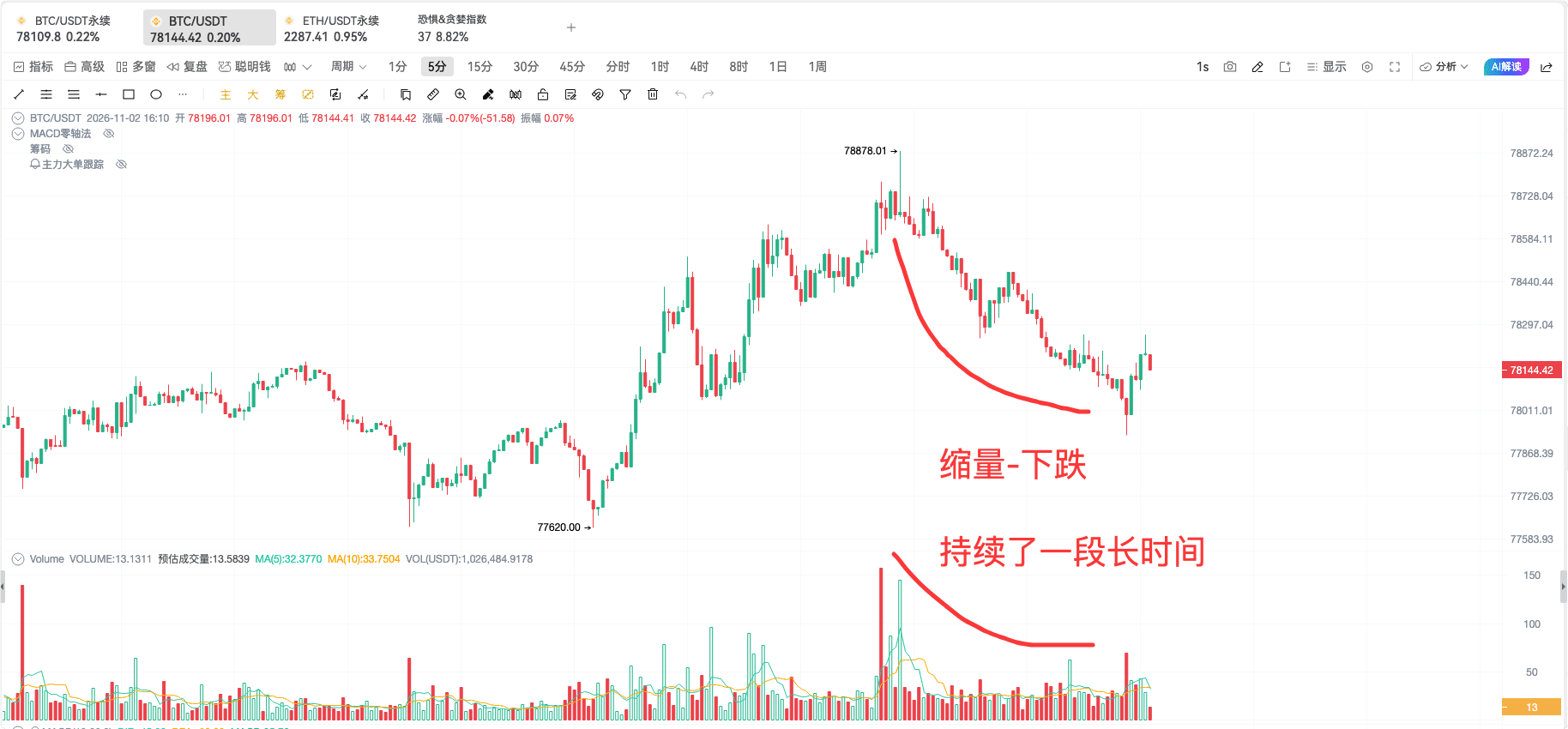
Back to Bitcoin, the market has recovered from the morning's decline, and the price has rebounded again. It feels like the market is about to embark on a new journey.
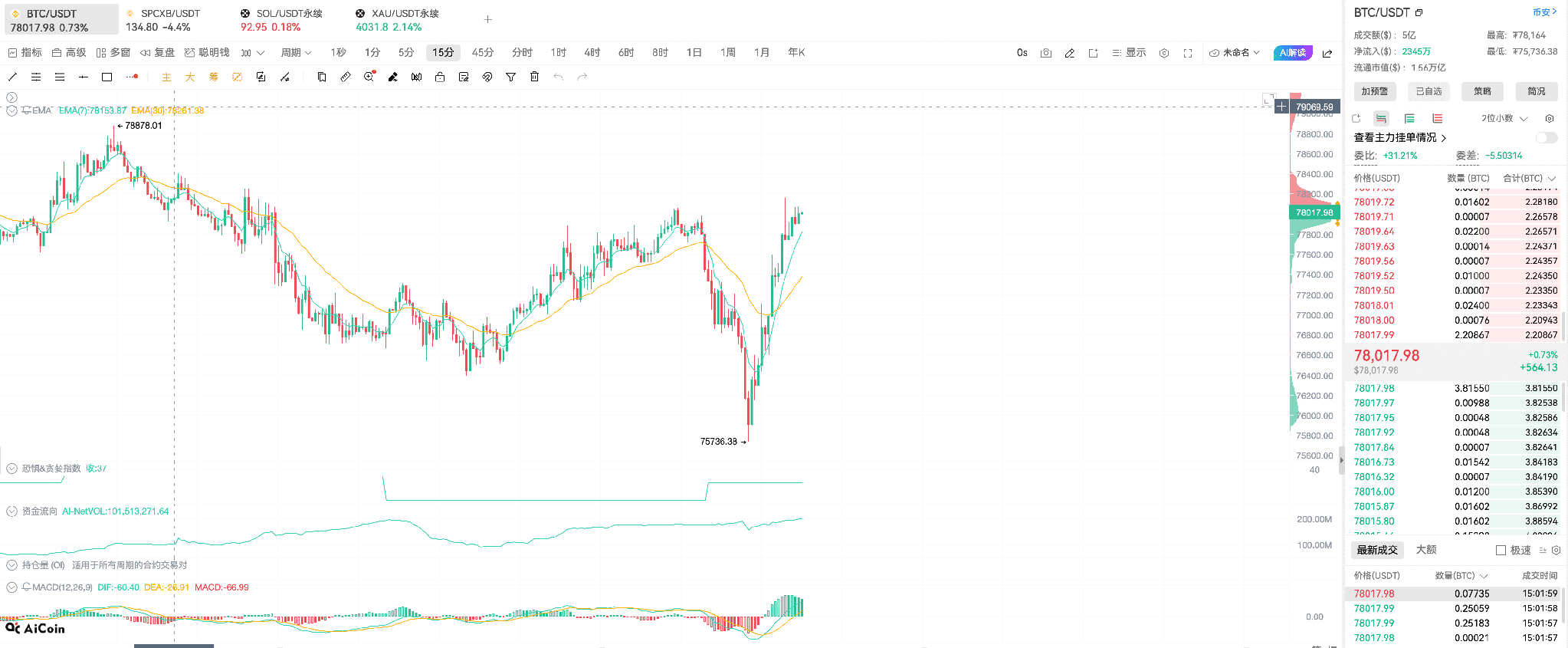
Overall, the market is oscillating back and forth in the range between 70,000 and 80,000. I prefer to arrange for spot and cash allocations in batches, rather than relying on leverage to chase every rise and fall. Even if the margin looks sufficient, it does not mean it can withstand all fluctuations.
If newcomers are not familiar with Binance's bStocks, they can take a look; I have not independently verified the product rules and rights, so everyone should consult the official explanations themselves.
According to the product introduction at the time, besides stock tokens corresponding to Apple, Nvidia, and Tesla, there are also tokenized products linked to ETFs like SPYB and QQQB. These do not equate to directly holding stocks or ETFs; rights, custody, and redemption arrangements need to be verified separately.
The introduction at the time stated that it supports 24-hour trading, with a minimum buy-in of around $5, and the ability to withdraw to a BNB Smart Chain wallet. These specific rules have not been independently verified here and need to be checked for regional eligibility and the product page.
I want to discuss the idea of diversified allocations, not to package stock tokens as stable investments.
SPYB benchmarks the SPDR S&P 500 ETF Trust, which corresponds to a broad exposure of around 500 large American companies, aiming to reduce bets on a single stock. However, it is still important to clarify what rights the specific tokens provide and how they track the underlying assets; they will also be subject to market declines and risks associated with the products themselves.
QQQB can serve as a supplementary option; its holdings lean more towards technology and growth sectors, with higher concentration.
If I have a bullish outlook on Nvidia or Tesla, I would rather allocate only 5% of the stock position to those stocks, rather than taking up my entire stock position with them.
SPYB is responsible for building the core of the US stocks, PAXG is for the gold position, while USDT and USDC are maintained separately in spot accounts and wealth management, to meet liquidity and appreciation needs respectively.
bStocks essentially provide a third allocation idea, bundling US stocks, gold, and US dollar assets into an on-chain asset portfolio.
Cross-asset allocation can disperse some risks but will not automatically stabilize returns; tokenized products also have an added layer of issuance and custody arrangements that need understanding.
If you agree with Bob Loukas’s cyclical analysis point of view—that BTC is relatively anti-fragile, currently seeking a 60-day cycle low—if you want to allocate to cryptocurrencies, you can focus on the following segments and targets that I observed to be relatively strong, the segment descriptions are solely my observations and do not represent statistical conclusions:
RWA — Traditional assets on the blockchain, a major line of interest for institutional compliance funds
LINK / ONDO / XAUT
Privacy — One of the hot sectors in 2026, with ongoing tightening of regulations, the demand for privacy-related assets still exists
ZEC / XMR / DASH
DeFi — Protocols with real transaction fee revenues have historically repaired faster during bottom phases
UNI / AAVE / HYPE
Mainstream L1 — Sound ecosystems and ample liquidity are the main targets for institutional capital
ETH / BNB / SOL
Last month, I shared a watchlist. The following image includes many riddles and mixed some listing expectations; just take a casual look; I won't decode it for you, nor will I take the listing time in the image as fact.
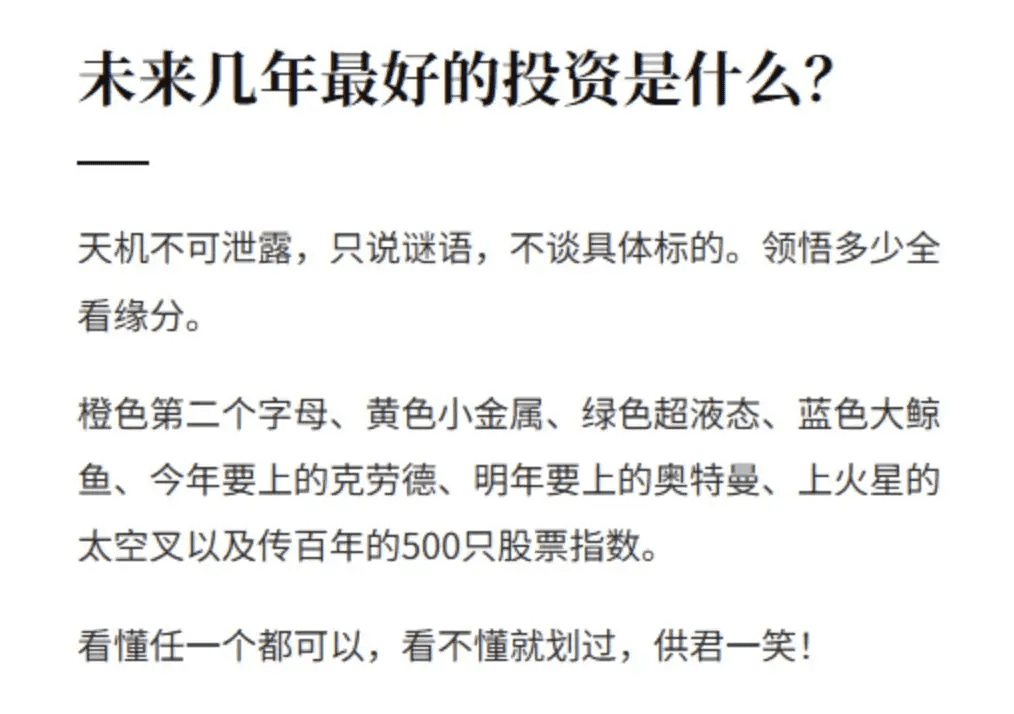
The crypto space is filled with diverse strategies, but the underlying logic of profit is not complicated.
It's easy to fall into a cognitive trap in this circle: seeing a project doing well and immediately determining that its token is worth buying; noticing the token's continuous rise and using that to justify that the project is high quality.
This is a place saturated with stories of instant wealth, and to maintain a long-term mindset, one must constantly remind oneself that the market's opportunities will never run dry.
Every time we miss an opportunity that seems within reach, when emotions rise, we inevitably feel disappointed, thinking we may never encounter an equal opportunity again; this is a form of shortsightedness, driven by emotions.
Currently, there are live broadcasts every day; feel free to keep following AiCoin fellows! Reserve a spot in advance 👇
https://www.aicoin.com/zh-Hans/live/list?tab=upcoming
Join our community to discuss and grow stronger together!
Official Telegram community:
AiCoin Chinese Twitter:
Hype Rebates:
https://app.hyperliquid.xyz/join/AICOIN88
Binance Rebates [Invitation Code: aicoin668]:
https://jump.do/zh-Hans/xlink-proxy?id=3
Coinbase Rebates [Invitation Code: Y8L23JL]:
https://jump.do/xlink?checkProxy=true&proxyId=25
免责声明:本文章仅代表作者个人观点,不代表本平台的立场和观点。本文章仅供信息分享,不构成对任何人的任何投资建议。用户与作者之间的任何争议,与本平台无关。如网页中刊载的文章或图片涉及侵权,请提供相关的权利证明和身份证明发送邮件到support@aicoin.com,本平台相关工作人员将会进行核查。