In an exclusive interview with Bloomberg, Hyperliquid co-founder Jeff Yan repeatedly emphasized: Hyperliquid is not an exchange, but the "underlying infrastructure layer that supports exchanges."

This statement may sound like a legal or regulatory expression at first glance, but when viewed in the context of DEX trading itself, it actually explains the most critical product trade-offs of Hyperliquid:
Hyperliquid is not building a web platform more akin to CEX, but is attempting to put the most core elements of an exchange—
the order book, margin, liquidation, and market deployment capabilities—into a verifiable, reusable blockchain system.
This is why traditional markets view Hyperliquid as a competitor on one hand, while starting to explore how to use its infrastructure on the other.
For ordinary traders, what truly deserves attention is not the grand judgement of "Will DEX replace CEX?" but a more practical question:
When trading shifts from platform accounts to on-chain addresses, how does the trading experience actually change? Are these changes sufficient to offset the risks users must take on themselves?
1. The core change of DEX trading is not "withdrawing coins to a wallet"
Many people's understanding of DEX still revolves around "connecting wallets and exchanging tokens." This model suits simple spot exchanges but cannot explain why Hyperliquid can support large-scale perpetual trading and RWA markets.
Hyperliquid officially positions itself as a transparent, open, high-performance blockchain infrastructure catering to financial applications. The official documentation likens it to a liquidity infrastructure for financial applications, emphasizing that trading, lending, stablecoins, and perpetual contract markets can all be built on it.
This means DEX trading in the Hyperliquid model at least includes three layers:
The first layer is user-controlled assets and account permissions.
The second layer is on-chain order books and matching status.
The third layer includes markets, trading terminals, and financial applications that can be deployed by various teams.
Traditional CEX usually combines these three layers within a single company: the platform controls the account system, maintains the matching engine, determines which markets to list, and users complete transactions through the platform's interface.
Hyperliquid attempts to separate them: the underlying protocol handles trading status and market infrastructure, users participate through addresses and signatures, and third parties can build applications or markets on top of this infrastructure.
This is not simply "putting CEX on-chain." It is more like breaking down the part originally completed by a company's backend into publicly verifiable protocol states and composable application layers.
2. Why Hyperliquid did not choose the simplest AMM route
The easiest trading method for DEX to popularize in its early days was the automated market maker, or AMM.
The advantage of AMM is its simplicity and openness; anyone can provide assets to a liquidity pool, and users can directly complete exchanges. However, for high-leverage perpetual trading, AMM is not always suitable: it needs to handle continuous quoting, depth, liquidation, funding rates, and bad debts in extreme market conditions.
Hyperliquid chose an order book model that is closer to traditional exchanges.
The advantage of an order book is that the quotes and depth from buyers and sellers are clearer. Traders can use limit orders, stop-loss orders, or market orders, and market makers can manage their quotes and inventory more precisely.
However, the order book model has significantly higher infrastructure requirements. It not only needs to record user balances but also to handle matching orders, margin, positions, liquidation, and market data amid high-frequency order changes.
Hyperliquid's official documentation describes HyperCore as a core execution environment that includes spot, perpetual order books, and margin status.
Jeff Yan previously compared Hyperliquid to "a layer that can deploy exchanges," which is fundamentally because this layer not only provides an exchange pool but also offers a more complete set of trading market primitives.
This is also the most significant difference between Hyperliquid and many DEXs that "allow trading by simply connecting wallets":
It does not simplify trading to a one-time asset exchange, but seeks to retain the professional structure of an exchange on-chain.
3. Users gain stronger control but also take on more operational responsibility
DEX trading is often marketed as "users truly own their assets." This statement is not incorrect in direction, but it is incomplete.
In centralized exchanges, users' assets typically manifest as account balances in the platform's database. The platform can freeze withdrawals, modify risk control parameters, restrict accounts, or require re-verification of identity. Users gain convenience but need to trust that the platform can accurately record their assets and complete withdrawals when needed.
In a non-custodial trading model, users participate in trading through addresses and signatures, and the underlying system does not need to retain users' withdrawal permissions for the long term. This reduces the risk of a single platform misappropriating funds or centralized custody failing, but simultaneously places more responsibility on users:
- If private keys or signing permissions are leaked, the platform may not be able to recover assets for users;
- Signing incorrect authorizations could lead to direct losses;
- If the frontend is spoofed or poisoned, the on-chain execution may still be legitimately occurring;
- Wallets, cross-chain bridges, stablecoin issuers, and third-party custody still have their own risks;
- Liquidation of perpetual positions, funding rates, and slippage do not disappear just because trading occurs on-chain.
Therefore, the core value of DEX is not "no risks," but rather changing the distribution of risks.
Users reduce their reliance on a single custodial platform but increase their responsibility for wallet security, signature judgment, contractual interactions, and position management.
This also explains why data analysis tools are very important. Users should not only look at "this is a DEX," but also need to know which frontend they are connected to, what type of market they are trading in, what the margin model for positions is, where the prices are sourced from, and whether the current liquidity is sufficient to handle the scale of their trades.
4. The trading experience of Hyperliquid is key to "like CEX, but not fully dependent on CEX"
Hyperliquid's ability to attract a large number of traders is not because users are willing to sacrifice all trading experiences for decentralization.
On the contrary, its product philosophy is to retain the elements that professional traders are familiar with: order books, markets, limit orders, perpetual contracts, leverage, and real-time position management; while minimizing users' reliance on traditional platforms' internal ledgers and withdrawal processes.
This creates a very unique DEX experience:
It is close to CEX in terms of interface and trading logic, while differing from CEX in asset control and on-chain verifiability.
For many users, the real motivation for the shift is not ideology, but several very practical trading concerns:
- Can accounts trade around the clock?
- Can the market quickly list new assets?
- Can trading and clearing statuses be publicly verified?
- Can large positions and market data be directly observed?
- Is it necessary to keep funds long-term in a single platform account?
- Can different markets be managed under the same margin system?
Hyperliquid has evolved from a niche platform primarily focused on perpetual contracts to a market for proxy contracts for real-world assets such as stocks and gold; the revenue over the past 12 months reached $713 million.
Here, "proxy contracts" needs to be accurately understood. They provide exposure to the prices of corresponding assets but do not equate to holding actual stocks, gold, or crude oil, nor do they automatically include dividends, voting rights, or physical delivery rights.
However, from a trading perspective, users can observe these markets within the same type of on-chain order book, manage margins, and express directional views. This unified experience represents the portion traditionally segmented by different exchanges, brokers, clearinghouses, and trading periods in conventional markets.
5. What RWA trading truly changes is trading time and market boundaries
Hyperliquid's RWA market is not simply "putting stock names on-chain."
Its greater change is liberating trading time from the workdays and trading hours of traditional markets.
The trading volume of real-world assets on Hyperliquid has nearly matched that of native crypto assets; in just July 2026, RWA trading volume exceeded $115 billion.
During the conflict in Iran this February, while the traditional crude oil market was closed, crude oil perpetual contracts on Hyperliquid were still tradable, with daily transaction volumes rapidly increasing to several billion dollars.
Such scenarios illustrate that on-chain perpetual trading does not only serve cryptocurrency speculators. When geopolitical risks occur over weekends, traditional markets are closed, or traders from different global regions need to manage risks in real-time, a 24/7 market will naturally create demand.
But we must also recognize that these products are derivatives of prices of crude oil, gold, or stocks, not the underlying assets themselves. They address issues of price exposure and trading time, not inventory, delivery, corporate governance, and securities registration issues.
In other words, Hyperliquid provides a new trading entry point, not simply moving the entire traditional asset ownership system onto the blockchain.
6. HIP-3 turns "Who will build the market" into an open question
One of the features that best embodies Hyperliquid's infrastructure positioning is HIP-3.
Official documentation shows that HIP-3 allows deployers to create their own perpetual DEX. Deployers are responsible for defining the market, including oracle and contract specifications; they also oversee market operations, including oracle pricing, leverage limits, and necessary market settlements.
Each HIP-3 DEX has independent margins, order books, and deployer settings.
This represents a significant change: the market is no longer completely determined by the underlying protocol team.
In the past, what users could trade largely depended on what centralized exchanges or platform operators decided to list. HIP-3 allows qualifying deployers to build products around new assets and markets.
This is crucial for RWA. Different teams can design their own markets tailored to stock indices, precious metals, energy, forex, or other data sources without waiting for a central platform to audit one by one and take on full product operational responsibilities.
But open deployment also means responsibilities are redistributed.
Deployers need to carefully handle oracle quality, leverage settings, abnormal market conditions, and market settlements. Users cannot assume that all HIP-3 markets have the same liquidity, price quality, and risk control capabilities just because the trading interface looks similar to Hyperliquid's native market.
This is also one of the largest cognitive differences between DEX trading and traditional CEX trading:
Traditional platforms concentrate market selection and risk responsibility on the operator; open protocols entrust more market innovation opportunities to deployers, while also placing the task of identifying risks on users.
7. Jeff Yan's choice of "not financing" and its relevance to DEX trading
Hyperliquid has not relied on traditional VC funding; Jeff Yan believes a neutral technology layer should not have privileged internal investors.
This is not just a simple startup story but relates to the product positioning of DEX.
If a trading platform is held by numerous early investors, those investors typically care about token release schedules, revenue distribution, listing arrangements, and exit timelines. The platform must coordinate interests among users, market makers, investors, and teams.
Hyperliquid, by choosing to self-fund and adopt a more restrained organizational structure, tries to focus on underlying technology and market utilization. It aims to make the protocol closer to a neutral infrastructure rather than a financial application controlled by an investment group.
This certainly does not mean it is free from conflicts of interest, nor does it imply that an anonymous team, protocol governance, and token distribution don’t need scrutiny.
The real benefit it brings is a more consistent narrative for the "infrastructure layer" positioning: first allowing markets and applications to operate at the underlying level, and then enabling different teams to build products around it, rather than designing the commercial boundaries of the platform according to financing stages.
8. DEX will not simply replace CEX; rather, it may become the underlying supplier for CEX
Jeff Yan describes Hyperliquid as "a layer that supports exchanges," which has another practical implication: DEX and CEX do not necessarily have to be an either/or choice.
The advantages of traditional exchanges still exist: fiat entry, customer service, compliance identity, brokerage systems, clearing networks, and institutional relationships are all parts that pure protocols cannot achieve independently.
The advantages of DEX lie in: on-chain verifiability, round-the-clock openness, more flexible market deployment, asset and application composability, allowing users not to have to entrust all their funds long-term to a single platform.
The more likely structure to emerge in the future is not that all users leave CEX for DEX, but that different institutions use on-chain infrastructure at different layers:
- Regulatory bodies responsible for customer access and compliance;
- Brokers responsible for distribution and account relationships;
- Market deployers responsible for products and oracles;
- Hyperliquid providing underlying capabilities like order books, margins, and clearing;
- Trading terminals responsible for converting complex data into interfaces users can understand.
The previous announcement by ICE and TradeXYZ to bring a Hyperliquid-based perpetual market to the US exemplifies this layered structure.
Therefore, the most important competitive advantage of DEX may not be "ensuring users never interact with centralized platforms," but rather allowing centralized platforms to no longer have exclusive rights over all critical capabilities.
9. How should ordinary traders understand this change
For ordinary users, the value of Hyperliquid lies not in chasing the term "DEX," but in whether trading decisions can become more transparent, timely, and verifiable.
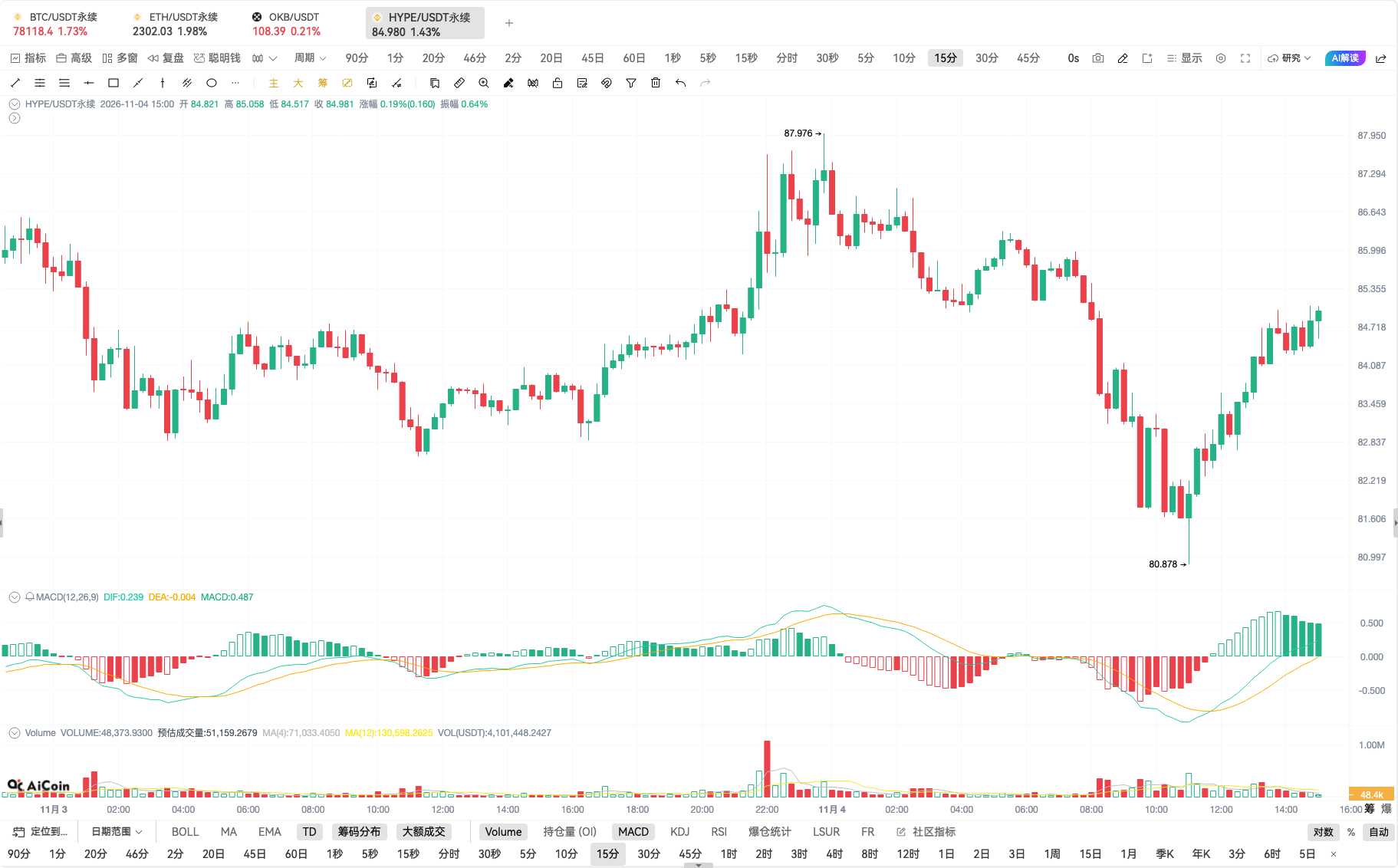
When using the AiCoin mobile app to observe the Hyperliquid market, you can focus on four key questions.
First, is the market's rise driven by spot transactions or by perpetual leverage and short liquidations? Price increases themselves do not indicate a healthy trend.
Second, are open interest and funding rates simultaneously rising? If open interest is rapidly increasing while funding rates persistently lean to one side, the market may have accumulated significant crowding risk.
Third, are large addresses making directional trades or hedging across different platforms? A single address's long and short positions do not automatically equate to "smart money being bullish" or "smart money being bearish."
Fourth, is trading occurring in the native market or HIP-3 market? The deployers, oracles, liquidity, and settlement responsibilities can differ for different markets, and users cannot merely look at whether the interface appears on the same platform.
AiCoin's professional candlestick charts, funding rates, open interest, liquidations, large order movements, and address behavior data are suitable for establishing a pre-trade checklist process: observe market structure first, then determine direction; confirm liquidity before deciding positions; understand the product before using leverage.
If you need to execute trades on Hyperliquid, you can use the exclusive entry: Connect to Hyperliquid.
Invitation code: AICOIN88. Compliant trades can receive a 4% fee rebate, with specific qualifications, calculation methods, and timing subject to the activity rules.
The rebate can only reduce part of the trading costs and cannot offset funding rates, slippage, oracle, private key, frontend, and clearing risks.
Conclusion
Jeff Yan's reluctance to label Hyperliquid as an exchange does not deny users trading on it, but rather seeks to redefine the boundaries of an exchange.
A traditional exchange is a company, a brand, a set of account systems, and a group of regulatory responsibilities; Hyperliquid seeks to become a collection of order books, margins, clearing, and market deployment capabilities, allowing different applications and institutions to build their own trading entrances.
If this direction holds, in the future, users may no longer see "a certain exchange owns a particular market," but rather different applications provide trading services through the same underlying liquidity infrastructure.
This will not cause CEX to disappear, nor will it make DEX inherently safe. It will only change the location of value capture: from a single platform's accounts and interfaces, to publicly verifiable trading statuses, liquidity networks, and reusable market infrastructure.
For Hyperliquid, the true test begins here.
It needs to prove its ability to not only allow retail investors to trade perpetually, but also to enable third-party developers, RWA market deployers, market makers, and regulatory institutions to continuously utilize this underlying system.
For traders, the most significant signals to observe are not the next short-term spikes, but:
When more trading entrances, more markets, and more institutions start relying on the same set of on-chain trading infrastructure, has DEX truly transformed from a product into a layer of the financial market?
Exclusive benefits for AiCoin users
👉 Enter invitation code AICOIN88 when binding the Hyperliquid account for 4% fee rebate
🔗 Exclusive registration link:
https://app.hyperliquid.xyz/join/AICOIN88
📖 Beginner tutorials:
-《AiCoin PC terminal Hyperliquid authorized trading tutorial》:
https://www.aicoin.com/zh-Hans/article/514197
-《AiCoin mobile terminal Hyperliquid authorized trading tutorial》:
https://www.aicoin.com/zh-Hans/article/541383
-《Zero-based entry! Hyperliquid first trade ultra-detailed graphic tutorial》:
https://www.aicoin.com/zh-Hans/article/510225
📖 Community communication:
-Telegram:
-Discord:
-AiCoin-Group chat:
https://www.aicoin.com/link/chat?cid=N6OVMor5g
The content of this article only represents the author's personal views and does not represent the platform's stance. The opinions, conclusions, and suggestions in the text are for reference only and do not constitute any investment advice related to this platform. Investors should still bear market risks, regulatory risks, and compliance risks with local laws and regulations when investing in US stocks (especially foreign exchange controls, offshore investment declaration, etc.).
免责声明:本文章仅代表作者个人观点,不代表本平台的立场和观点。本文章仅供信息分享,不构成对任何人的任何投资建议。用户与作者之间的任何争议,与本平台无关。如网页中刊载的文章或图片涉及侵权,请提供相关的权利证明和身份证明发送邮件到support@aicoin.com,本平台相关工作人员将会进行核查。