Monad Races Ahead in the Post-Quantum Era: Abandoning Signature Aggregation, Using "Counting Votes" to Maintain 100 Milliseconds Block Time.
By: @r2Jamong
Translated by: AididiaoJP, Foresight News
On October 27, Monad's developer Category Labs released Quantum Cadence—a post-quantum consensus protocol. It is the quantum-resistant version of Cadence, which itself is the multi-proposer consensus protocol that Monad launched in July of this year and has yet to go live on the mainnet.
Rather than a product launch, this seems more like Monad is showing their cards early: a high-performance L1 planning how to embrace the post-quantum era.
It is noteworthy that Monad's choice is almost completely opposite to Ethereum's. Ethereum's approach is to rebuild signature packaging schemes that can be easily broken by quantum computers into quantum-resistant forms; Monad simply removes the signature packages entirely from the consensus. Both chains run on the same execution environment—EVM; why is the divergence in approach so drastic?
Signature Packages: The Critical Point of High-Performance Consensus
Currently, most high-performance blockchain consensus relies on a mechanism called "quorum certificate" (QC). A QC is a bundle of signatures that proves at least two-thirds of the validators voted for the same block, with validators passing these signature packages among themselves. BLS signatures make this process inexpensive: hundreds of signatures can be aggregated into a single 96-byte signature.
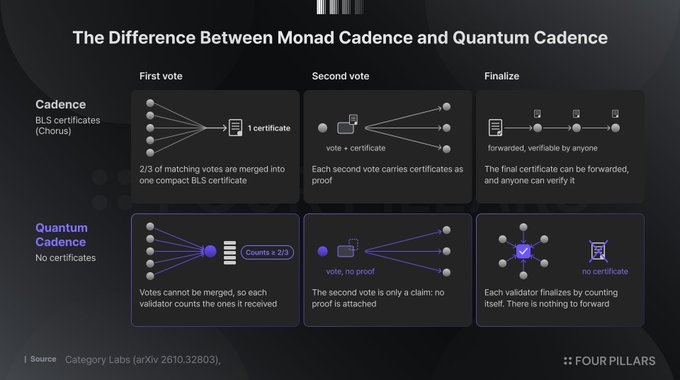
The problem is that quantum computers can break BLS.
Moreover, quantum-resistant signatures are large and cannot be aggregated effectively. The strength of BLS is to compress hundreds of validators' signatures into one small 96-byte package; regardless of how many people vote, the same small package is transmitted. This doesn't work with quantum-resistant signatures: the NIST standardized ML-DSA-44 produces a signature that is 2420 bytes, and no post-quantum signature can aggregate like BLS. If it cannot be compressed into a small package, a "quorum certificate" can only list hundreds of signatures individually, turning it into a large list of hundreds of KB. Monad requires a 100-millisecond block time; broadcasting this every slot would be bandwidth prohibitive.
Monad's Cadence aims for a block interval of 100 milliseconds and allows multiple proposers to submit blocks at the same time. It cannot bear the load of broadcasting such certificates for every validator in every slot.
Monad's Solution: No Signatures, Just Counting Votes
Monad did not wait for a smaller post-quantum aggregation solution to emerge, but directly removed the burdensome signature packages from the consensus. Each validator counts the votes they receive themselves and independently determines whether the quorum has been reached. Safety and liveness are built on the certification channel and hash, rather than on signatures. The purpose of the post-quantum signatures is retained only for identifying malicious validators. Each validator can sign a maximum of two votes per slot (block time).
A paper published on October 23 conducted a simulation: 200 validators, 1Gbps link, fault-free path, 5000-byte signature. With 100 proposers, each validator's upstream traffic actually decreased by 27%, from 772Mbps in the original Cadence to 561Mbps. The final confirmation time was 231 milliseconds, compared to 229 milliseconds for the original—almost no difference.
The Dilemma for Ethereum is Decentralization, while Monad's Dilemma is Speed
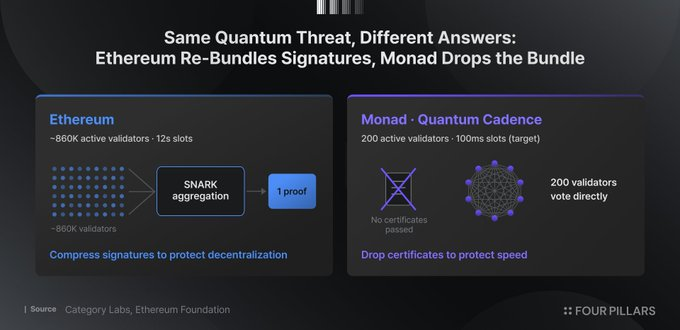
As of early October, Ethereum has approximately 860,000 active validators. Anyone can join, making it unrealistic for such a dispersed group to directly count each other's votes. Therefore, Ethereum chose to rebuild the signature packages: replacing BLS with a hash-based leanXMSS, and then compressing and aggregating those signatures that cannot be merged directly using SNARK. Generating proofs takes time, but Ethereum's 12-second slot allows for absorbing this overhead.
In contrast, Monad cannot afford to wait for SNARK aggregation with its 100-millisecond slot intervals. However, the smaller set of 200 validators makes it feasible for "everyone to directly count all votes." In facing the quantum threat, Ethereum opted to preserve the design of decentralization, while Monad chose to maintain speed.
Quantum-Resistant Signatures are Not a Panacea
NIST has indeed standardized signature algorithms that can withstand quantum computers, but these standards cannot be applied indiscriminately to every network's scenarios. Changing to post-quantum signatures does not resolve all issues at the level of blockchain consensus. Every network needs to prepare for its own problems early, rather than waiting for others to provide solutions.
For Monad, the key to resisting quantum threats is not in the signature algorithms, but in addressing problems within the consensus structure—specifically, the structure built on credential exchange. Other blockchain networks face similar challenges. EVM-compatible chains might borrow Ethereum's results when migrating account signatures; however, the consensus layer is their own homework, which no one else will do for them.
Quantum computers that pose a threat to blockchain networks do not yet exist, with most forecasts predicting they will not appear until the early to mid-2030s. However, time is not plentiful. Even Ethereum anticipates that the transition for just L1 will stretch to 2029, and changes to its consensus structure might take several years from research to mainnet implementation. This may explain why Monad released its quantum-resistant version even before Cadence went live on the mainnet. The matter of quantum resistance cannot wait for someone else to set standards. It is a task that each network must independently complete within its own architecture.
免责声明:本文章仅代表作者个人观点,不代表本平台的立场和观点。本文章仅供信息分享,不构成对任何人的任何投资建议。用户与作者之间的任何争议,与本平台无关。如网页中刊载的文章或图片涉及侵权,请提供相关的权利证明和身份证明发送邮件到support@aicoin.com,本平台相关工作人员将会进行核查。


