The U.S. midterm elections saw the Democratic Party sweep both houses, triggering concerns about tightened regulations on AI data centers that spread like a stone dropped into a calm lake, with shockwaves rapidly transmitting to the Seoul stock market. The two major benchmark indices in South Korea triggered selling circuit breakers on the same day, with leading semiconductor stocks facing severe declines, as this "blue tsunami" tests the core export engine of the South Korean economy.
On November 5, the Korea Composite Stock Price Index (KOSPI) opened down 1.82%, and the decline continued to widen, triggering the sell-sidecar mechanism on the same day before noon, temporarily halting programmatic sell orders. As of 2:25 PM that afternoon, the KOSPI had dropped 5.50% from the previous trading day to 5371.41 points, while the KOSDAQ index fell 5.11% to 678.4 points, with both indices rarely triggering market stabilization mechanisms on the same trading day. Samsung Electronics and SK Hynix saw their stock prices plunge 7.8% and 9.81%, respectively.
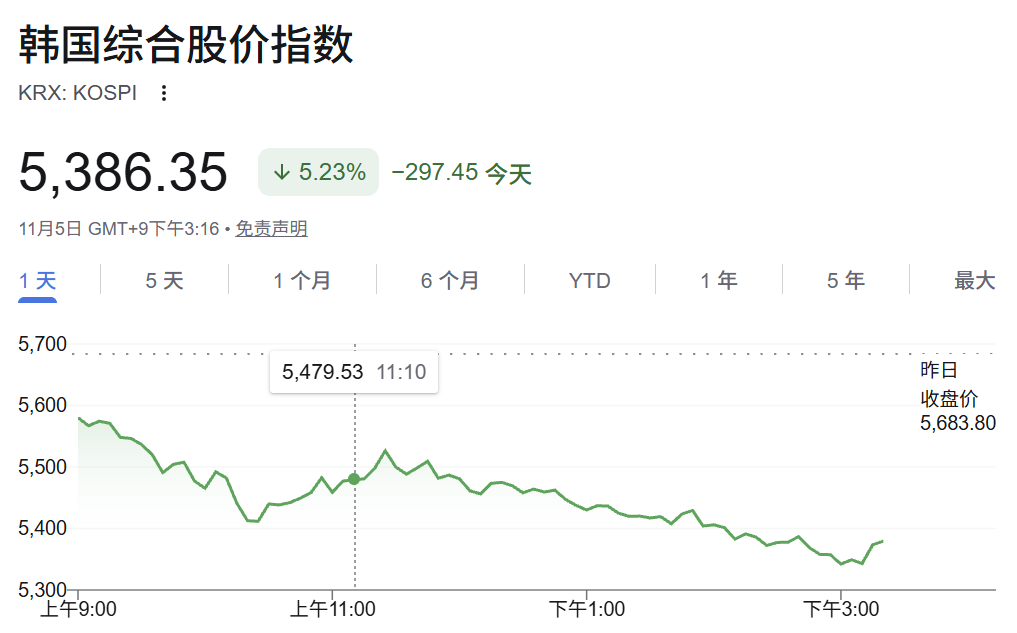
The direct trigger for this round of plummeting was the Democratic Party's victory in the gubernatorial elections in key data center states like Texas, Ohio, and Georgia, which heightened concerns over obstacles to the approval of new data centers. Given that Samsung Electronics and SK Hynix together account for over half of the KOSPI market value, any fluctuations in sentiment in the semiconductor industry will have amplified effects on South Korea's benchmark index.
Democrats Sweep, Data Center Regulation Concerns Surge
The Democratic Party achieved a historic "blue sweep" in this midterm election, gaining control of both the House and Senate while winning gubernatorial seats in several states with high concentrations of data centers.
Among these, Texas Governor-elect Gina Hinojosa promised during her campaign to immediately suspend all approvals for new data centers once elected. According to local Texas newspaper the Texas Forum and citing analysis from DataCenterWatch, 43% of the 74 gubernatorial candidates across 36 states expressed support for suspending or banning the construction of new data centers.
The market response was also directly influenced by the performance of U.S. stocks on the previous trading day. Although major U.S. stock indices rose overall on the 4th — with the S&P 500 up 1.58%, the Dow Jones Industrial Average up 3.03%, and the Nasdaq up 1.44% — the internal structure was severely polarized.
Large tech stocks such as Apple, Microsoft, and Amazon each rose over 5% in one day, while semiconductor stocks like Nvidia, Micron, SanDisk, and Intel generally declined, with drops between 3% and 8%. Emerging AI computing power leasing companies CoreWeave and Nebius plummeted 9.9% and 6.7%, respectively, while the Philadelphia Semiconductor Index fell 3.1%, reaching a six-month low.
South Korean Semiconductor and Electrical Equipment Stocks Under Pressure
The declines in the South Korean market were concentrated in the semiconductor and electrical equipment sectors closely related to AI infrastructure. Samsung Electronics fell 5.39%; SK Square dropped 6.56%; and Samsung Electro-Mechanics saw a dramatic drop of 10.31%. Semiconductor equipment companies in the KOSDAQ market also faced significant declines, with Jusung Engineering down 10.23%, Simmtech down 13.90%, and EO Technics down 11.72%.
Electrical equipment companies like transformer manufacturers were not spared either. The market is concerned that delays in data center construction will directly compress demand for transformers. Hyosung Heavy Industries, HD Hyundai Electric, and Sanil Electric saw declines of 10.10%, 7.53%, and 12.84%, respectively.
Future Asset Securities analyst Seo Sang-young stated, "The Democratic Party also won elections in crucial data center regions like Texas and Georgia, leading to significantly increased market concerns about grid access, approval processes, and the tightening of power cost regulations. Companies heavily indebted to build new data centers will face higher financing costs and greater profit pressures if project timelines are delayed."
Future Asset Securities senior researcher Kim Seok-hwan pointed out, "Tighter AI regulations could disrupt the capital expenditure plans of large tech companies. These companies need to build data centers to fulfill commitments to clients like OpenAI and Anthropic, ultimately translating these commitments into cloud revenue. Delays in data center construction will postpone revenue realization windows, prompting hyperscale cloud service providers to reassess subsequent investment rhythms, which will also put pressure on expected demand for high-bandwidth memory and other advanced chips."
Policy Pathways Have Limitations; Some Analysts Believe Impact May Be Brief
The Bank of Korea's New York branch pointed out in a report that the election results are unlikely to drive a significant shift in the overall policy direction of the Trump administration, but "may have limited impact on AI regulations and related investment rhythms."
Professor Yang Jun-seok of Catholic University of Korea stated that even with the Democratic Party controlling both houses of Congress, it would be difficult to gather the two-thirds majority needed to override a presidential veto, fundamentally limiting their actual policy advancement scope; therefore, the election results alone cannot be expected to have a direct, substantial impact on AI investments.
However, he also noted that if the Democratic Party further clarifies its tight stance on the development and investment in AI, coupled with other pressures the industry is facing — including public concerns about AI taking jobs, increasing energy bills, and consuming vast water resources, as well as the debt pressure that large tech companies face due to heavy investments in AI — this could evolve into "meaningful additional suppressive factors."
NH Investment & Securities researcher Jo Yeon-ju takes a more optimistic stance, believing, "The Democratic Party is also well aware of the strategic importance of AI dominance and will not rashly implement significant delays, but will tend to provide compensation to local residents to promote the construction of data centers. The material impact on large tech companies may just be a storm in a teacup."
iM Securities researchers also noted that while concerns over tightened regulatory approval for AI data centers suppress semiconductor investment sentiment, expectations of cost savings from falling crude oil prices are spreading to sectors like aviation and transportation, which warrants ongoing attention.
Renewable Energy Sector Benefits Against the Trend
While the overall market is under pressure, some sectors are viewed as potential beneficiaries of the "blue tsunami." Following the Democratic Party's consolidation of majority positions, expectations for the resumption of supportive policies for renewable energy have risen, with solar, wind, nuclear, and energy storage system (ESS) related stocks being broadly identified as beneficiaries.
DS Investment & Securities researcher Ahn Joo-won stated, "As the Democratic Party gains stronger bargaining power in future legislation due to their overwhelming electoral advantage, the demands in the renewable energy sectors like solar and wind will be fully reflected, and stocks related to wind energy and fuel cells will benefit from this."
Yuanta Securities researcher Lee Jae-won cautioned, "After the Democratic Party gained control of Congress and won key gubernatorial seats, the probability of stricter regulation on AI data centers has increased, and the approval restrictions and grid cost pressures in major data center construction areas such as Texas could delay the AI capital investment process, thus lowering demand for memory semiconductors and dragging down prices."
免责声明:本文章仅代表作者个人观点,不代表本平台的立场和观点。本文章仅供信息分享,不构成对任何人的任何投资建议。用户与作者之间的任何争议,与本平台无关。如网页中刊载的文章或图片涉及侵权,请提供相关的权利证明和身份证明发送邮件到support@aicoin.com,本平台相关工作人员将会进行核查。


