While the midterm elections in the United States stirred the nerves of global markets, a significant piece of news capable of rewriting Wall Street trading history was overlooked by many.
On November 3, Mike Selig, chairman of the U.S. Commodity Futures Trading Commission (CFTC), announced: Single-stock perpetual contracts have been approved for trading on regulated exchanges in the U.S. for the first time, and are included in the dual regulatory framework of the CFTC and SEC.
This means that the "perpetual contracts," which have primarily been popularized by cryptocurrency trading platforms, have finally crossed the regulatory framework of the traditional securities markets in the U.S.
To put it simply, Wall Street has started to learn from Crypto, "borrowing" its most successful financial invention of the past decade—perpetual contracts (Perps).
Interestingly, this change is not entirely driven by Wall Street; in the past six months, Crypto trading platforms have been attempting to bring U.S. stock assets like Apple, Nvidia, and Tesla on-chain, and reorganize the trading methods of these assets using perpetual contracts, stablecoin margin, and even a 24/7 order book.
Now, even the parent company of the New York Stock Exchange, ICE, has begun to consider introducing Hyperliquid's perpetual contract infrastructure to the U.S.
A year ago, we discussed whether U.S. stocks could operate like Crypto without closing; one year later, the market is now discussing whether U.S. stocks can directly adopt Crypto's trading rules?
1. From "Last Hour" to "Never Expiring": Why Did Wall Street Eventually Favor Perps?
To understand the significance of this CFTC breakthrough, it is essential to grasp what exactly perpetual contracts have changed.
Little known is that perpetual contracts are one of the few truly "native financial innovations" from the crypto sphere, first pioneered by the now-defunct cryptocurrency derivatives exchange BitMEX in 2016.
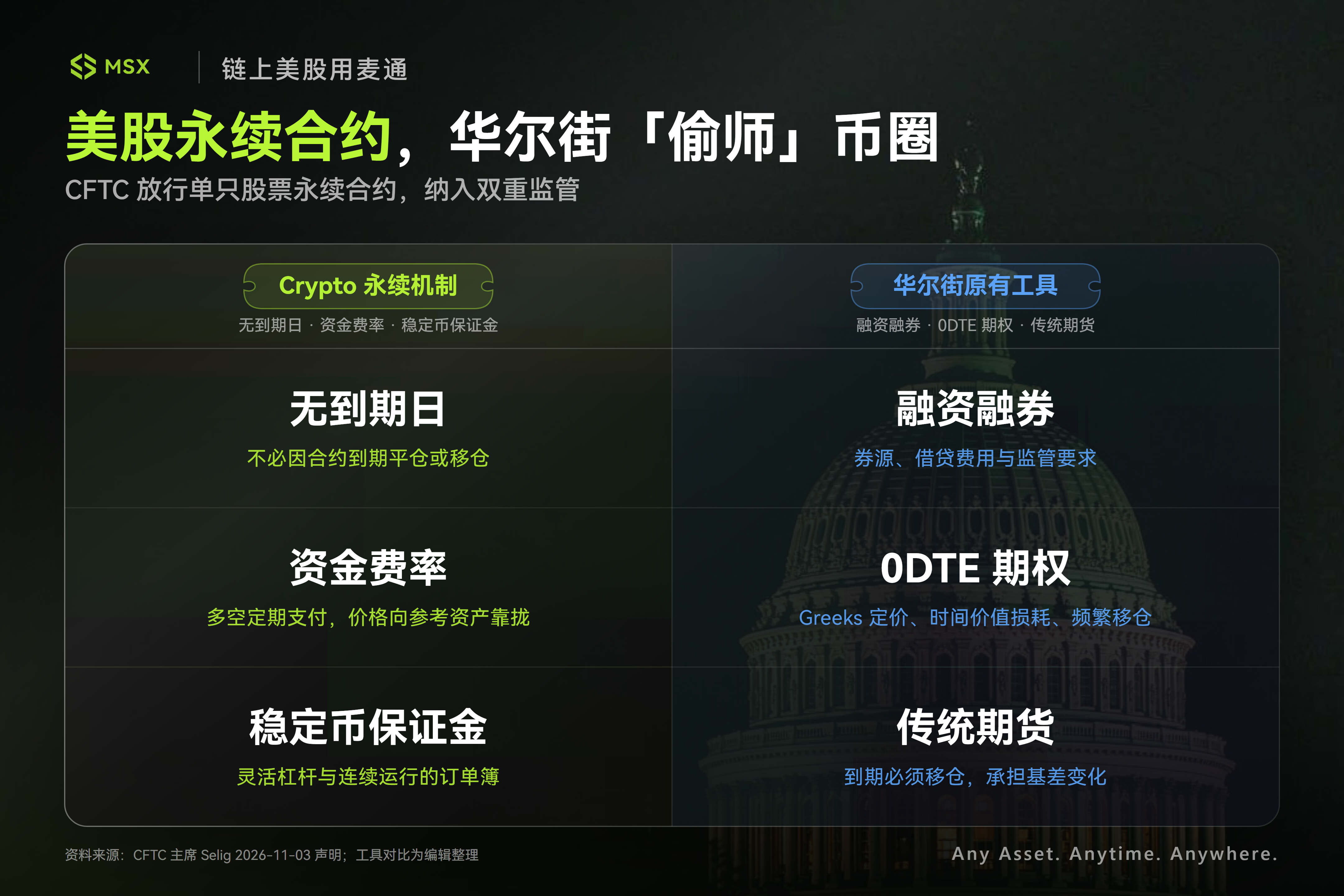
Generally speaking, in the U.S. stock market, if investors want to trade single stocks (like NVDA, TSLA) with leverage or short selling, mainstream options have their limitations:
- Margin trading: Relies on brokers to provide financing and short selling services; not only can the cost of funds be relatively high, but short selling is also restricted by the availability of borrowable stocks, lending fees, and various regulatory requirements, making it difficult to form a globally unified, round-the-clock trading mechanism;
- Options, particularly the increasingly popular 0DTE end-of-day options: While powerful, the complexity of Greek letter pricing, time value decay (Theta Decay), and frequent rollover increase the threshold for average investors and disperse liquidity across different expiration dates and strike prices;
- Traditional futures: Have a definite expiration date; if investors want to hold a position longer, they must periodically roll over their contracts, incurring additional trading costs and basis risk;
The most significant innovation of Crypto perpetual contracts is the removal of the expiration mechanism from traditional futures.
Investors can hold long or short positions indefinitely without being forced to close or roll over due to expiring contracts; the platform incentivizes contract prices to converge with referenced asset prices through the funding rates paid by both long and short positions, combined with flexible leverage and continuously running order books, creating an entirely different trading experience compared to traditional securities.
This mechanism has been a "great kill" in the crypto market.
In recent years, BTC and ETH perpetual contracts have gradually become the most dominant derivative trading tools in the crypto market, supporting massive trading ecosystems on platforms like Binance, OKX, and Bybit. According to statistics from The Block, by 2025, perpetual contracts accounted for about 75% of the total trading volume at centralized crypto exchanges, with an annual trading volume approaching $49 trillion, far exceeding spot and options markets.
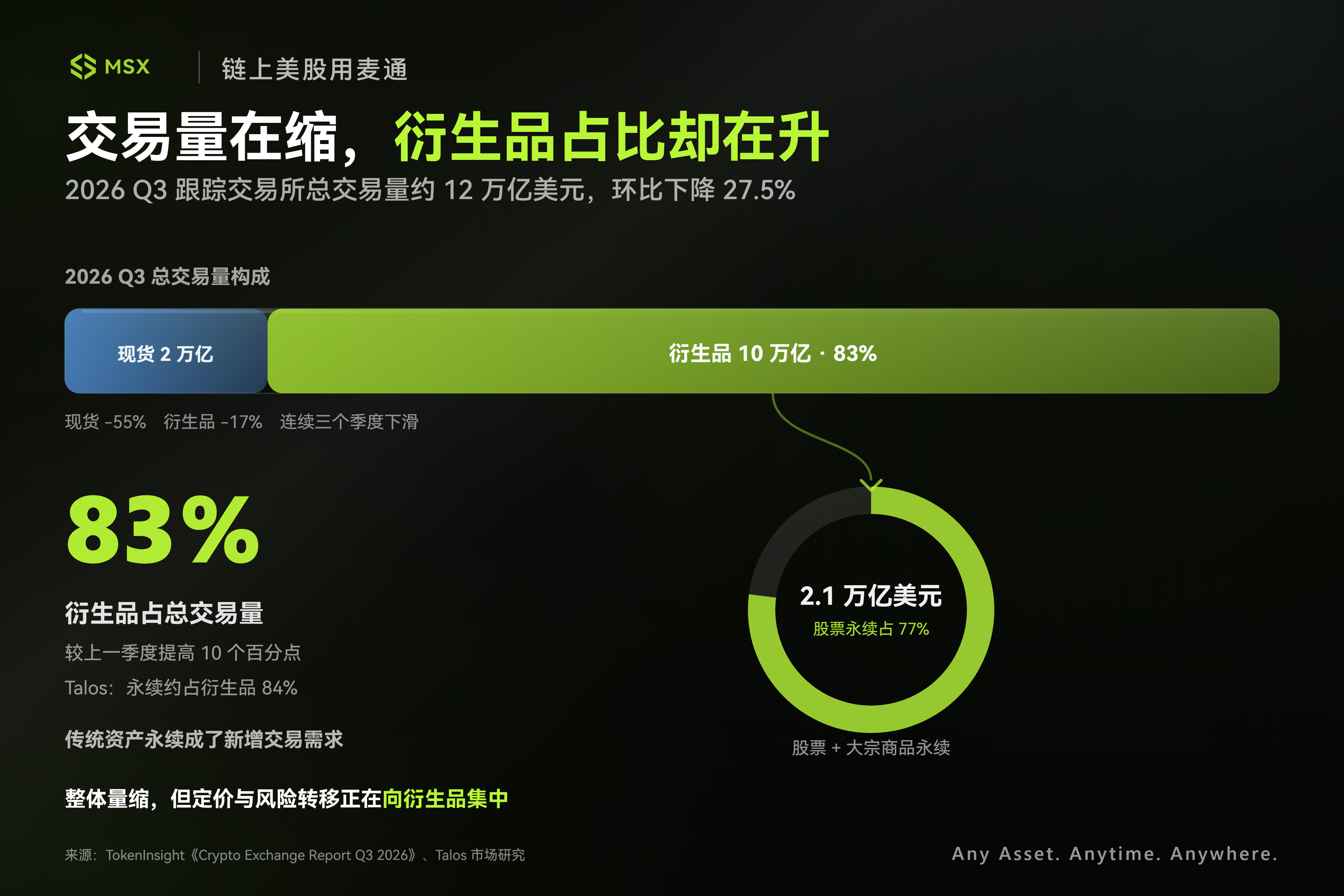
This trend continued in 2026, with the latest Q3 exchange report from TokenInsight indicating that derivatives accounted for 83% of the total trading volume across major crypto trading platforms.
In other words, perpetual contracts had already become the core infrastructure supporting the entire industry's trading liquidity, price discovery, and risk transfer.
However, as this efficient trading method began to extend to traditional assets such as stocks, gold, crude oil, and indices, a pressing question emerged: Why can global investors trade Nvidia and Tesla with ease on crypto platforms 24/7, yet find it challenging to access similar products within the compliant framework in the U.S.?
This challenge stems from both technological constraints of underlying infrastructure and the jurisdictional barriers of the U.S. regulatory system over the years.
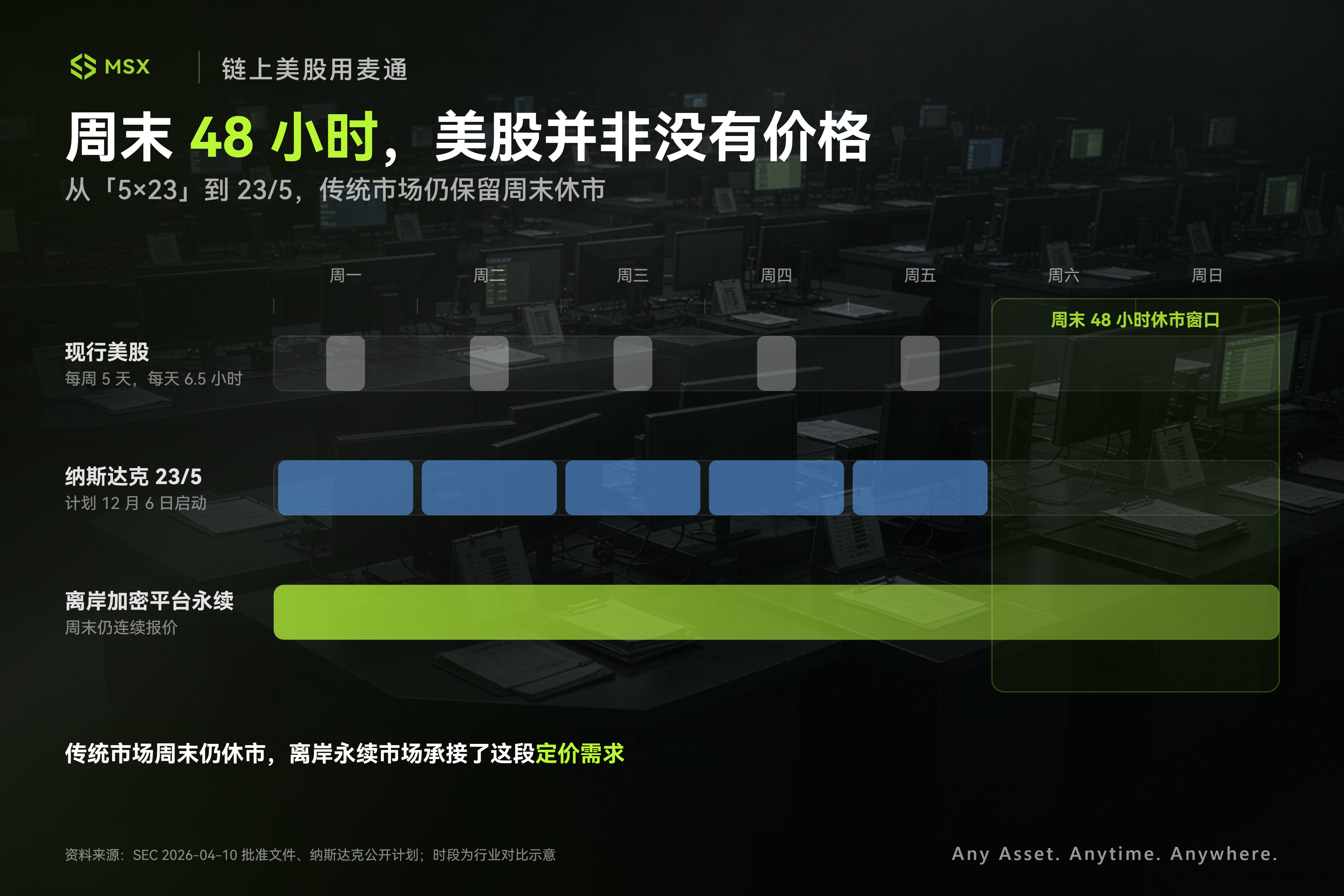
On a technological level, as pointed out in our previous article "Can U.S. Stocks Sprint Toward 'Never Closing'?: Why Did Nasdaq Launch the '5x23 Hour' Trading Experiment?," traditional U.S. stock spot trading operates like a finely tuned machine, where even if Nasdaq extends its matching hours to 23 hours a day, brokers, custodians, and clearing houses (DTCC) are still constrained by centralized ledger end-of-day batch processing, reconciliations, and margin transfers.
The forced "one-hour downtime window every day" and "48 hours off on weekends" represent real problems that traditional financial infrastructure must address as it moves toward operational continuity.
On the regulatory side, while single-stock perpetual contracts act as reference assets, they adopt the native perpetual derivatives structure of Crypto, which precisely straddles the intersection of the CFTC (responsible for commodities and derivatives) and the SEC (responsible for securities markets), leading to uncertainties regarding regulatory authority and product classification that have historically placed these products in a state of ambiguity regarding their implementation.
This issue began to see substantial changes this year:
- On March 11, 2026, the SEC and CFTC signed a memorandum of understanding (MOU) to clarify and enhance coordination between the two agencies regarding financial innovation, market regulation, and investor protection;
- Subsequently, on May 29, CFTC approved the submission of KalshiEX's first Bitcoin perpetual contract BTCPERP, marking the true entry of Bitcoin perpetual contracts into U.S. regulated exchanges;
- And the November 3 announcement further extended this progress into the traditional securities field: According to CFTC Chairman Selig, single-stock perpetual contracts were classified as securities futures products under the framework of the Commodity Futures Modernization Act of 2000 (CFMA), thus requiring compliance with both the Commodity Exchange Act and U.S. federal securities laws, while being subject to oversight by both the CFTC and SEC;
Specifically, trading venues that can provide such products need to meet the qualifications of being a designated contract market (DCM) registered with the CFTC and meet the requirements of notifying the SEC to become a national securities exchange authorized to trade securities futures products.
Moreover, it is noteworthy that regulatory changes have begun to translate into actual products.
On November 3, Kalshi started offering four single-stock perpetual contracts corresponding to Amgen (AMGN), McDonald's (MCD), Qualcomm (QCOM), and Costco (COST), with maximum leverage of about 4.9 times.
For the U.S. market, this not only means more stock trading tools, but it also signifies that the trading mechanisms pioneered by crypto trading platforms are beginning to gain recognition in the traditional financial regulatory framework.
2. Reviewing the Past Year: The "Triple Convergence" of Regulation, TradFi, and Crypto Platforms
If the CFTC's actions represent the traditional financial regulatory system starting to accept perpetual contracts, then in the past year, Crypto-native platforms have achieved a considerable amount of product exploration.
Looking back at this timeline, we can see that the development of tokenization in U.S. stocks has gradually begun to form a more complete trading system involving spot trading, perpetual contracts, leveraged trading, and cross-asset margining.
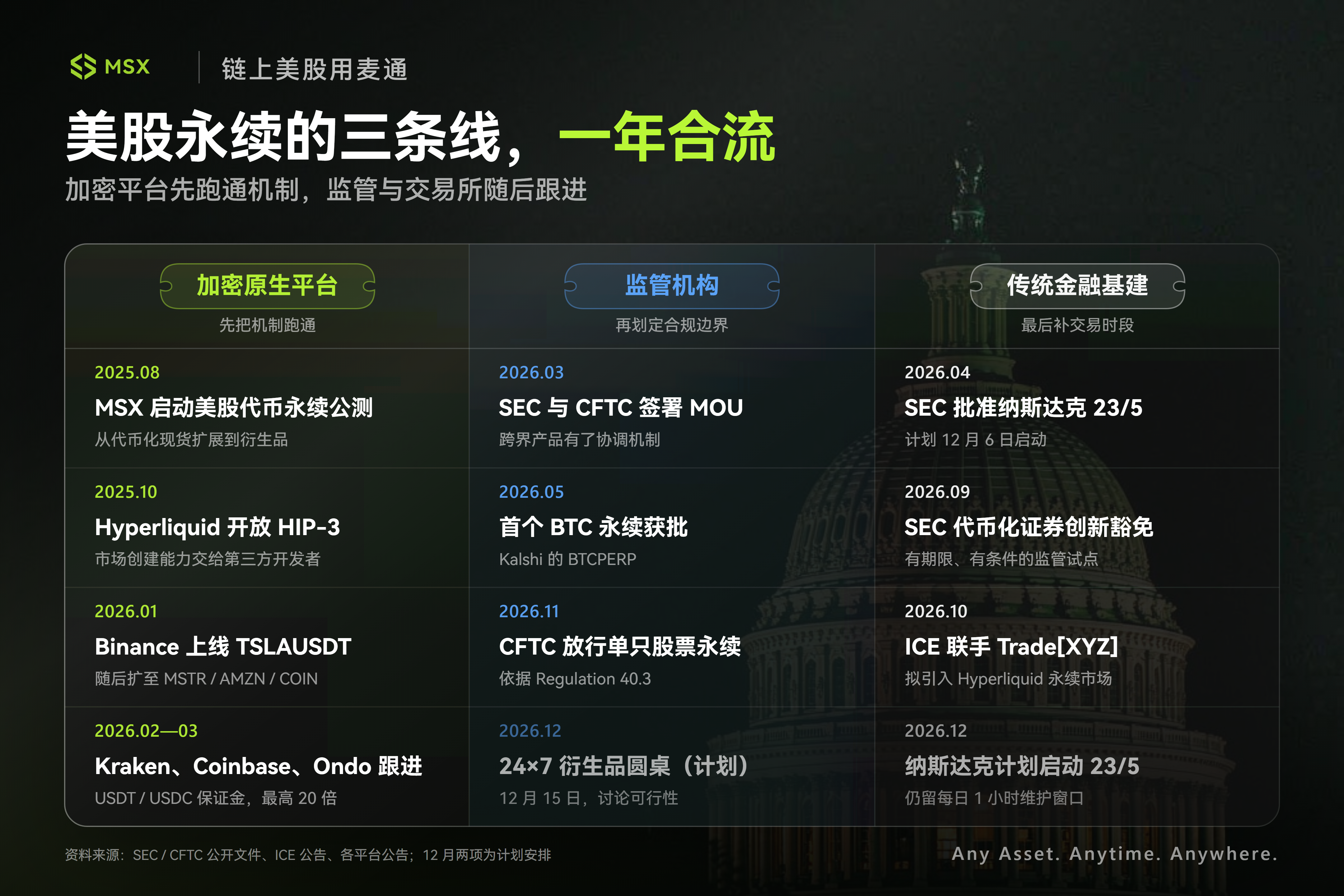
As early as August 11, 2025, MSX launched a public test of its tokenized perpetual contracts for U.S. stocks, further expanding previous tokenized stock spot trading into the derivatives market.
Following this, in October 2025, leading on-chain derivatives platform Hyperliquid launched a pivotal HIP-3 mechanism, opening the market creation capabilities of perpetual contracts to third-party developers, thus breaking through the boundaries of BTC and ETH and quickly expanding to stocks, indices, commodities, and forex.
Entering 2026, the U.S. perpetual stock trading sector saw more major trading platforms concentrating their efforts:
- On January 28, Binance launched the TSLAUSDT stock perpetual contract; on February 9, it further introduced multiple stock perpetual contracts including MSTR, AMZN, CRCL, COIN, PLTR, using USDT for margin and settlement, enabling 24/7 trading.
- On February 3, Ondo Finance announced the Ondo Perps plan, intending to bring traditional assets like stocks, ETFs, and commodities into the perpetual contract market and further explore using tokenized securities as collateral. The platform went live in July.
- On February 24, Kraken launched tokenized stock perpetual contracts based on xStocks, offering eligible non-U.S. users in over 110 countries 24/7 leveraged trading on stocks like Nvidia, Apple, and Tesla with maximum leverage of up to 20 times.
- On March 20, Coinbase officially launched stock perpetual contracts, allowing eligible non-U.S. users to settle in USDC, trading U.S. stocks and crypto assets within the same derivatives trading system.
- Bitget also included Stock Perps in its product suite, covering numerous U.S. stocks and ETFs, including Nvidia, Apple, Tesla, and Microsoft, with related contracts settled in USDT, supporting near round-the-clock trading.
It is noteworthy that this wave of expansion coincided with a continued decline in transaction volume in the native Crypto market.
According to a report by TokenInsight, the sample of exchanges they track saw a total trading volume of approximately $12 trillion in the third quarter, down 27.5% quarter-on-quarter, marking a continued decline for three consecutive quarters—among them, spot trading volume fell by 55% to $2 trillion, and derivative trading volume fell by 17% to $10 trillion.
However, one intriguing data point is that despite the overall decline in trading volume, the proportion of derivatives in total trading volume has actually increased to 83%, a 10 percentage point rise from the previous quarter.
At the same time, trading volume of perpetual contracts on traditional financial assets is rapidly increasing. In the nine exchanges tracked by the report, the total trading volume of stock and commodity perpetual contracts reached $2.1 trillion in the third quarter, with stock perpetual contracts accounting for approximately $1.61 trillion, or 77%; commodity perpetual contracts reached approximately $491 billion.
This set of data sends a clear signal: as the original Crypto trading market faces growth pressures, traditional financial assets are becoming a pivotal direction for crypto trading platforms to compete for new trading demand.
Of course, the platform's expansion into TradFi cannot simply be attributed to the decline in crypto market trading volume. More critically, leading trading platforms already have robust derivative engines, stablecoin settlement systems, margin management, and a global user base, making it unnecessary to build a trading system from scratch when expanding into assets like stocks, indices, gold, and crude oil.
For them, rather than being limited to competing for finite BTC and ETH trading flow, it's more logical to replicate the already matured trading infrastructure across additional asset classes.
Moreover, the products of these platforms have diverged into two paths at the structural level:
- The first type is "synthetic perpetual contracts" anchored to stock prices, such as Binance's USDT-denominated contracts and Coinbase's USDC-denominated contracts, where investors gain exposure to the ups and downs of stock prices without involving real stock deliveries;
- The second type revolves around perpetual and combination systems based on "tokenized stocks", exemplified by earlier platforms that successfully closed the loop between spot and contract, like MSX, Kraken using xStocks, and Ondo supporting tokenized securities as collateral;
While these two paths are not entirely the same, both push the transition of traditional assets from merely price exposure to richer trading and financial applications.
As Crypto-native platforms continue to expand, traditional financial giants are now entering the fray.
On October 29, the parent company of the New York Stock Exchange, Intercontinental Exchange (ICE), announced a partnership with Trade[XYZ], planning to introduce a perpetual contract market based on Hyperliquid to the U.S.
According to the proposal released by both parties, ICE will be responsible for operating the new regulated trading market and clearing infrastructure, while strategically investing in Trade[XYZ]; Trade[XYZ] will handle market design and product technology, with future plans covering assets such as stocks, indices, cryptocurrencies, commodities, and forex.
It's worth noting that this new market aims to reestablish dedicated trading and clearing systems around U.S. regulatory requirements, with related business still requiring regulatory approval.
The symbolic significance of this matter is quite strong.
In the past, Crypto platforms attempted to move traditional assets on-chain, challenging the control traditional exchanges had over asset liquidity and trading entry; now, the parent company of the New York Stock Exchange has chosen to collaborate with the native perpetual contract market of Crypto, even directly investing in relevant participants.
Crypto possesses more flexible trading mechanisms, stablecoin settlement, and a global user base; traditional finance boasts a mature regulatory framework, clearing infrastructure, and institutional resources, and both sides are beginning to realize that true value in the future lies in who can integrate the advantages of both systems.
3. Pricing U.S. Stocks on Weekends: Is All-Day Liquidity Really Coming?
If the first two sections discussed trading products and regulatory systems, the most profound impact of this change lies in the subtle transfer of market pricing power.
Historically, price discovery in U.S. stocks has primarily concentrated in the trading hours of traditional venues like Nasdaq and the New York Stock Exchange, even as pre-market and after-hours trading have gradually become popular, weekends and holidays still represented a market vacuum lasting over 48 hours.
However, the closure of the traditional U.S. stock market does not mean that investors' demand for trading U.S. stocks disappears.
The emergence of perpetual contracts for U.S. stocks is changing this situation.
Now, even when Wall Street closes on Fridays, global investors can trade Nvidia, Apple, and Tesla perpetual contracts uninterrupted on crypto trading platforms or on-chain protocols; global sudden events, company news, macro data, or even weekend market sentiments can be translated into continuous price changes through these trading markets.
It can be said that the perpetual contracts for U.S. stocks on crypto platforms, especially during weekends when the U.S. stock market is closed, have gradually evolved from mere speculative quotes to a continuous price discovery market with certain reference value.
1. From "Basis Flattening" to Cross-Platform Arbitrage: How is Weekend Pricing Formed?
Many may wonder, since Nasdaq and the New York Stock Exchange have closed, how can real-time prices continue to form for Nvidia and Tesla on crypto platforms?
Taking Coinbase's stock perpetual contracts as an example, prices are actually formed through internal price indices, perpetual contract order books, tokenized stock quotes, and cross-platform trading:
- During normal trading hours, the index price is primarily built using external stock market sources like Pyth and Blue Ocean ATS;
- During weekends and certain market closure periods, the internal index is used, combining the EMA of perpetual contract marking prices and available tokenized stock quotes to create new price references;
- At the same time, the platform also implements price deviation limits and transition mechanisms when reconnecting to external market data to minimize abnormal volatility caused by price switching;
This mechanism at least demonstrates that weekend pricing for U.S. stocks is no longer simply a matter of freezing Friday’s closing price until Monday; rather, it starts to form a continuously running price discovery system through multiple data sources and market mechanisms.
What gradually matured this mechanism are forces from two aspects.
First, the funding rate mechanism inherent in perpetual contracts. When the contract price consistently exceeds the reference index, the funding rates typically shift positively, requiring longs to pay fees to shorts, thereby increasing the cost of holding high-premium longs; conversely, when the contract price is below the reference index, negative funding rates will elevate the holding costs of shorts.
This provides continuous adjustment incentives for both long and short positions but does not guarantee price accuracy, especially when external spot markets are closed, as the reference index itself may exhibit lag.
More importantly, the involvement of cross-platform quantitative arbitrage funds has played a role. As platforms like Hyperliquid, Binance, and Coinbase gradually establish multiple competing trading locations, price discrepancies for the same stock may arise across different perpetual contract markets.
For example, suppose that on Saturday Nvidia's perpetual contract is quoted at $200 on Platform A, while Platform B has a quote of $203; if the reference asset, contract specifications, settlement mechanisms, and liquidity are sufficiently close on both sides, arbitrageurs might buy in the low-price market and sell in the high-price market, waiting for the price differential to converge.
It is essential to note that this trading still falls under the category of basis trading across platform derivatives and does not equate to conducting risk-free hedging of real U.S. stock spots at any time. Especially on weekends, the traditional stock market may not provide continuous spot hedging channels, and traders must still bear risks involved with funding rates, margin, liquidity, and Monday's opening gaps.
Nevertheless, with an increasing number of participants and trading venues, price deviations between different markets are more easily identifiable and tradable, making weekend prices less reliant on a small number of orders from a single platform.
From funding rates to cross-platform arbitrage, to multi-source pricing and market-making mechanisms, the originally somewhat isolated weekend trading markets are forming a more mature price correction system.
2. From "Shadow Price Discovery" to All-Day Markets: Why Can't Wall Street Be Absent?
More noteworthy than the conventional weekend basis convergence is the price discovery capability when significant unforeseen events occur.
In the past, whether sudden geopolitical tensions, macro tariff policy statements, or major tech giants releasing pivotal product and regulatory news on non-trading days, the traditional U.S. stock market often lacked a unified market that could facilitate continuous trading and fully express bullish or bearish views before reopening.
However, the situation differs in the 24/7 operating U.S. perpetual market.
Global macro traders, quantitative funds, and information arbitrageurs can engage in real-money long and short bets on Saturdays and Sundays, allowing the potential impacts of sudden events to be reflected in the perpetual contract prices in real-time.
This means that when the traditional U.S. stock market reopens, the price changes formed in the crypto market over the weekend can serve as an essential reference for observing market expectations; in some major events, weekend perpetual contracts might even preemptively reflect the market's repricing of new information before the traditional stock market.
Of course, this does not imply that the Monday opening price of U.S. stocks will necessarily align perfectly with the weekend perpetual contract price—weekend liquidity, information accuracy, market maker risk preferences, and actual buy and sell orders post-open can all contribute to potential price deviations.
Moreover, weekend perpetual contract prices are essentially market quotes within specific trading venues, not official stock prices recognized by Nasdaq or the New York Stock Exchange. Nonetheless, this is already sufficient to alter how market observation has been conducted in the past: during traditional stock market closures, U.S. perpetual contracts on crypto platforms are becoming a new channel for "shadow price discovery."
This is not a simple price following act; rather, it involves global traders articulating their expectations for future market trends through continuous trading.
By understanding this, we can better comprehend why the CFTC's approval for single-stock perpetual contracts to launch in U.S. regulated trading venues carries such significant meaning:
As "weekend pricing" and "around-the-clock derivatives liquidity" have begun to take root in the crypto world, Wall Street naturally does not wish for such price discovery to occur long-term outside its regulatory framework.
Once regulated exchanges in the United States begin offering similar single-stock perpetual contracts, traditional market makers like Citadel Securities, Jane Street, and Virtu will have opportunities to actively participate in price discovery and risk hedging between different trading venues while complying with regulatory requirements. At that point, liquidity interconnections between traditional finance and the Crypto market are likely to deepen further.
Revisiting the Nasdaq’s proposed 23-hour trading model discussed last year reveals a more holistic evolution process.
In the articles, we previously posed a question: why was Nasdaq eager to advance stock tokenization? Because if financial markets truly shift towards all-day trading, traditional exchanges cannot merely stick to their existing trading hours and matching business, but must rethink their roles in asset issuance, trading, and settlement systems.
Now, this question has a new answer.
As U.S. stocks begin trading perpetual contracts, as weekend price discovery becomes relatively continuous, and as traditional exchanges start proactively integrating Crypto’s trading infrastructure, the competition in financial markets is no longer about whether TradFi or Crypto will replace each other but about who can more swiftly establish the next-generation all-day trading network.
In the past, Crypto learned from traditional finance; in the next phase, it may very well be traditional finance that starts learning from Crypto.
免责声明:本文章仅代表作者个人观点,不代表本平台的立场和观点。本文章仅供信息分享,不构成对任何人的任何投资建议。用户与作者之间的任何争议,与本平台无关。如网页中刊载的文章或图片涉及侵权,请提供相关的权利证明和身份证明发送邮件到support@aicoin.com,本平台相关工作人员将会进行核查。


