Author: r2Jamong (Researcher at Four Pillars)
Translation: Deep Tide TechFlow
Deep Tide Overview: As the acceleration of quantum computing hardware evolves and the post-quantum cryptography standards from the National Institute of Standards and Technology (NIST) gradually take effect, the ability of blockchain public chains to withstand quantum attacks has shifted from academic hypothesis to an imminent survival battle at its core. However, the idea held by the vast majority that “we can directly replace existing signatures with quantum-resistant algorithms” has encountered a devastating physical wall in the face of high-performance consensus throughput.
In this in-depth technical report, Four Pillars researcher r2Jamong systematically compares and analyzes the fundamental differences between the latest post-quantum consensus protocol, Quantum Cadence, recently released by Monad and Ethereum's path of quantum resistance evolution. Ethereum, with 860,000 active validator nodes, is constrained by the communication overhead of a highly distributed network and can only rely on leanXMSS signatures and time-consuming SNARK proofs for compression within a 12-second long slot, firmly defending its decentralized baseline; whereas Monad, in order to maintain a limit slot of 100 milliseconds, cannot afford the computational delay of SNARK aggregation and decisively chooses to completely eliminate the heavy signature bundle from the consensus critical path.
By replacing the cumbersome process with lightweight bidirectional authenticated channels, hashing point-to-point voting, and strictly limiting the large quantum signatures to post-factum punishing (Slashing) segments, Monad has not only achieved 231 milliseconds of near-instant finality within a high-concurrency network of 200 nodes but has also dramatically reduced the network's upload bandwidth consumption by 27%. This article profoundly reveals a core insight for the industry: the security of public chains in the post-quantum era is by no means a universal off-the-shelf standard, but rather a systems engineering problem that must be independently solved by each public chain in the balance of its own architecture.
On October 27, Monad's development team, Category Labs, officially unveiled the post-quantum consensus protocol, Quantum Cadence. Quantum Cadence is the quantum-resistant upgraded version of Cadence, which is a multi-proposer consensus protocol introduced by Monad in July of this year.
Currently, Cadence itself has not yet officially launched on the mainnet. Therefore, Quantum Cadence should be understood as a foresighted showcase of Monad’s strategic technical reserves made in advance for the post-quantum era.
Monad's Quantum Cadence has taken a completely different technical direction than Ethereum's post-quantum design. Ethereum is committed to restructuring its vulnerable-to-quantum attacks signature bundle into a new quantum-resistant form; whereas Monad has simply chosen to completely abandon the signature bundle altogether to achieve quantum resistance.
Both are blockchain networks and operate in the same execution environment, namely the EVM. So, why do they have such a significant divergence in their technical paths when facing the post-quantum era?
Deciphering Monad's Quantum-Resistant Consensus Architecture
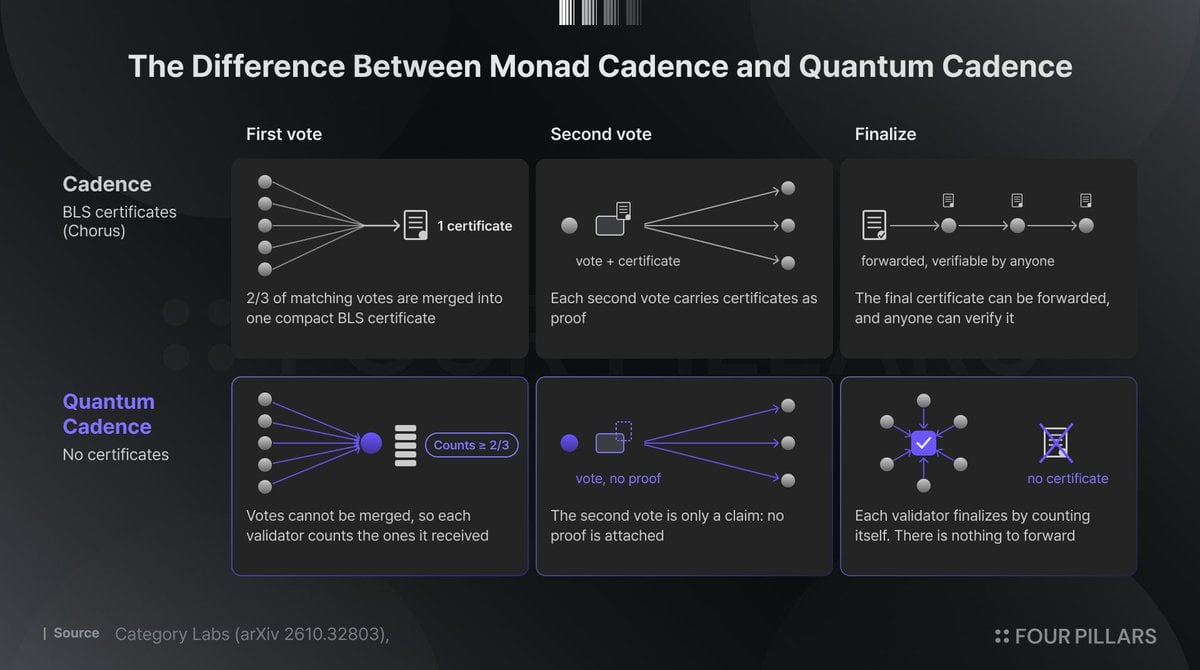
Figure: Comparison of Monad's quantum-resistant Cadence consensus architecture with traditional certificate exchange
Most of today's high-performance blockchain consensus mechanisms heavily rely on Quorum Certificates (QC). QC is essentially a bundled signature package that has been aggregated to prove that at least two-thirds of the validators have cast favorable votes on the same block, with validators broadcasting these certificates to each other.
BLS signatures make this process extremely cheap, as hundreds or thousands of signatures can be losslessly compressed into a micro-signature of just 96 bytes. However, a fatal issue is that quantum computers can easily break the BLS signature algorithm.
Secure signatures that can withstand attacks from quantum computers are typically very large, and they are inherently very difficult to aggregate effectively.
For example, the ML-DSA-44 algorithm, standardized by the National Institute of Standards and Technology (NIST), generates a single signature that is as large as 2420 bytes. Currently, no post-quantum signature can achieve the compactness and speed of aggregation like BLS signatures.
In the absence of an efficient aggregation mechanism, a consensus certificate can quickly balloon into a heavy list containing hundreds of large signatures. Monad's Cadence consensus aims to achieve an ultra-short slot interval of 100 milliseconds and allows multiple block proposers to submit blocks in parallel at the same time. It simply cannot bear the network load of broadcasting such a large certificate by every validator in each slot.
Therefore, Monad did not passively wait for smaller size post-quantum aggregation algorithms to emerge but chose instead to eliminate the heavy signature bundle completely from the main flow of consensus.
Under the new mechanism, each validator independently counts votes locally after receiving ballots and verifies whether the quorum has been met. The network's safety and liveness rely on authenticated secure communication channels and hashing checks, not on relying on multiple nested signature proofs.
The large post-quantum signatures have been streamlined and retained only for identifying and punishing malicious validators who violate rules afterward. Under normal circumstances, each validator only needs to sign at most two ballots in each slot.
In the technical paper released on October 23, the research team conducted in-depth simulations under strict assumptions of a 1Gbps network connection, 200 validators, fault-free execution paths, and single-signature sizes of 5000 bytes.
In the extreme scenario where 100 proposers are proposing blocks in parallel, the network upload bandwidth consumption for each validator actually decreased compared to the original Cadence protocol, dramatically reducing by 27%, from 772Mbps to 561Mbps. Meanwhile, the time for transactions to reach final confirmation was 231 milliseconds, almost indistinguishable from the original 229 milliseconds.
The Core Contradiction of Ethereum Is Decentralization, Monad's Core Contradiction Is Extreme Speed
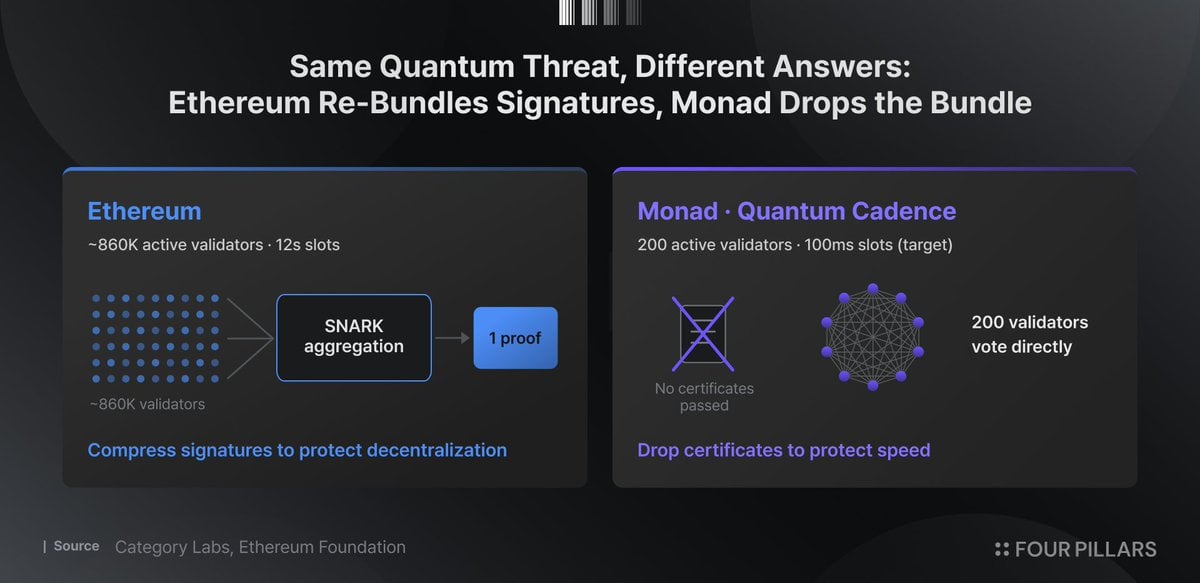
Figure: Performance trade-offs between Ethereum's SNARK signature aggregation and Monad's authenticated hashing channel
As of early October, the Ethereum network has about 860,000 active independent validators. Ethereum allows anyone to join without thresholds, making it entirely unrealistic for such a large and highly decentralized distribution of participants to directly verify each other's votes.
Therefore, Ethereum has no choice but to reconstruct its signature bundle. It plans to use a hash-based signature scheme, leanXMSS, to completely replace the vulnerable BLS signatures and compress these numerous signatures that cannot be directly merged using SNARK zero-knowledge proofs.
Generating zero-knowledge proofs consumes considerable time, but Ethereum's relatively lengthy slot time (currently 12 seconds) provides ample buffer space to absorb these computational overheads.
Monad's technical demands are, in contrast, entirely different. Cadence aims for an extreme slot interval of 100 milliseconds, meaning there is simply no spare time to wait for lengthy SNARK proof aggregation computations.
On the other hand, Monad's relatively compact scale of 200 validator nodes makes it entirely practical for each validator to count votes directly and verify all other votes locally.
Faced with the grand question of countering quantum threats, Ethereum has chosen an architectural design that fully protects its extreme decentralization features, while Monad has chosen a technical path that resolutely guards extreme throughput and responsiveness.
Quantum-Resistant Signature Algorithms Cannot Solve All Problems: Deep Structural Reconstruction at the Consensus Architecture Level
Although NIST has standardized advanced signature algorithms that can withstand quantum computer attacks, these industry general standards cannot be directly and seamlessly applied to any networks in different working scenarios.
In the realm of blockchain consensus, merely switching to post-quantum signature algorithms cannot solve all engineering challenges. Every network must proactively prepare for its unique performance and topology bottlenecks instead of passively waiting for external ready-made solutions to redeem them.
For Monad, achieving quantum resistance has never depended on merely choosing a specific signature algorithm; it must involve a thorough and radical reconstruction of the underlying consensus mechanism structure that relies on certificate exchange.
Other blockchain networks also face this ultimate choice. EVM-compatible chains, when migrating conventional account signatures, may draw from Ethereum’s explorations in account abstraction and quantum-resistant signatures; but, at the underlying consensus architecture level, this is entirely a bespoke issue for each public chain, and no one can substitute their efforts.
Strong quantum computers capable of truly threatening mainstream blockchain security have yet to emerge, and the industry widely predicts their arrival in the early to mid-2030s. However, the time window for technical transformation afforded to public chain teams is hardly ample.
Even Ethereum itself is expected to have its Layer 1 transition to quantum resistance last at least until 2029; while a new consensus mechanism evolving from the academic frontier to eventual deployment in a mainnet environment often requires several years of rigorous research and practical validation.
This is precisely why the Monad team could not wait to announce its quantum-resistant version even before the Cadence protocol has officially landed on the mainnet.
The defense battle of post-quantum cryptography will not come to a natural conclusion simply because an institution establishes a universal standard. It is a hard-core question that must be independently solved by each blockchain network within the balance of its unique system architecture.
免责声明:本文章仅代表作者个人观点,不代表本平台的立场和观点。本文章仅供信息分享,不构成对任何人的任何投资建议。用户与作者之间的任何争议,与本平台无关。如网页中刊载的文章或图片涉及侵权,请提供相关的权利证明和身份证明发送邮件到support@aicoin.com,本平台相关工作人员将会进行核查。


