Author: Zhang Yaqi, Wall Street Watch
One of the most severe sell-offs in U.S. stock market history is pushing the hedge fund industry into a rare systemic stress test.
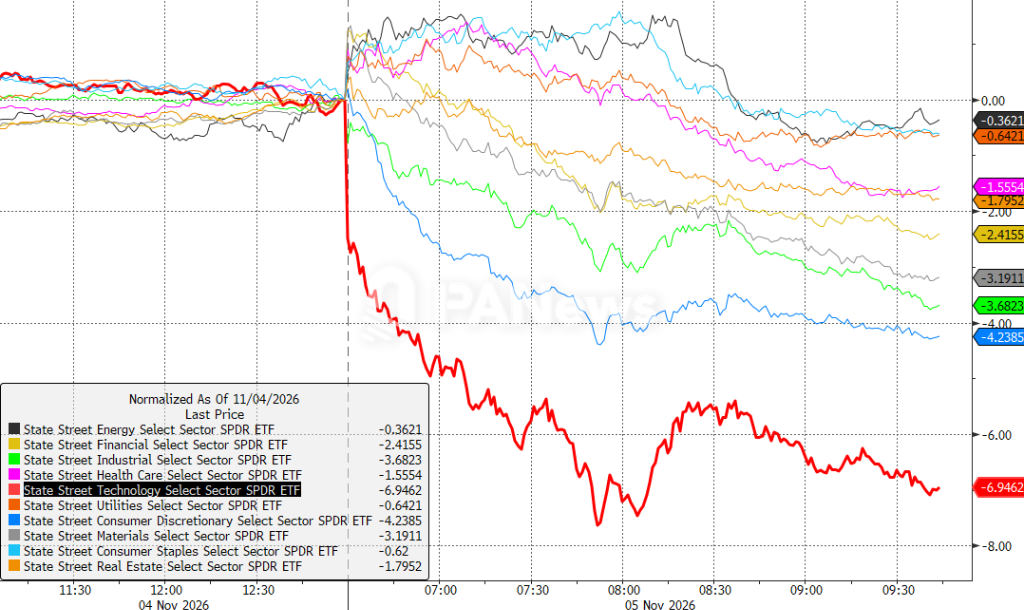
According to a Morgan Stanley client report, October was the month with the largest active liquidation scale for equity hedge funds in over a decade, with their market exposure reduced by about 9% since June. The Nasdaq 100 index plummeted 6.4% in a single day on Thursday, evaporating about $2.3 trillion in market value, and the VIX "fear index" soared by 70%, further exacerbating an industry predicament that has persisted for several months. Meanwhile, several hedge funds, including Samlyn Capital, Engineers Gate, and Walleye Capital, have recently announced layoffs or restructuring.
The market turbulence has inflicted damage on the industry beyond a single event. Goldman Sachs noted in a report to clients on Thursday that hedge funds focusing on telecommunications, media, and technology sectors lost over 4% in a single day, eliminating nearly all of the up to 24% annual gains accumulated earlier this summer before the AI rally reversal; multi-strategy funds also lost 1.4% that day, with technology stocks and momentum trading being the main drags.
October Liquidation Wave: The Largest Scale of Liquidations in Over a Decade
The concentrated outbreak of this pressure occurred in October. The Morgan Stanley report shows that the active liquidation of long-short equity hedge funds this month reached the highest level in over a decade, with more than 40% of such funds experiencing flat or negative returns as of October this year, while the S&P 500 index and the Nasdaq Composite index maintained positive annual returns during the same period.
Industry insiders stated that various institutions have been continuously reducing team sizes and liquidating positions in recent weeks to control risks, and these actions have further depressed the popular positions held by many funds, creating a negative feedback loop. Various mainstream investment styles within multi-strategy funds, including fixed income trading and macro trading, have performed poorly in recent months.
A bank executive with business ties to hedge funds stated that had it not been for many funds actively reducing leverage in the previous weeks, Thursday's losses could have been even more severe.
Star Fund Performance Reversal, Some Institutions Face Margin Calls
At the specific institutional level, Lone Pine Capital's hedge fund recorded over a 40% increase in the first half of this year, but subsequently encountered its worst three-month performance since inception in the third quarter. According to insiders, the fund incurred a pre-tax loss of 8.8% in October, with its pre-tax net return turning negative at -7.5% as of October this year. The company's assets under management were approximately $19 billion in September. Lone Pine stated in a letter to investors for the third quarter that performance was hampered by the rapid reversal of AI stocks, and its short strategy targeting companies perceived to be vulnerable to AI impacts also experienced inverse losses.
According to The Wall Street Journal, the once-prominent Arini Capital Management has significantly reduced its bond holdings in recent weeks, partly due to margin calls issued by counterpart banks.
Walleye Capital, after facing its worst single-month performance since March 2020, laid off several equity portfolio managers this week. In a letter to investors obtained by The Wall Street Journal, this multi-strategy fund, which once managed over $17 billion in assets, stated it would return funds to some clients after assessing optimal scale.
Institutional Structural Adjustments: Layoffs and Strategic Contraction Concurrently
This wave of market volatility is driving some institutions to initiate deeper strategic restructuring. Insiders revealed that Samlyn Capital, managing about $7 billion, is narrowing its investment focus to financial services stocks, leading to the departure of heads of other sectors and related investment team members. Some insiders mentioned that Samlyn's flagship fund has incurred a loss of about 5% as of October this year.
Engineers Gate, a fund with a size of about $4 billion founded by Glenn Dubin, recently decided to shut down most of its "quantitative fundamental" strategies—strategies that combine human judgment and quantitative methods—and laid off all portfolio managers under that strategy except for five, with business head Mike Daylamani also leaving. Bloomberg had previously reported on Engineers Gate's layoffs. Insiders indicated that the fund's decline as of October this year was in the mid-single-digit range, and the company stated it would continue to focus on core quantitative investment strategies.
Third Point founder and billionaire Dan Loeb humorously remarked on social media X on Thursday with the comment "Hold tight to your hedge fund manager" in light of this historic market crash. Behind this joke is the deep pressure faced by the entire industry after experiencing the summer AI rally reversal, concentrated liquidations in October, and significant market turbulence driven by politics this week.
免责声明:本文章仅代表作者个人观点,不代表本平台的立场和观点。本文章仅供信息分享,不构成对任何人的任何投资建议。用户与作者之间的任何争议,与本平台无关。如网页中刊载的文章或图片涉及侵权,请提供相关的权利证明和身份证明发送邮件到support@aicoin.com,本平台相关工作人员将会进行核查。


