Author: Deep Tide TechFlow
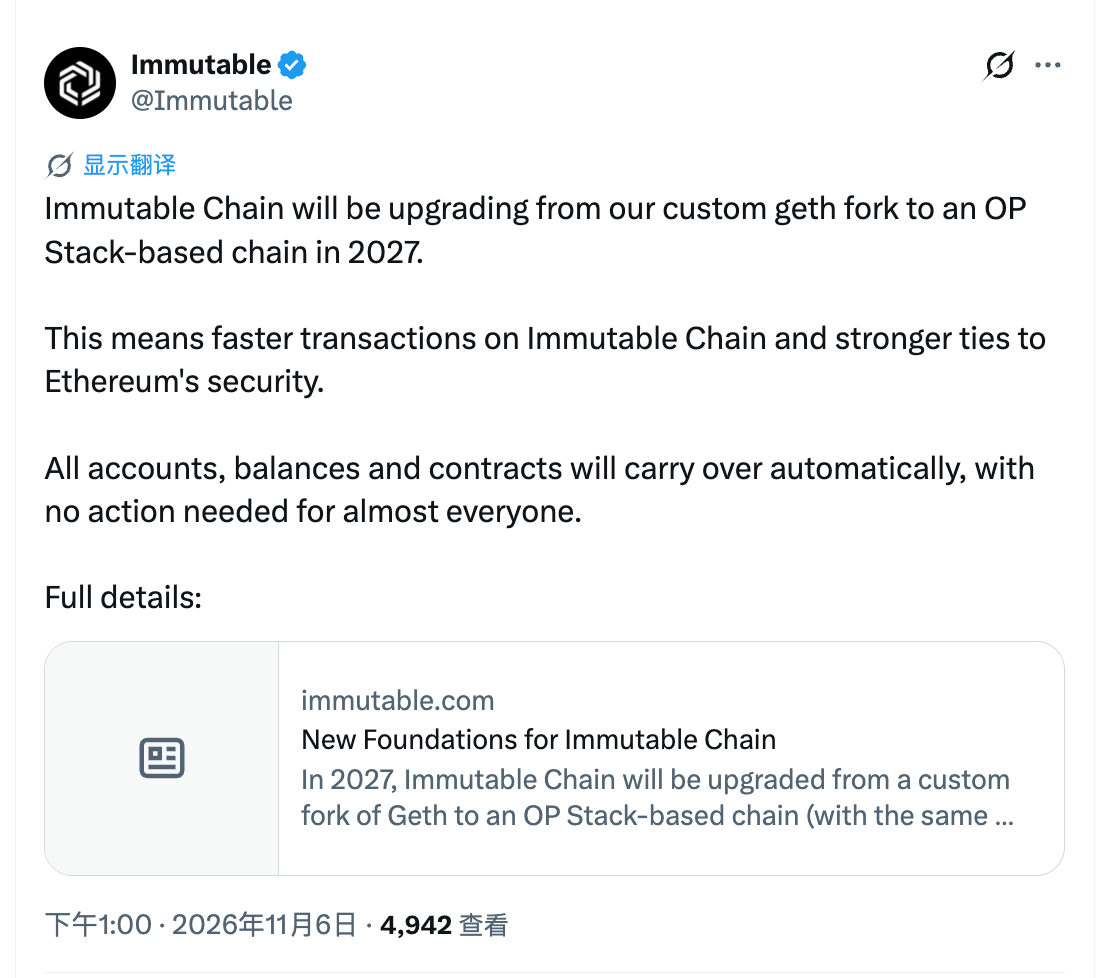
On November 6, 2026, Beijing time, the Web3 gaming public chain Immutable officially announced the evolution roadmap, planning to upgrade Immutable Chain from a customized Geth fork to an OP Stack-based architecture in mid-2027.
According to Immutable's official announcement, after the upgrade, the network will become a standard Ethereum Rollup, with block generation time reduced from 2 seconds to 1 second, replacing the existing cross-chain relay solution with Ethereum's native state commitment.
Farewell to Custom Fork Architecture, Integrating Superchain Ecological Standards
Since its launch, Immutable Chain has maintained its underlying consensus and execution using a deeply customized fork codebase based on Go-Ethereum (Geth). Maintaining a private execution layer fork requires the team to independently bear the burdensome engineering tasks of continuously synchronizing to Ethereum's mainnet hard forks, patch adaptations, and underlying fixes.
After transitioning to OP Stack developer specifications, the underlying client and execution environment will align directly with Ethereum's standard mainline. Various Ethereum Improvement Proposals (EIPs) and EVM core upgrades can be smoothly integrated without the need for the team to refactor, significantly reducing the long-term maintenance costs of the protocol.
With the ecological migration, Immutable will officially integrate into the Optimism Superchain interoperation matrix.
Native Cross-Chain Bridge Cleaning, Introducing State Commitment Verification
The asset cross-chain settlement logic will undergo structural reorganization. Currently, Immutable Chain's native asset cross-chain relies on a multi-party messaging mechanism based on Axelar cross-chain network, which supports network interoperability but has its trust foundation dependent on the signature authorization of intermediary network nodes.
The new architecture will reshape the bridging links, with direct publication to Ethereum's mainnet state commitment as the sole settlement foundation. The official plan will introduce Permissioned Fault Proofs in phases and later integrate Zero-Knowledge Validity Proofs (ZK Validity Proofs) in subsequent engineering evolution.
The underlying verification logic will return to the Ethereum Rollup mechanism, with the ultimate determinacy of asset cross-chain directly guaranteed by Ethereum's mainnet consensus, cutting off security reliance on external cross-chain relay protocols.
Block Production Speed Increased to 1 Second, Withdrawal Cycle and Transaction Cost Adjustments
In terms of gaming interaction experience, the network's block interval will be directly compressed from the current 2 seconds to 1 second, halving the confirmation delay for high-frequency on-chain actions and meeting the immediate state synchronization requirements of action-based and real-time card games.
Performance optimization is accompanied by specific mechanism trade-offs. Since transaction states and proof data need to be submitted directly to Ethereum's data availability (DA) layer, the on-chain fundamental transaction costs will slightly increase compared to a pure sidechain model.
The native withdrawal mechanism will also change. Following the standard dispute resolution process of Optimistic Rollup, assets moved back to Ethereum's mainnet through the official native bridge will trigger an approximately 7-day anti-fraud challenge window, and immediate cross-chain needs will require supplementary channels provided by external liquidity service providers.
Zero Friction Seamless Migration, Testnet Support Exiting by Year-End
The network migration will adopt a seamless state migration strategy. The existing Chain ID, all user addresses, token balances, smart contract logic, and on-chain authorization records will be completely retained, and developers and ordinary players will not need to manually transfer assets or redeploy contracts during the migration period.
The official migration window is scheduled for mid-2027, during which the mainnet will execute a few hours of block production pause to complete the underlying engine replacement, and the exact downtime maintenance schedule will be publicly announced to the community in advance.
Infrastructure cleanup will proceed simultaneously. Immutable confirmed it will officially shut down current testnet support for gaming projects by the end of 2026, as game developers have generally shifted to local simulation nodes and production environment validation, streamlining independent sandboxes to help the team focus on the mainnet's migration preparations.
免责声明:本文章仅代表作者个人观点,不代表本平台的立场和观点。本文章仅供信息分享,不构成对任何人的任何投资建议。用户与作者之间的任何争议,与本平台无关。如网页中刊载的文章或图片涉及侵权,请提供相关的权利证明和身份证明发送邮件到support@aicoin.com,本平台相关工作人员将会进行核查。


