Bitcoin mining companies are making an increasingly obvious choice: no longer using all their electricity and data center resources to mine BTC, but instead leasing this infrastructure to AI companies.
On November 5, Riot Platforms announced the signing of a 15-year data center leasing agreement, providing AI company Anthropic with a 910 megawatt data center site and power infrastructure located in Texas, USA, with a total contract value of approximately 28 billion dollars, and expected average annual rent of about 1.8 billion dollars.
On the same day, another large mining company, Core Scientific, also announced plans to complete its exit from self-operated Bitcoin mining business by the end of 2026, shifting its business focus to AI and high-performance computing (HPC) data center hosting starting in 2027.
These two pieces of news together reveal that mining companies' business models are changing: in the past, they relied on computational power competition, mining BTC to generate revenue; now, they are beginning to directly convert electricity access capability, land, and data centers into long-term leasing income for AI companies. 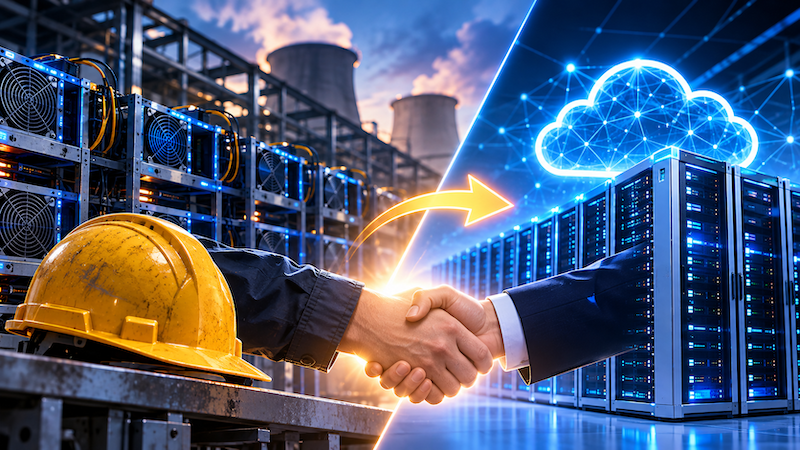
From Mining BTC to Selling Computational Power, Why are Mining Companies Shifting Collectively?
This transformation primarily stems from changes in the economics of mining.
After the Bitcoin halving, the block reward income for mining companies has been compressed, while electricity, equipment depreciation, maintenance, and financing costs do not decrease simultaneously. As competition in overall network computing power continues, some listed mining companies have unit mining costs that exceed market prices.
CoinShares pointed out in their Q2 2026 mining report that the weighted average cash mining cost for listed mining companies is approximately 75,500 dollars per BTC, with the average Hashprice dropping to 27.7 dollars per PH/s/day in June, reaching a historic low. For mining companies with higher costs, continuing to expand self-operated mining may not necessarily bring better capital returns.
Meanwhile, the demand for AI computational power is growing rapidly. Training and inference of large models require a large number of GPUs, stable power supply, and data centers suitable for high-density computing. New data centers in the United States face limitations such as power grid access queues, transformer supply, and approval cycles; thus, mining companies that already have grid access, land, and power capacity have gained new commercial value.
The infrastructure that mining companies built for mining is becoming a resource for AI companies to compete for.
Riot and Core Scientific: Two Transformation Paths
Riot is a recent representative case.
In addition to signing a long-term lease agreement for 910 megawatts worth approximately 28 billion dollars with Anthropic, Riot has previously worked with companies like AMD to promote data center collaboration. The company plans to deliver related facilities in phases, with the full 910 megawatt capacity expected to be completed by July 2028.
Notably, Riot is funding its infrastructure expansion by selling BTC. The company disclosed that it sold a total of 20,264 BTC in the first nine months of 2026, worth approximately 1.5 billion dollars; of these, 10,599 BTC were sold in the third quarter. As of the end of September, its BTC holdings decreased from 11,380 at the end of June to 2,418.
This means that Riot is not only redirecting future power resources towards AI but is also monetizing its accumulated Bitcoin reserves to fund new businesses.
Core Scientific's transformation is more thorough.
The company achieved data center hosting revenue of 215.4 million dollars in the third quarter, a nearly 60% quarter-over-quarter increase, accounting for about 92% of total revenue for the quarter; in contrast, self-operated mining revenue was only 12.3 million dollars, a year-on-year decline of approximately 79%. Management stated that they plan to exit their self-operated mining business in the fourth quarter.
As of the end of September, Core Scientific had 485 megawatts of hosting capacity and was advancing long-term data center projects related to CoreWeave and AMD. The company anticipates that after the relevant collaborations are fully delivered, a combined capacity of approximately 1.1 gigawatts is expected to generate significant annual revenue.
These two companies represent different stages: Riot retains its mining business while expanding AI infrastructure; Core Scientific has already shifted its resource allocation focus to data center hosting, preparing to exit self-operated mining.
The Valuation Logic of Mining Companies is Changing, and BTC Will Be Affected
The most direct change from mining companies transforming towards AI is in the valuation logic.
In the past, mining companies' revenue and stock price highly depended on BTC prices, overall network computing power, mining difficulty, and energy costs. When BTC rises, mining companies often achieve higher profits; when the market declines, profit margins can quickly contract.
The AI data center business places more emphasis on long-term lease contracts, already connected power capacity, customer credit, and facility delivery capabilities. Stable long-term contracts have the opportunity to provide more predictable cash flow, which may allow mining companies to gain a valuation method different from traditional mining companies.
However, this does not mean that all mining companies can become AI infrastructure companies. CoinShares' report shows that mining companies that already have AI or HPC contracts have valuations significantly higher than their peers who have not signed contracts and still primarily focus on mining. The market is pricing actual contracts and deliverable capacities, rather than merely paying for transformation plans.
For BTC, mining companies selling reserves will increase market supply in the short term, but it is necessary to distinguish between two situations: selling existing BTC reserves constitutes a one-time asset monetization, while the ongoing sale of newly mined BTC relates to the operational cash flow of mining companies. The two should not be simply equated.
In the medium to long term, if more mining companies exit self-operated mining, overall network computing power may be affected. However, the Bitcoin network will adjust difficulty to adapt to changes in computing power; what truly merits attention is the speed of miner exits, network security budgets, and the profitability of remaining mining companies.
The Transition to AI is Not Without Risks
The biggest challenge of mining companies' transformation is the significant capital investment and engineering aspects required to go from having power resources to actually building AI data centers.
AI-grade data centers have far higher requirements for power supply stability, heat dissipation, network connectivity, and facility standards than traditional mining sites. Costs of renovations, financing, and delivery cycles may all impact project returns.
Moreover, long-term lease contracts do not eliminate risks. If customer demand changes, projects are delayed, or financing fails to materialize, mining companies may face heavy capital expenditure pressures. Data center approvals, power usage restrictions, and local residents' opposition to energy consumption may also become new obstacles.
The shift of mining companies towards AI is not just about seeking revenue sources outside of mining, but is redefining the core assets they own. In the past, they sold BTC to generate income; now they are starting to sell electricity access capabilities and computing infrastructure. What truly determines the success or failure of this transformation is not how many billion-dollar contracts have been signed, but whether they can deliver on time and continuously generate cash flow.
If you are also interested in the Crypto market and want to participate in trading or asset allocation, you can register through the following exclusive channels to enjoy benefits:
Binance: Register through the exclusive link and enter the invitation code aicoin668 to enjoy a 10% rebate.
Registration Link: https://jump.do/zh-Hans/xlink-proxy?id=3
Benefits Group: https://www.aicoin.com/link/chat?cid=gmLgwvKD1
OKX: Register through the AiCoin exclusive link to enjoy a permanent 20% rebate.
Registration Link: https://jump.do/zh-Hans/xlink-proxy?id=2
Benefits Group: https://aicoin.com/link/chat?cid=l61eM4owQ
Bitget: Enjoy a 10% trading fee rebate by registering through AiCoin's exclusive channel.
Registration Link: https://jump.do/zh-Hans/xlink-proxy?id=6
Benefits Group: https://aicoin.com/link/chat?cid=N63yYYKQE
You are also welcome to join the AiCoin-related communities to get more information on new exchange coins and earning opportunities:
Official Telegram Community: https://t.me/aicoin_support
AiCoin Chinese Twitter: https://x.com/AiCoinzh
This content only represents the author's personal view and does not represent the position of this platform. The views, conclusions, and suggestions in this article are for investors' reference only and do not constitute any investment advice related to this platform. The market has risks; investing requires caution.
免责声明:本文章仅代表作者个人观点,不代表本平台的立场和观点。本文章仅供信息分享,不构成对任何人的任何投资建议。用户与作者之间的任何争议,与本平台无关。如网页中刊载的文章或图片涉及侵权,请提供相关的权利证明和身份证明发送邮件到support@aicoin.com,本平台相关工作人员将会进行核查。