Next Monday, November 9, the "Hyperliquid Layer2" Elysium created by Kinetiq will officially launch. Fomo and Pumpfun trading applications will support this chain, and GMGN also announced its participation on the first day. As the Robinhood Chain market cools down, on-chain traders have already sensed new opportunities. Ansem also expressed a strong interest in Elysium.

The launchpad is also starting to warm up. According to the first-day testing data released by Ascend, the trading volume was approximately 5.97 million dollars, with 47,254 transactions completed, 873 tokens deployed, and 34,808 dollars in protocol fees generated. This indicates a strong supply of new coins and demand for trading.
However, new chains never lack the excitement of the opening. What truly deserves attention about Elysium is the Hyperliquid, Kinetiq behind it, and a group of applications attempting to connect the issuance, trading, and long-term operation of new coins.
Hyperliquid On-Chain Ecosystem Gaps
The trading business of Hyperliquid has already taken off, but there are still significant gaps on the application side.
HyperCore is responsible for the order book and trade matching, while HyperEVM handles smart contract applications. Both share the underlying state, and the execution capacity of HyperEVM needs to account for the operation of HyperCore. This gives Hyperliquid a powerful trading market, but it struggles to accommodate high-frequency, crowded, and rapidly evolving on-chain applications.
Kinetiq is well aware of this issue.
Elysium came into being as a result. According to Kinetiq co-founder Omnia’s introduction in an interview, this chain uses the Arbitrum technology stack and Conduit's G2 sorter, with a target block time of 100 milliseconds, paying gas with HYPE, and settling to HyperEVM. We have previously introduced that Elysium aims to provide a more generous execution environment, allowing for the token trading, issuance, and DeFi demands surrounding Hyperliquid to find a place to land.
The value of Fomo, Pumpfun trading applications, and GMGN lies in incorporating Elysium into the usage habits that traders are already familiar with. Seeing new coins, checking trades, buying and selling, without needing to learn a new set of unfamiliar tools. For new projects, this also means there is an opportunity to reach people beyond the Hyperliquid native community at the time of issuance.
Post-trading services are also being supplemented. The ecosystem list introduced by Omnia includes Uniswap, 0x, KyberSwap, Li.Fi, Wormhole, as well as wallets and infrastructure like MetaMask, Rabby. Nest is preparing to build a trading pool on Uniswap v4 to meet the mainstream asset exchange needs brought by new coins, along with the continuous liquidity needs as projects grow.
A Launchpad Aligned with Interests
The easiest business for a launchpad to become involved in is to continually issue new coins and then extract fees from trades. As long as the creators and the platform can get money quickly, whether the project can survive until next week becomes the trader's own problem.
Ascend is attempting to break this dynamic.
On the token creator's side, it ties fee distribution to project growth. A portion of the early creator fees for new coins will be temporarily held, to be released as the project meets certain conditions; in higher market cap ranges, creators receive a larger share of the base trading fees, while the proportion taken by the protocol decreases. Creators can also choose to allocate their share for holder rewards, project token buybacks, or a combination of these uses.
This design aims to encourage a clear behavior: making the project grow continuously is more appealing than taking fees immediately after a bulk issuance. Teams willing to leave trading revenue for the community also have established tools available.
Ascend has made further arrangements for its own revenue.
It does not issue a separate platform token but directly uses KNTQ as the protocol token. The business growth of the launchpad is aligned with the interests of Kinetiq and Elysium.
According to the official documentation's distribution model, of every 100 dollars in protocol fees, 10 dollars go into the treasury, 72 dollars are used to purchase KNTQ, and 18 dollars are used to purchase HYPE. Of the purchased KNTQ, 40% is for destruction, while the remaining 60% supports ecosystem token buybacks, Ascend points program, and protocol’s own liquidity; the purchased HYPE is used for rewarding participants and staking.
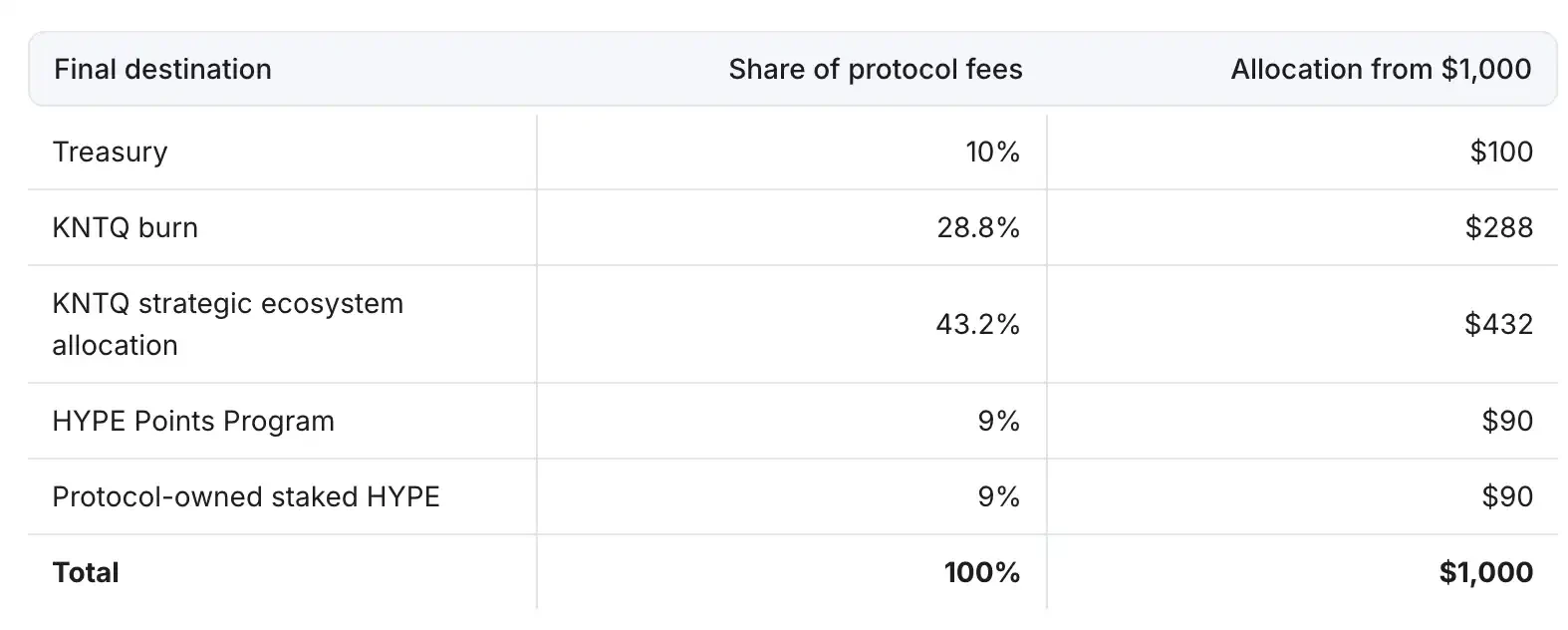
Therefore, the more active new coin trading is on Ascend, the more funds enter KNTQ, HYPE, and ecosystem projects according to this design. KNTQ holders can pay attention to Ascend without needing to go around to another launchpad token; Ascend can also leverage the existing Kinetiq community for initial attention.
Omnia mentioned that Elysium will use 50% of sorter income to buy back KNTQ; Ascend will share its Elysium sorter income for builder support, including funding and HyperCore spot listing preparation. Income generated from on-chain trading has the opportunity to help new projects enter the market.
For HYPE holders, Ascend has also designed a different way to participate: depositing kHYPE into its staking vault, using the staking returns to purchase qualifying ecosystem tokens, and then distributing the tokens to the corresponding stakers. Holders retain their HYPE exposure while participating in new projects with staking returns.
These mechanisms collectively point to a common goal: to ensure that trading activities on the launchpad continue to provide funds to support the assets and projects behind it.
Activating HyperCore's "Coin Listing Effect"
The growth goals of many new coins ultimately land on "listing on a larger exchange." Omnia described a similar path for Elysium in an interview: projects first accumulate attention, trades, and liquidity on-chain, then enter the HyperCore spot market, further vying for HIP-3 deployers to open perpetual contract markets.
Ascend has written this path into its project support system. Qualified projects can gain Ascended status, entering the scope of subsequent ecosystem support and preparing for the HyperCore spot and HIP-3 markets.
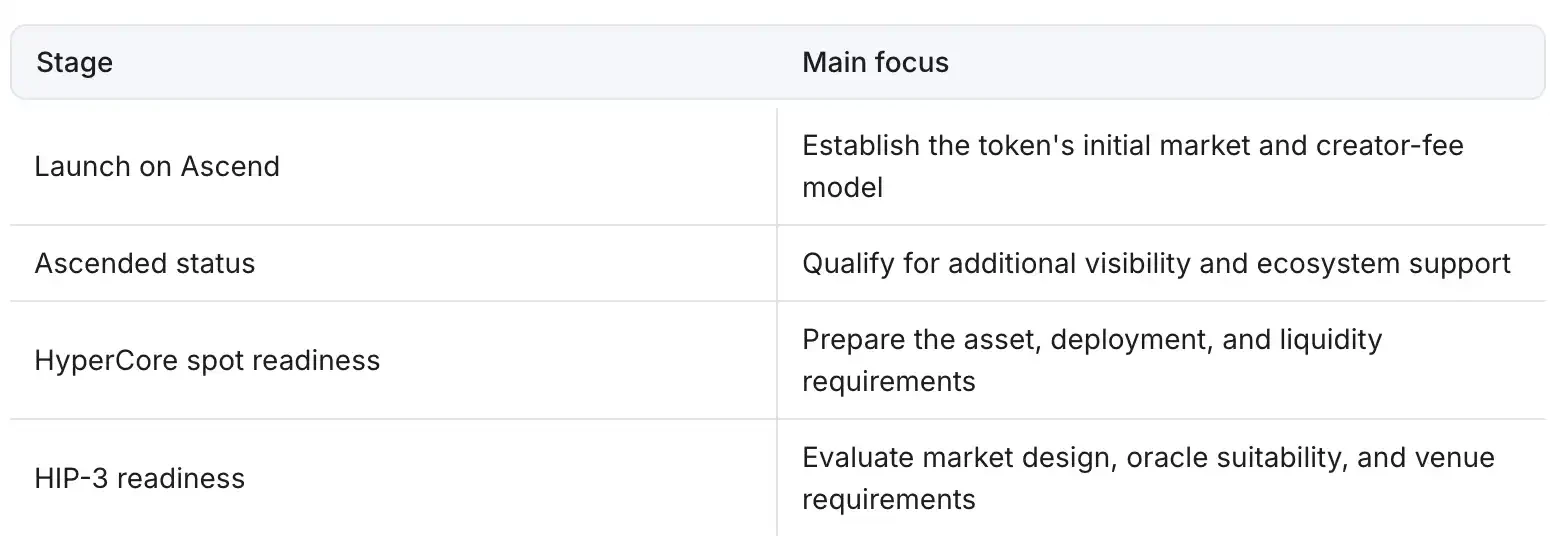
The same path also applies to assets beyond memes.
Elysium is designed around HyperCore's prices and order book depth to attract professional market makers to provide spot quotes, then hedge risks on HyperCore. Traders complete a regular exchange at the front end, while the market-making demand behind it can further become contract transactions on Hyperliquid.
Montra
Unlike Ascend's direct use of KNTQ as the protocol token, another launchpad Montra retains its own protocol token MONTRA and uses it to organize early participants.
Montra’s standard token issuance process is directly built on Uniswap v4. Token creators can choose to allocate their fee income to the team wallet, multiple recipients, or directly distribute it to token holders; the protocol takes its share, and in the MONTRA buyback design, 70% of it is used to purchase and burn MONTRA, while 30% goes into the treasury.
For traders looking to explore Elysium, a more direct focus is the MONTRA token airdrop.
25% of the total supply of MONTRA will be used for airdrops, divided into five categories, each accounting for 5% of the total:
- Existing active users of HYPE, KNTQ, and Elysium.
- Early active creators and traders of Montra.
- Participants who discover, trade, and hold the top ten tokens of Montra at the time of the snapshot.
- Liquidity providers.
- Verified quality creators and builders referrals, as well as contributions to social media content and dissemination (verified through the official Discord).
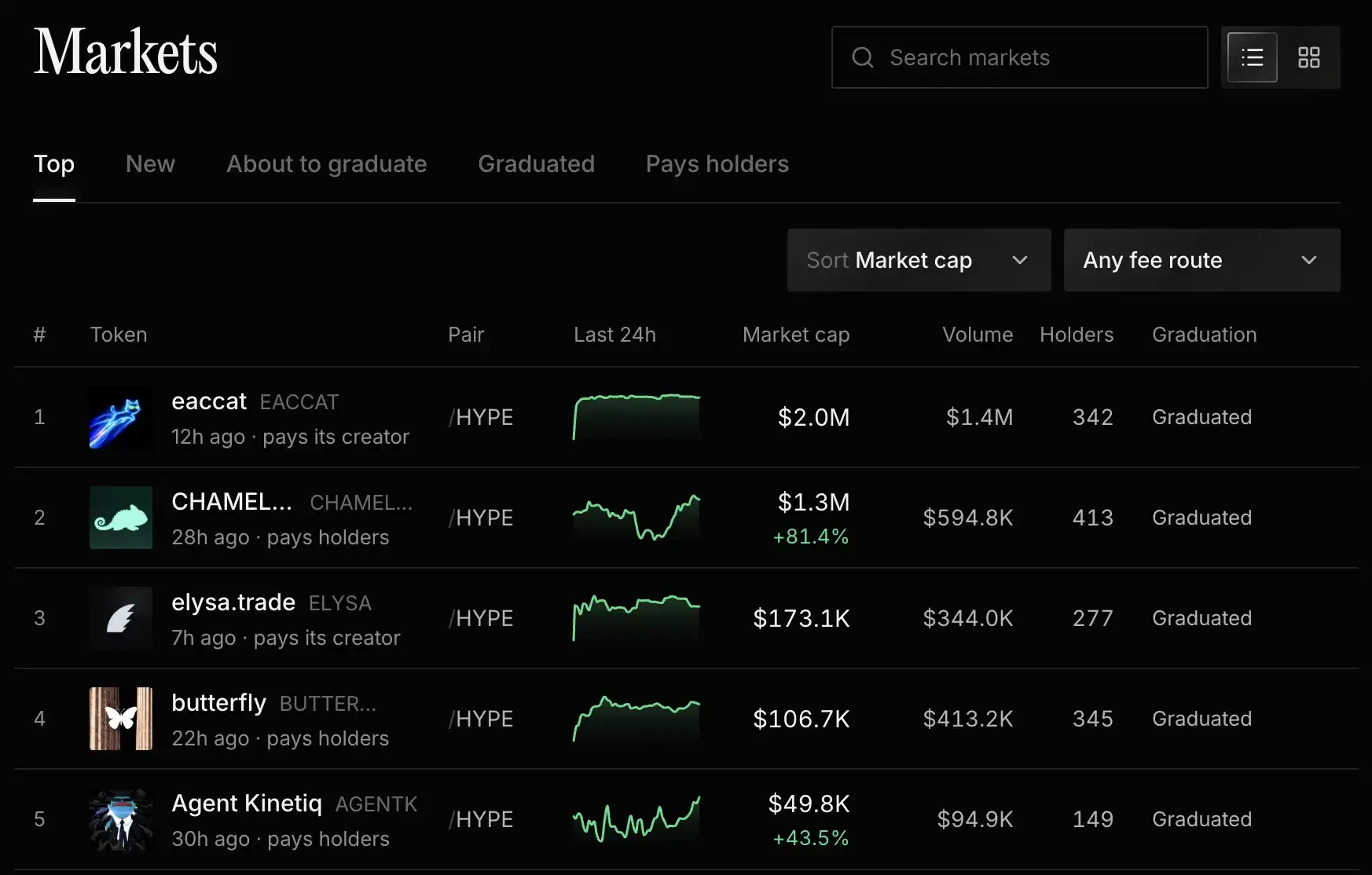
Montra has recently opened pre-trading, with two tokens already exceeding a market capitalization of 1M.
Ascend concentrates value into KNTQ, while Montra expands distribution with its independent token, thus providing different starting methods for Elysium. For traders, these two launchpads will also serve as important windows to observe where new projects emerge and where funds accumulate.
After Robinhood, Elysium is poised to become the next on-chain focus: Pumpfun, Ascend, and Montra issuing assets, fomo and gmgn serving as trading entrances, and Hyperliquid providing expectations for "coin listing" and exit liquidity.
免责声明:本文章仅代表作者个人观点,不代表本平台的立场和观点。本文章仅供信息分享,不构成对任何人的任何投资建议。用户与作者之间的任何争议,与本平台无关。如网页中刊载的文章或图片涉及侵权,请提供相关的权利证明和身份证明发送邮件到support@aicoin.com,本平台相关工作人员将会进行核查。


