Author: tranks (@heytranks, Data provided by: Bonanza Lab)
Translation: Shenchao TechFlow
Senchao Guide: As one of the most active cryptocurrency trading hubs for retail investors globally, the South Korean won (KRW) trading market has traditionally had a significant liquidity spillover effect on the global secondary market. However, since the implementation of the Specific Financial Information Act in 2021 and the establishment of a digital asset trading alliance (DAXA) among five major exchanges, the listing criteria in the South Korean market are undergoing profound institutional changes.
On-chain data think tank Bonanza Lab's detailed statistics for Upbit, Bithumb, Coinone, Korbit, and Gopax show that the proportion of locally launched altcoins dropped from 85% to single digits following regulatory enforcement, while assets with more than two years of mature trading history on overseas mainstream exchanges have become the focus of scrutiny. This regulatory evolution has significantly reduced investment warnings and delisting risks, but it has also weakened the revenue from trading fees associated with first-day surges, forcing South Korean exchanges to explore the ultimate transformation of their business.
The regulatory framework gradually takes shape, and the proportion of locally launched tokens declines significantly
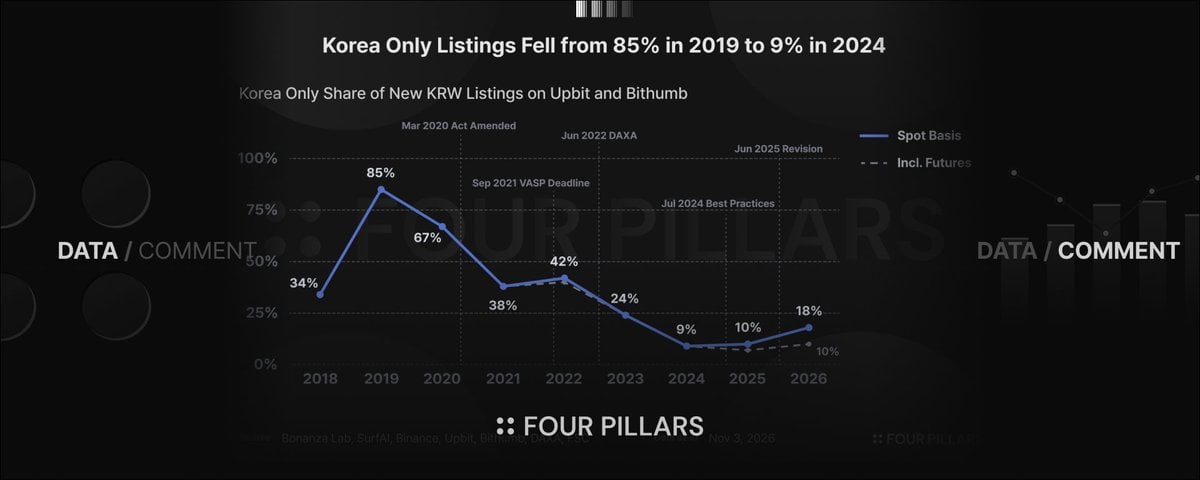
As South Korea's cryptocurrency regulatory framework gradually establishes and improves, the proportion of purely South Korean tokens (Korea-only listings) has significantly decreased.
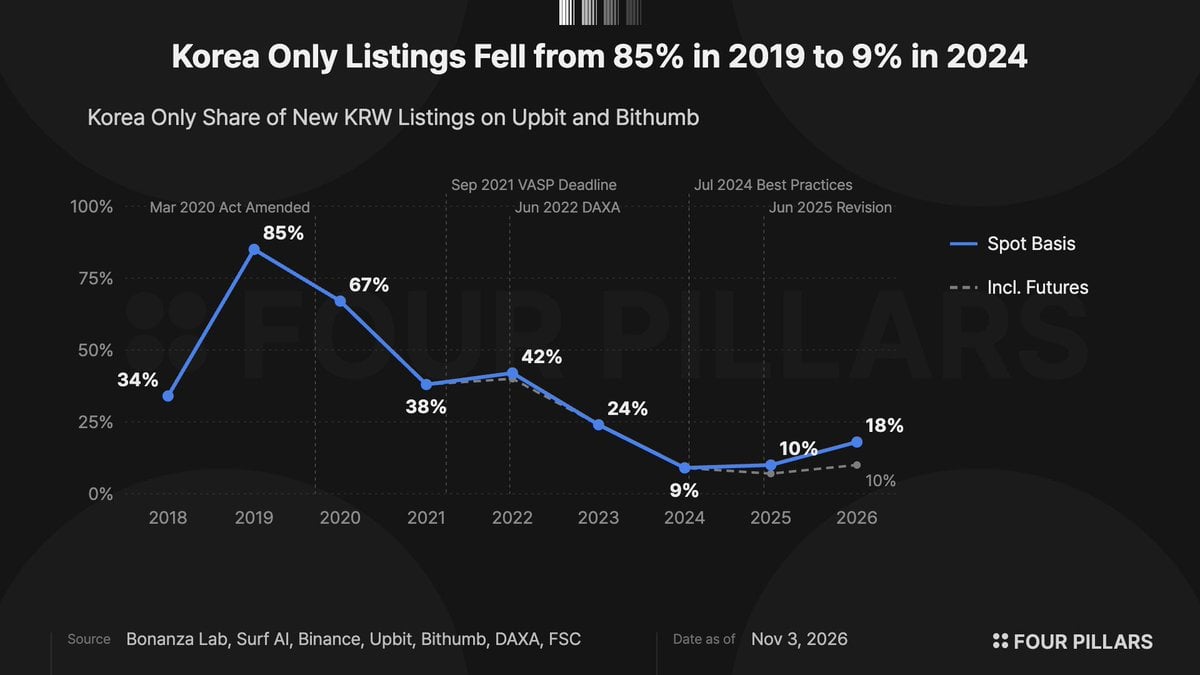
Figure: Trend of the proportion of locally launched tokens among the five major KRW exchanges in South Korea (2019 to 2026)
The above figure shows the evolution of the proportion of purely South Korean locally launched assets among new trading pairs in Upbit, Bithumb, Coinone, Korbit, and Gopax, the five regulated KRW trading platforms.
This proportion has significantly declined from 85% in 2019 to 9% in 2024. Compared to the development milestones of South Korea's virtual asset regulation, its institutional evolution path is very clear.
This transition began with the Specific Financial Transaction Information Report and Utilization Act (referred to as the Specific Financial Act). This act took effect in March 2021, requiring trading platforms to complete official real-name registration by September 2021.
For the KRW market, obtaining a bank-verified real-name account became a mandatory legal requirement, and exchanges must strictly implement anti-money laundering (AML) compliance standards at traditional financial levels. It is estimated that these compliance standards directly reshaped the listing decisions of exchanges.
In fact, the number of purely locally launched tokens sharply decreased from 19 per quarter to just 3 in the third quarter of 2021 (the quarter when registration submissions were due), after which the South Korean market's listing targets fully shifted to prioritize assets that already had trading records overseas.
Subsequently, unified listing review standards were introduced, which all exchanges adhered to. In 2022, the five KRW exchanges jointly formed the Digital Asset Trading Alliance (DAXA) and established standardized review guidelines, with the best practice principles for listings to take effect in July 2024.
Although these guidelines do not make overseas listings an absolute prerequisite, they stipulate that assets traded on compliant overseas exchanges for more than two years may be considered to automatically meet the basic review requirements such as white paper and information disclosure.
By 2026 (as of October), the proportion of purely locally launched tokens had slightly rebounded to 18%, but if assets that first traded in overseas futures markets are excluded, the actual proportion remains at a very low level of 10%.
The total volume of new listings increases against the trend, timing dynamically adjusts with market cycles
Despite the significant shrinkage in the share of purely locally launched tokens, this does not mean that the total number of new listings by South Korean exchanges is decreasing.
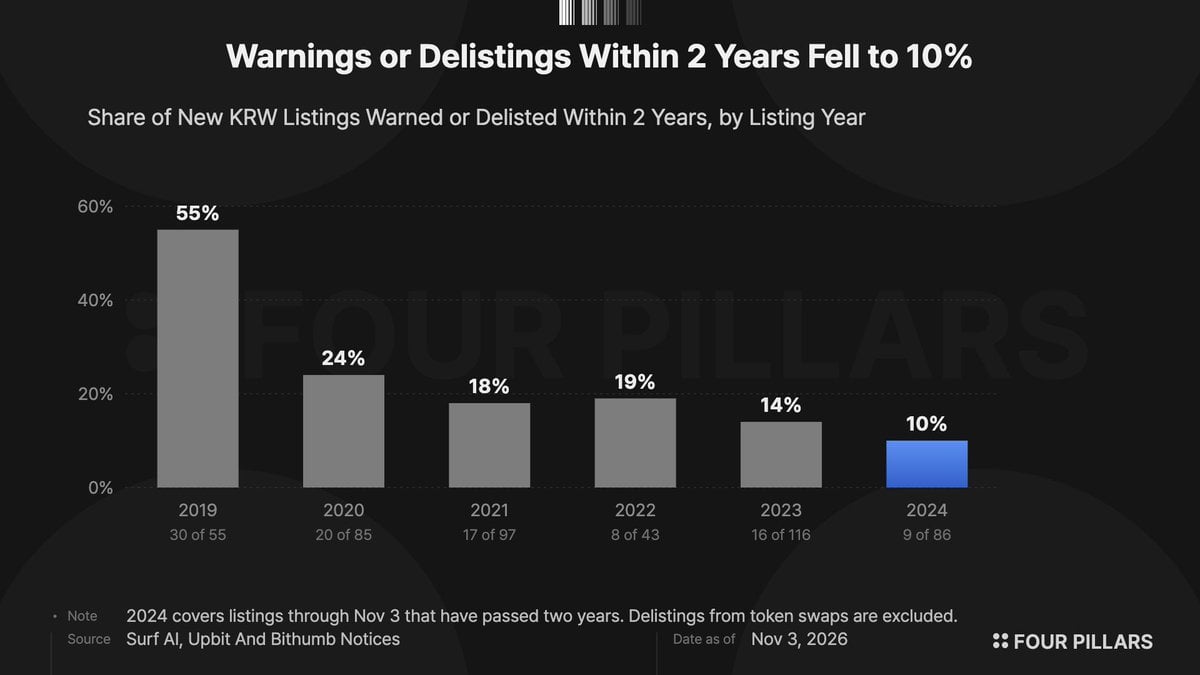
Figure: Number of new listings in South Korea's KRW market and the distribution of overseas trading time structure
Statistics show that the total number of new listings in the KRW market for mainstream platforms Upbit and Bithumb increased from 43 in 2022 to 116 in 2023, reaching 125 in 2024, and climbing to 238 in 2025.
The amount of time an asset has been trading overseas before entering the South Korean market shows a high cyclical correlation with the overall market situation.
In 2025, when Bitcoin was at a historical high in KRW, as many as 111 assets were rapidly introduced to the South Korean market within 30 days after being listed overseas, accounting for 47% of the total listings that year.
In stark contrast, in 2026, mature assets with trading histories of more than a year overseas became the new main force, totaling 52 (accounting for 31%), even legacy tokens that had been traded overseas for more than six years (such as CRV and RSR) were officially introduced to the South Korean market during this period.
Therefore, the listing practices of South Korean exchanges have undergone significant changes: on one hand, they adhere to the access framework centered on assets that are already listed overseas established during the regulatory formation phase; on the other hand, they flexibly adjust the timing of specific new listings in advance or delay it based on the temperature of the secondary market.
Improved stability post-listing, significant reduction in the delisting rate of mature overseas assets
As the proportion of assets with trading history overseas continues to rise, the overall stability of tokens after being listed in South Korea has significantly improved.
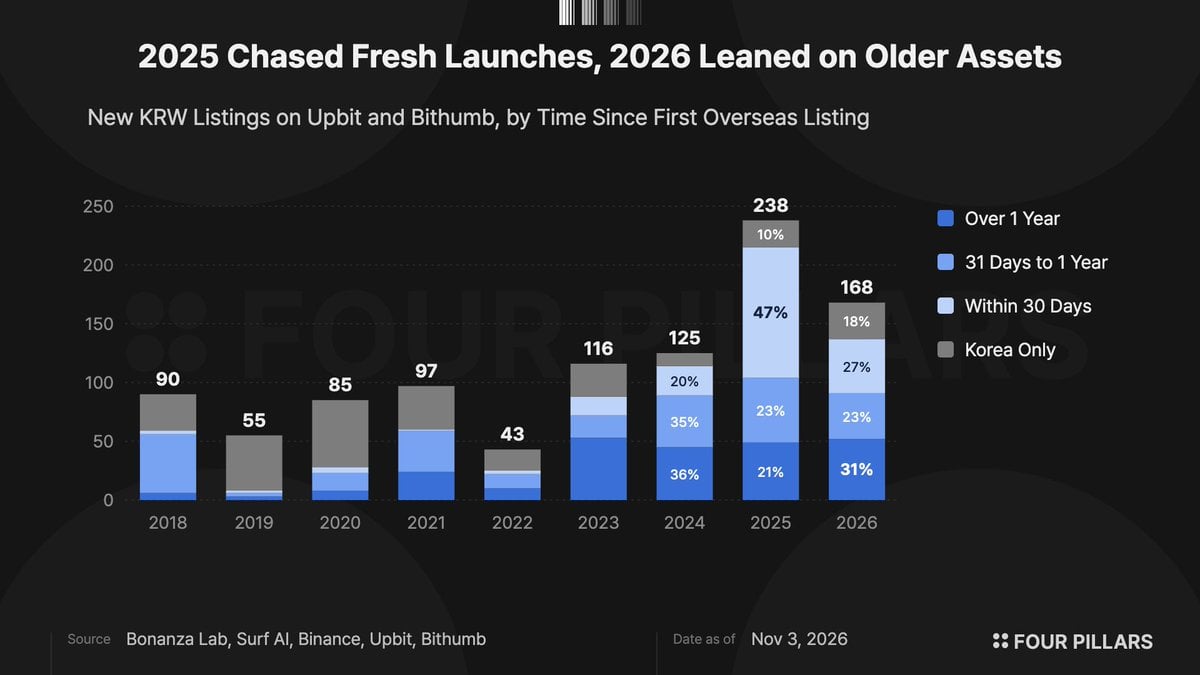
Figure: Proportion of assets listed as investment warnings or delisted within two years of listing
The proportion of assets listed as "investment warnings" or declared to terminate trading (delisted) within two years after being listed has steadily decreased from 24% in the 2020 listings to 10% in the 2024 listings.
Assets with different listing attributes show significantly divergent risk performance. Among all assets listed between 2020 and 2024, 44 out of 148 locally launched tokens (accounting for 30%) were listed as warnings or delisted within two years; while for assets that first traded overseas, only 26 out of 279 (accounting for 9%) faced similar situations, with the warning rate being less than one-third of that for locally launched tokens.
Overseas trading time and price resilience, price fluctuations in the first month tend to stabilize
At the same time, the length of time an asset has been trading overseas significantly impacts its price dynamics in the South Korean secondary market after being listed.
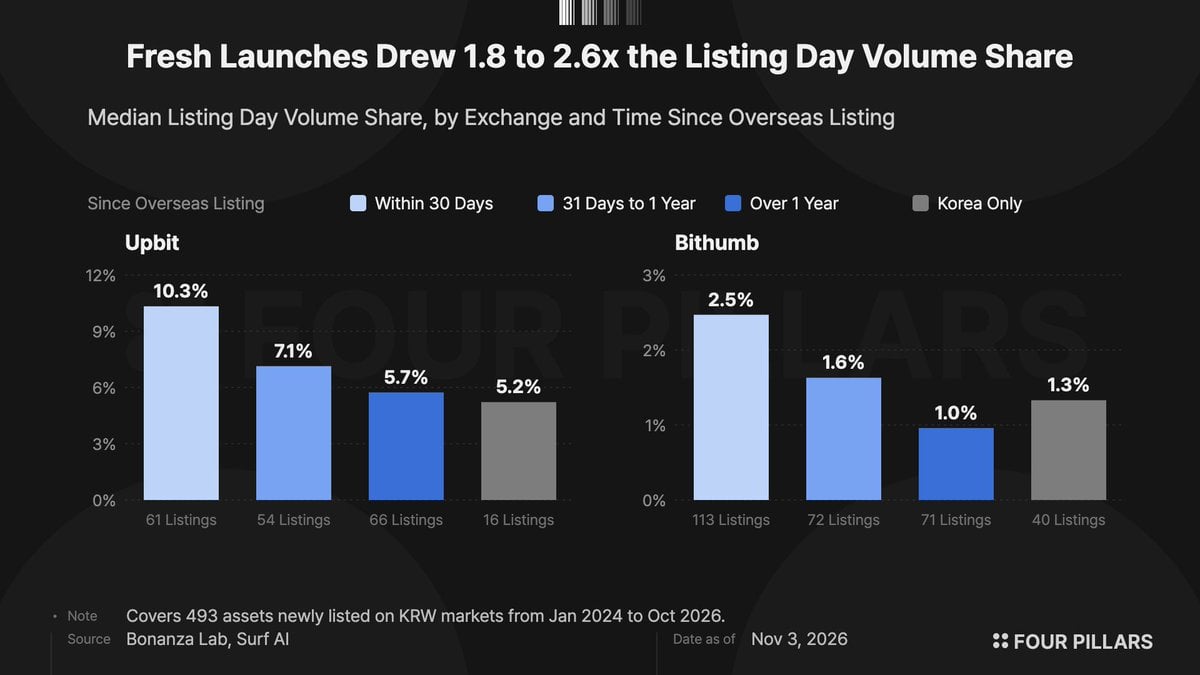
Figure: Comparison of the median price decline of assets with different overseas trading histories 30 days after listing
From the statistical median, assets that were urgently introduced to South Korea within 30 days after being listed overseas experienced a median price decline of 39% within the first 30 days after being listed in Korea; in contrast, mature assets with more than a year of trading history overseas had a median price decline of only 7% 30 days after being listed.
In short, assets that traded overseas first tend to have a lower probability of being placed on investment warnings or being delisted after being listed in South Korea; among these assets, the longer the overseas trading time, the smaller the price retracement in the initial phase of their listing in South Korea.
Due to the effective reduction of the review burden for such mature assets by the best practice guidelines, even if the listing schedule is dynamically adjusted according to market conditions, South Korean exchanges will likely anchor their listing focus on mature assets with long-term trading histories overseas for the long run.
The new challenge for exchanges: cooling liquidity and revenue transformation beyond listings
However, overly prioritizing the listing model based on overseas trading history is not entirely good news for exchanges.
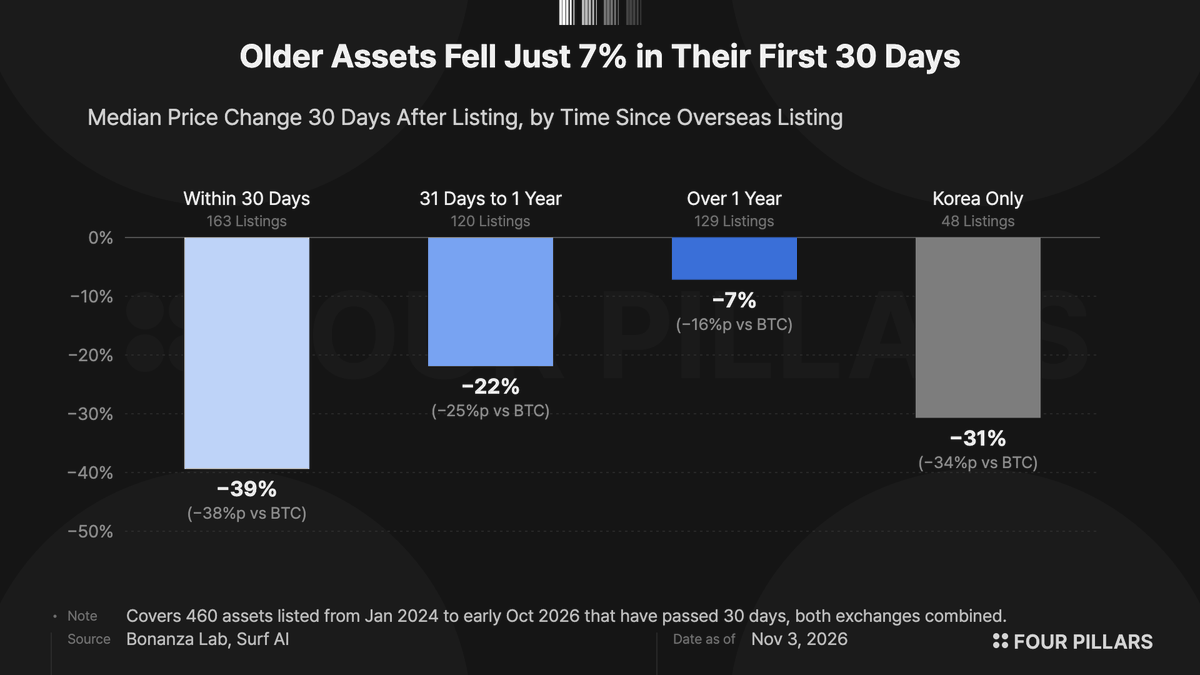
Figure: Proportion of first-day trading volume and reliance model on exchange fees
This is because those well-traded assets overseas often generate relatively limited speculative trading volume on their first day of trading in South Korea.
As most of the revenue of South Korean exchanges heavily relies on spot trading fees, new tokens lacking explosive first-day potential may directly drag down the exchanges' profitability.
Of course, if a bullish market restarts in the future, the number of new emerging popular assets just recently released overseas may again increase, thereby alleviating revenue pressure in the short term. But if exchanges merely rely on a passive listing structure, it would be difficult to establish a sustainable business model that is resilient to market cycles.
As the regulatory compliance system matures, the safety and stability of listed assets have indeed greatly improved. The core challenge currently faced by South Korean exchanges is how to expand new trading demands and diversify business revenue sources beyond merely being driven by listings.
Note: The data and statistics in this article are supported by the on-chain research institution Bonanza Lab (https://bonanzalab.io).
免责声明:本文章仅代表作者个人观点,不代表本平台的立场和观点。本文章仅供信息分享,不构成对任何人的任何投资建议。用户与作者之间的任何争议,与本平台无关。如网页中刊载的文章或图片涉及侵权,请提供相关的权利证明和身份证明发送邮件到support@aicoin.com,本平台相关工作人员将会进行核查。


