Author: Wall Street Insights
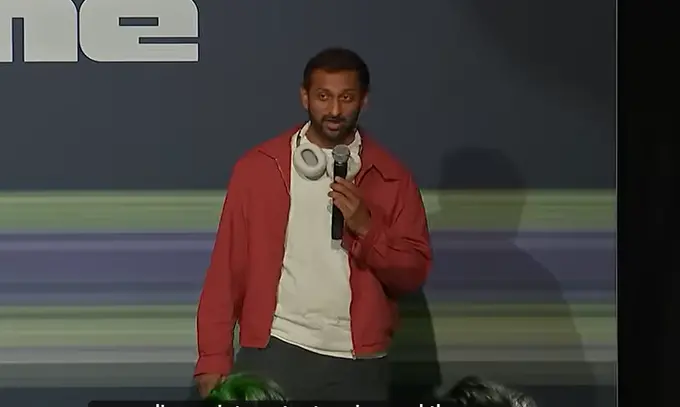
On November 3, Dylan Patel, founder and CEO of semiconductor research firm SemiAnalysis, delivered a speech at Runtime 2026 on the topic of computing power, capital, and data centers.
He noted that OpenAI and Anthropic are heavily pre-ordering computing power; for example, in 2027, their share of new computing power will account for 25% to 40%. Under the pressure of demand, the rental price of NVIDIA H100 has rebounded significantly from its lows, and in the future, the rental fee for B300 could rise to over $7 per hour.
The funding side is also tight: U.S. Treasury yields have surged over the past two months, with the 10-year yield exceeding 5% in early October, making it increasingly difficult for emerging cloud vendors relying on borrowed money to build data centers to secure financing.
This speech occurred a week after Anthropic publicly filed its S-1, and the market had just seen the computing power account behind a leading lab. Patel said that NVIDIA has intervened to support about 6.5 gigawatts of computing power clusters, but it still cannot change the overall tight supply-demand landscape.
Newly Added Computing Power is Mostly Booked by Two Labs
The tightness in computing power stems from a concentration of buyers. The total global computing power has increased rapidly: about 60 gigawatts by the end of 2024, exceeding 100 gigawatts by the end of this year, nearly doubling in two years. Patel said, "By the end of 2024, the global computing power will be 60 gigawatts, and by the end of this year, it has exceeded 100 gigawatts, nearly doubling in two years."
The largest buyers of the increment are OpenAI and Anthropic. The total computing power in their hands was approximately 4 gigawatts at the end of last year, around 10 gigawatts this year, and expected to exceed 20 gigawatts next year. Looking at the increment, the combined new computing power taken by the two will be between 25% and 40% in 2027.
Patel estimated: "They are taking 25%, 30%, or 40% of the newly added computing power. At the end of last year, OpenAI and Anthropic's revenues soared with Claude Code, leading them to buy computing power frantically, and Meta also started buying aggressively. For many people now, it is no longer possible to purchase computing power."
Another detail worth noting is that this computing power is primarily used for training rather than serving users (inference). Patel said that Anthropic currently has 4 gigawatts, of which the entire Claude Code only accounts for several tens of megawatts.
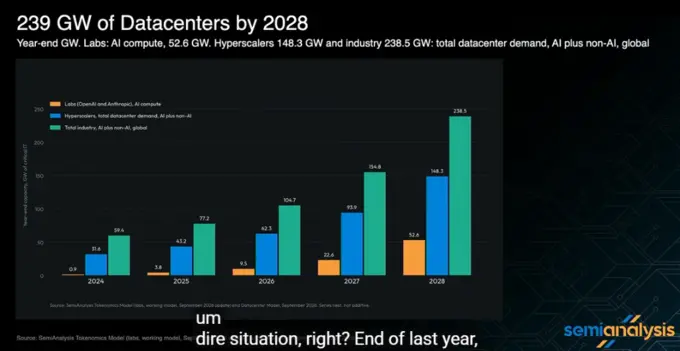
Figure: Global Data Center and Major Labs Computing Power Demand Forecast from 2024 to 2028
Profitable Inference for Open Source Models with Rising Rental Prices
With more buyers, prices will naturally rise. Patel believes that another driving force behind rising rental prices is the highly profitable business of selling Tokens (the metric units of model output), leading to many willing to pay high prices for GPU rentals compared to those willing to sell.
He provided a calculation based on each megawatt. Building a B300 cluster and spreading the construction and five-year operation costs comes to about $9 million per year; renting from cloud firms, "if you can get it down to $14 million a year, consider yourself lucky." But as long as you rent it out for open source model inference, you can earn profits significantly higher than that. Even with a utilization rate of only 30%, substantial returns can still be achieved.
This estimate is based on SemiAnalysis's open source InferenceX benchmark, using containers that anyone can download, only utilizing two sets of open-source inference software, vLLM and SGLang, without any custom optimizations.
The price data aligns with this logic. Patel said that last October was the lowest point, with H100 around $1.70, and you could find it as low as $1.45; now the transaction price is between $2.40 and $3.20, and signing for this price two years ago would have been considered unbelievable, yet now people are eager to sign within this range.
SemiAnalysis's own one-year contract index had already been $2.35 in March this year, and in October the listing prices from companies like Nebius continue to rise. Patel primarily discussed short-term and secondary market prices, where large orders from super-scale cloud firms are not included in this discussion.
His judgment for the next steps is: "If H100 rises above $3 and B300 rises above $7, I won’t be surprised. If you can find B300 at $6 per hour, you should sign it and then go sell Tokens; that's the right decision."
The obstacle is that cloud firms require prepayment, which is even more difficult for startups: one-year contracts are hard to procure, and startups often cannot confirm if they will still be around in a year. As for closed-source models, he said that Anthropic has already given up on the profit margin of APIs, focusing solely on scaling.
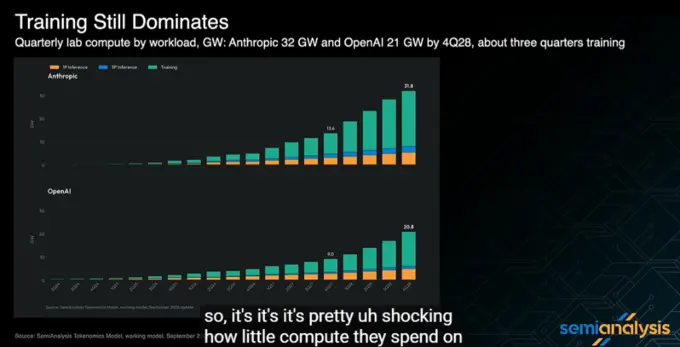
Figure: Breakdown of Computing Power Load Structure between Anthropic and OpenAI by Quarter
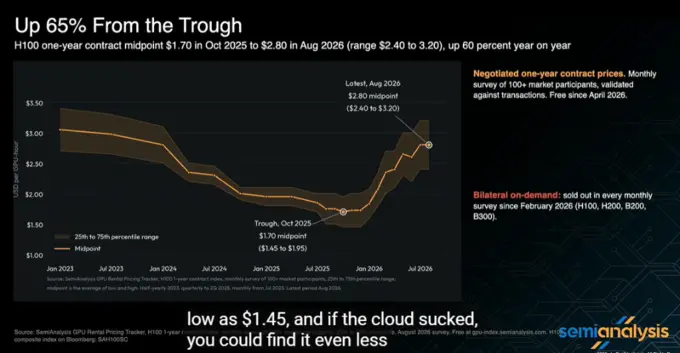
Figure: Rental Price Trends for NVIDIA H100 GPUs One-Year Contracts
Delivery Bottlenecks and Differentiated Service Evaluations among Cloud Providers
Securing the computing power is just the first step; the usability of the cluster ultimately determines its actual value. SemiAnalysis conducted an evaluation called ClusterMAX, tracking 323 cloud providers and evaluating 77 of them, ultimately issuing only 19 awards, while the vast majority fell into "unusable" or "poor performance."
In Patel's view, the best are CoreWeave and Nebius, but both have very poor availability: they will not be selling computing power for the next six months, as they are sold out. Nebius requires prepayment for an entire year or six months; the price is high, but this is one of the very few ways to secure computing power.
Oracle and Google were also rated excellently, with Google upgrading from a bronze medal in the first round. More companies had their ratings downgraded: as evaluation standards became stricter, Azure fell to a silver medal, and Together and Lambda dropped to bronze. AWS has remained at the back, primarily due to its cumbersome delivery process, requiring extensive communication with multiple personnel to secure a cluster, which is time-consuming, and the network configuration is also quite complex.
The most striking issue in the evaluation is security. SemiAnalysis allowed AI models to test for vulnerabilities within these cloud platforms, and some vulnerabilities are already publicly known on the internet; the models were able to directly find and exploit them to access other clients' storage.
In one of the tests, they used an open-source model to gain access to Slurm permissions for the entire cluster and saw the name of a national defense department. Many cloud providers only discover security vulnerabilities when alerted by clients, and some take days to respond even after being alerted.
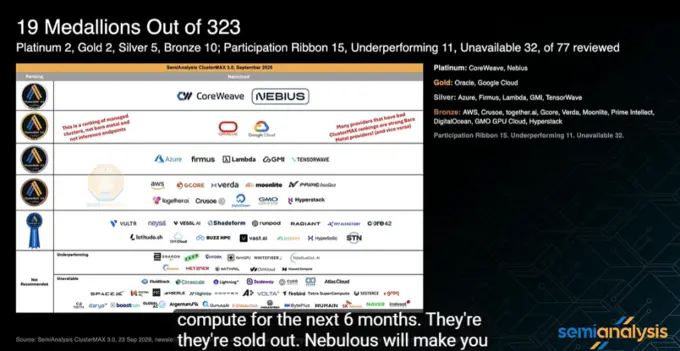
Figure: SemiAnalysis ClusterMAX Cloud Provider Delivery Capability and Security Evaluation Rankings
Rising Interest Rates and the Debt Dilemma of Computing Power Supply
Increasing the supply of computing power requires massive capital, and the price of capital is rising significantly. Patel reiterated that by the end of 2029, global AI capital expenditures will be about $11 trillion, with about $7 trillion coming from debt financing, most of which will be spent on chips, networks, and data center construction.
In this interest rate environment, loan flows show significant polarization. The 10-year U.S. Treasury yield has increased from 3.96% to 5.31% in early October this year, and AI-related debt issuance has noticeably cooled in September. Patel stated that if an emerging cloud vendor wants to raise $2 billion to build a 1-gigawatt data center, it is nearly impossible to secure money in the current debt market.
The only way is to pre-sell the computing power to super-scale cloud vendors, who then obtain financing in the bond market. Although they secured loans, this computing power cannot enter the open market for the entire industry.
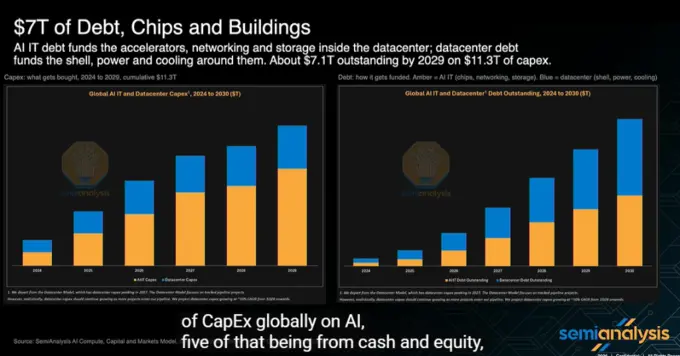
Figure: Predictions for Global AI Capital Expenditures and Debt Financing Trends from 2024 to 2030
The result is that approximately 65% to 70% of the computing power already contracted for next year will flow to super-scale cloud vendors and leading AI labs. For startups, renting clusters requires half of the deposit upfront, and delivery can take three to nine months, creating extremely high barriers to acquiring computing power.
NVIDIA's approach is to support the clusters. Patel summarized it into three categories: SoftBank Energy only guarantees land, power, and facilities; this is a 9-gigawatt facility in Ohio, expected to be operational around 2030, fully reserved for OpenAI; Firmus is committed by NVIDIA to rent the clusters at specific prices, ensuring the other party does not profit or lose, but with this guarantee, lenders are willing to lend; the third type provides guarantees on hardware residual values.
In scale, NVIDIA has backed about 6.5 gigawatts, which will be sold to the open market rather than just for super-scale cloud vendors. He gave an upper limit of 45 gigawatts, yet even this would only make up a small part of the new computing power added before 2030.
In conclusion, he emphasized the enormous scale of Token consumption: several leading providers process over 100 trillion Tokens daily, and each company’s annual revenue is rising. He summarized that whether computing resources can be more widely distributed will determine the vitality of the entire ecosystem and avoid the entire industry being overly constrained by a few monopolistic labs.
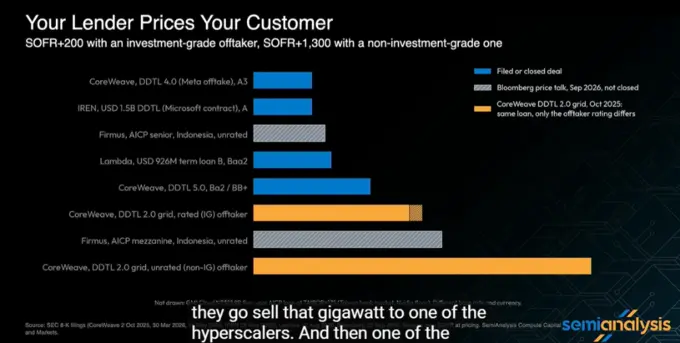
Figure: Comparison of Different Lending Agreement Interest Rates and Rating Spreads among Computing Cloud Vendors
免责声明:本文章仅代表作者个人观点,不代表本平台的立场和观点。本文章仅供信息分享,不构成对任何人的任何投资建议。用户与作者之间的任何争议,与本平台无关。如网页中刊载的文章或图片涉及侵权,请提供相关的权利证明和身份证明发送邮件到support@aicoin.com,本平台相关工作人员将会进行核查。


