In the middle of the night, just as I was about to sleep without waiting for GPT-6.2 Sol,
the AIHOT assistant suddenly pinged me with a message in the Feishu group.

Okay, now I don’t need to sleep.
At 3 AM, Claude finally officially released Claude Fable 5.2.

Meanwhile, OpenAI is selling a handheld device for 200 dollars tonight.

I told you not to release GPT-6.2 Sol last week, since its reputation is so good; isn't it awkward now...?
Currently, Claude Fable 5.2 has officially launched across all channels, and I can already see it in my Claude desktop app.
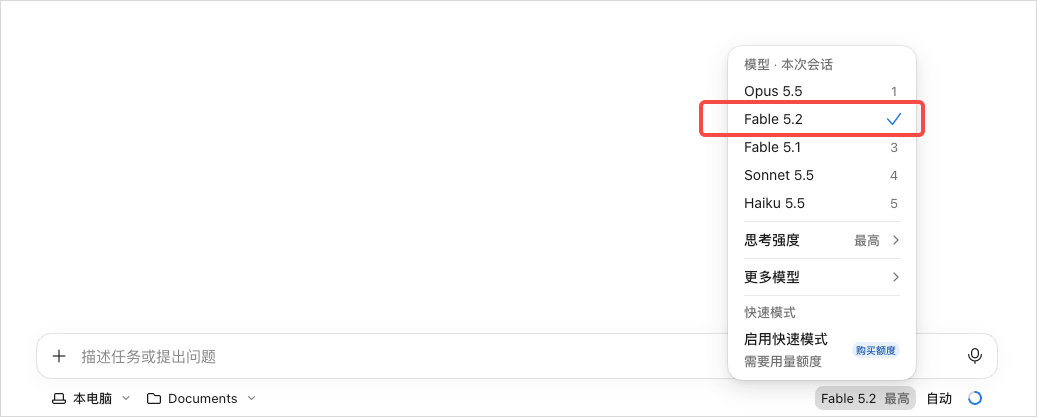
At the same time, Anthropic has opened temporary access to Fable 5.2 for Pro members at 20 dollars, but it's limited to this week.
They also offered a reset opportunity for Fable limits to Claude users subscribing to the 200 dollar Ultra version, based on their subscription time, and valid until March 8 of next year; to be fair, sometimes A\ is quite conscientious...

I received it too.

Here, everyone can note my remaining limit; I am a 200 dollar Ultra member, and before testing Claude Fable 5.2, I still had 30% left.
I am very happy. After enjoying Claude Opus 5.5 for nearly a month and a half, I finally waited for the new Fable model, although it isn’t the rumored Claude Fable 5.5; Anthropic named it Claude Fable 5.2.
This is actually normal; as early as September 9, there were leaks that Anthropic was running a new model, and the temporary code they provided was indeed called Fable 5.2. But later Opus 5.5 and Sonnet 5.5 came out one after another, and everyone naturally pushed forward; the next Fable surely had to be named 5.5, but in the end, it was 5.2, so it’s highly likely that Anthropic still has a more powerful Fable 5.5 hidden away.
Let’s take a look at the basic situation of Fable 5.2.
Claude Fable 5.2 still boasts 1M, meaning a million tokens in context, with a maximum output of 128K tokens, and the knowledge cutoff is in June 2026.
This time, the price actually saw a decrease; now everyone knows, tokens are too expensive and have exceeded the acceptable range for all humanity, so after the price increase trend, prices are now continuously dropping.
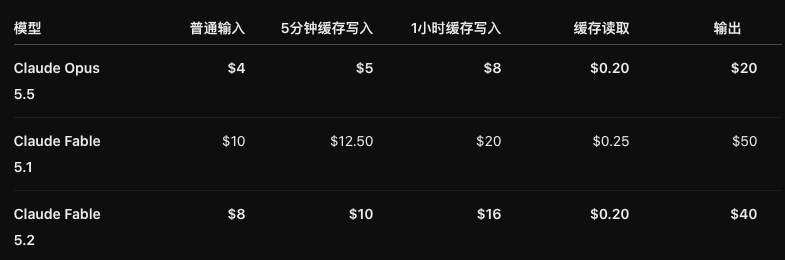
Fable 5.1 previously cost 10 dollars for a million tokens input and 50 dollars output.
Fable 5.2 has changed to 8 dollars input and 40 dollars output, with caching being similar, overall a 20% price drop.
The price comparisons among key models from Anthropic are roughly as follows.
Then in terms of speed, it’s also faster; the official claim is that it’s up to 30% faster than Fable 5.1, not a huge difference, but still better than nothing.
Also, misfires have decreased; the safety barriers around Fable have been criticized for a long time, and when it was first released in June, many people complained about it treating biological tasks as security threats. This time, the officials said that misinterceptions are about 55% less than 5.1, with cybersecurity-related ones being 60% less, and biology-related ones being 40% less.
There’s one point I really like, which is an advantage inherited from Opus 5.5: it finally started to sound more human. The previous output style of Fable 5.1 could be compared to Opus 5, which was full of jargon that I found very unpleasant and completely incomprehensible. Later, during Opus 5.5, Anthropic finally recognized that models are meant for people, hence the importance of dialogue and sounding human, leading to significant adjustments, and the reputation immediately improved.
This time, Fable 5.2 also retains the advantages of Opus 5.5, with similar speaking style.
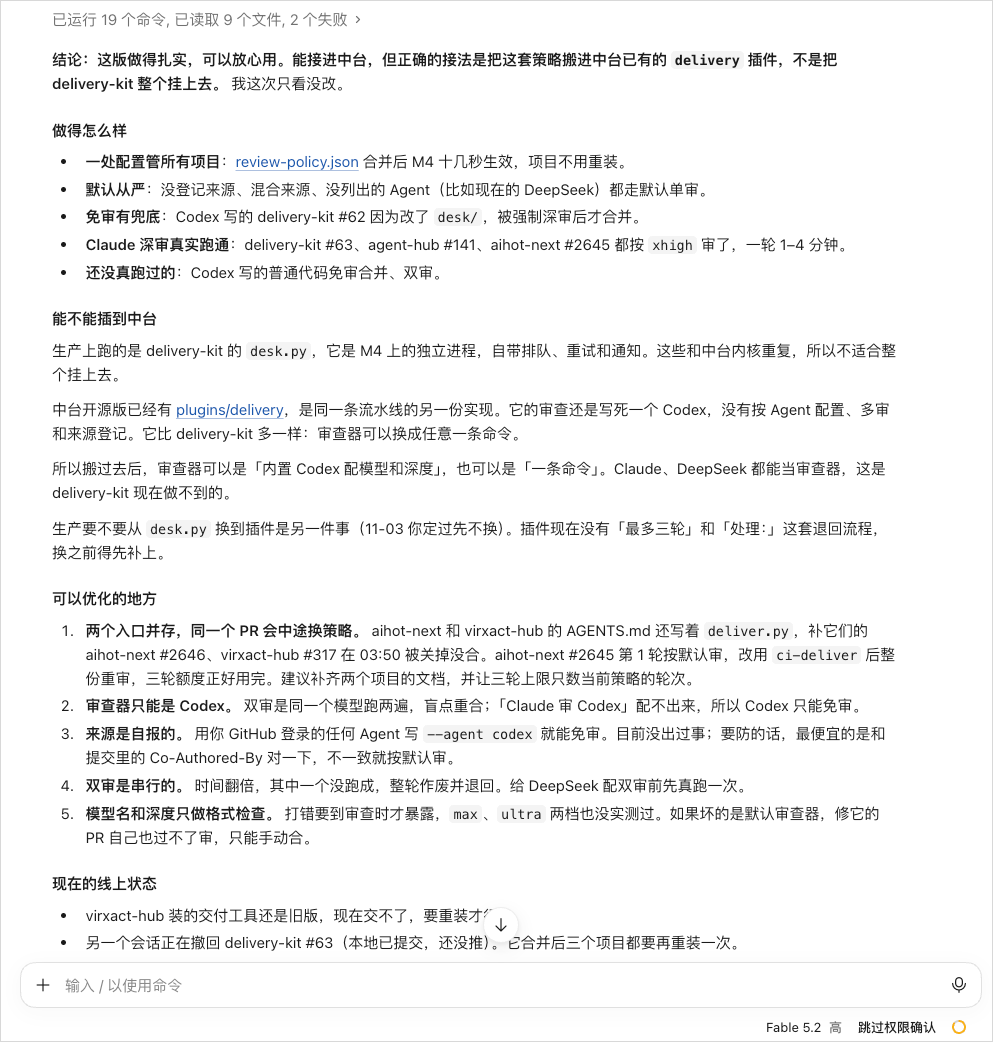
However, this response also shows that the sense of superiority of the Claude series models is even more pronounced due to the enhancement of Fable’s capabilities.
Because there has indeed been too much work done recently, and some of it involves underpinnings, which is a bit messy, so this time it directly overturned my idea and suggested a better and more appropriate approach: I should directly connect the things I modified into the universal middle platform plugin, rather than continuing to modify the previous broken CI middle platform.
I previously shared a fairly popular anecdote about the character differences between the Claude and GPT models.

“Me: I have to download 20 Excel files from the backend every week, then manually copy-paste them into one summary sheet. It’s too troublesome; help me write an auto mouse-clicking script.
GPT: Alright, boss! I've written it for you, automatically clicking, downloading, copying, pasting, and I even added exception handling and retry logic. In the future, you just need to click run!
Claude: Hey buddy, aren’t these 20 Excel files all exported from the same database? Why are you downloading them? I wrote you a SQL query that connects directly to your backend data source, so every week it generates the final report automatically. Why are you downloading Excel for no reason...?”
For someone like me, who is relatively inexperienced, hoping for a model with stronger capabilities that can tell me things I don’t know, Claude may indeed suit me better. Some call it wishful programming; of course, it can also be referred to as conversing with a deity.
In terms of benchmarks, there’s no need to think; the Fable series today is basically guaranteed to be SOTA.
With an AA index score of 65, it tops the charts.
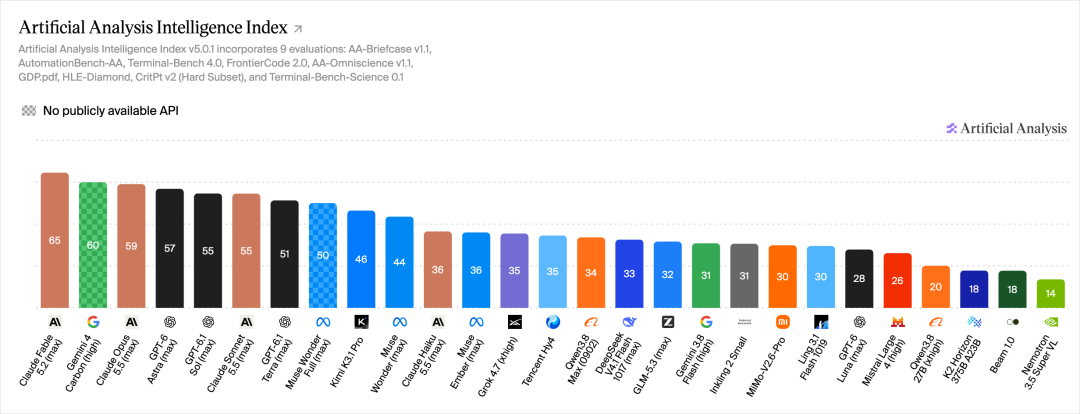
The official benchmarks are also significantly better than all others, and mainly based on Anthropic’s benchmarks, which you can definitely trust.
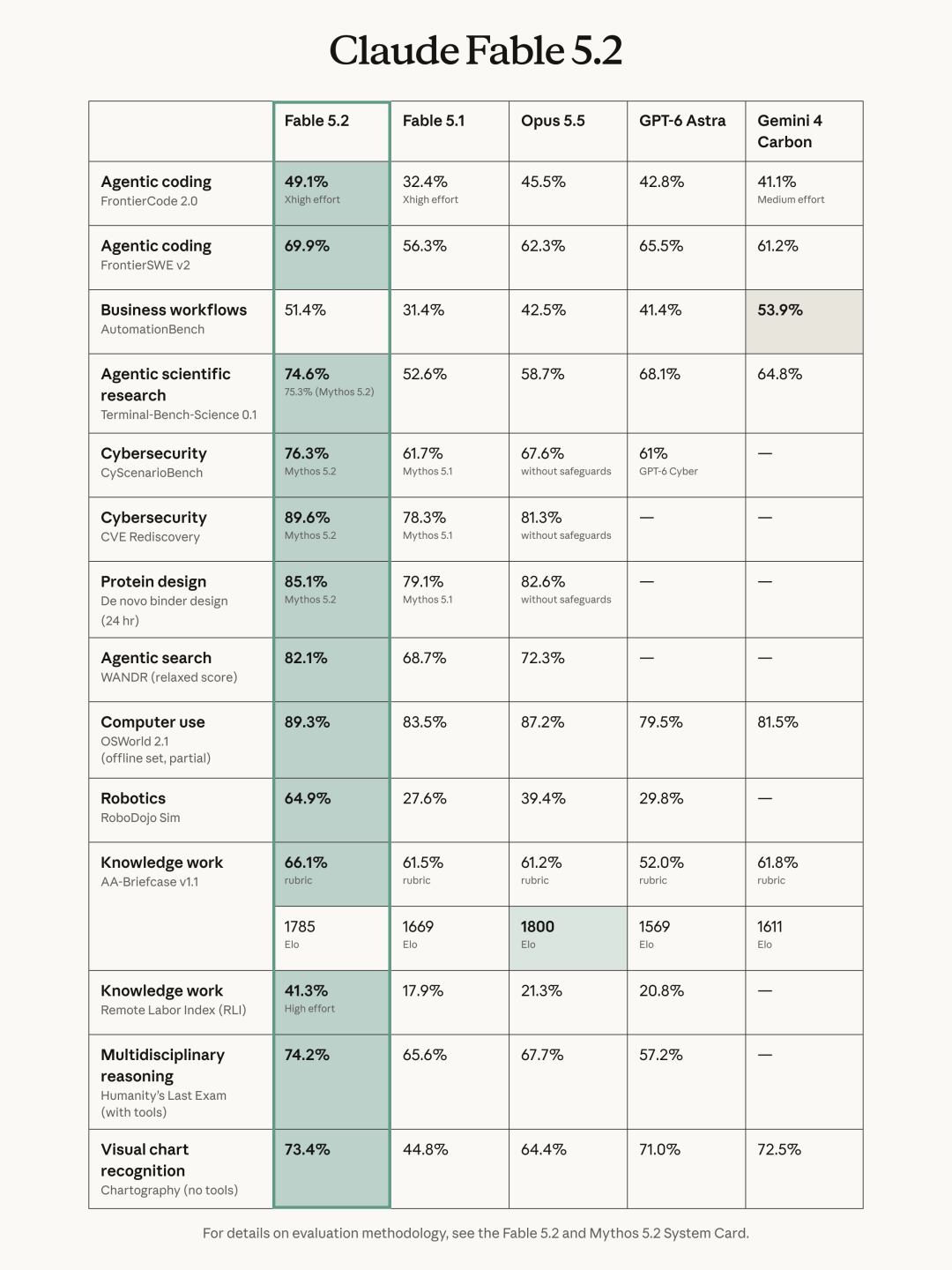
I won’t read through the benchmarks one by one.
Anthropic also conducted a very interesting experiment, assigning Fable 5.2 the task of designing a prototype operating system, starting from a blank folder, coordinating over 1000 sub-agents, continuously coding, testing, and reviewing code for eight days without stopping. Then, it produced a runnable operating system that could boot on a laptop, with its own kernel, disk, keyboard, and network drivers, permanent file storage, windows, a login interface, installation program, and built-in Claude features…
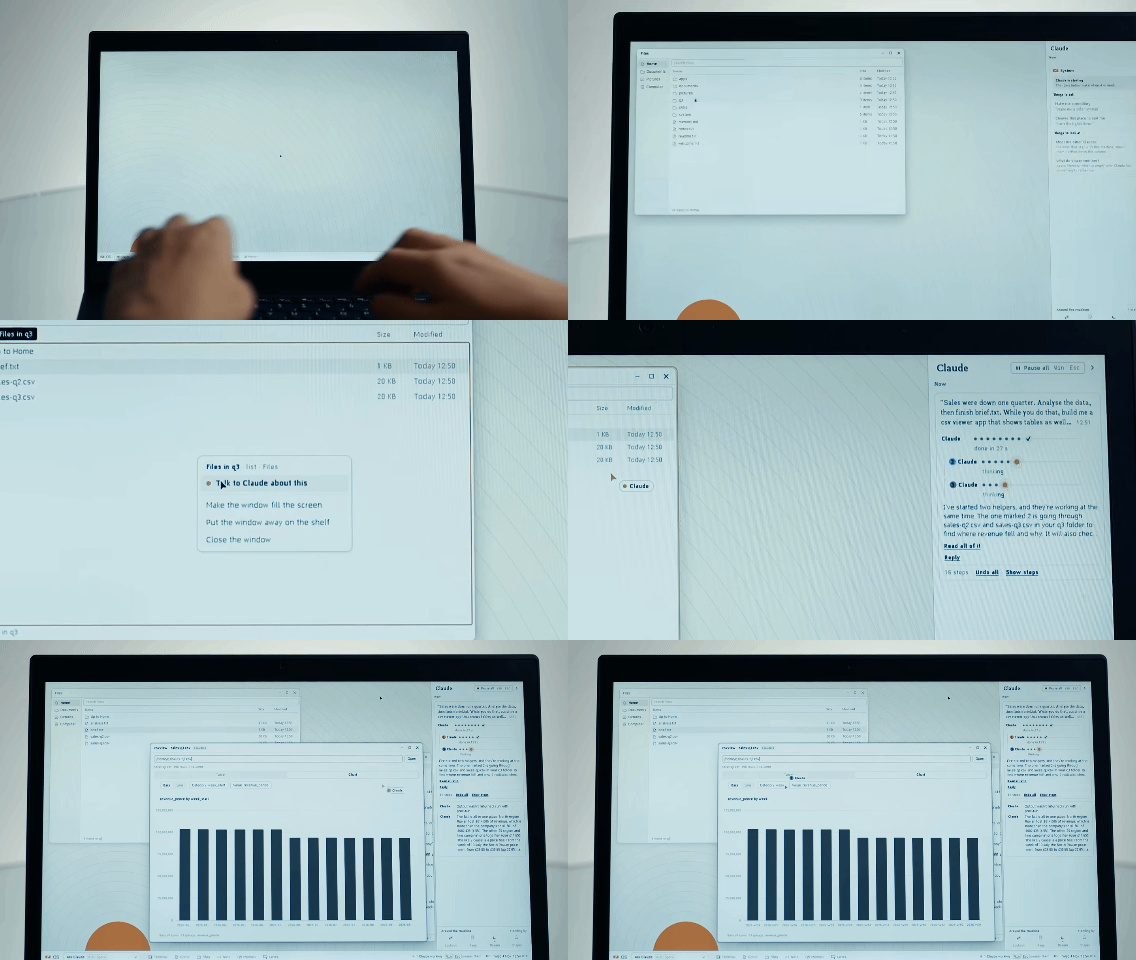
This hardcore test definitely exceeds our capabilities.
With a limited quota, I still focused on the longest plate of Opus 5.5, video effects, and frontend aesthetics.
(PS: To clarify, all cases below are single outputs; I did not have any secondary dialogues, nor did I do any post-processing; everything is just one prompt I sent, it ran for 2 hours, and it gave me the result without any further processing.)
First, what I thought of was actually a case originally prepared for GPT-6.2 Sol. The ChatGPT four-year anniversary is coming up soon, so I wanted to create a video about the history of ChatGPT over the past four years. This time, I decided to let Claude Fable 5.2 do it directly; one, to see the hallucination rate; two, to see the aesthetics; three, to check the accuracy of the code; and four, the NTR plot is simply too attractive.
My prompt was incredibly simple:
“Make a 40-second to 1-minute tribute video for ChatGPT’s four-year anniversary (2022.11.30–2026.11.30), in 16:9 landscape format, without narration, accompanied by original music. Gather the content online, highlighting key versions, milestones, and figures for these four years, no fabrications allowed. Before starting, observe the visual style on OpenAI’s official website, blog, and recent videos, then distill that as the visual tone of this piece. The tempo should be fast, with dense effects, full images, synchronized with the music. The video is positioned as a third-party tribute, not to be made to look like an official OpenAI production.”

Then, it got to work. After nearly an hour of work, Claude gave me this kind of video…
Honestly, I was momentarily at a loss for words.
I did double-check the information inside and, sadly, found that I couldn't identify any factual errors.
The information was sourced by Fable 5.2, the graphics were created by it, the music was composed by it, the transitions were timed by it, the effects were crafted by it, and the editing was done by it.
To be honest, I really lost my composure when I saw the final image.

Watching this video, I found myself deep in thought...
Then, I asked it to make a commentary video based on the article about the Super-agent from DeepSeek Harness.
Perhaps because the main color of DeepSeek is in AI’s commonly used blue, this video still gave off some AI vibes, but in terms of the finesse of the effects, I can only say that compared to Opus 5.5, there has indeed been a significant improvement. Previously, while Opus 5.5 could produce such effects, it involved a lot of hassle and multiple rounds of discussion, but now, it’s a straightforward output...
The text from Super-Agent astonished me the moment it came out.
This rhythm is genuinely that of a seasoned hand.
Then I tried a 3D scene using Three.js.
The prompt was as follows.
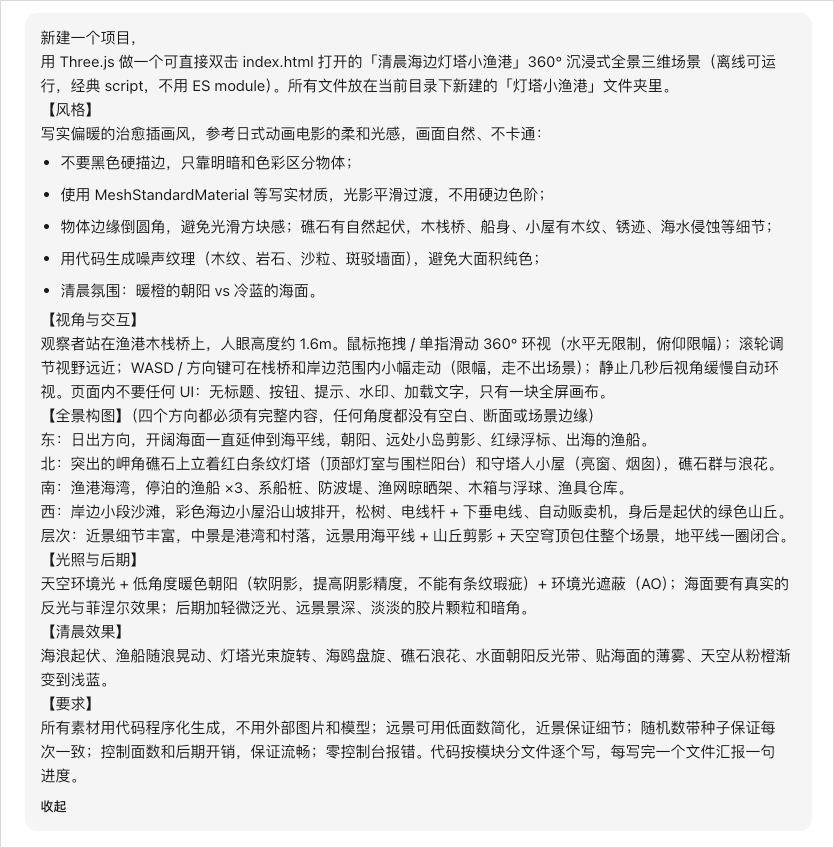
Then Fable 5.2 began working and after running for several minutes, I saw it thinking of previews in the summary; at that moment, I felt that the aesthetic sense of Claude's models is truly strong...

Static frames rendered entirely with pure code in the webpage, let’s see how it goes.


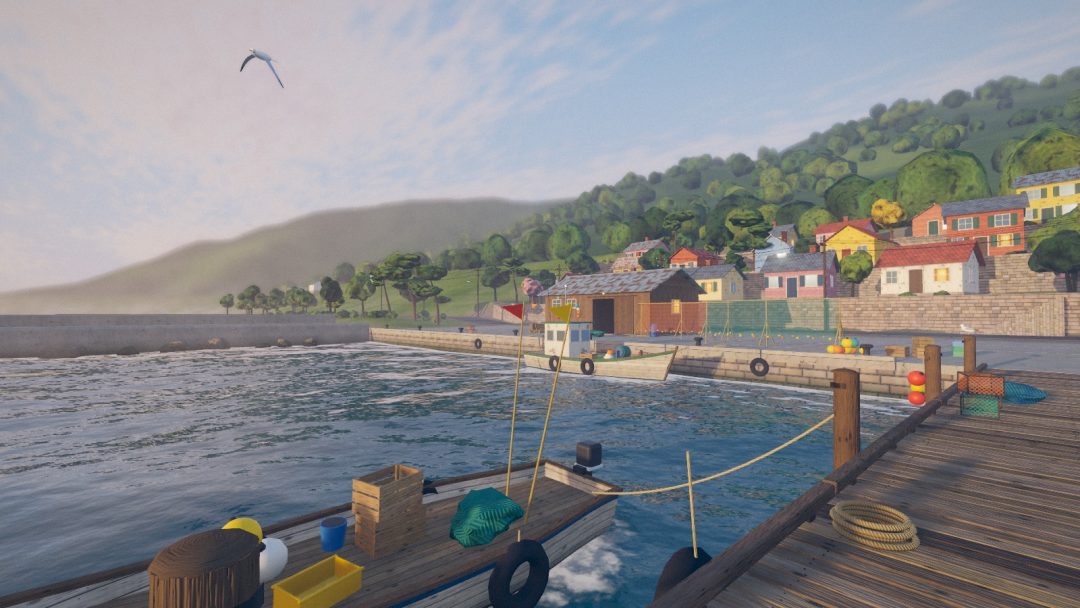
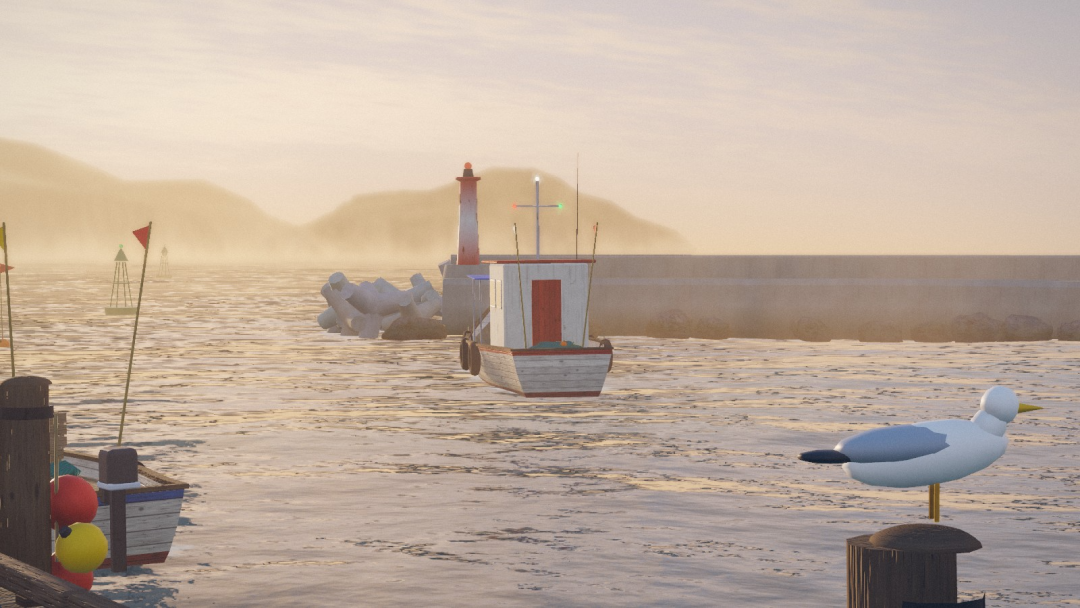
I honestly don’t know what to say about this.
After that, Fable 5.2 finished and provided me with the webpage.
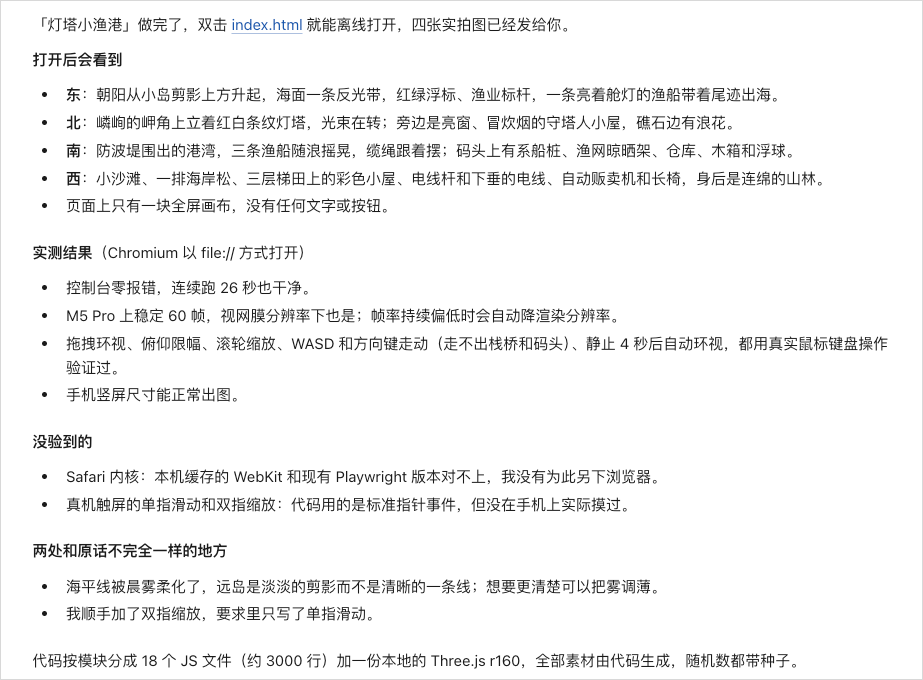
I also recorded a video.
It made a 3D voxel floating island.
Of course, the most outrageous was the building of the Apple store in Jing'an, Shanghai...
The prompt I provided was that I wanted to create a 3D webpage.

I never expected that this case would take nearly 2.5 hours.
Fable 5.2's first task was to search for reports about the Apple store in Jing'an, which was no problem.

Then, it started looking for real photos to use as reference...
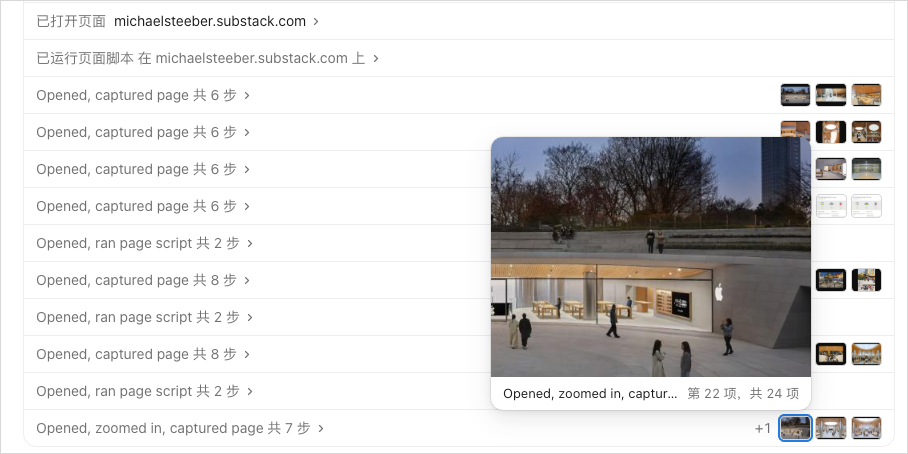
It even zoomed in on each one to examine the details.
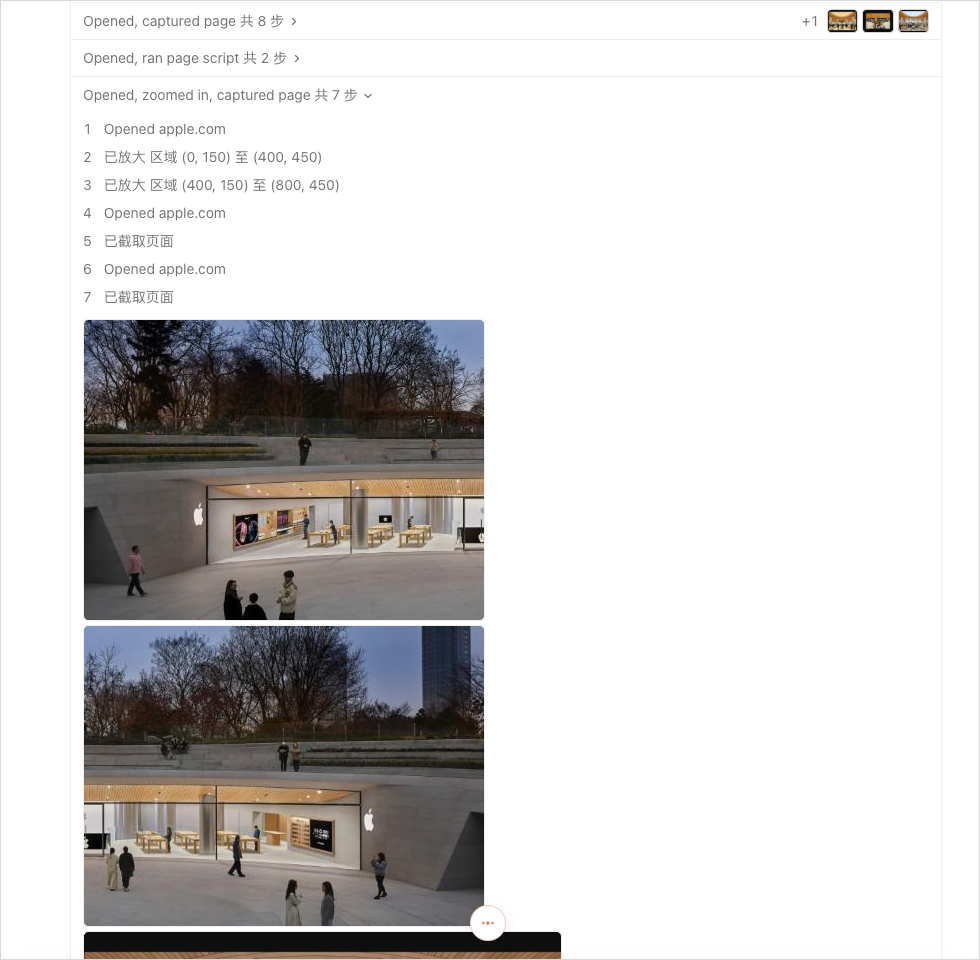
In total, it examined nearly a hundred images, looking for almost an hour.
After that, it finally felt ready to start modeling.
This took another hour or so.

I was honestly quite anxious internally because I didn’t know what level of output it would achieve.
Because this case was previously run when GPT-6 Astra had just come out, and back then it could produce such effects, which were already quite strong.
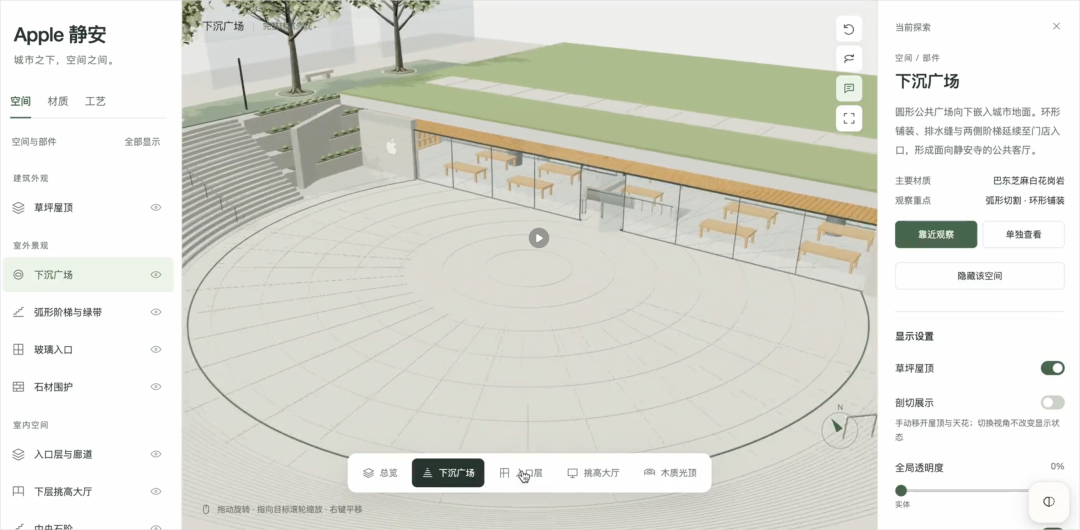
I didn’t know what Claude Fable 5.2 would come up with.
After 2.5 hours, Fable 5.2 submitted its work.
The static images looked like this.
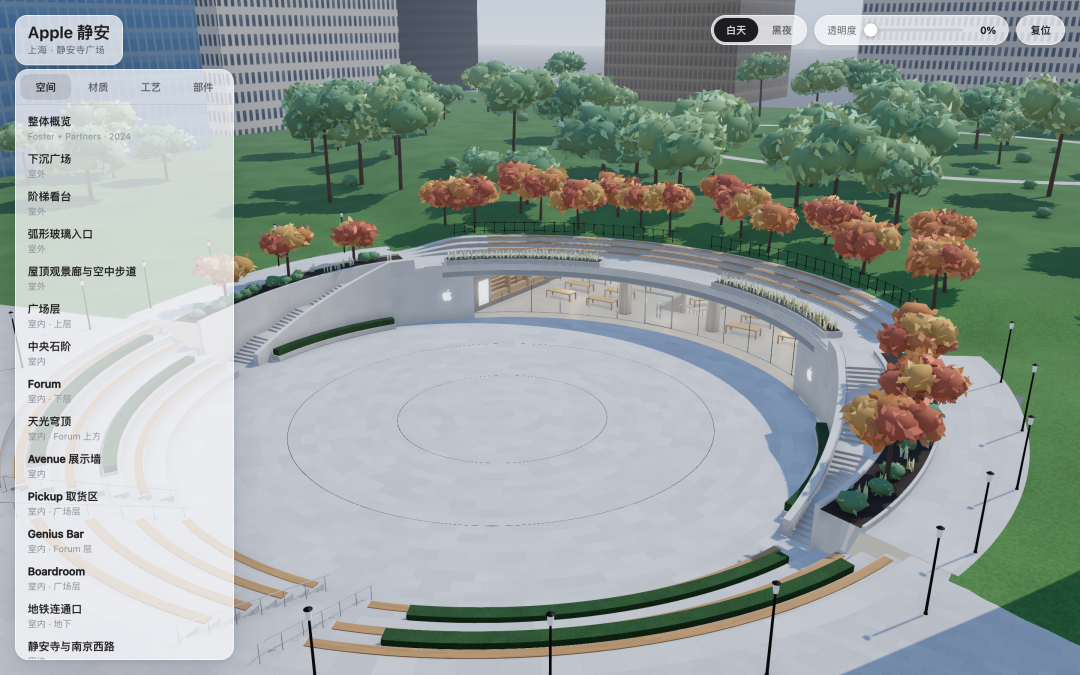
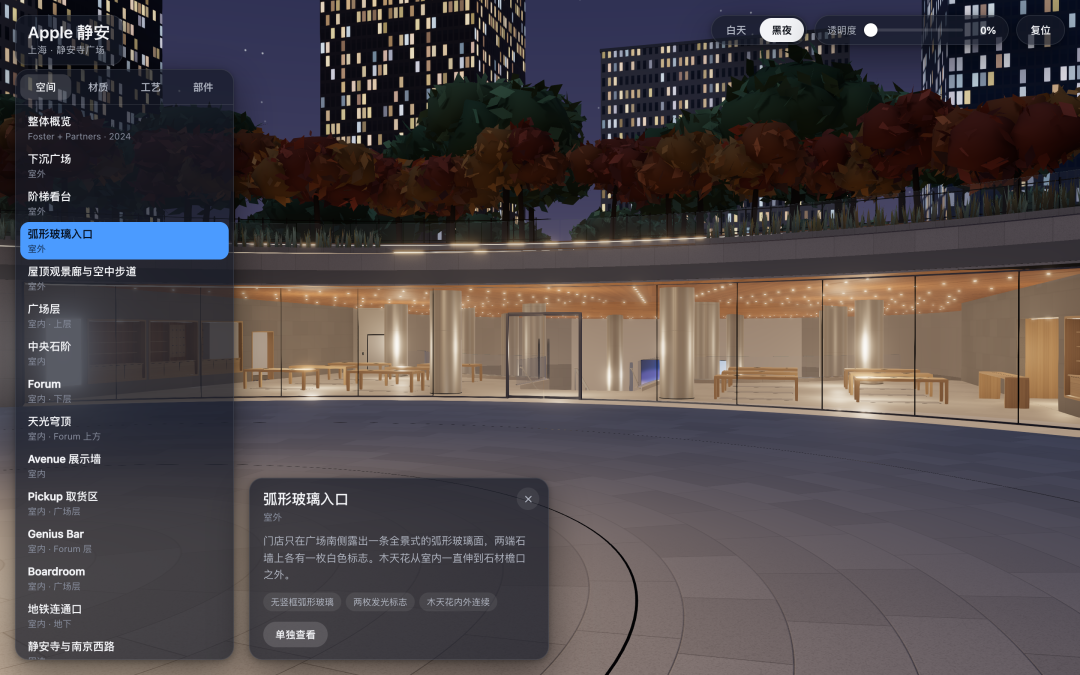
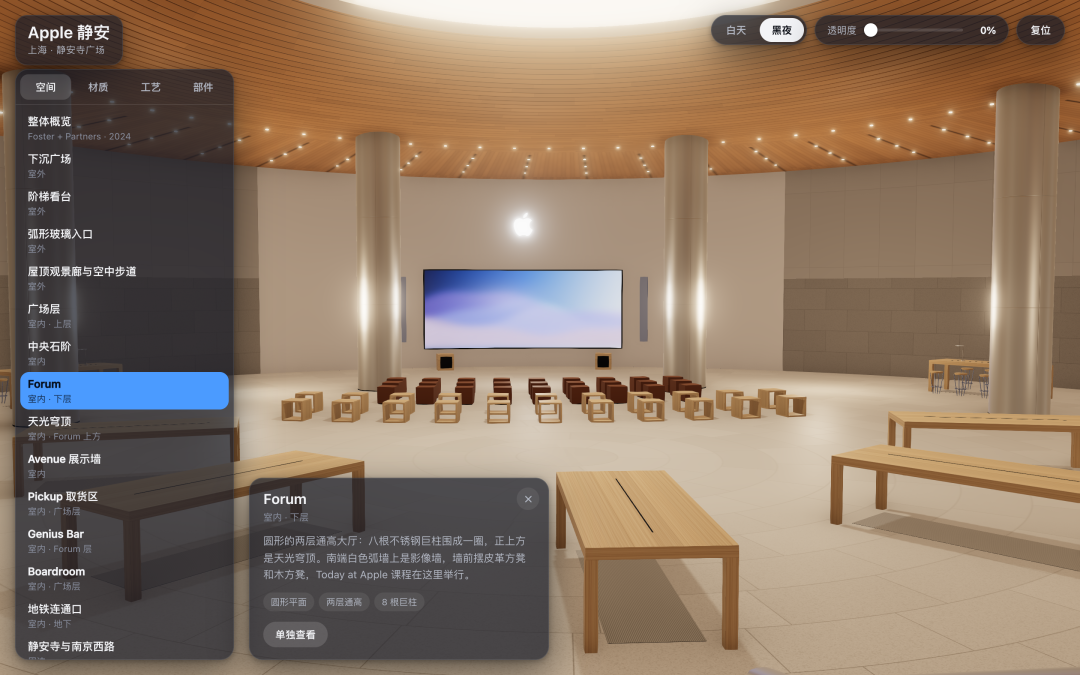
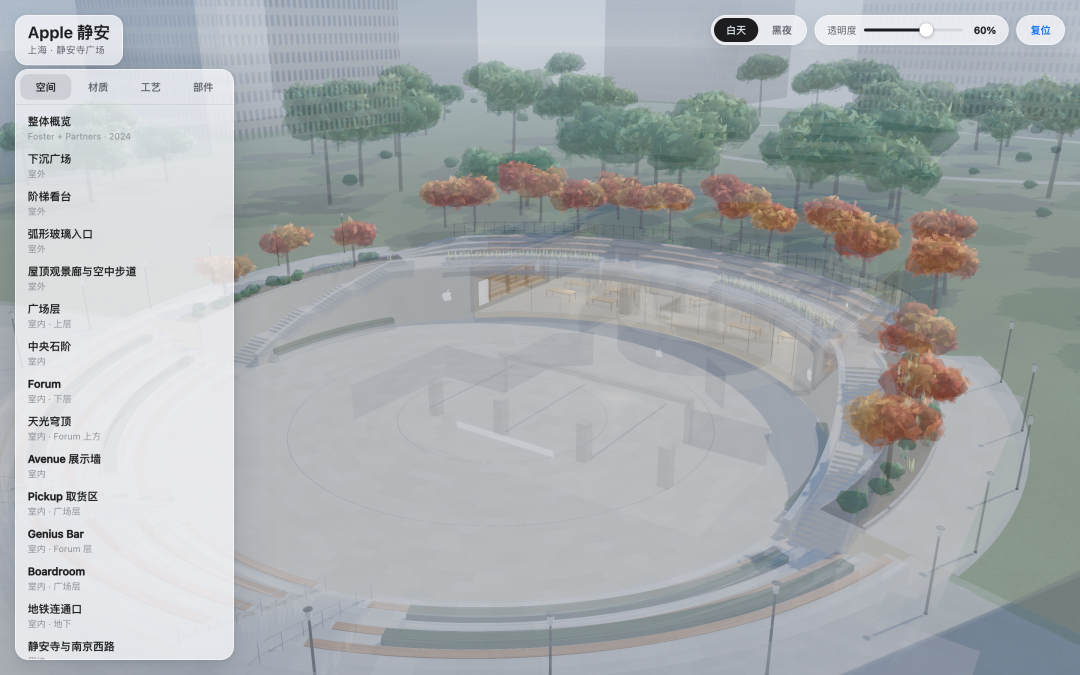
The video presentation looked like this.
One of my colleagues from the company who studied architecture remarked the most primitive word among humans after viewing it.

Because I found that it was indeed working diligently at mimicking and modeling; for this, I even specifically found an interior rendering of the Apple Jing'an store for comparison.
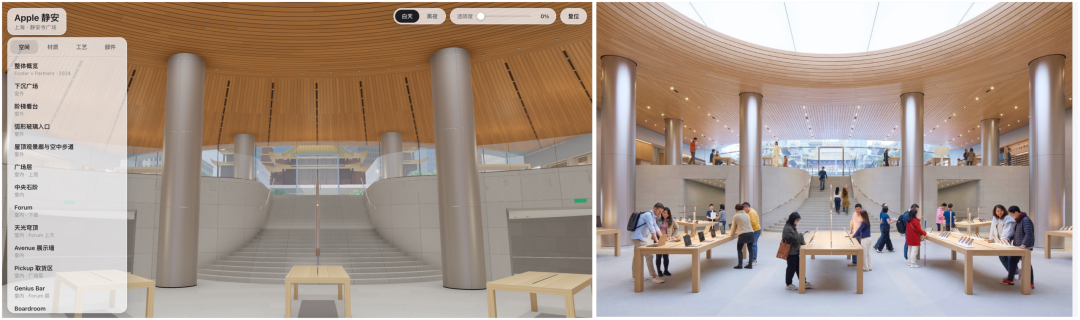
Note that this is one in a normal view, and one could even be considered as wide-angle.
Although we can’t say they are identical, from the material representation in modeling, spatial restoration, and overall proportionality, it has performed excellently.
Apart from the core material representation and the excellent reconstruction of the interior space, Fable 5.2 extended the details as much as possible to the circular sunken plaza outdoors:
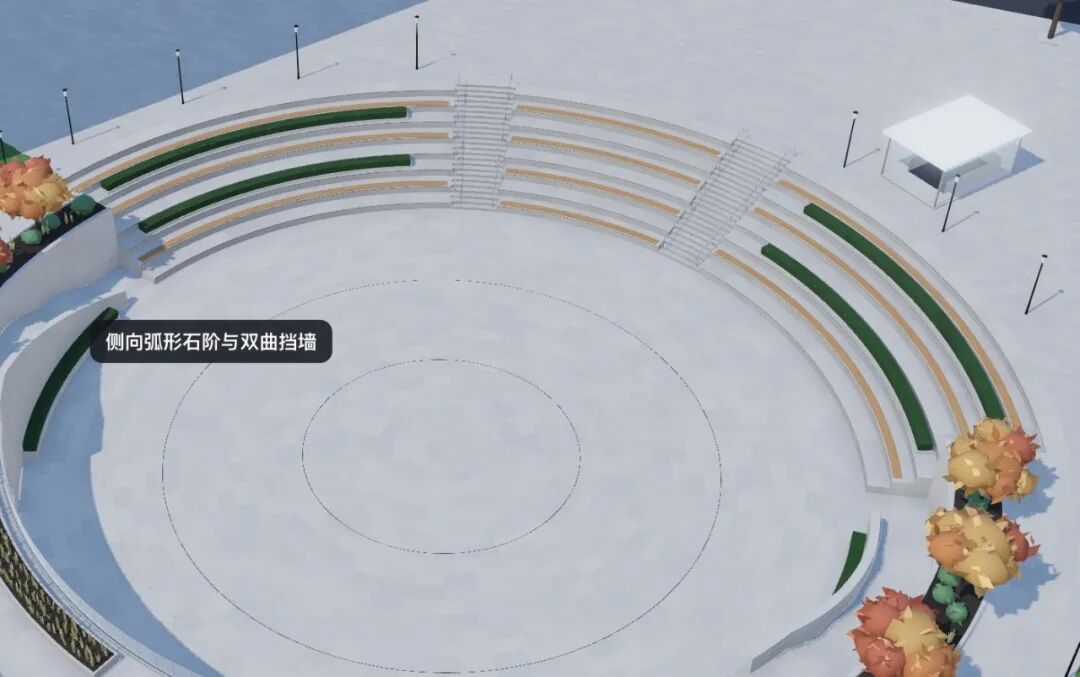
It can only be said that Fable 5.2 is indeed extremely strong in aesthetics and detail.
I ran about 10 tasks, mostly Fable 5.2 Xhigh. Everyone still remembers what I said at the beginning about how much quota I had left before running the tests, right?
At that time, I had 30% left, and now I've used 70%.
And now, I'm stuck at 94%.

In nearly 4 hours, with 10 tasks, I've consumed about 24% of my quota, and the usage of Fable is almost 50% used up.
To be honest, it is indeed pricey.
So while the Fable model is state-of-the-art and has strong capabilities, the price is a reality; therefore, on a daily basis, it will still mostly be Opus 5.5 and the soon-to-be-released GPT-6.2 Sol (which I have already been experiencing in a limited way for two days; it has a very good cost-performance ratio, comparable to Opus 5.5), while Fable 5.2 will be suited only for major diagnostic planning and directional models. Aesthetics and frontend tasks should be left to Opus 5.5, while algorithmic and backend-related tasks should be handled by GPT-6.2 Sol; this might be what I see as the optimal solution.
To be honest, models like Fable 5.2 are the best for personal agents. It's like you’re the emperor, and it’s the chancellor, guessing your thoughts based on your preferences and goals, then directing other ministers to get the work done—this is simply the perfect match, and it won’t burn through the quota too much.
This is about it.
Due to quota and time constraints, there are still many more playful tests I want to try that haven’t been explored yet.
For example, actually creating a game.
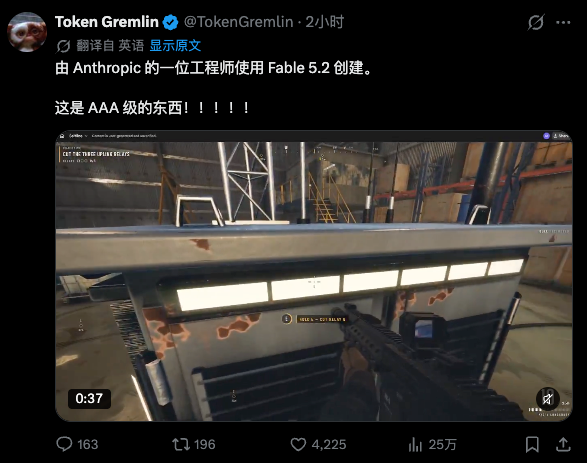
For instance, starting to attempt drawing graphics through code.
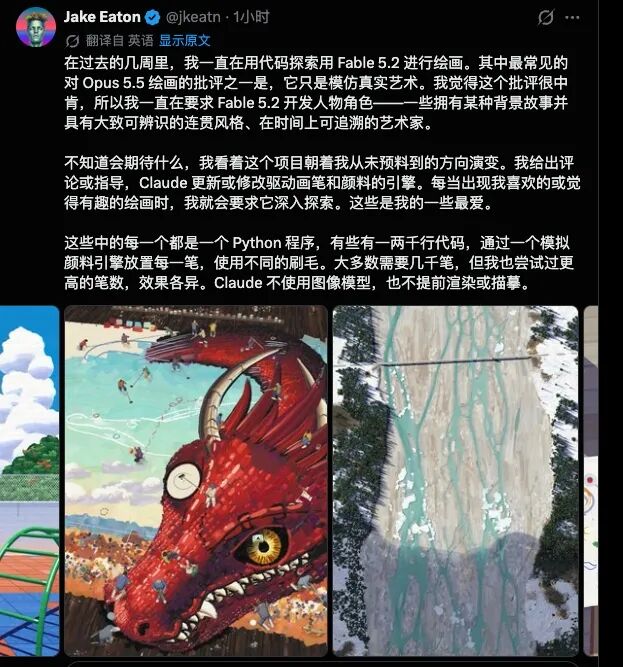
There’s just so much more.
Even leaning towards hardware and scientific research aspects.
It feels like every advancement in major models brings everyone more imagination.
Yes, this world still has so many delightful things that haven’t been explored.
Creation, as well as AI.
It’s truly fascinating.
It’s morning again; I wish everyone good morning, good afternoon, and good evening.
Today, let’s also be curious about the world~
免责声明:本文章仅代表作者个人观点,不代表本平台的立场和观点。本文章仅供信息分享,不构成对任何人的任何投资建议。用户与作者之间的任何争议,与本平台无关。如网页中刊载的文章或图片涉及侵权,请提供相关的权利证明和身份证明发送邮件到support@aicoin.com,本平台相关工作人员将会进行核查。


