Is L2 eating away at the value of L1? Is Ethereum losing its global composability?
During the peak of the Rollup narrative in the last two years, such anxieties filled the entire Ethereum community. The market logic at the time was that since the transaction costs on the mainnet were increasing, more applications, assets, and users would be migrated to independent L2s.
However, entering the year 2026, some interesting changes began to emerge.
From Synthetix deploying a new perpetual contract exchange back to the Ethereum mainnet, to ENS abandoning the long-prepared Namechain, to projects like Trueo and Superseed choosing L1 again, it seems that project teams feel that maintaining an independent L2 is no longer an optimal solution.
Even some L2s have begun to experience operational shrinkage or even shutdowns; for example, at the beginning of October, Blast, which once had over $2 billion in TVL, announced it would gradually cease operations, followed by Abstract also announcing it would close its network in December.
On the other hand, the Ethereum Foundation, by integrating the three strategic mainlines of "Scale," "Improve UX," and "Harden the L1," has pushed the mainnet performance into a new stage of engineering delivery. What has actually happened to Ethereum, moving from "Anything can be Rollup" to "Returning to the Ethereum mainnet"?
1. From "Exodus" to "Mainnet Return"
In the past few years, constrained by high Gas fees on the Ethereum mainnet, self-built L2s or deploying core business on other Rollups has almost become a standard action for many leading protocols.
However, recently, the on-chain ecosystem has been experiencing an interesting reverse adjustment, especially as different types of projects have begun to reassess the choice between L1 and L2 from the perspectives of infrastructure costs, asset security, and ecological liquidity.
The most representative case is ENS.
In 2024, ENS Labs planned a dedicated ZK Rollup for ENSv2—Namechain, hoping to reduce domain registration and management costs through an independent execution environment.
But by February 2026, ENS co-founder Nick Johnson announced that the project would stop the development of Namechain, directly deploying ENSv2 on the Ethereum mainnet. His reasoning was quite straightforward: the scaling speed of Ethereum L1 far exceeded the expectations of two years ago.
According to data disclosed by ENS Labs, as the Ethereum Gas Limit increased, the average Gas cost for ENS domain registration dropped by about 99% over the past year, from nearly $5 to less than $0.05; meanwhile, maintaining an independent L2 not only involves bearing node and infrastructure costs but also requires handling cross-chain resolution, bridging, security audits, and continuous operational duties.
If a business can already be completed on the mainnet at an extremely low cost, then continuing to maintain an independent Rollup may actually complicate the product architecture.
Similar changes have also appeared in the DeFi sector.
In June 2025, Synthetix, which had actively promoted the Ethereum L2 ecosystem, published "L2s are Dead, Long Live Ethereum," stating bluntly that the previous L2 scaling route brought problems such as liquidity fragmentation and unstable infrastructure. In December of the same year, Synthetix's new generation perpetual contract exchange officially launched on the Ethereum mainnet.
In the second half of 2026, there were even more specific migration actions:
- Trueo: Announced in September that it would primarily deploy from Base back to Ethereum L1, hoping to leverage the mainnet's stronger integration capabilities, network effects, and neutrality to construct a more credible prediction market and outcome oracle;
- ShapeShift: On October 1, migrated the rFOX staking plan from Arbitrum to the Ethereum mainnet. The reason was very practical: most of the FOX tokens were already held on the mainnet, making it unnecessary for users to cross-chain just to participate in staking;
- Superseed: Stopped its original L2 network in August, planning to shift the core products of the entire ecosystem to the Ethereum mainnet, no longer relying on the Gas income of an independent chain to support lending repayments, but instead achieving the original product goals through application layer revenue strategies;
- Nillion: Launched Blacklight L1 in October, migrating node operations that originally ran on Nillion L2 to the Ethereum mainnet, and planned to gradually phase out the existing L2 network;
Of course, these cases cannot be simply understood as all protocols withdrawing from L2, but at least indicate that more and more project teams are beginning to reassess the infrastructure based on the actual needs for security, liquidity, and execution efficiency.
What is even more noteworthy is that the operational pressures of some independent L2s have also begun to surface.
On October 2, Blast announced it would cease operations, citing that the cost of maintaining the network had exceeded the revenue generated by L2, and there was no reliable path to achieve economic sustainability; shortly after, Abstract also announced plans to shut down its network on December 15, even though it was already connected to over 144 applications and attracted more than 400,000 users, insufficient liquidity, limited DeFi ecosystem, and lack of institutional participation ultimately made independent operation of a consumer-level public chain unsustainable.
This also indicates that for many L2s, having a chain does not equal having a sustainable business model.
Especially against the backdrop of Ethereum continuously lowering the cost of L2 data publication and improving mainnet performance, simply relying on low Gas and token incentives to attract users has become increasingly difficult to form long-term competitiveness.
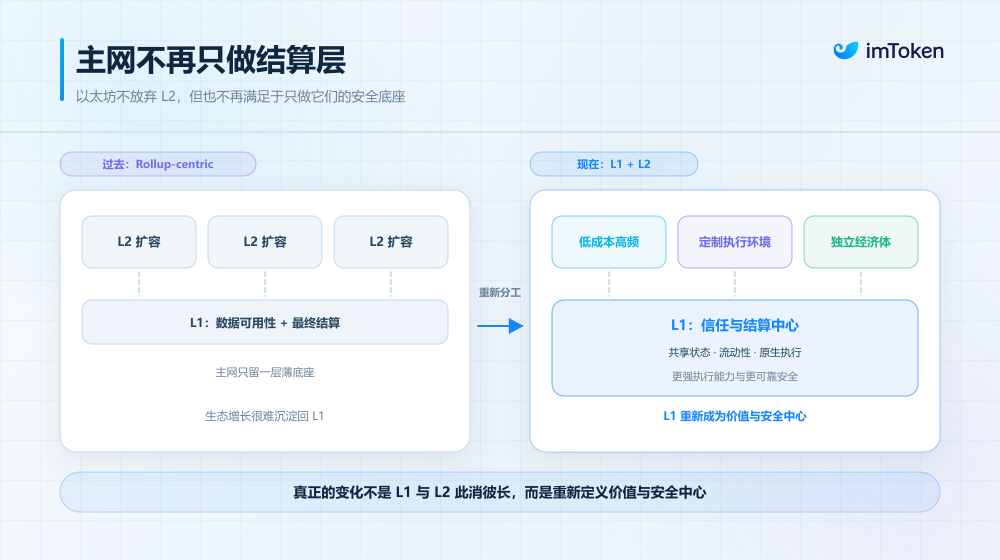
2. Reconstructing the Relationship between L1 and L2: "State Remains on Mainnet, Computation Outsourced"
Why are project teams no longer fixated on maintaining a "large and comprehensive" L2?
Apart from economic calculations, there is a more fundamental question: As more applications and liquidity are dispersed across different networks, what impact is this having on Ethereum's originally most important global composability?
In the initial Rollup-centric roadmap, the division of labor was actually very clear—L1 was responsible for security, data availability, and final settlement, while L2 was responsible for extreme scaling and low Gas.
In that era where mainnet Gas fees could reach tens of dollars, this was almost the only viable answer.
However, the development of reality has proven to be much more complex than expected. As of November 2026, ETHBEAT (formerly L2BEAT) has recorded dozens of different types of L2s, but only a few have reached Stage 2, with asset volumes barely noticeable; in contrast, major Rollups like Base, Arbitrum One, and OP Mainnet are still in Stage 1.
Ultimately, the speed at which L2 moves towards Stage 2 is far slower than expected; meanwhile, L1's own scaling progress is accelerating, as Vitalik Buterin has summarized, with the mainnet's own expansion speeding up, "the original vision of L2 and their role in Ethereum are no longer tenable."
Moreover, some L2s may choose to remain in Stage 1 for regulatory, business model, or customer control reasons.
This does not mean they are necessarily wrong; for institution applications that need to meet specific regulatory requirements, retaining certain management and upgrade permissions may actually be part of the product design. However, if they rely long-term on a few entities holding key upgrade rights and state adjudication rights, they should not simply be equated to a completely decentralized shard of the Ethereum mainnet.
Therefore, in specific application architecture, there is a consistent compromise practice approach, which is to keep assets and critical states on L1 while outsourcing high-frequency, complex computations to off-chain or other execution environments.
Synthetix's new generation perpetual contract exchange is a typical case; it employs a hybrid architecture in which user assets are still hosted by Ethereum L1 contracts, while order matching is handled by an off-chain high-performance CLOB (Central Limit Order Book) engine, and the transaction results are written back to the mainnet through batch settlement.
As a result, users do not need to bridge a large amount of assets to another chain for transaction speed, while also enjoying an order matching experience close to that of centralized exchanges.
Of course, this does not completely eliminate trust issues; Synthetix still has some margin management relying on the off-chain order book, and the off-chain matching system itself also needs to be scrutinized. However, asset custody and final withdrawal are still safeguarded by mainnet contracts, so users do not need to place the security of all their funds entirely in the hands of a standalone L2's sequencer and bridging system.
This actually provides another perspective: it is not necessary to move all computations on-chain to achieve true on-chain finance; the key is which aspects must be provided with irreplaceable trust guarantees by on-chain rules.
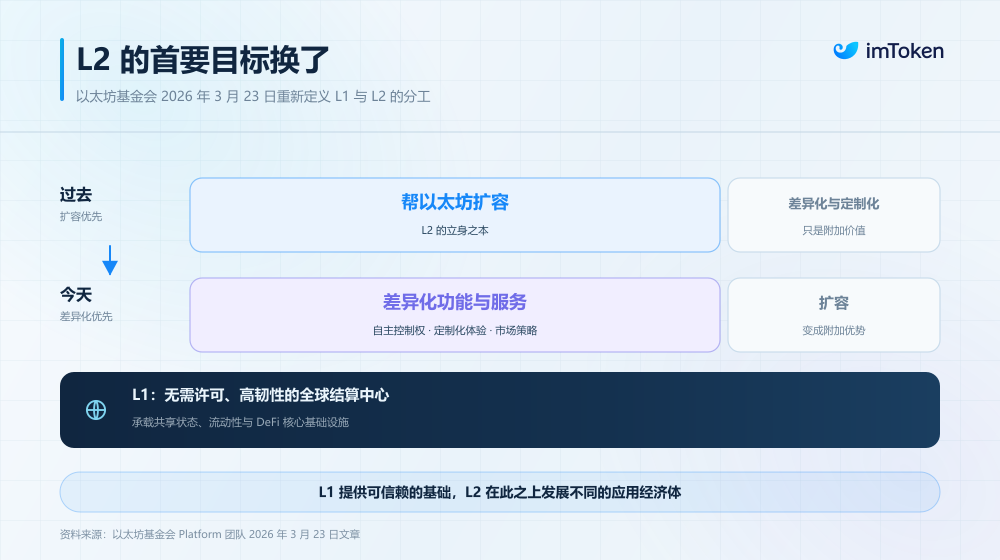
From a longer-term perspective, the Native Rollup research direction promoted by Vitalik may represent a more ideal solution (see extended reading "Understanding Vitalik's Reflections on L2: Farewell to Fragmentation, Reorientation Towards Native Rollup").
In simple terms, this involves using Ethereum's native ZK-EVM verification mechanism to allow the mainnet to directly verify the EVM execution results of Rollups, reducing dependence on external security committees and creating conditions for more trustworthy interoperability and synchronized composability between different Rollups.
Meanwhile, proposals like the Ethereum Economic Zone (EEZ) are also attempting to achieve closer synchronized interaction between different Rollups and the mainnet.
These technologies are still in various stages of research and validation, but they collectively point toward one direction: allowing users not to be forced to accept fragmented assets, liquidity, and trust systems just because they use different execution environments.
Of course, L2s will not disappear as a result; for high-frequency trading, gaming, privacy computing, and applications needing autonomous control over execution environments, L2 still holds significant value.
What truly needs to change is the past mindset of treating "scaling" as L2's only core mission.
3. When both L1 and L2 become inexpensive, how will ETH capture value?
The previous discussion focused on changes in infrastructure and application architecture, ultimately returning to a more pragmatic question: If the Ethereum mainnet continues to grow stronger and more applications return to L1, will the value logic of ETH also change accordingly?
In recent years, the crypto market's valuation of ETH has largely depended on the fee-burning mechanism brought by EIP-1559.
According to this mechanism, the transaction fees paid by users consist of a base fee (Base Fee) that will be destroyed, and a priority fee (Priority Fee) that is paid to validators. When the network experiences high transaction demand and block space is tight, the Base Fee tends to rise, and the amount of ETH burned increases accordingly.
This has also been an important basis for the past "Ultrasound Money" narrative; if the network continues to grow, fee burning has the potential to offset or even exceed the new issuance of ETH, driving ETH into a net deflation state.
But the problem lies precisely here.
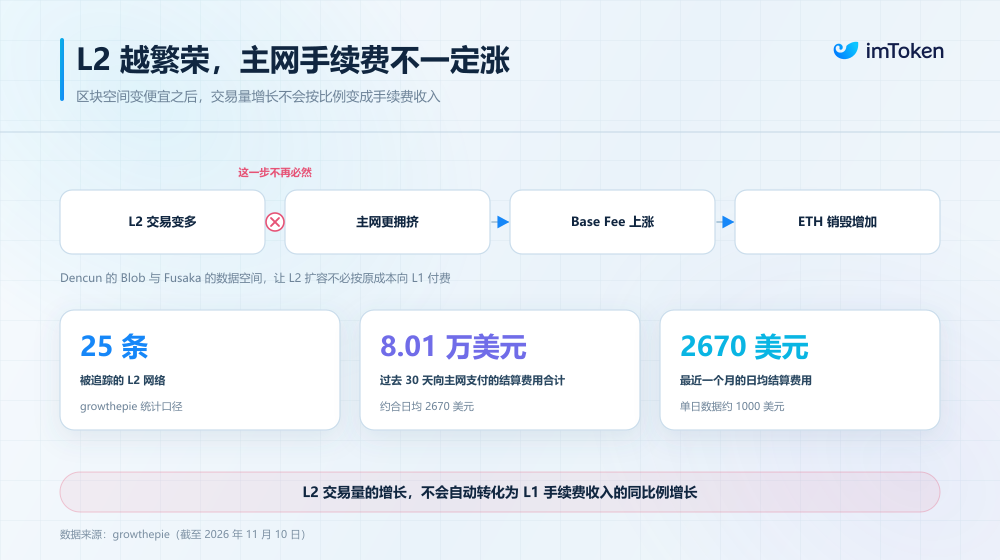
As upgrades like Dencun and Fusaka continuously lower the costs for L2s to submit data to the mainnet, and the mainnet itself continuously raises the Gas Limit, the cost and fee income for individual transactions may decline accordingly.
Even if the trading volume of the entire ecosystem continues to expand, it does not mean that the amount of ETH burned will grow in sync; if we rely solely on increasing Gas fees to support ETH's valuation, it may actually impose higher costs on ordinary users and real applications, ultimately harming the network's long-term competitiveness.
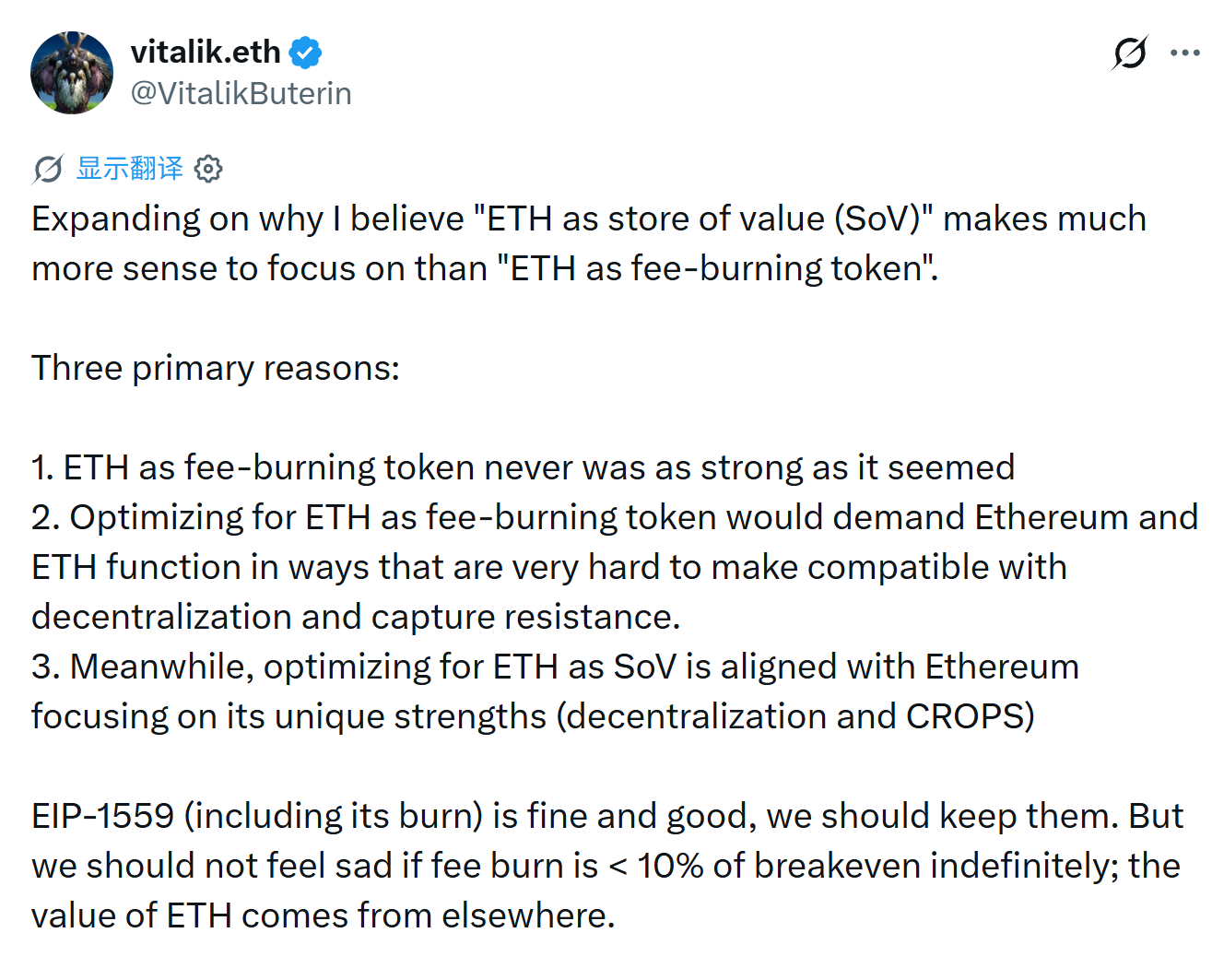
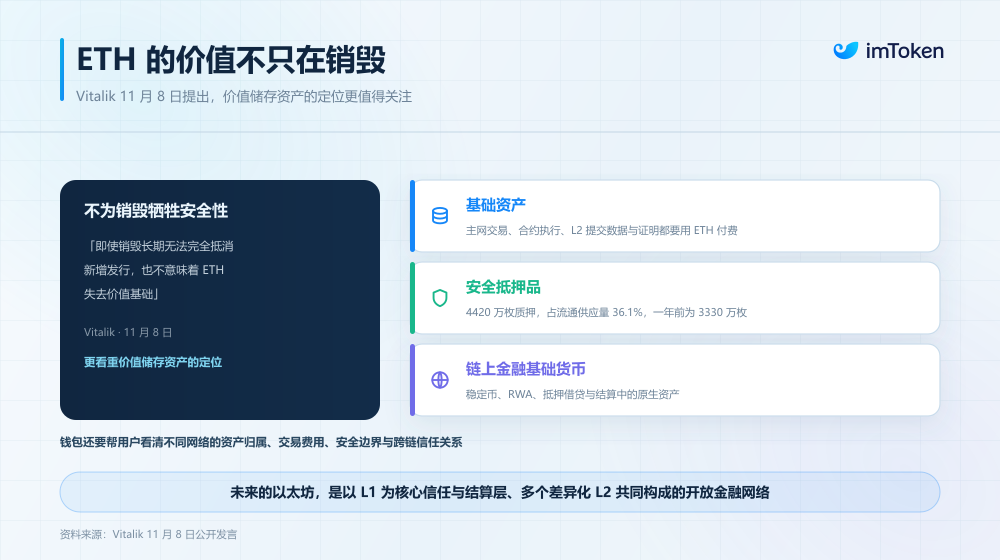
Vitalik Buterin specifically discussed ETH's value positioning, and his view is quite clear: compared to understanding ETH primarily as an asset whose value is generated through fee burning, he believes that positioning ETH as a store of value is more worthy of long-term investment for Ethereum.
Vitalik did not deny EIP-1559, nor did he advocate for the cancellation of the fee burning mechanism.
On the contrary, he believes that this mechanism remains reasonable and should continue to be retained, but even if in the future fee burning can only offset less than 10% of breakeven issuance, holders should not feel disappointed because the value of ETH does not solely depend on burning.
Why?
First, the periods when ETH was burned at its highest rates were largely due to speculative activities within the crypto industry.
For example, in 2022, the minting of Yuga Labs' Otherdeed NFT generated approximately $180 million in fees burned in a single day, but this revenue was not true external demand. If the overall crypto market shrinks and users' speculative capacities decline, such transactions and fee income may also disappear.
Thus, deducing ETH's long-term valuation solely from historical burning data cannot establish a reliable value baseline.
Second, if to support a market cap of hundreds of billions of dollars for ETH, the network requires constant high fee income, Ethereum may need to behave like large commercial companies, constantly increasing R&D investments, adjusting product directions, and taking more active governance interventions.
This does not completely align with Ethereum's long-standing goals of decentralization and resistance to control.
More importantly, intentionally maintaining high Gas fees to increase burning could exclude ordinary users who most need privacy, security, and open financial services.
So, aside from fee burning, what should ETH's long-term value be based on?
In Vitalik's view, the answer is Ethereum's truly unique competitiveness: decentralization, and the CROPS characteristics he summarized, which include Censorship Resistance, Ownership Resistance, Open Source, Privacy, and Security.
These attributes ultimately point to a more pragmatic value—stability, and the ability for the network to continue operating in the face of changing external environments.
Especially in an era of accelerated AI technology development and constant changes in traditional finance and digital infrastructure, a financial infrastructure that can maintain neutrality, reliability, and resistance to external control over the long term may be far more important than high fee revenue at a particular stage.
From this perspective, the reinforcement of L1 is actually solidifying the long-term value foundation of ETH from three dimensions.
- Core state and settlement capacity, constructing Ethereum's most important network effect: Computation itself can be commoditized, execution environments can be replicated, but a shared settlement layer with a large volume of assets, mature financial protocols, and deep liquidity is difficult to establish in a short time, which means that ETH’s status as a fundamental Gas asset, native collateral, and settlement asset may be strengthened as core financial activities converge again;
- Mainnet scaling, allowing ETH’s value no longer to depend on high single transaction costs: In the past two years, Ethereum has been trying to solve a long-standing contradiction of how to increase throughput without letting the hardware threshold for nodes spiral out of control. If a series of technologies mature gradually, Ethereum has the opportunity to transition from a past "low-frequency, high-cost" settlement network to a global financial infrastructure with higher throughput and lower usage costs;
- Staking mechanism and economic security, establishing a more solid underlying demand for ETH: From the perspective of the entire network, the value of ETH is forming a more diverse support; it is both the native resource required for network operation and the economic collateral for PoS consensus, as well as an important collateral and liquidity asset in DeFi and on-chain financial systems. This is much more comprehensive than relying solely on fee burning to explain ETH's long-term value;
Conclusion
If we view the development trajectory of Ethereum over the past few years as an expansion experiment, then the changes in 2026 seem to signify that Ethereum is beginning to seek a balance point for the entire ecosystem again.
L2s will not disappear, nor should they; they remain an important component of Ethereum's efforts to expand application scenarios, carry differentiated execution environments, and serve more users.
But at the same time, L1 cannot remain in a role that only provides data availability and final settlement for the long term.
It needs to re-strengthen its execution capabilities, liquidity central position, censorship resistance, and economic security to ensure that the most important assets and financial states can settle in a sufficiently trustworthy environment.
As the "Lean Ethereum" philosophy conveys—subtracting redundancy and friction, and reinserting the core principles of security, censorship resistance, and state consensus back into the protocol center (see extended reading "One Year Later, 'Lean Ethereum' Resurfaces: What Does Ethereum Want to Deliver?").
Thus, when the most valuable states and liquidity converge back to the mainnet, a stronger-performing, more unified experience, and a more solid value foundation are poised to open a new chapter for Ethereum in the next decade.
免责声明:本文章仅代表作者个人观点,不代表本平台的立场和观点。本文章仅供信息分享,不构成对任何人的任何投资建议。用户与作者之间的任何争议,与本平台无关。如网页中刊载的文章或图片涉及侵权,请提供相关的权利证明和身份证明发送邮件到support@aicoin.com,本平台相关工作人员将会进行核查。


