Author: Sam, Techub News
Introduction
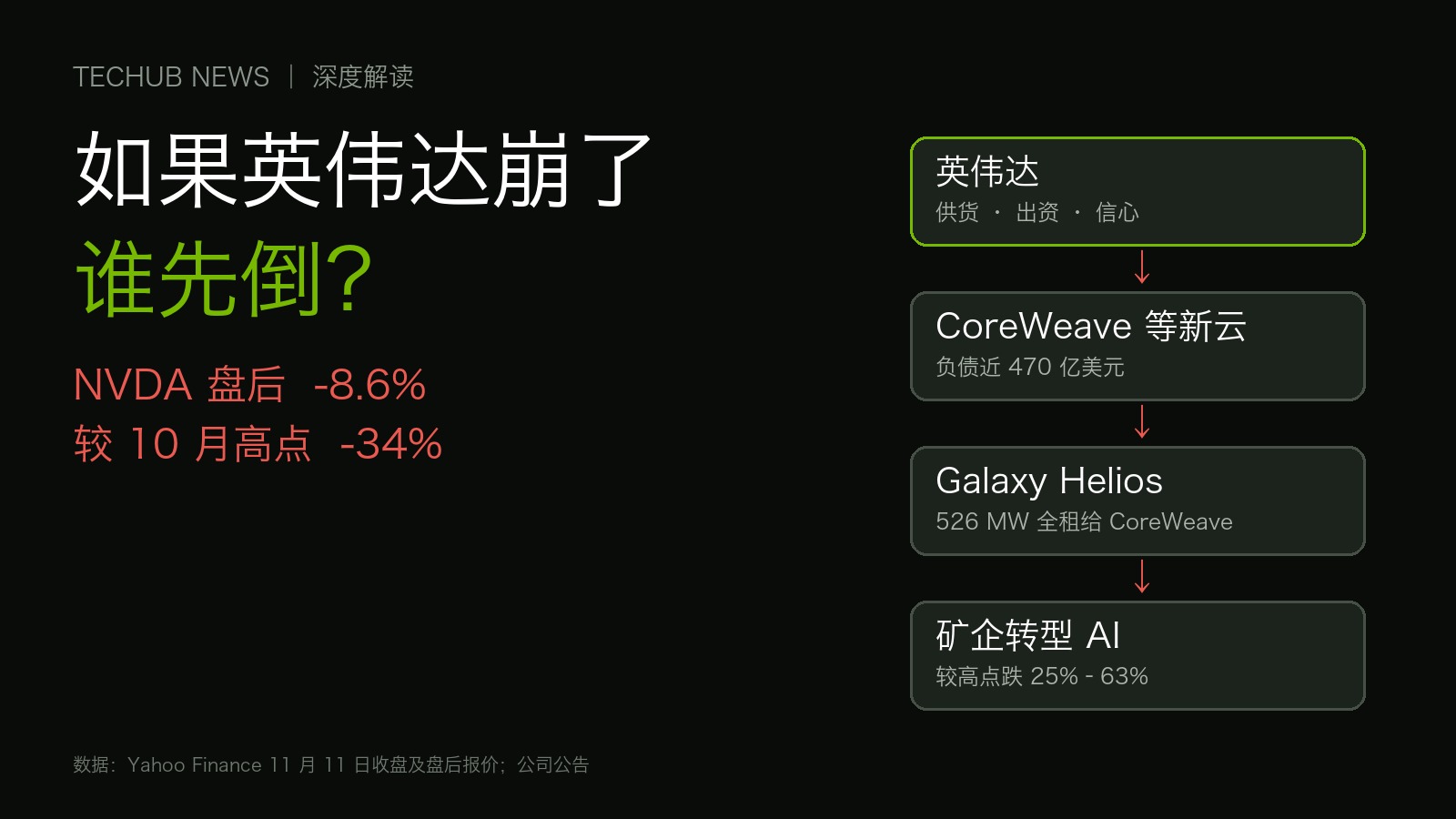
On November 11, when the U.S. stock market closed, the AI sector had just experienced a good day: CoreWeave’s earnings report exceeded expectations, with a single-day stock price increase of 24.7%. Galaxy, Nebius, Dell, and Micron also surged, and NVIDIA rose by 2.9%. Hours later, The New York Times broke the news of Jensen Huang's second extramarital affair, with Kim Powell, NVIDIA's Vice President of Healthcare, who is one of his direct subordinates. The Wall Street Journal then reported that the board was considering his future. After hours, NVIDIA’s stock fell to $158.78, an 8.6% drop from the closing price, and it had lost more than one-third from its peak on October 6.
Two scandals within a week brought out foreign intelligence suspicions in the first case and touched on corporate governance in the second. The market began to seriously consider a question that few had contemplated in the past few years: if Jensen Huang were to leave and NVIDIA’s valuation were to collapse, what would become of the companies that rely on NVIDIA for supplies, blood transfusions, and narratives?
Key Summary
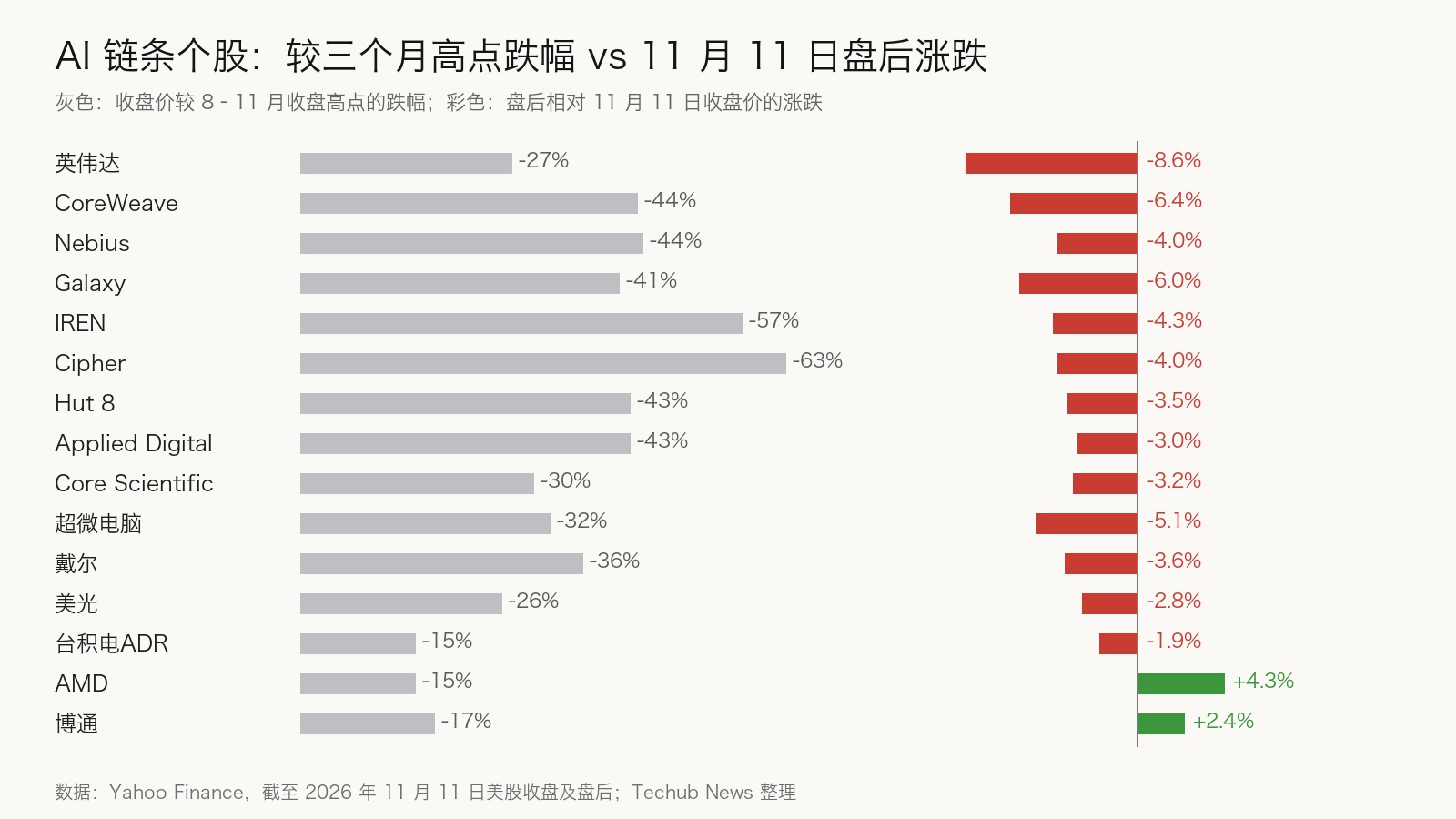
- After hours on November 11, NVIDIA fell 8.6% to $158.78, a cumulative drop of about 34% from the high of $239.24 on October 6; CoreWeave and Galaxy dropped 6.4% and 6.0% respectively after hours, while AMD and Broadcom rose against the trend.
- NVIDIA is a supplier, shareholder, and source of funding for CoreWeave: this January, it invested $2 billion at $87.20 per share, which means an unrealized loss of about 30% based on the closing price on November 11. As of the end of Q3, CoreWeave had nearly $47 billion in debt, with funding in 2027 primarily relying on customer prepayments and hardware partner financing.
- Galaxy’s AI business is almost entirely tied to CoreWeave: the Helios campus is fully leased to CoreWeave at 526 megawatts, with a potential total contractual value exceeding $30 billion, and an expected additional investment of $4 billion for phase two construction.
- AI computing companies that transitioned from Bitcoin mining have generally declined by 25% to 63% from three-month highs; IREN has lowered its 2027 fiscal year capital expenditure, with about $6 billion of the remaining $15 billion spending yet to be determined.
- The real risk does not lie in the scandals themselves but in whether they coincide with a slowdown in AI capital expenditure: the former is a one-time valuation shock, and the combination could evolve into a "collapse" of the entire chain.
1. Two Scandals in a Week: From "Trust" to "Considering Future"
The timeline is short. Since the end of October, The New York Times and other media outlets have reported on Huang's close relationship with Alice Huang, a former executive of Singapore-based chip company Megaspeed, who is suspected of being recruited by Chinese intelligence agencies. The Chinese Ministry of Foreign Affairs responded on October 30, calling the relevant reports "wild speculations"; on November 6, it was reported that U.S. intelligence agencies believed the two had a romantic relationship. The chairs of three House committees collectively wrote on November 4, demanding his attendance at a closed-door explanation on November 18. On November 8, Huang admitted to the affair in a letter to employees, and the board announced the establishment of an independent committee for investigation while expressing "confidence in Huang and his leadership team" and stating there was no reason to believe national security or company secrets had been compromised.
Three days later, the situation changed. According to Yahoo Finance quoting The New York Times, Huang also had an extramarital relationship with Kimberly Powell, NVIDIA's Vice President of Healthcare, who is one of his approximately 60 direct subordinates; the two were seen behaving intimately at a company conference in March. The Wall Street Journal then reported that the board was meeting to decide whether to replace Huang. Powell's originally scheduled appearance at the Milken Health Summit was also canceled at the last minute.
The first incident centers on national security, and NVIDIA can argue that no conclusions have yet been reached in the investigation; the second relates to the relationship between the CEO and a direct subordinate, which is a typical governance red line for U.S. publicly traded companies. Thus, the market's reaction was even more intense than the previous week.
2. Three Possible "Collapses," Varied in Degree
Before discussing "what if NVIDIA collapses," we must clarify what exactly is collapsing.
Scenario One: Emotional Shock. Huang remains or transitions in some way, the investigation finds no national security issues, and NVIDIA's orders and product cadence remain unaffected. In this case, the decline is mainly due to an increase in risk premium, lasting as long as the investigation and Congressional briefing progress.
Scenario Two: Leadership Change. Huang steps down. Bloomberg previously cited Bernstein analyst Stacy Rasgon's report, indicating that this incident highlights NVIDIA's "key personnel risk": Huang leads the company’s long-term strategy and personally participates in a large amount of operations, while NVIDIA has no publicly announced succession plan. A leadership change will not cause GPU orders to vanish overnight, but the market will reassess NVIDIA’s execution capacity and whether its support for the entire ecosystem in terms of funding and resources can continue.
Scenario Three: Demand Chain Breaks. Leadership changes or the fermentation of the scandal coincide with a slowdown in AI capital expenditure, causing clients to delay purchases and downstream new cloud companies to struggle to obtain funds and face delivery delays, forming a negative feedback loop. This is the true meaning of "collapse," and the impact will not be limited to NVIDIA alone.
From current signals, the market appears to be pricing in Scenario One and Scenario Two; several signs of Scenario Three have emerged, but have not yet formed a coherent pattern.
3. First Circle: CoreWeave, a Customer Nurtured by NVIDIA
NVIDIA and CoreWeave's relationship is not just about selling cards. According to the announcement by both parties on January 26 this year, NVIDIA invested $2 billion in CoreWeave at $87.20 per share, with plans to build over 5 gigawatts of AI factories by 2030, and NVIDIA also promised to use its financial strength to help CoreWeave expedite the acquisition of land, power, and facilities. CoreWeave's closing price on November 11 was $60.77, and NVIDIA's investment has incurred an unrealized loss of about 30%.
CoreWeave's Q3 performance announced on November 10 was not bad: revenue reached $3.66 billion, up 168% year-on-year, exceeding expectations; the full-year revenue guidance was raised to $13 billion to $13.3 billion; revenue backlog reached $13.25 billion. However, its balance sheet is quite heavy: by the end of Q3, its debt approached $47 billion, with a capital expenditure target of $37 billion to $39 billion in 2026. CNBC reported that CEO Michael Intrator indicated that most of the funds needed for 2027 would come from customer prepayments and financing from hardware partners, with the company only raising a small amount of funds; CFO Nitin Agrawal stated there were no plans to issue unsecured debt at the parent company level before 2027 based on current yields.
This is where CoreWeave is most sensitive to NVIDIA's risks. Its expansion is built on three pillars: customer willingness to prepay, a stable asset-backed debt market, and continued supply and funding from hardware partners such as NVIDIA. If NVIDIA enters a transition and investigation period, whether the third pillar will shake is uncertain for the market. CoreWeave fell 6.4% after hours, and its stock price has decreased by 44% from the August peak.
Similar new cloud companies are in a similar situation. Nebius has fallen 44% from its three-month high, Applied Digital is down 43%, and their business models similarly involve borrowing money to buy NVIDIA GPUs and then renting out the computing power.
4. Second Circle: Galaxy, a Landlord Betting on a Single Tenant
"As long as CoreWeave doesn't go bankrupt, Galaxy will be fine." This judgment generally holds true but requires a few caveats.
Galaxy’s Q3 materials released on October 27 showed that it has leased all key IT loads of 526 megawatts in the Helios campus in Dickens County, Texas to CoreWeave, with a total expected annual income exceeding $1 billion from its three phases, and the adjusted EBITDA profit margin on the rental level is over 90%. If the two five-year renewal options are exercised, the total potential value of the contract exceeds $30 billion. The first phase of 133 megawatts was delivered in Q2 of this year, with an annual base rent of $315 million and construction costs of $1.8 billion; the second phase of 260 megawatts is planned to start leasing in Q2 of 2027, with an annual base rent of $675 million and estimated construction costs of $4 billion.
This contract represents a qualitative change and concentration risk for Galaxy. As long as CoreWeave pays rent on time, this is a 15-year cash flow with extremely high profit margins; however, if CoreWeave's financing is hindered, the delivery and leasing timing for the second and third phases may be renegotiated, while Galaxy will first need to invest billions of dollars in construction. Ultimately, the landlord's risk is, in essence, the tenant's credit risk, and the tenant's credit is partly tied to NVIDIA.
On November 11, Galaxy followed CoreWeave's surge, up 13.2%, but fell 6.0% after hours, and has decreased by 41% from its high on September 22. It also has cryptocurrency trading and asset management businesses; Bitcoin has fallen about 15% from its peak in September, which does not help.
5. Third Circle: Those Transitioning from Mining to AI
Over the past two years, a group of Bitcoin mining companies have transformed their power and space into AI data centers, becoming the periphery of NVIDIA’s ecosystem. Their declines have been steeper than CoreWeave’s: Cipher Mining has dropped 63% from its three-month high, IREN is down 57%, Hut 8 has fallen 43%, Core Scientific is down 30%, and TeraWulf has decreased by 25%.
IREN is the first among these companies to hit the brakes. According to its earnings conference on November 6, the company set the remaining capital expenditure for fiscal 2027 at $15 billion, lowered from previous estimates, citing flexibility in adjusting expansion pace according to market conditions; currently, cash, untapped GPU financing, and uncollected customer prepayments total about $9 billion, with total debt around $10.2 billion. According to The Information, IREN is one of the parties that caused Microsoft's capital expenditure in the last quarter to be about $5 billion less than planned due to delayed deliveries, a claim that neither IREN nor Microsoft has confirmed.
The common point among these companies is that their most valuable assets are power and space, while they lack cash. Once NVIDIA loses momentum, their financing costs will rise first.
6. Hardware Chain: Who is Falling, Who is Rising
Server and supporting equipment suppliers are also within NVIDIA's sphere of influence. As of the after-hours quotes on November 11, Supermicro fell 5.1%, Dell dropped 3.7%, Micron fell 2.8%, Vertiv dropped 2.2%, and TSMC ADR fell 1.9%. Their distances from peaks are also significant: Dell is down 37% from its high in September, Micron is down 26%, and Supermicro is down 32%.
Notably, there are two exceptions: AMD rose 4.3% after hours, and Broadcom increased by 2.4%. One interpretation is that, in the market's view, NVIDIA's problems are seen primarily as "NVIDIA's issues" rather than problems with AI computing demand, prompting some funds to start looking for alternatives. If a leadership change occurs, the incentive for clients to diversify procurement and increase self-research for chips will strengthen, which would be beneficial for AMD, Broadcom, and the custom chip supply chain.
7. Indices and Capital: A Ripple Effect
As of the market close on November 11, the Philadelphia Semiconductor Index has fallen 20.1% from its peak on October 6, entering a technical bear market; the Nasdaq Composite Index fell 7.7%, and the S&P 500 Index dropped 2.6%. NVIDIA is one of the largest weighted stocks in the U.S. market, and its decline will be passively transmitted to the entire market through index funds.
Another time point worth noting: Anthropic is expected to go public on the Nasdaq next week, with NVIDIA as one of its cornerstone investors in the $26 billion private placement. Reports from Yahoo Finance mentioned that having cornerstone investors such as NVIDIA would have enhanced market confidence in this issuance, but the current scandal could shake that sense of security. The financing window for the AI sector is also dependent on NVIDIA's stability.
The crypto market is experiencing indirect effects. Companies like Galaxy, IREN, and Core Scientific span both the crypto and AI sectors, and their stock prices have combined pressures from both sides; Bitcoin is currently around $74,000, down about 15% from its peak in September, and has not yet shown drastic fluctuations in sync with NVIDIA.
8. What to Watch Next
First is the board's decision. The board has hired the law firm Wachtell, Lipton, Rosen & Katz to assist with the investigation; how the discussion of retention or dismissal ends, as reported by The Wall Street Journal, is a watershed moment between Scenario One and Scenario Two.
Second is November 18. Three committee chairs of the House require Huang to attend a closed-door explanation that day; whether the intelligence suspicions can be clarified will impact NVIDIA's position in Washington and its business in China.
Third is the financing for new cloud companies. CoreWeave has stated it will issue new debt linked to contracts in the coming weeks, and the pricing of this debt is the most direct window to observe whether the market transmits NVIDIA's risks downstream.
Fourth is Anthropic's pricing. Whether the AI capital market can still support a trillion-dollar valuation will also determine the financing environment for this chain.
The scandal will eventually pass, and NVIDIA's GPUs will not slow down due to the CEO's private life. The real caution is this: when a company serves as both the supplier and the source of funding and confidence for the entire AI infrastructure, and when the helm of this company becomes the risk itself, the leverage of the entire chain is exposed.
References
2. NVIDIA: Statement from NVIDIA Board of Directors (2026-11-08)
4. CNBC: CoreWeave beats on revenue and lifts guidance, easing AI slowdown concerns (2026-11-10)
5. Galaxy Digital: Q3 2026 Company Overview (8-K attachment, 2026-10-27)
6. The Motley Fool: IREN Q1 2027 Earnings Call Transcript (2026-11-06)
7. Letter from the Chairs of Three House Committees to Jensen Huang (2026-11-04)
Editor’s Note: This article is a scenario analysis, not a prediction of NVIDIA or related companies' stock prices. Market data is sourced from the closing prices and after-hours quotes of U.S. stocks on November 11 (as of the time of publication on November 12, Beijing time), with three-month peaks being the closing price highs between August and November 2026; information regarding Jensen Huang's second extramarital affair and board deliberations comes from reports by The New York Times and The Wall Street Journal, and NVIDIA has not yet formally responded. Data on CoreWeave, Galaxy, and IREN is from company announcements, earnings documents, and earnings call transcripts.
Disclaimer: This article is solely for informational reporting and analysis and does not constitute any investment advice.
免责声明:本文章仅代表作者个人观点,不代表本平台的立场和观点。本文章仅供信息分享,不构成对任何人的任何投资建议。用户与作者之间的任何争议,与本平台无关。如网页中刊载的文章或图片涉及侵权,请提供相关的权利证明和身份证明发送邮件到support@aicoin.com,本平台相关工作人员将会进行核查。


