Original author: Sleepy
At around 5:30 PM Eastern Time on November 11, The Wall Street Journal released exclusive news that the Nvidia board is preparing to dismiss Jensen Huang.
Just over twenty minutes earlier, The New York Times had just exposed his second extramarital affair, with Kimberly Powell, the vice president of Nvidia's medical business, who has reported directly to him for nine years. That evening, Bloomberg followed up by stating that the board was already in contact with external headhunters. After hours, Nvidia dropped by about 9%.
As the first company in history to surpass a market capitalization of $5 trillion, Jensen Huang has led Nvidia for a solid 33 years.
Interestingly, none of the materials that have been densely thrown out in the past two weeks in an attempt to unseat Jensen Huang is something new.
Photos from the first extramarital affair were taken in June 2024; the U.S. Commerce Department's investigation began in September 2024; the intelligence department's surveillance confirmed Jensen Huang's identity in the summer of 2025; the short-selling firm incorporated the two's relationship into a 40-page public report six months ago; as for the video from the second relationship taken in a San Jose hotel, it was filmed in March of this year.
These materials quietly lay in Washington's filing cabinets, law firm folders, short-selling firms' hard drives, and former employees' cell phones for half a year to two years, and then suddenly, during the 14 days from October 29 to November 11, they were released one by one as if scheduled.
In Silicon Valley, which advocates Founder Mode, the private morality of founders is often the easiest flaw to overlook. But this time, this set of rules has failed with Jensen Huang.
We want to understand why, and why precisely during these 14 days? In this crisis seemingly triggered by scandalous news, who exactly needs Jensen Huang to step down?
Suppressed Memorandum
The outside world has pieced together a complete story about the Singapore company Megaspeed and its managing director Huang Le, a shell company that was spun off from a Chinese gaming company and has only $5.7 million in cash, how it obtained Nvidia's official cloud partnership license in just four days and purchased at least $4.8 billion worth of Nvidia chips through a data center in Malaysia.
During electronic surveillance of Huang Le, U.S. intelligence agencies traced her close relationship with Jensen Huang, assessing that she had been recruited with the task of approaching Jensen Huang to influence Nvidia's continued lobbying in Washington for easing chip export controls to China.
This investigation had originally been unable to proceed for more than a year.
The reason lies in the White House; over the past year, Jensen Huang has almost become a regular at Mar-a-Lago and the White House.
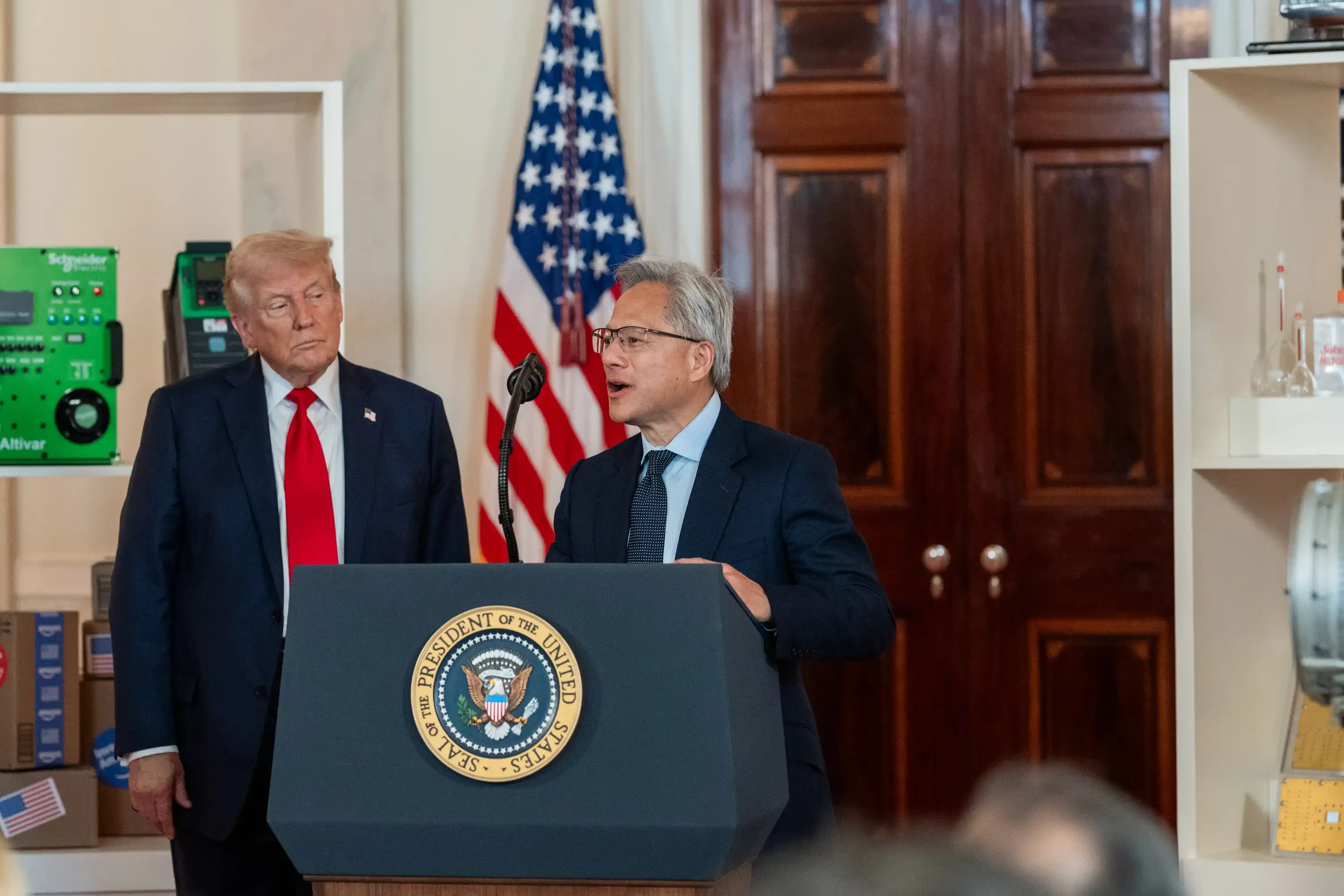
When Trump was inaugurated in January 2025, he was not among the first batch of invited tech company founders, but he quickly secured a ticket.
In April, he attended a Mar-a-Lago dinner with a ticket price of $1 million and subsequently Nvidia anonymously donated $25 million to the White House banquet hall renovation project, according to documents obtained by The Washington Post; this figure tied with Apple as the highest among all companies. By this year, Nvidia even established its first political action committee in company history, with two vice presidents in charge of software and hardware each donating $443,000 to the Republican National Committee on the same day.
The returns were immediate. In May 2025, the White House abolished the AI diffusion rules from the Biden era; in July, shipments of H20 chips to China resumed; in December, Trump announced that Nvidia could sell more powerful H200 chips to approved Chinese customers, with the condition that the U.S. government takes a 25% cut from sales.
At the end of last year, Jensen Huang had proudly recounted on Joe Rogan's podcast the opening line from the first call he received from Commerce Secretary Howard Lutnick: "Jensen Huang, I'm Secretary Lutnick. I just want you to know you are a national treasure, and Nvidia is a national treasure. Whenever you need to speak with the president or the government, just give us a call; we're always here."
When a company's CEO is referred to as a "national treasure" by the Commerce Secretary, the regular enforcement mechanisms are hard to operate.
In August 2025, after Huang Le was interviewed by the police in Singapore, Nvidia's General Counsel Tim Tait directly called Department of Commerce Deputy Secretary Kessler to question whether there were pushes from the U.S. side. Weeks later, frontline investigators received internal directives that all inquiries involving Nvidia must be approved by the Deputy Secretary, and the name Megaspeed could no longer be mentioned outside.
According to reports from The New York Times and Axios, from then on, the Department of Commerce's entity list did not add any new companies for 13 months, and over 100 companies’ names approved by the interdepartmental committee, including the specifically requested Megaspeed, were all suppressed by the Department of Commerce.
Even after intelligence officers reported to Trump the findings of Jensen Huang's surveillance in October 2025, Trump decided to do nothing.
After administrative channels were completely blocked, Washington's hawks advocating tighter chip control towards China had no choice but to find an alternative route.
In the spring of 2026, Secretary of State and National Security Advisor Rubio personally supervised the drafting of a top-secret memorandum, packaging together the surveillance records, their romantic relationship, and national security risks, circulating it among cabinet officials with high-level security clearance. On the eve of Trump's visit to China in May, Rubio even reminded Trump in person on Air Force One.
But Trump still did not change his plans. He downplayed this matter later by saying it "doesn't affect me," and he still took Jensen Huang to Beijing, seating him at the main table during the White House banquet in September.
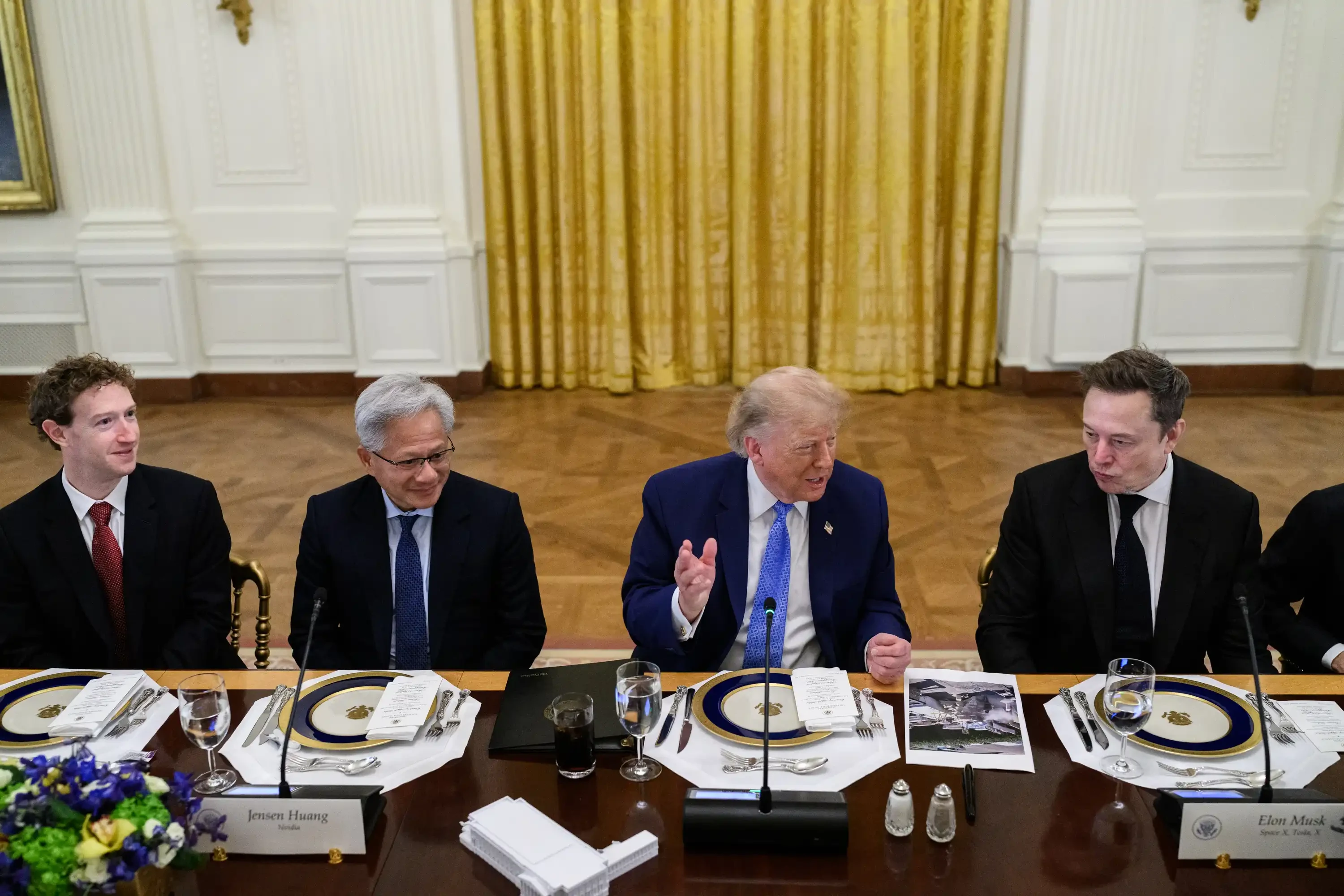
For five whole months, that top-secret memorandum had no further developments. Until the end of October, someone decided to overturn the table.
14 Days and the Final Blow
If you lay out the reports since October 29 in chronological order, you'll find this was not an incidental media leak but a precise hunt pinned at the intersection of politics and business.
The first shot was fired on October 29, Thursday. The New York Times published the first investigation, "Nvidia's Leader Viewed as Target of Chinese Spy Conspiracy."
This article unusually bore six bylines, with reporters covering the White House, trade export controls, Asian geopolitics, Silicon Valley, and intelligence all on it. In The New York Times, this caliber signifies that interdepartmental verification has been ongoing for months, and the sources feeding the information span multiple levels of the White House, intelligence community, and the Department of Commerce.
Why release it on this day? Because five days later is the November 3 midterm elections in the U.S., and three weeks later Trump is going to Shenzhen for the APEC Summit. Exposing this matter before the summit effectively blocks Trump's possibility of making deals to ease chip controls.
What's more meticulous is the scale of the leak; the first article only mentioned that the two were in a close relationship, without any references to extramarital affairs.
This was clearly a hook left for later. Indeed, Nvidia fell into the trap that very day, with the spokesperson sharply denying, stating that seeing customers is part of the CEO's job, and that the interactions between Jensen Huang and Huang Le "are neither abnormal nor surprising."
Once the midterm elections concluded and the Democrats won both chambers, the pace of the net closing suddenly accelerated.
On November 5, three Republican House committee chairs jointly sent a letter requesting Jensen Huang to appear at a closed-door briefing; on the same day, in the White House Situation Room, Treasury Secretary Basant publicly questioned Secretary of Commerce Lutnick in front of the Secretary of Defense and the Secretary of State as to why Megaspeed was not yet listed on the entity list. The next day, Friday, the last trading day before the weekend, The New York Times and The Financial Times simultaneously released the second wave of reports, directly characterizing their "romantic relationship."
Just two days later, on Sunday, November 8, when they were still saying "not unusual," Jensen Huang had to send an apology letter to over 40,000 employees, stating, "I was unfaithful to my wife."
The following Monday and Tuesday, the focus of the leak quickly shifted from personal life to criminal compliance, with media revealing how the General Counsel Tait intervened in the Department of Commerce investigation, which has now been transferred to the Department of Justice as a criminal investigation; Bloomberg and The Information then released trade data, accusing Nvidia of underreporting approximately 50,000 chips, aiding a network spanning China and Singapore to send at least $7.5 billion and around 240,000 restricted GPUs to China.
But even by Tuesday night, many people in Silicon Valley and Wall Street still felt Jensen Huang could weather through this.
The reason is simple; the so-called espionage charges are based on a previously undisclosed memorandum. Beijing-based observer Fred Gao pointed out the logical flaws within it on Substack, noting that Beijing has been restricting domestic large enterprises from purchasing H200, requiring that inference computing prioritize the use of domestically-produced chips, resulting even in 600,000 chips being stuck in Hong Kong. Why would a government that is limiting the purchase of Nvidia chips send someone to lobby Jensen Huang to sell more chips?
He stated, "Unpublished means unfalsifiable."
As long as the Department of Justice does not produce an indictment, the upper-level accusations will forever remain at the level of verbal sparring, and Nvidia's board has every reason to retain its founder. For the board to abandon Jensen Huang, what is needed is an event that does not rely on intelligence agencies and would be a clear violation within any publicly listed U.S. company.
Thus, at 5:31 PM on Wednesday, November 11, the final blow came.
The New York Times published its fourth report. This time, the sources were five former Nvidia employees, with the female lead being Kimberly Powell, a direct subordinate who has been with Jensen Huang for nine years and is the vice president of the medical business. The most damaging detail in the report is that during the GTC conference in March of this year, the two were captured engaging in intimate behavior in a hotel by passersby, and Jensen Huang's security team intervened on the spot, asking the photographer to sign a non-disclosure agreement.
This changed the nature completely.
Entanglements with external customers could at most be considered a lapse in private morality; but concealing a years-long conflict of interest with a direct subordinate and utilizing company security resources to cover it up is regarded as a violation of fiduciary duty in publicly listed companies. Steve Easterbrook of McDonald's, Brian Krzanich of Intel, and Mark Hurd of HP all fell on the same red line.
More than twenty minutes later, The Wall Street Journal released the exclusive news that the board was preparing to change leadership.
Can a heavyweight exclusive news piece be written in just twenty minutes? Perhaps before The New York Times sent out its article, decisions to sever ties with Jensen Huang had already been handed to the media from within the board or by someone close to it.
Why Did No One Save Him?
Washington's hawks handed over the knife, but for the situation to escalate to the point where the board is preparing to replace him, it cannot be separated from another group's tacit consent, mainly Jensen Huang’s largest customers, the startup companies he invested in, and his peers in Silicon Valley.
For the past three years, no one in Silicon Valley has dared to offend Jensen Huang. It was the time when Larry Ellison and Musk pleaded with him at Palo Alto's Nobu restaurant throughout an entire meal, "Please take our money and give us more GPUs." When cards are limited, whoever gets the card first can train their models three months earlier, and all the power lay firmly in Jensen Huang's hands.
But Silicon Valley companies that have been suffering under Huang for a long time have long started looking for a way out behind the scenes.
One way out is in Washington. According to reports from The Wall Street Journal, Microsoft and Amazon AWS have been lobbying the GAIN AI Act on Capitol Hill since the end of 2025, with the central demand that AI chip manufacturers must prioritize meeting domestic buyer orders before shipping overseas.
The reason Jensen Huang desperately lobbied the White House to ease export controls to China and even supported Southeast Asian cloud manufacturers like Megaspeed was not just to sell more cards, but more critically, to retain enough buyers outside the four major U.S. cloud manufacturers, ensuring that negotiating power would not fall into the hands of a few giants. For Microsoft and Amazon, supporting export controls under the banner of "national security" ultimately benefits them directly by legitimizing the retention of Nvidia's original overseas manufacturing capacity for themselves.
The other way out lies in the underlying technology.
During the week when Nvidia's market value evaporated by $400 billion in just two days, Anthropic, a company that Nvidia once invested in, launched the largest IPO roadshow in history, valued at about $1.4 trillion. Its CEO, Dario Amodei, has been one of the most vocal opponents in Silicon Valley against Nvidia's exports to China, previously comparing the sale of the H200 to "selling nuclear weapons to North Korea," while Jensen Huang criticized this statement as "stupid."
Anthropic's co-founder and chief computing officer, Tom Brown, revealed that the company used its cutting-edge model Claude Mythos, taking only about 3 days to automatically rewrite and port almost 100% of the underlying computational kernel, with negligible engineer involvement, enabling Claude to run on AMD chips, while such work previously required dozens of systems engineers and took over half a year.
Over the past twenty years, Nvidia's high gross margin of up to 75% has not been due to chip hardware but rather the extraordinarily high switching costs brought by the CUDA ecosystem. But now, AI itself has dismantled that wall. In its prospectus, Anthropic stated that it had treated Amazon's Trainium, Google's TPU, Nvidia's GPU, and AMD's GPU as interchangeable computing pools. At the same time, self-developed chips from Google, Amazon, and Meta have all been ramping up production this year.
If in 2023 or 2024, shaking Jensen Huang could have caused the entire U.S. stock market to crash, by November 2026, Blackwell and Rubin's schedules would already stretch to 18 months later, and the large tech companies' self-developed chips would be in full production, even the migration costs of CUDA are being offset by large models.
The capital market's voting is more honest than any statement; on Monday, November 9, Nvidia's stock plunged nearly 9% during trading, but on the same day, the Philadelphia semiconductor index soared nearly 7%, with AMD surging 13.26%, while Broadcom, TSMC, and SK Hynix all reported gains.
The money didn't leave AI; it simply felt that it didn't necessarily have to bet on Nvidia anymore.
As for Musk, after the White House Situation Room meeting on November 5, before Trump approved actions against chip transfer companies, he specifically called Musk to ask his opinion, to which Musk expressed support.
Six days later, when the financial account ZeroHedge stirred Musk to recruit Jensen Huang on X, Musk replied an hour and a half later, "That would be an honor."
Wife Guy and Six Votes
Even so, this matter still seems quite strange in Silicon Valley.
After all, Silicon Valley has always harbored remarkable tolerance towards the private morality of top founders. Musk fathered twins with a senior female executive at his company Neuralink and was exposed to scandals involving multiple subordinates, yet he did not lose any position, and Tesla's shareholder meeting even passed his compensation package potentially worth up to $1 trillion with over 75% approval last year. Paul Graham's "Founder Mode" and Marc Andreessen's critical commentary on "tech ethics" and "risk management" essentially endorse one thing: as long as founders can lead everyone to win, the rules can bend for them.
According to the standards of "Founder Mode," with no COO, having 60 executives report directly to him, and even working on Thanksgiving, Jensen Huang should have been the most revered example in Silicon Valley. When the first gossip broke, Sequoia partner Sean McGuire and Bill Ackman indeed voiced their support for him on X, stating he was "irreplaceable for America's AI leadership."
Why did this exemption suddenly fail with the second gossip?
One reason is the public image Jensen Huang cultivated for thirty years.
Musk can smoke marijuana on podcasts, and Andreessen can openly attack moral scrutiny, but a Taiwanese immigrant who was sent to a boarding school in Kentucky at nine, has used men's restrooms, and has served plates at Denny's does not possess the capital to be accepted by the power elite in Silicon Valley and Washington while indulging in caprice.
For thirty years, regardless of how much the market value has soared, Jensen Huang has always told the same nearly flawless story: he met his first love, Lori, at seventeen, promising to become CEO by thirty; his clothes are chosen by his wife and daughter; besides work, he only goes home to accompany his wife and children; even when California's wealthy collectively protested against the wealth tax, he would obediently state, "It's my honor to pay $8 billion in taxes."
As the American magazine Slate commented on November 11, Jensen Huang fell into the "Wife Guy" trap. Zuckerberg and Musk do not win trust through family virtues, while only Jensen Huang has regarded being a "family man" as the foundation of his personal credit. Amid geopolitical suspicions and subtle anti-Chinese sentiment, this harmless model minority image is his way of reassuring the American public and politicians.
And when you treat moral perfection as a talisman, the backlash from moral bankruptcy is also doubled.
However, more fatal than the collapse of his persona is the institutional fragility. Musk and Zuckerberg will not be removed by their boards, but Jensen Huang might, and the fundamental difference lies in the equity structure.
When Nvidia went public in 1999, dual-class share structures were not yet popular in Silicon Valley. After more than twenty years of dilution and reduction, Jensen Huang's stake in Nvidia is now only about 3.56%, and more than half is held jointly with his wife in a family trust, with one vote per share and no special voting rights. In contrast, Zuckerberg possesses 60.6% voting rights over Meta, while Musk retains 85.1% voting rights in SpaceX.
In Nvidia's board of 11 members, as long as 6 independent directors nod, they can fire Jensen Huang that very evening.
While these six votes have never been cast against him in the past 33 years, it is because all the board members have been his own people. The average tenure of the ten independent directors is nearly 15 years, with Tanchi Cox, Mark Stevens, and Harvey Jones being there since its founding in 1993, and the chief independent director Stephen Neill being the former head of the external law firm Cooley that has served Nvidia for 33 years. In 2006, when Jensen Huang pushed CUDA against Wall Street's criticism, and the stock price did not rise for years, it was these old board members who had become billionaires with him that shielded him from aggressive investors.
Internally, Jensen Huang's authority was similarly unchecked. Nvidia is the only company in the S&P 100 without a chairman, lacks a president, has no COO, and even no chief compliance officer; he has rejected all succession plans in recent years, while placing his daughter, son, and son-in-law into core business departments one after another.
This familial structure, called efficiency in favorable conditions, becomes a minefield in adverse situations.
This week, as shareholders' lawsuits were filed in the federal court in Northern California, Congress threatened subpoenas, and General Counsel Tait was exposed for allegedly interfering with federal investigations, the situation for the old directors completely changed.
If it were purely a matter of private morality, old friends could take the fall for him; but if it involved concealing conflicts of interest from the board, using company resources to sign non-disclosure agreements, and even the Department of Justice interfering in the judiciary, the directors would face real personal legal liabilities themselves.
The decision to bring in the law firm Wachtell Lipton and have former Southern District Assistant U.S. Attorney Jin Junxian lead the internal investigation was made by the 77-year-old chief independent director Neill. Neill himself hails from a top white-collar crime defense background, having represented Theranos founder Elizabeth Holmes, and when Holmes couldn't afford legal fees in 2019, it was he who applied to the court to withdraw from her representation. He knows better than anyone when to protect his client and when to protect himself.
From this perspective, the five former employees who suddenly spoke to The New York Times provided the board with a most dignified off-ramp. The top-secret national security memorandum cannot be used as grounds for board decisions, but "concealing conflicts of interest with direct subordinates and violating business codes of conduct," once verified, could directly trigger dismissal clauses.
Stay, with Less
There are still five days until the third-quarter earnings conference call on November 17; and six days until the closed-door briefing in Congress on November 18.
Three years ago on November 17, when the OpenAI board fired Sam Altman, over 700 employees jointly confronted them, welcoming him back days later. Recently, 88% of certified Nvidia employees on the workplace community Blind have shown support for Jensen Huang's continued tenure. However, a $5 trillion publicly listed company is ultimately not a startup lab.
Georgetown University professor Jason Schlesinger speculates that the final outcome may not necessarily be Jensen Huang's complete exit; it may be "stay, with less"—remaining on board, but relinquishing significant control and accepting a strong number two figure while restructuring the board that has accompanied him for 33 years.
If this truly is the outcome, neither the tens of billions in computing power guarantees he has made externally nor the sales channels maneuvering through geopolitical gaps will be solely governed by him anymore. For Washington's hawks, cloud firms frustrated with computing power allocation, Wall Street institutions, and directors eager for immunity, "a Jensen Huang who relinquishes power" may be more advantageous than just replacing him directly; Nvidia will continue to profit, but no longer under the sole dominion of one individual.
Three years ago, when Nvidia's market value crossed $1 trillion, Jensen Huang returned to the Denny's restaurant where he founded the company in San Jose and nailed a plaque on the wall of the booth they often sat in.
A month later, when the host of the podcast Acquired asked him, if he could go back to age 30 sitting in that Denny's booth, would he still be willing to start Nvidia from scratch again?
Jensen Huang's answer at that time was: "I wouldn't do it."
免责声明:本文章仅代表作者个人观点,不代表本平台的立场和观点。本文章仅供信息分享,不构成对任何人的任何投资建议。用户与作者之间的任何争议,与本平台无关。如网页中刊载的文章或图片涉及侵权,请提供相关的权利证明和身份证明发送邮件到support@aicoin.com,本平台相关工作人员将会进行核查。


