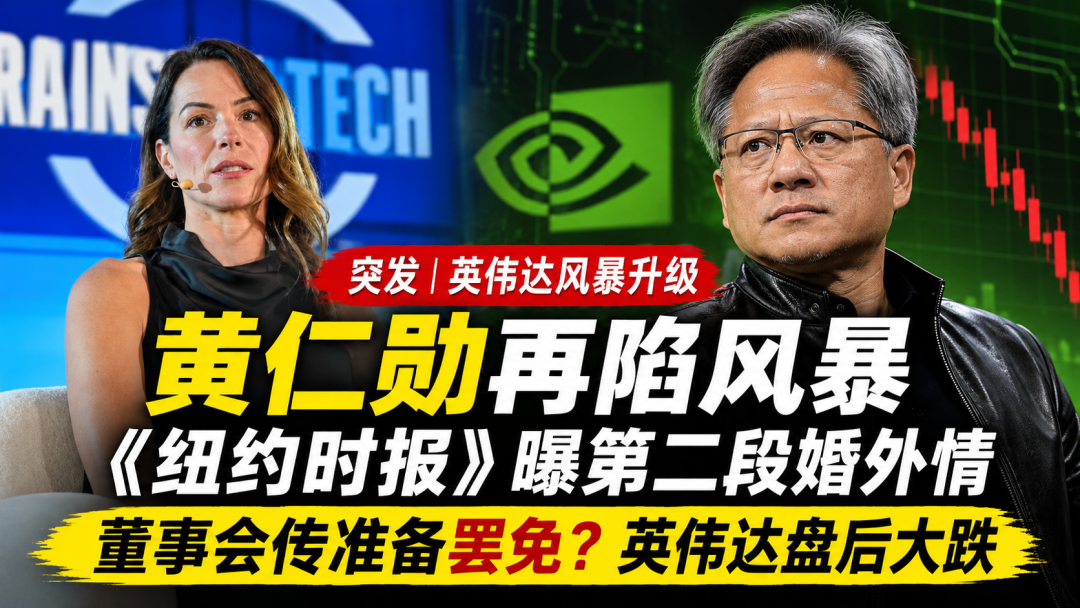
On the morning of November 12, Beijing time, two events almost landed simultaneously.
The first, reported by The New York Times on Wednesday (November 11): Jensen Huang is involved in a second extramarital affair, with Kimberly Powell, Vice President of NVIDIA's healthcare business, age 48, who reports directly to him.
The second, reported by The Wall Street Journal: The NVIDIA board is preparing to remove this founder and CEO, with a decision possibly coming as soon as Wednesday.
NVIDIA's stock price plunged sharply after hours, dropping more than 9% at one point. Just a few hours earlier, during regular trading on November 11, it had risen by 2.87%, and the Philadelphia Semiconductor Index surged by 5.66% that day.
The stock was rising during the day, only to crash after hours. This time difference indicates one thing: The market initially believed this storm would pass, but the word "dismissal" shattered that illusion.
This time is completely different from last time
The relationship acknowledged in the November 8 letter involved an external business person, Alice Huang, who previously served as Managing Director of the Singapore data center company Megaspeed. The key terms of that line were export controls and national security—Megaspeed's Malaysian affiliate procured AI devices containing NVIDIA GPUs worth at least $4.8 billion between June 2024 and February 2026, and the U.S. is investigating whether these goods have been inappropriately directed to China.

This time is different. Powell is an executive at NVIDIA, having joined in 2008, promoted to Senior Director of AI Business Development in 2016, and appointed Vice President of Healthcare at the end of 2017, responsible for advancing NVIDIA's chips in medical imaging and life sciences.
The first relationship questioned "where the chips went," while the second questions "has your personnel authority been influenced by personal matters."
This explains why the center of the storm shifted from Capitol Hill to the boardroom.
The most striking detail in the report was about the GTC conference in March this year: According to two former employees, Huang and Powell were seen behaving intimately at a hotel in San Jose, and a bystander recorded the scene on a phone. Huang's security personnel intervened when they discovered it, isolating the person and demanding they sign a non-disclosure agreement.
It must be clarified regarding the boundaries of evidence: The New York Times explicitly stated that the reporter did not see the video firsthand; all details come from five former employees who requested anonymity, with no publicly available independent footage and no official confirmation from either party. NVIDIA declined to comment, and Powell did not respond. When the reporter called Huang for confirmation, his response was, "I don't think you should be speaking directly with me." He then hung up.
However, one thing does not require waiting for evidence—NVIDIA's own code of conduct requires employees to avoid "any situation that may cause a conflict," including personal relationships. And when this relationship involves direct reporting lines, it automatically triggers another question: Have the powers of compensation, promotion, performance, and personnel arrangements been contaminated? Currently, there are no reports proving that Huang has interfered with Powell's job arrangements, but that is precisely what the investigation needs to answer.
Three days: from "full confidence" to "preparing to dismiss"
The timeline shows changes that are somewhat unreal.
On November 8, Huang sent a letter to employees admitting to infidelity, and the board announced it would initiate an independent investigation while publicly stating: "We have full confidence in Huang and his leadership team."
On November 10, independent directors hired former U.S. Attorney Joon H. Kim from the law firm Wachtell, Lipton, Rosen & Katz to lead the investigation. This firm is among the toughest in the field of corporate governance in the U.S., and the board has entrusted the investigation to outsiders.
On November 11, the second extramarital affair was exposed; The Wall Street Journal reported that the board was preparing for dismissal.
Three days. This is not the investigation coming to a conclusion, but the investigation itself turning into pressure. The board's statement of "full confidence" had a validity period of only 72 hours.
Institutionally, he was never untouchable
Many people think that a founder's control over a company is natural. NVIDIA is precisely a counterexample.
Checking the public data: Huang benefits from holding about 870 million shares, accounting for 3.58% of the company's common stock. In contrast, BlackRock holds 7.43% and Vanguard 7.31%, both more than him.
More crucially, NVIDIA does not adopt a dual-class share structure; one share, one vote. Huang does not have super voting rights. The board consists of 11 members, 10 of whom are independent directors, and the company does not have a chairman; it is overseen by Chief Independent Director Stephen C. Neal (former CEO of Cooley LLP).
Additionally, there is one rule that is the hardest: Article 32 of the NVIDIA Company Bylaws states that any executive can be removed from office at any time without the need to first establish wrongdoing or violations, simply requiring a majority of sitting directors to vote in favor. Article 28 also clearly states that the CEO is among the executives.
Translated, this means: The board can remove Huang without needing to prove he did anything wrong, as long as there is a majority of votes.
How has he steered for 33 years?
It is not by shareholding, but by authority and trust. In June of this year, during the board elections, he received approximately 16.65 billion votes in favor and 166 million votes against, with a 99% approval rate. 99% five months ago, preparing for dismissal five months later—what evaporated in between was not shares, but trust.
The real weakness: No second-in-command
If the board really wants to take action, it will immediately encounter a more difficult question: Who will take over?
NVIDIA has an extremely flat organizational structure, and Huang has himself said that more than 60 senior managers report directly to him. From product development, technical roadmap to global customer relations, supply chain coordination, and industry investment, everything rests on his shoulders. The company has no publicly available succession plan, and he has repeatedly expressed the desire to continue for several more decades.
Currently, the most favored temporary candidate is CFO Colette Kress, who holds about 4.44 million shares.
Harvard Business School professor David Yoffie’s judgment is very straightforward: If the board believes Huang should step down, but has not prepared a suitable successor, the company will face a very difficult situation. Yale's Jeffrey Sonnenfeld directly compared him to Steve Jobs—his personal image and operational influence are deeply embedded in the company.
The most ironic thing is that NVIDIA itself wrote this risk in its fiscal year 2026 annual report: The company relies heavily on a long-serving executive team, and if it cannot ensure effective succession planning, knowledge transfer, and smooth transitions of key personnel, it may hinder strategic planning, execution, and long-term development.
A company worth $4.5 trillion, noting in legal documents that "we rely on one person." This phrase is usually a disclaimer, but when something goes wrong, it is a judgment.
In the same week, another matter is more worth watching
In the same week that Huang's news filled the headlines, Anthropic included a statement in its IPO roadshow video that I believe is much more important than the rumors.
Co-founder Tom Brown stated: Claude Mythos took only about three days to run an Anthropic model on the AMD MI355X to achieve "usable performance," with virtually no one intervening throughout the process, and almost 100% of the required GPU cores were only ported or written by itself.
According to Anthropic's past experience, adapting to a new chip typically requires dozens of engineers and takes 6 to 12 months.
Anthropic also portrayed its computing power as a "replaceable pool": Amazon Trainium, Google TPU, NVIDIA GPUs, AMD GPUs, lined up together, with research, development, customers, and internal use all drawn from this one pool.
In this diagram, NVIDIA is just one of four squares.
The significance of this matter is heavier than any rumor: NVIDIA's deepest moat has never been the chip itself, but the switching costs brought by the CUDA ecosystem—switching chips requires rewriting code, maintaining teams, and spending a year. If AI can compress this process to three days, then that wall begins to leak.
On one side, the founder's position is shaking, while on the other, the moat is leaking.
When both "people" and "walls" are loosening, that is the real problem.
What is the market pricing?
Let's sort out the numbers:
On November 9, it fell by 4.27%, with a single-day market value loss of about $190 billion; on November 10, it dropped another 5.47%, closing at $168.89, with an intraday low of $165.89, nearing the 52-week low. The cumulative decline over the two trading days was 9.51%, with a market value evaporating by about $430 billion, close to the combined market value of Guizhou Moutai and CATL.
Looking at it over a longer period, the stock price has retreated about 30% from the previous high of $243.37.
On November 9, American investor Mark Kistenmacher filed a securities class action lawsuit in the U.S. District Court for the Northern District of California, listing NVIDIA and Huang as defendants, with the proposed lawsuit period from October 9, 2025, to November 8, 2026. The plaintiff claims it is an issue of information disclosure but also seeks to hold Huang personally responsible. The case is still in its early stages, and the court has not yet confirmed the class action status.
On November 10, Wells Fargo lowered its target price from $315 to $300 while maintaining an "overweight" rating, clearly citing investigation and key person risks as reasons.
Note this combination: lowering the target price but maintaining an overweight rating. The implication is—business is still good, but this person is now a variable.
Conclusion
Returning to the point, there are several matters worth calmly observing.
First, this is a public lesson in corporate governance.
NVIDIA has proven that the system is more reliable than human emotions: holding 3.58% of shares can allow one to serve as CEO for 33 years because the board has always trusted him; once that trust is lost, a rule stating "a majority can remove an executive" is enough, without even needing a reason. This logic applies equally to Chinese AI companies—many domestic companies still operate under a founder-dictated model, and establishing decision-making, succession, and compliance mechanisms while still small will have the lowest cost. The power that is written into the system is always more reliable than the authority given by personal emotions.
Second, industrial changes may not be a bad thing.
The diversification of customers is something that has already begun to occur. Anthropic's "replaceable computing pool" is not a slogan; it is a result that has already been achieved; Microsoft's, Google's, and Amazon's self-developed chips are also in progress. This presents a window for domestic computing power, but too much optimism is unwarranted—what has always been difficult to break is not the hardware parameters, but the belief that "only NVIDIA can run." The first to reduce switching costs will truly seize the opportunity.
Third, do not rush to conclusions.
Dismissing someone is currently only "reportedly" and "preparing"; the board meeting has not yet been held, and the investigation has no conclusions. On November 17, NVIDIA will release its third-quarter earnings report for fiscal year 2027, with market expectations of around $108 billion in revenue. Sentiment can cause a 30% downturn, but only performance can determine if it has truly reached its peak.
Finally, let me give my judgment.
NVIDIA's most valuable asset has never been those GPUs.
It is the belief that "everyone believes it is irreplaceable."
This time, what has been shaken is precisely that belief—shaken not by competitors but by a video in a hotel corridor and a piece of code finished in three days.
免责声明:本文章仅代表作者个人观点,不代表本平台的立场和观点。本文章仅供信息分享,不构成对任何人的任何投资建议。用户与作者之间的任何争议,与本平台无关。如网页中刊载的文章或图片涉及侵权,请提供相关的权利证明和身份证明发送邮件到support@aicoin.com,本平台相关工作人员将会进行核查。


