The gold trend in 2026 underwent a significant rise and subsequent fall. At the beginning of the year, the gold price once hit a historical high near 5500 USD per ounce, but afterwards, it continuously adjusted towards a range of 3800-4100 USD, influenced by changes in Federal Reserve policy expectations, a temporary strengthening of the dollar, and a rebound in risk appetite. This marks a pullback of approximately 25-30% from the year's peak.
For traditional gold investors, the focus moving forward should not be on a one-sided narrative, but rather on several key variables: the direction of real interest rates (especially real yields on U.S. Treasuries), the strength of the dollar index, whether geopolitical risks are heating up again, and whether the purchasing pace of gold by central banks is slowing. These factors will directly influence the gold price center and will determine the demand elasticity of on-chain gold tokens in the secondary market.
Tokenization of gold is no longer a novelty. XAUT (Tether Gold) and PAXG (PAX Gold) are the most mainstream on-chain gold products available in the market today, with each token corresponding to one ounce of physical gold that meets the London Bullion Market Association (LBMA) Good Delivery standards. Both prices have historically tracked spot gold prices closely and their combined market capitalization accounts for the vast majority of the tokenized gold sector. However, even though the act of "moving gold onto the blockchain" has matured, competition still exists between them, increasingly manifesting in liquidity and redemption experience rather than who launched first.
The Issuance Mechanism, Custody, and Redemption Are Not the Same
Both have the same core commitment: a 1:1 correspondence with physical gold and provide a redemption path. However, the execution details differ significantly.
- XAUT: Issued by Tether-related entities, the gold is mainly stored in Swiss vaults, with audits predominantly conducted through quarterly reports. It supports multi-chain deployment, and its trading channels lean more toward global mainstream exchanges for spot and perpetual contracts.
- PAXG: Issued by Paxos Trust Company, which is regulated by the U.S. OCC, the gold is stored in LBMA-certified vaults in London, with a higher audit frequency (monthly independent verification + accessible specific gold bar information). It primarily operates on Ethereum and has recently expanded to networks such as Solana and Base.
In terms of redemption, both support exchanging tokens for physical gold bars or cash, but the threshold is not low. Physical redemption typically requires the amount to be close to or exceed that of a full Good Delivery gold bar, meaning that ordinary holders' actual exit path is almost always through selling in the secondary market. This indicates that "redeemable" and "convenient to redeem, low friction redemption" are two separate matters. The regulatory environment also differs: PAXG is backed by U.S. trust regulation, while XAUT relies more on the issuer's own reserve proofs and market trust. These differences directly determine which side different investors are willing to allocate their funds to.
Market Capitalization and Holders Are Just Surface; Liquidity Is Key
Recent data (around November 2026) shows that XAUT's market capitalization typically hovers around 3 billion USD, with a circulating supply of about 750,000-830,000 tokens; PAXG's market capitalization is around 1.7 billion USD, with a circulation of about 440,000-450,000 tokens. XAUT leads in scale and number of holders, with trading volume often higher, particularly active in spot and contract pairs on mainstream platforms like Binance. PAXG, on the other hand, has a more stable presence in certain regulated or institution-preferred channels.
However, a large market capitalization does not equate to better liquidity, nor does it imply greater stability under extreme market conditions. The price anchoring of gold tokens fundamentally relies on the depth of the secondary market: the thickness of buy and sell orders, inter-exchange price differentials, and whether funds can flow smoothly in and out when the cryptocurrency market is overall volatile. Because XAUT is more closely tied to the USDT ecosystem and global trading pairs, its price may react faster during weekends or severe fluctuations in the cryptocurrency market, but it can also experience greater short-term deviations; PAXG, being more institutional and regulatory-friendly, may have smoother volatility, but could be limited in depth on certain trading pairs. The real test of anchoring ability is not the routine tracking errors (which are usually small for both), but whether trades can be completed quickly and with low slippage under extreme conditions.
On-Chain Transfers and Actual Usage Experience
On-chain transfer costs and speeds depend on the network used. XAUT's multi-chain approach allows some users to transfer on cost-effective chains; PAXG is more concentrated on Ethereum and its L2 extensions. The number of holders and on-chain activity may fluctuate with gold price changes and cryptocurrency market sentiment, but sustained net redemptions or net issuances reflect true demand more effectively. Changes in supply itself send signals: when gold prices fluctuate significantly, whoever has a smoother redemption process and more predictable costs is more likely to retain funds.
The Essence of Competition: Liquidity and Redemption Experience
The competition in gold tokenization ultimately does not hinge on who first moves gold onto the chain, but rather who can provide better liquidity and redemption experiences. Market capitalization is merely an outcome, not a cause. Trust in the issuer, regulatory backing, multi-chain coverage, exchange depth, and price anchoring stability under extreme conditions are the real points that investors weigh. For most people, holding and trading in daily routines is far more important than actually redeeming a full gold bar, thus the depth of the secondary market and price differentials directly determine the cost of use.
To visually compare the price trends, trading volume changes, and deviations from spot gold prices for both tokens across different periods, you can view the K-line charts for XAUT and PAXG on AiCoin.
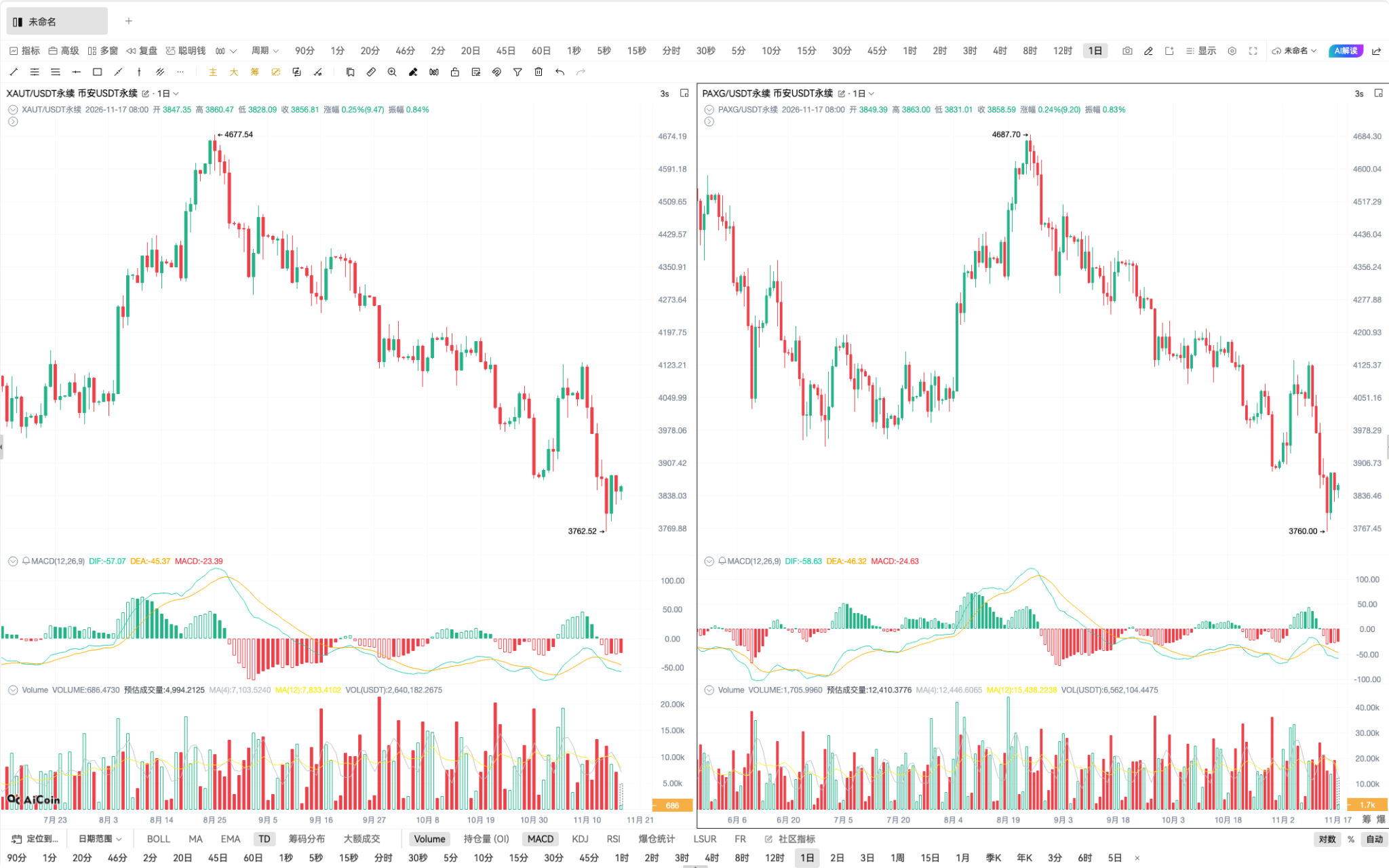
The AiCoin platform supports observing both in conjunction with spot gold trends, and you can also see the trading volumes and fund flows of different trading pairs concurrently, making it easier to judge whether the anchoring is stable and which side is more prone to wider price differentials under extreme conditions, providing more reference value for those making allocations or short-term tracking. Data will change with the market, so it is recommended to rely on real-time quotes.
(This article is for informative and observational purposes only, and does not constitute investment advice. Both gold and crypto assets carry risks of price fluctuations and issuer risks.)
免责声明:本文章仅代表作者个人观点,不代表本平台的立场和观点。本文章仅供信息分享,不构成对任何人的任何投资建议。用户与作者之间的任何争议,与本平台无关。如网页中刊载的文章或图片涉及侵权,请提供相关的权利证明和身份证明发送邮件到support@aicoin.com,本平台相关工作人员将会进行核查。