Author: Nancy, PANews
The child of the version cannot escape a cut either.
After suffering heavy liquidation during the July storm, "AI stock god" Leopold Aschenbrenne seems to have once again stood at the center of the market storm. This time, the impact comes from the financial shock of the "blue wave," which has spurred speculation about market liquidation. Over the past few months, Leopold has maintained a low profile, barely accepting any public interviews, and few details have been disclosed regarding the movements of his fund.
Until the release of the third quarter 13F holdings report, the market finally caught a glimpse of the new layout of this aggressive AI bull. The report revealed that the portfolio value of his AI hedge fund, Situational Awareness, has shrunk by more than 90% compared to the previous quarter. At the same time, Leopold is re-entering the market, betting on AI through common stocks and call options, attempting to adjust risk exposure to avoid repeating the previous leveraged liquidation.
However, as a new wave of market cold sweeps in, can this consistently bullish AI aggressive trader exit unscathed during this new round of tests?
Holdings shrank by 90% in the third quarter, new strategy for betting on AI
In the summer liquidation storm a few months ago, Leopold was forced to relinquish a significant amount of chips. The market has been watching this aggressive AI bull's re-entry and betting strategy. The third quarter 13F filings finally revealed the answer.
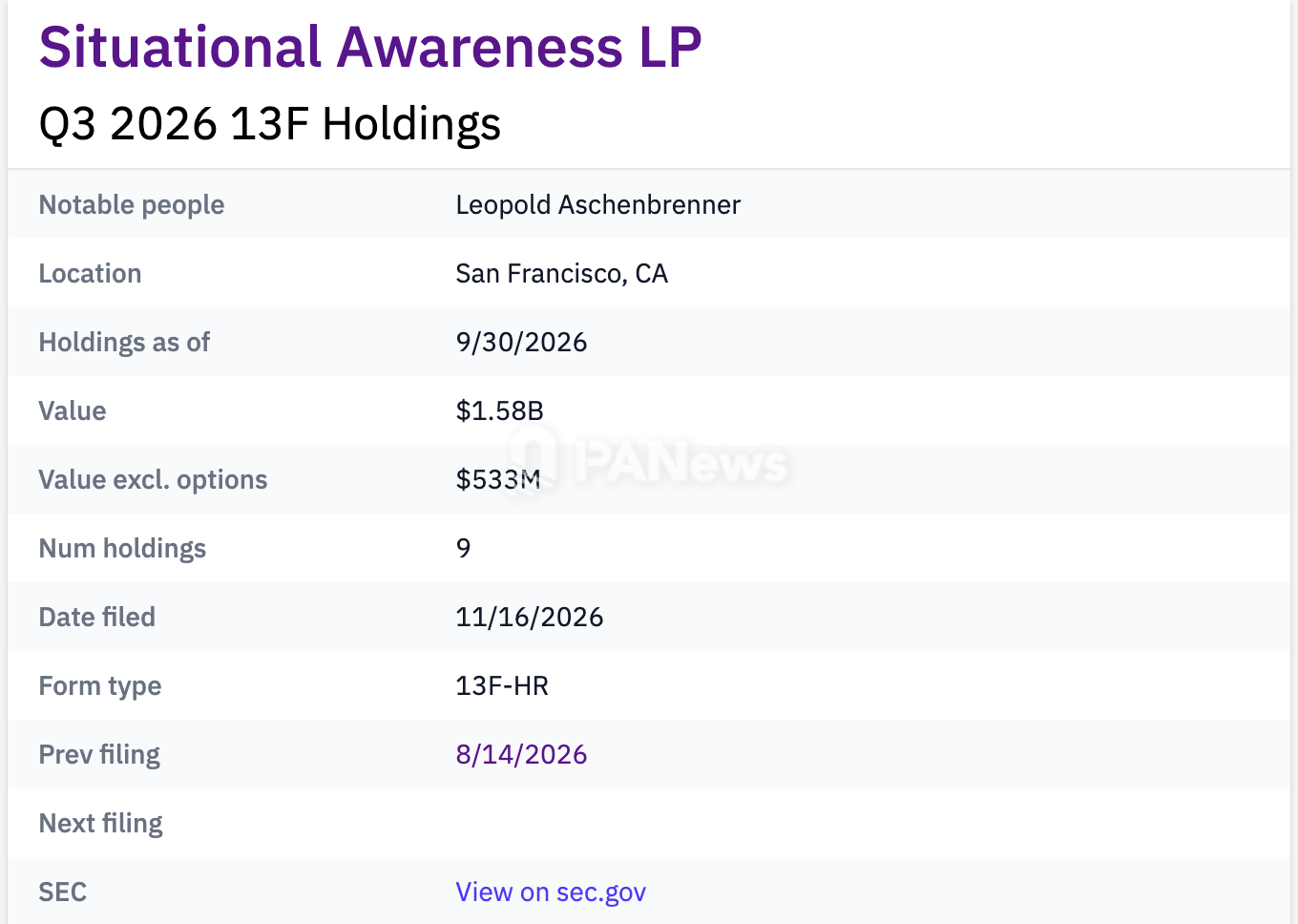
As of September 30, Situational Awareness disclosed a total portfolio value of $1.58 billion, a staggering drop of around 92% compared to approximately $20.2 billion at the end of the second quarter. In terms of the number of holdings, the fund held 9 stocks in the third quarter, a significant decrease from 26 in the previous quarter, indicating a sharp contraction in the portfolio.
But more noteworthy than the change in portfolio size is that Leopold's posture in betting on AI has changed.
Looking back at the second quarter, Situational Awareness had almost all of its public market positions allocated to common stocks, with negligible options exposure, focusing investments on AI storage chips and computing power infrastructure. By the third quarter, the fund sharply reduced equity positions while increasing call options to gain upward exposure to AI assets.
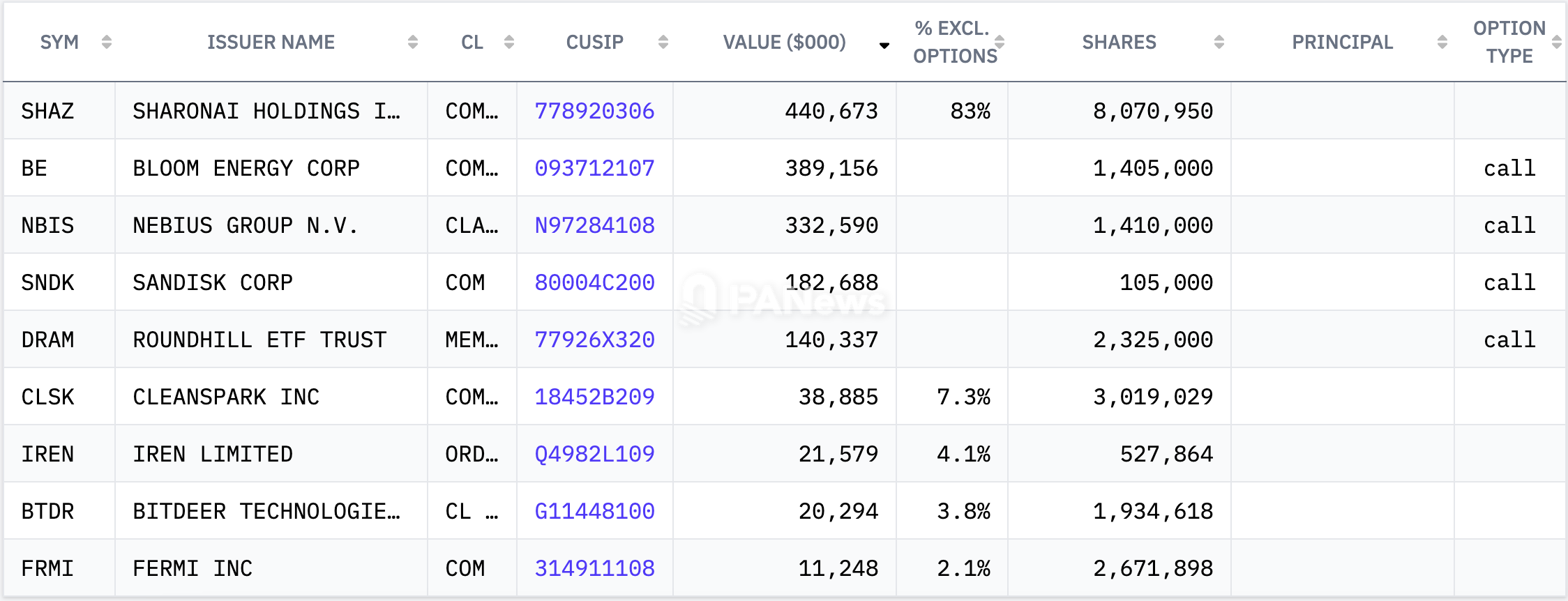
In terms of common stocks, at the end of the third quarter, Situational Awareness retained only 5 stocks. Among them, SharonAI (SHAZ) became the largest position, with a holding market value of approximately $441 million, accounting for 82.7% of all equity holdings. Compared to about 5.396 million shares at the end of the second quarter, the fund has further increased its holdings to 8.071 million shares, an increase of nearly 50%. Currently, its shares represent around 22.6% of SharonAI's float.
Meanwhile, the fund has significantly reduced its existing holdings in cryptocurrency mining and computing power-related companies, including CleanSpark, IREN, and Bitdeer. Among them, the number of IREN shares decreased from approximately 9.47 million to about 530,000 shares, a drop of over 94%; CleanSpark's shareholding also decreased by about 75%. However, the fund's new entry into Fermi indicates it is still seeking new investment opportunities in AI infrastructure.
In the options space, based on nominal exposure calculation, about 66% of the investment exposure comes from call options, with strategies covering power for data centers, AI cloud computing, and the storage industry chain.
Bloom Energy and Nebius became the two largest options bets for the fund, with corresponding underlying values of approximately $389 million and $333 million, respectively; at the same time, the fund also established call option positions for Sandisk and the Roundhill Memory ETF, with corresponding underlying values of approximately $183 million and $140 million, respectively.
It is noteworthy that Leopold has not completely abandoned the storage sector. In the second quarter, Sandisk and Micron were the core bets of Situational Awareness, accounting for a total of 56% of the fund's disclosed holdings. However, by the third quarter, the fund had cleared its position in Sandisk common stock, instead regaining its upward exposure through call options.
Restarting the AI gamble faces a cold wave, holding Anthropic as a trump card
Leopold restarts a new gamble, still firmly a bull on AI. This time, while the investment logic hasn't changed, the scale of funds and the way risk is expressed have changed.
In July this year, Leopold was caught in a "death spiral" caused by leveraging, and his aggressive investment strategy led the fund to suffer heavy losses. The latest 13F filing does not directly disclose the actual leverage level of Situational Awareness, but the structure of the options holdings reveals Leopold's adjustments to risk control in this new round of betting.
In fact, in September this year, the Financial Times quoted insiders stating that when the fund re-entered the market, it mainly adopted full payment options and established a large number of new positions through customized options while reducing leverage levels to far below previous levels.
A full payment option refers to the option buyer paying the entire premium upfront when establishing a position, thus avoiding the need to use margin or financing leverage. This trading mode strictly locks the buyer's maximum loss within the range of the paid premium, mechanically isolating the risk of forced liquidation or margin calls. Customized options allow both parties to design contracts based on specific needs, enabling the fund to flexibly adjust risk exposure to match its investment goals.
However, reducing leverage does not mean that market risks can be avoided. AI-related stocks have been under pressure for some time. In particular, after the U.S. midterm elections, concerns about the slowdown in data center construction have intensified, and factors such as whether AI investment returns can be realized, whether massive capital expenditures can be sustained, and related turmoil within Nvidia's management have continuously fermented, triggering a new wave of sell-offs in the market.
If Leopold did not timely adjust positions after October, then the investment portfolio newly established in the third quarter coincided with this round of significant correction. From the performance of the main holding stocks, this round of correction has had a considerable impact on Leopold's new layout. Based on the holdings at the end of the third quarter, since October, SharonAI's stock price has fallen by about 59.66%, Bloom Energy has dropped about 36.1%, and Nebius Group has decreased by over 53.8%. This means that even if Leopold reduced leveraging through options, the new positions still face risks arising from the decline in the underlying asset prices.
Meanwhile, Situational Awareness's external financing channels have also encountered changes. According to previous disclosures, JPMorgan Chase has decided to stop lending to Situational Awareness. Previously, JPMorgan provided financing to the fund through its prime brokerage business and was one of its main lenders. After losses occurred in the fund, JPMorgan notified the fund that it would terminate the lending relationship.
Of course, the holdings at the end of the third quarter do not represent Leopold's latest layout.
Another detail worth noting is that during the last round of liquidation turmoil, Leopold nearly sold his private equity stake in Anthropic, which he jointly holds with his wife Avital Balwit (Chief of Staff at Anthropic). This equity stake was valued at about $5 billion, with an initial company valuation of about $60 billion when the position was established. Now, with Anthropic's valuation soaring to $1.4 trillion and an IPO imminent, the potential value of this early investment has significantly increased, which may become an important trump card for Leopold.
However, the market direction for AI has changed. Investors are no longer simply buying into the growth story but are beginning to reassess the returns and costs behind this investment feast, and Leopold's AI gamble will face greater challenges.
免责声明:本文章仅代表作者个人观点,不代表本平台的立场和观点。本文章仅供信息分享,不构成对任何人的任何投资建议。用户与作者之间的任何争议,与本平台无关。如网页中刊载的文章或图片涉及侵权,请提供相关的权利证明和身份证明发送邮件到support@aicoin.com,本平台相关工作人员将会进行核查。


