Author: AiPlot Research Institute
Focus: RWA / Digital Assets / In-depth Analysis of Financial Infrastructure
Website: https://aiplot.com/?utm_source=aicoin
In the past two years, the core narrative of RWA has been simple: put U.S. Treasury bonds, gold, stocks, funds, real estate, and credit assets on the blockchain, and then prove that the market is growing through the tokenization scale.
But as the market size approaches $40 billion, simply answering "how many assets are on-chain" is no longer enough. Investors need to know more: do these assets generate real returns? Where do the returns come from? Can tokens be redeemed in a timely manner? Is there liquidity in the secondary market? Are the assets still reliable in stress scenarios?
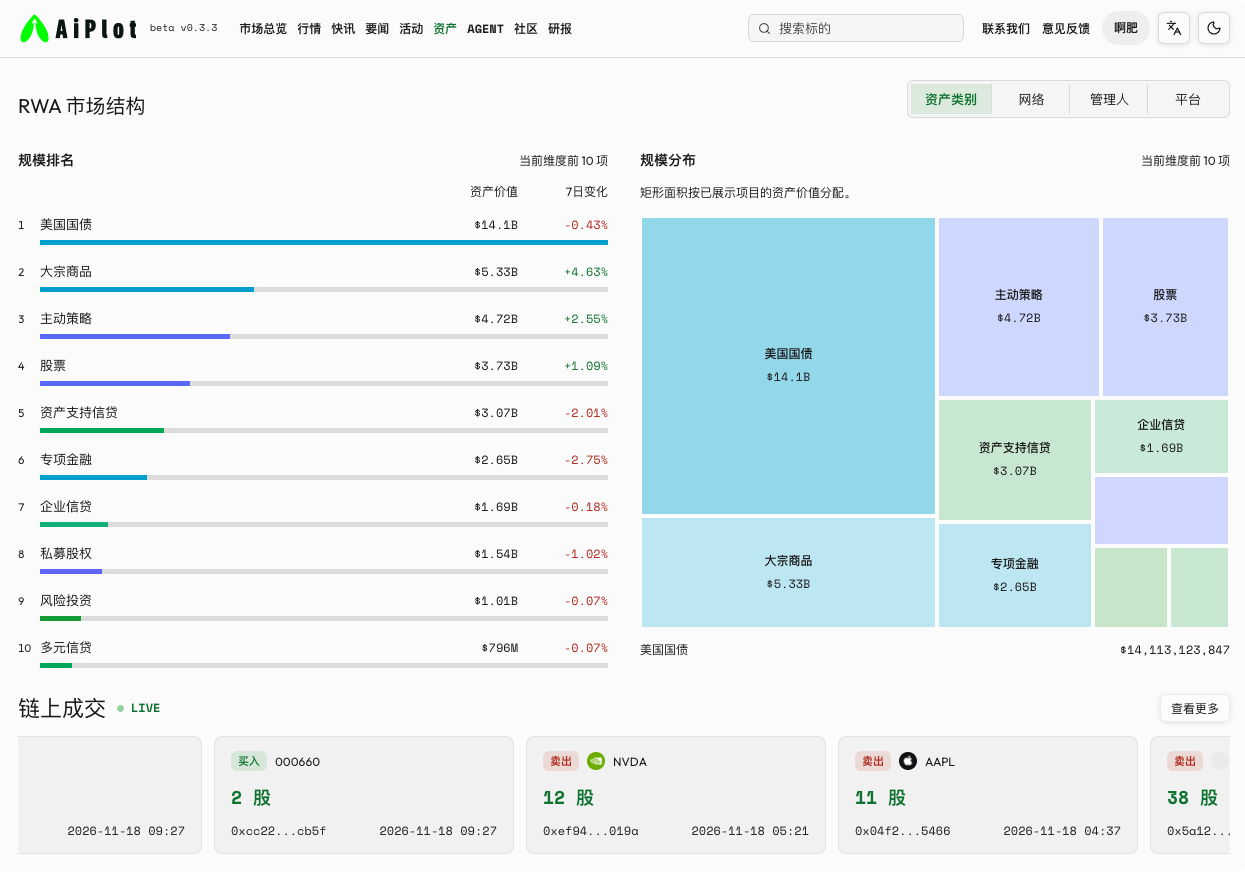
As of November 16, 2026, the size of distributed real-world assets is about $39.52 billion; tokenized credit has grown by about 1.7% in the past 30 days, while tokenized Treasury bonds have decreased by about 5.5% during the same period.
The value of distributed assets is about $39.66 billion, a decrease of 1.41% in the past 30 days; the value of representative assets is about $42.825 billion, an increase of 15.75% in the past 30 days; and the number of asset holders is about 5.788 million, an increase of 6.57%.
This set of data does not mean that RWA has lost growth; rather, it indicates that differentiation has appeared within the market: a portion of assets has seen a scale adjustment on-chain, while another portion has continued to see an increase in representative value and user numbers. RWA is transitioning from the "scale expansion phase" to the "asset quality screening phase."
1. The decline in distributed value does not equate to the disappearance of RWA demand
The value of distributed assets is closer to the scale of assets that have been distributed, recorded, and held via blockchain networks.
The value of representative assets reflects the broader asset values represented, mapped, or connected by on-chain products. It is not necessarily equivalent to the market value of tokens that are already freely circulating on-chain.
The number of holders represents market participation but does not directly indicate the capital size, investment duration, or asset quality of holders.
Therefore, the combination that appeared on November 17 — declining distributed asset values, increasing representative asset values, and growing holder numbers — can be interpreted in several ways:
First, there may still be more real assets in the market being included in tokenized products or asset mapping systems, but the actual circulation on-chain is affected by price, redemption, and capital migration.
Second, some assets may migrate from one product to another or shift from distribution on a public chain to more restricted institutional channels. Changes in statistical scale do not necessarily indicate that the underlying assets have been completely withdrawn.
Third, an increase in the number of users with declining distributed value suggests that the market may be expanding its number of participants while simultaneously experiencing asset price fluctuations, product redemptions, or capital structure adjustments.
This is why one cannot rely solely on an "RWA total market value" to gauge the state of the industry. Total scale needs to be observed alongside asset types, holder numbers, transfer volumes, yield rates, and redemption conditions.
2. Why the growth of tokenized credit is worth noting
Dynamic displays show that tokenized credit has grown by about 1.7% in the past 30 days. This growth rate is not extreme, but its significance may outweigh short-term fluctuations.
The underlying assets of U.S. Treasury-type RWAs are relatively standardized, making them easier for investors to understand. Tokenized credit, on the other hand, is closer to the truly complex segments of traditional finance that can better price risks.
The returns from credit assets typically come from borrower interest payments, rather than solely from Treasury yields or asset price increases. This may include corporate loans, asset-backed loans, private credit, supply chain financing, real estate financing, and specialized finance.
If these assets can be issued, recorded for shares, distributed cash flows, and redeemed through the blockchain, RWA will no longer just be about replacing a familiar financial product with a token; it will be attempting to reconstruct the distribution methods of private credit.
However, the high returns from credit assets also mean more complex risks. Investors need to know:
- Who the borrower is;
- What the borrowing purpose is;
- Whether the loan has collateral;
- How the collateral is valued;
- How long the loan term is;
- How interest is paid;
- Who is responsible for handling defaults;
- Whether token holders can redeem in advance;
- Whether redemption requires waiting for asset maturity or secondary market acquisition.
Therefore, tokenized credit cannot be evaluated solely by APY. High returns may represent higher credit risks, longer lock-in periods, more complex underlying assets, or weaker secondary liquidity.
3. The pullback of Treasury-type RWAs indicates that yield is not the only competitiveness
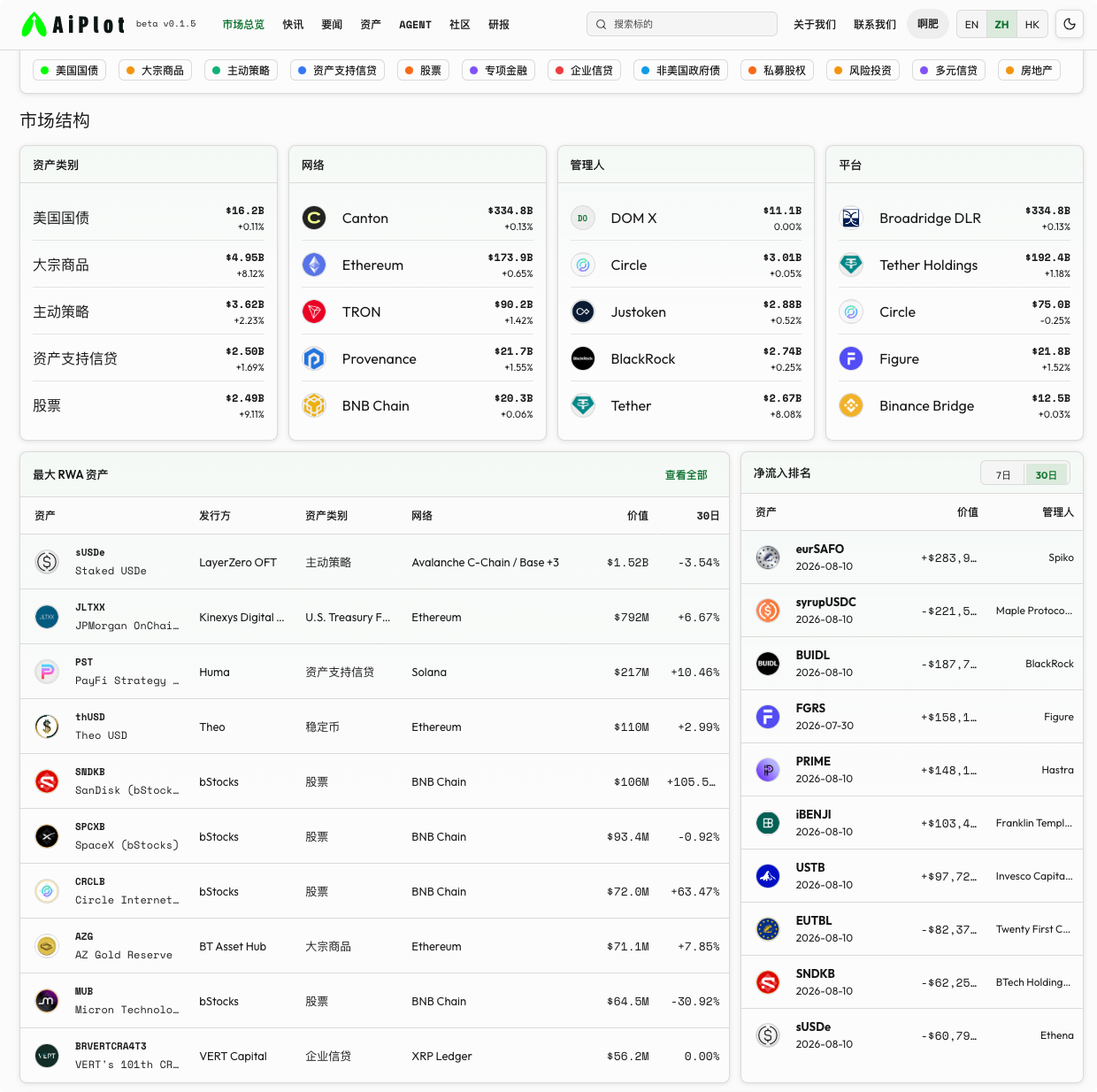
Tokenized Treasury bonds have decreased by about 5.5% in the past 30 days. Several major U.S. Treasury bond fund products have exhibited varying degrees of scale changes. For instance, USDY, USYC, and iBENJI remain the main assets on the page, but the scales and market performance of different products are inconsistent.
The attractiveness of Treasury-type RWAs comes from relatively clear underlying assets, stable interest sources, and lower credit risks. However, when market interest rates, U.S. dollar liquidity, stablecoin demand, or preferences for on-chain funds change, Treasury tokens may also experience scale fluctuations.
It is important to distinguish between two scenarios.
One involves changes in book-scale due to price and interest rate fluctuations. Variations in the prices of underlying bonds, the exchange rates of U.S. dollars, or yield curves can all impact product valuations.
The other involves real exits of funds from products. Investors may transfer funds to other asset classes due to higher on-chain yields, changes in market risk appetite, or redemption demands.
Without more granular data on net flows, redemptions, and holder numbers, one cannot directly conclude that funds have permanently exited Treasury-type RWAs based only on a 30-day scale decline. However, this does indicate that Treasury tokens are no longer a category that automatically grows upon issuance.
Competitions between products have begun: who can provide better yields? Who can redeem faster? Who has broader on-chain coverage? Who can access more trading platforms and lending protocols? Who can facilitate usage for institutions?
4. The focus of competition in RWA is shifting from "assets on-chain" to "assets available"
Tokenizing real assets is just the first step.
If an asset is minted as a token but has no sustained returns, no clear redemption process, and no secondary market liquidity, it is difficult to truly become a financial asset. It is more like an on-chain registration certificate.
RWA that truly possesses financial value must meet at least four conditions simultaneously.
1. The underlying asset has verifiable economic value
The asset cannot rely solely on the market consensus of the token itself. It requires verifiable cash flows, collateral, debt relations, or asset returns.
For example, the basis of a treasury product is government debt and interest payments; the basis of a credit product lies in the borrower's repayment cash flow; the basis of a gold product involves stored gold bars and redemption mechanisms.
2. The source of returns is transparent
Investors need to know whether returns come from interest, rent, dividends, trading profits, or asset price increases. Different sources of return correspond to different risks and cannot be simply wrapped in one APY.
Especially for actively managed strategies, past returns may not necessarily be replicable. The more complex the strategy returns, the more disclosure on asset allocation, leverage, trading counterparties, and risk control methods is required.
3. The redemption mechanism remains valid in stress scenarios
Redemption in normal markets is not difficult. The real test occurs when a large number of holders redeem simultaneously.
Investors need to know whether redemptions are completed immediately, on a T+1 basis, or require weeks of waiting; whether the redemption is paid in stablecoins, fiat, or underlying assets; whether redemptions are subject to KYC, regional, or minimum amount restrictions; how the issuer will fulfill redemption requests when the underlying assets lack liquidity.
Tokenization does not automatically eliminate the maturity mismatch of the assets. If the underlying loan term is three years, but the token allows for immediate redemption, the issuer still needs to prepare liquidity buffers or secondary market exits.
4. Tokens can enter real financial scenarios
If an asset can only be bought and held, its use efficiency is limited.
More valuable directions include collateralized lending, repurchase transactions, corporate treasury management, cross-border settlements, fund share transfers, and inter-institutional security and payment arrangements.
Assets that are utilized by more protocols and financial institutions may evolve from "tokenized products" to "on-chain financial infrastructure."
Five, the growth of credit assets may also be accompanied by higher liquidity risks.
The attractiveness of tokenized credit lies in its yield, but liquidity is often weaker than that of Treasury bonds and stablecoins.
The underlying market depth of Treasury-type products is high, and the asset pricing and trading frameworks are relatively mature. Credit assets, however, could be customized, non-standardized, and consist of longer-term loan portfolios. Even if broken down into tokens, the underlying assets themselves may still not be quickly sellable.
This creates an important maturity mismatch issue:
Tokens can transfer on-chain, but that does not mean the underlying credit assets can be quickly liquidated in the real world.
If the number of holders grows rapidly, but the trading depth of the secondary market does not increase in tandem, the assets may encounter a situation of "transferable on-chain, difficult to exit in reality."
Therefore, when analyzing credit-related RWAs, the issuance scale and redemption terms should be considered simultaneously. A product that grows quickly in scale, if it has a long redemption period or a thin secondary market, may not be superior to a smaller scale product with transparent redemption mechanisms.
6. Why the growth of holder numbers is more worthwhile to track than total scale
The number of asset holders is about 5.788 million, increasing by 6.57% in the past 30 days.
The growth in holder numbers indicates that RWA is expanding to more wallets and users, but cannot be simply interpreted as institutional funding entering on a large scale.
The number of holders may be influenced by the following factors:
- Small users hold stablecoins or cash equivalents;
- The same user has multiple addresses across networks;
- Product distribution channels have increased;
- Cross-chain mapping causes changes in address counts;
- Institutions hold the same class of assets across multiple custodial wallets.
Therefore, the number of holders should be observed alongside average positions, asset concentration, transfer activity, and redemption behaviors.
However, from a market research perspective, holder numbers remain an important signal. They indicate that RWA is no longer just a closed pilot for a few institutions, but is forming a more extensive product distribution network.
The next aspect worth observing is: does the growth in holders lead to real trading? Are these users holding long-term? Are they using the assets for lending, settlement, or collateral?
7. RWA has entered the "competition of yield quality" phase
Early competition in RWA was primarily scale-driven: who could put more Treasury bonds, gold, or funds on-chain first.
Now, competition is shifting towards yield quality. Yield quality does not simply refer to the level of APY but whether the returns possess the following characteristics:
- Clear sources;
- Sustainability;
- Risk-reward matching;
- Verifiable cash flows;
- Clearly defined redemption conditions;
- Liquidity arrangements under market pressure.
This will lead to market stratification.
The first tier consists of low-risk, low-yield, and high-liquidity products. Typical representatives are cash management and Treasury-type products. Their advantage is not in being the highest yielding, but in asset transparency and low volatility, making them suitable as on-chain funding infrastructure.
The second tier includes products with medium liquidity and medium yields. These comprise some active strategies, private bonds, and asset-backed credit. They require more detailed risk disclosures and rely more on the asset management capabilities of the issuers.
The third tier encompasses high-yield, low-liquidity products. These include some private credits, specialized finance, and real estate credits. They may offer higher returns, but investors bear longer lock-up periods, higher default risks, and weaker secondary liquidity.
Different tiers of assets should not be compared using the same set of metrics. Placing high-yield credit alongside short-term Treasury bonds on the same APY ranking table can easily obscure credit and liquidity risks.
Conclusion: Putting real assets on-chain is easy; realizing real returns is the true skill
The RWA market is approaching $40 billion, representing an important scale node, but scale itself is not the end.
The recent pullback in tokenized Treasury bonds, the sustained growth in tokenized credit, the expansion of representative asset values and holder numbers—all these changes together indicate that the RWA market has entered a stage of structural differentiation.
The truly competitive products in the future will not necessarily be those with the fastest growth in scale, but those that can simultaneously prove three things:
First, the underlying assets indeed have real value;
Second, the sources of returns can be verified and matched with risks;
Third, investors can complete redemptions or transfers according to clear rules when they need to exit.
The first phase of RWA is putting real assets onto the blockchain. The second phase is to make these assets ownable, tradable, collateralizable, and capable of settling while continuously realizing cash flows.
Therefore, in the future study of RWA, one should not only ask "how many assets are on-chain," but also question: how much real yield do the assets generate? Can the yields be sustained? Is the liquidity sufficient? Is the redemption mechanism reliable?
Only when the real cash flows and exit mechanisms behind the tokens can withstand scrutiny will RWA truly transform from an asset issuance narrative into a usable financial infrastructure.
For more data and analysis, please follow Aiplot:
https://aiplot.com/?utm_source=aicoin
📖 Community Communication:
Telegram:
https://t.me/+IIYMcJigBAo4Mjg1
The content of this article only represents the author's personal views and does not represent the platform's position. The viewpoints, conclusions, and suggestions in the article are for reference only for investors and do not constitute any investment advice related to this platform. The market has risks, and investments are subject to caution.
免责声明:本文章仅代表作者个人观点,不代表本平台的立场和观点。本文章仅供信息分享,不构成对任何人的任何投资建议。用户与作者之间的任何争议,与本平台无关。如网页中刊载的文章或图片涉及侵权,请提供相关的权利证明和身份证明发送邮件到support@aicoin.com,本平台相关工作人员将会进行核查。