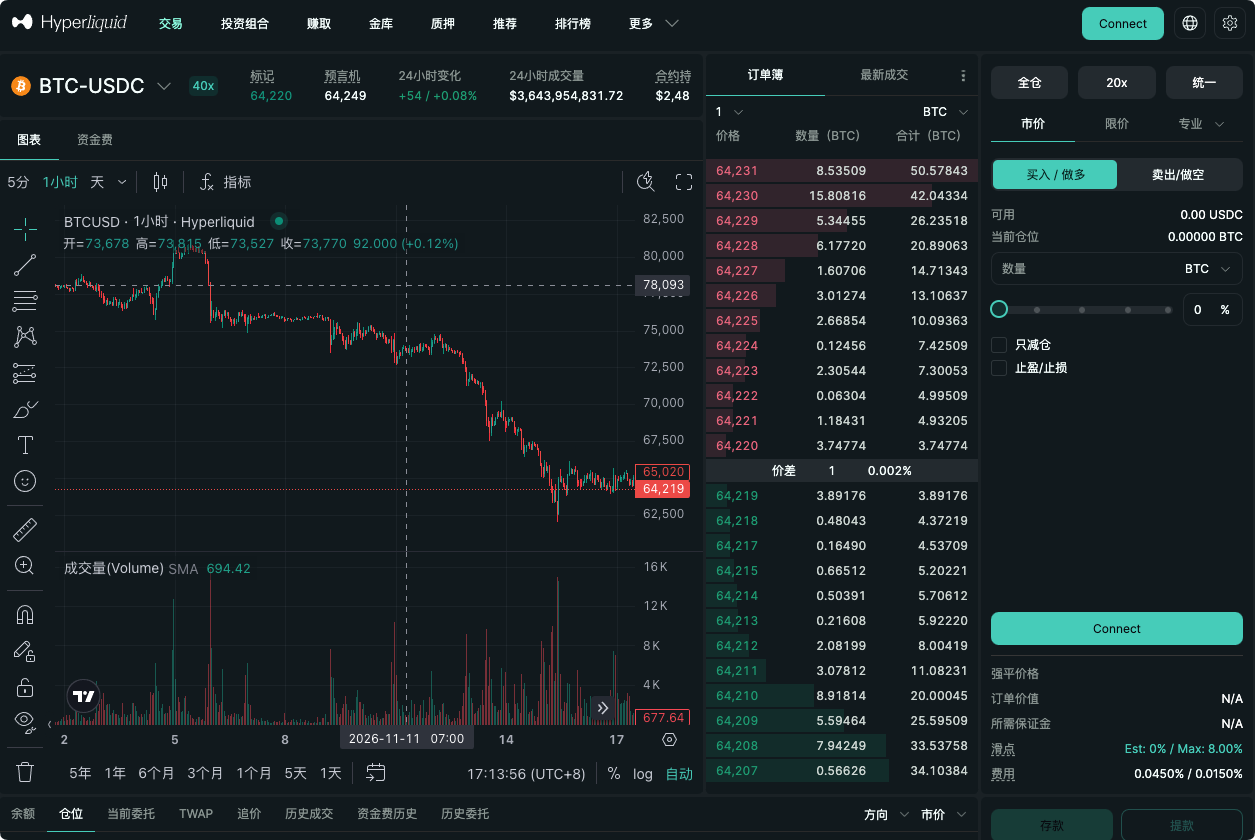
Hyperliquid's change that is most easily underestimated by the market is not how many cryptocurrency trading pairs it has launched, but rather that stock perpetuals have shifted from a "future narrative" to a real component of platform revenue and trading volume.
In the third quarter, Hyperliquid's stock perpetual trading amounted to approximately $153.8 billion, a quarter-on-quarter increase of 161%, accounting for 58.8% of HIP-3 trading; during the same period, the total platform trading was about $730.6 billion, with stock perpetuals accounting for about 21%.
This set of data has two implications.
First, stock perpetuals have become sufficiently large that they can no longer be considered a marginal experiment outside of crypto perpetuals.
Second, precisely because it is now sufficiently large, any changes in the U.S. regulatory landscape could impact Hyperliquid's future client sources, liquidity distribution, and valuation expectations.
Therefore, what is more worth discussing today is not "whether Hyperliquid can enter the U.S.," but:
When stock perpetuals have become an important source of trading for the platform, can they withstand a reevaluation by U.S. courts regarding product classification, investor protection, and regulatory authority?
1. First, look at the numbers: Stock perpetuals are no longer just a growth curve on a PPT
According to AiCoin's analysis, Hyperliquid's stock perpetual trading in the third quarter was about $153.8 billion, a quarter-on-quarter increase of 161%. It accounted for 58.8% of HIP-3 trading and about 21% of the total platform trading during the same period.
This indicates that Hyperliquid's expansion into non-crypto markets has entered a new phase.
In the past, discussions around HIP-3 often framed it as a layer of products that might one day carry stocks, commodities, and forex. However, if stock perpetuals now contribute about one-fifth of the platform's total trading volume, their significance to the platform is no longer just "an additional growth option," but rather they are starting to influence the actual trading structure of the platform.
The daily trading volume of Hyperliquid's stocks and commodity perpetuals has grown from about $140 million to over $4 billion in the past year, with revenue contributions from stock and commodity trading increasing approximately sixfold during the same period.
While the statistical calibers and time frames of these two sets of data are not completely aligned, they cannot be mechanically summed, nor can the growth in trading volume be directly equated to growth in net profit. However, they collectively point to one trend:
Hyperliquid is reducing its dependence on the single cryptocurrency market cycle.
When BTC and ETH enter a low-volatility phase, users may still trade Nvidia, the S&P 500, crude oil, or other HIP-3 markets. For the platform, this means that trading demand has the opportunity to expand from "Is the cryptocurrency market active?" to "Is there pricing divergence in global risk assets?"
2. The value of stock perpetuals is more than just providing users with another long position button
The reason stock perpetuals can quickly attract trading volume is not only because they provide new underlying assets, but also because they rewrite several restrictions found in traditional stock trading.
Traditional stock trading has fixed opening and closing hours, and some markets are also restricted by region, account qualifications, and trading hours. Perpetual contracts provide price exposure without an expiration date, support two-way trading and leveraged trading, and accommodate changes in market sentiment over a longer time horizon.
ICE and TradeXYZ stated in their official announcement that they plan to bring the perpetual markets based on Hyperliquid into the U.S. regulatory framework, with product ranges including crypto assets, stocks, stock indices, commodities, forex, and other real assets. The announcement also emphasized that this plan requires regulatory approval and will establish dedicated market and clearing structures.
This explains why stock perpetuals will become the key product in Hyperliquid's story in the U.S.:
- It is one of the fastest-growing asset classes in existing on-chain trading;
- It most easily connects traditional financial institutions and retail trading demand;
- It most easily touches upon the regulatory boundaries between securities, securities futures, swaps, and investor protection.
In other words, stock perpetuals possess both the greatest growth imagination and the most complex compliance issues.
3. U.S. regulatory disputes are not about "whether there is demand," but about "what exactly is this product"
The two lawsuits mentioned in AiCoin's updates touch upon the classification of perpetual contracts and the regulatory basis for single-stock perpetuals.
The first is the CME challenging the CFTC’s handling of Bitcoin perpetual contracts. The CME's core argument is that products without an expiration date are closer to swaps and should not be subjected directly to the futures route. Reuters previously reported that the CME seeks to overturn the CFTC's approval of Kalshi's Bitcoin perpetual contracts, with the core dispute being how perpetual products should be classified within the U.S. legal framework.
The second case is the Capital Markets Alliance's challenge to single-stock perpetuals. AiCoin noted that its members include Cboe, Citadel Securities, and the Healthy Markets Association, focusing on whether single-stock perpetuals bypass the existing regulatory and investor protection frameworks of the securities market.
The Cboe's official announcement confirmed that it has joined the legal challenge against the CFTC's approval of single-stock perpetual derivatives.
It is important to distinguish between two concepts:
The court's temporary refusal to halt the product does not equate to the court confirming that the regulatory path is solid.
AiCoin stated that on November 3, the judge rejected the emergency application to immediately suspend the relevant approvals but showed substantial concern regarding the plaintiff's claims about the CFTC's authority; a preliminary injunction hearing for the stock perpetual case is scheduled for December 1.
Before the final judgment, at least three possibilities exist for the market:
- The existing approval paths continue to hold, with more platforms advancing under the futures framework;
- The court finds issues with some product classifications or approval bases, necessitating that relevant products be suspended, restructured, or reapproved;
- Different asset classes are treated separately, leading stock perpetuals and crypto, commodity, and forex perpetuals down different regulatory paths.
Therefore, one cannot simplistically interpret "U.S. regulators are starting to accept perpetual contracts" as meaning that all perpetual products have obtained the same legal status.
4. Why the ICE and TradeXYZ plan is still not Hyperliquid directly entering the U.S.
The most important line in ICE and TradeXYZ's announcement is not "based on Hyperliquid," but "subject to regulatory approvals." The two parties plan to establish a new, dedicated market and clearing structure aimed at retail clients and will rely on a KYC/AML-compliant customer base to conduct trading.
The official plan shows that the roles of the parties are not the same:
- Hyperliquid provides the underlying on-chain infrastructure;
- TradeXYZ designs and implements the real asset perpetual market;
- ICE operates the regulated market and provides exchange, clearing, and regulatory capabilities;
- Future FCMs, brokers, and distribution platforms will support customer onboarding and trading access;
- ICE's joint arrangement with OKX also requires its own regulatory approvals.
This does not mean Hyperliquid's existing global front end is being directly opened to U.S. users; rather, it embeds on-chain matching and market infrastructure within a new regulated market structure.
Payward's official plan also takes a similar approach. Payward intends to create, own, and manage the HIP-3 market through its Bitnomial platform, responsible for contract clearing and settlement; NinjaTrader Clearing will support customer accounts. Only clients who complete onboarding and simultaneously enter the list of licensed entities will be eligible to trade these products.
This indicates that a more accurate expression of "Hyperliquid entering the U.S." is:
Regulated entities are attempting to integrate Hyperliquid's on-chain order book and market deployment capabilities into a compliance trading and clearing framework usable by U.S. customers.
Whether this can ultimately take place depends not only on Hyperliquid's technology and trading volume but also on product classification, exchange licensing, clearing mechanisms, customer protection, KYC/AML, and state or federal regulatory requirements.
5. The larger the stock trading, the more the uncertainty of the U.S. path deserves to be repriced
AiCoin's updates contain a judgment worth noting: The larger the stock trading, the more shareholders and coin holders need to recalculate whether the U.S. market can open smoothly.
This statement does not imply that regulatory delays will destroy Hyperliquid but reminds the market not to prematurely incorporate all potential value from U.S. expansion into current prices and valuations.
Hyperliquid currently has a business foundation that can operate independently. AiCoin cites HRC's Q3 report indicating that Hyperliquid's third-quarter agreement revenue was approximately $190.9 million, a quarter-on-quarter increase of 21.7%; the Assistance Fund allocated approximately $148.7 million for purchasing HYPE.
These revenue and buyback activities occurred before the full rollout of U.S. cooperative projects. They demonstrate that Hyperliquid's existing business does not entirely rely on the U.S. market for its establishment.
Therefore, the impact of U.S. regulations is more likely to reflect on growth rates and valuation elasticity:
- If cooperation goes smoothly, U.S. customers and traditional financial distribution channels may bring in new liquidity;
- If cooperation is delayed, existing global markets can continue to operate, but the entry speed of new U.S. customers will slow;
- If the legal classification of stock perpetuals is overturned, related collaborations may adjust product structures rather than all Hyperliquid collaborations automatically terminating;
- If different rules apply to crypto, commodities, and forex products, ICE and TradeXYZ may still advance other asset classes first.
The ICE announcement itself also clearly stated that the planned scope includes various markets, such as crypto assets, commodities, and forex. Thus, encountering legal resistance for single-stock perpetuals cannot directly imply that all cooperation with ICE and TradeXYZ will fail.
6. What HYPE holders should really observe is not a simple "U.S. favorable"
For HYPE holders or traders, the most common mistake is to directly convert U.S. regulatory news into a one-dimensional price judgment.
What is more worth tracking are three sets of data changes.
First, can the trading volume of stock perpetuals be sustained?
A trading volume of approximately $153.8 billion in the third quarter is impressive, but a single quarter's data cannot prove a long-term trend. It is important to continue observing the share of trading in stock perpetuals across different market environments, as well as whether the trading volume is accompanied by sustained OI growth.
If trading volume rises without a noticeable increase in OI, it may be more about high-frequency turnover; if both trading volume and OI rise simultaneously, it indicates that new leveraged positions are entering, potentially expanding both platform revenue and clearing risks.
Second, does revenue growth depend on a single market?
The sixfold growth in revenue from stock and commodity trading is a positive signal for the diversification of platform revenue. However, it is also necessary to continue observing the income contributions from stocks, indices, commodities, and crypto perpetuals, as well as the profit-sharing, market making incentives, and risk costs among HIP-3 deployers.
Trading volume is not profit, and agreement revenue is not the company's net profit. Only when trading growth can consistently translate into sustainable revenue, and when risk preparedness and liquidity costs are manageable, can revenue diversification truly be regarded as completed.
Third, has cooperation with the U.S. entered the actual operational phase?
Announcements, strategic investments, and regulatory applications all indicate progress but do not mean customers can trade yet.
What needs to be observed include:
- Whether regulatory approvals are formally obtained;
- Whether a dedicated exchange or clearing structure has been established;
- Whether the customer onboarding and licensing mechanism is live;
- Which products are opened first;
- Which brokers or FCMs are responsible for distribution;
- How on-chain liquidity connects with U.S. compliant customers.
Until these nodes emerge, "the U.S. market opening" should still be viewed as a forward-looking scenario rather than a present business fact.
7. How ordinary users should observe this change
Such regulatory and market structure changes are not suitable for determining direction based solely on a single piece of news.
In the AiCoin mobile app, Hyperliquid stocks, indices, commodities, and crypto perpetuals can be placed within the same observation framework: first look at the changes in trade volume, then examine OI, funding rates, and clearing distribution, finally confirming whether price increases come from new money entering or from short-term short covering.
Especially in the HIP-3 market, different deployers are responsible for market definitions, oracle, and operations; markets should not merely be compared on the basis of "they are all contracts on Hyperliquid." Stock perpetuals involve trading hours, reference prices, oracle during market closures, and clearing risks under extreme volatility.
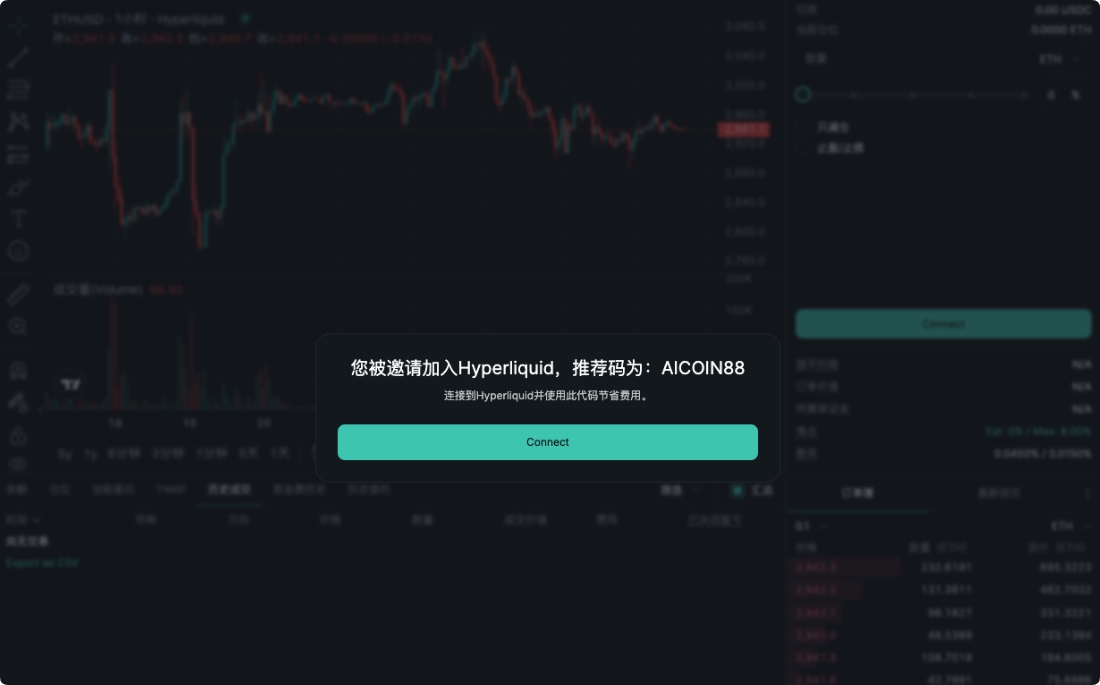
If one wishes to continuously observe smart money, major funds, OI, funding rates, and on-chain alerts via the AiCoin mobile app, a dedicated entry for Hyperliquid can be used: Connect to Hyperliquid
https://app.hyperliquid.xyz/join/AICOIN88
Invitation code: AICOIN88. Transactions that comply with the rules are eligible for 4% fee rebates, with specific rebate eligibility, calculation basis, and payment timing subject to the activity rules.
Rebates can only reduce some trading costs and cannot eliminate risks related to leverage, clearing, slippage, oracle deviations, lack of liquidity, and regulatory changes.
Conclusion: First remove the U.S. premium, then evaluate how much Hyperliquid itself is worth
Hyperliquid's third-quarter stock perpetual trading of about $153.8 billion, which accounts for roughly 21% of total platform trading, indicates that stock perpetuals have become a significant real business for the platform, rather than a distant story.
However, the U.S. regulatory lawsuits also remind the market that business growth and legal grounding are two different curves.
Hyperliquid can continue to grow based on global markets, HIP-3, and multi-asset trading; ICE, TradeXYZ, and Payward will need to package on-chain infrastructure into a trading, clearing, and customer protection framework acceptable to the U.S.
Thus, a more robust judgment is:
The U.S. market is a growth option for Hyperliquid, not a survival condition for its existing business; stock perpetuals are key growth engines, but they also stand at the most stringent level of regulatory scrutiny.
Exclusive Benefits for AiCoin Users
👉 When binding a Hyperliquid account, enter the invitation code AICOIN88 to enjoy a 4% fee rebate.
🔗 Exclusive registration link:
https://app.hyperliquid.xyz/join/AICOIN88
📖 Beginner's Tutorial:
"AiCoin PC Hyperliquid Authorizing Trading Tutorial":
https://www.aicoin.com/zh-Hans/article/514197
"AiCoin Mobile Hyperliquid Authorizing Trading Tutorial":
https://www.aicoin.com/zh-Hans/article/541383
"Zero-Basis Entry! Extremely Detailed Illustrated Tutorial for First-Time Trading on Hyperliquid":
https://www.aicoin.com/zh-Hans/article/510225
📖 Community Interaction:
Telegram:
Discord:
AiCoin Group Chat:
https://www.aicoin.com/link/chat?cid=N6OVMor5g
The content of this article only represents the author's personal views and does not reflect the stance of this platform. The views, conclusions, and suggestions in this article are for investor reference only and do not constitute any investment advice related to this platform. Investing in U.S. stocks still requires independently bearing market risks, regulatory risks, and compliance risks with local laws and regulations (especially foreign exchange controls, foreign investment reporting, etc.)
免责声明:本文章仅代表作者个人观点,不代表本平台的立场和观点。本文章仅供信息分享,不构成对任何人的任何投资建议。用户与作者之间的任何争议,与本平台无关。如网页中刊载的文章或图片涉及侵权,请提供相关的权利证明和身份证明发送邮件到support@aicoin.com,本平台相关工作人员将会进行核查。