The number of scam networks in the Asia-Pacific region ranks first in the world
Cases of deep fake scams in Hong Kong surged by 72%
Companies should strengthen AI agent identity verification control
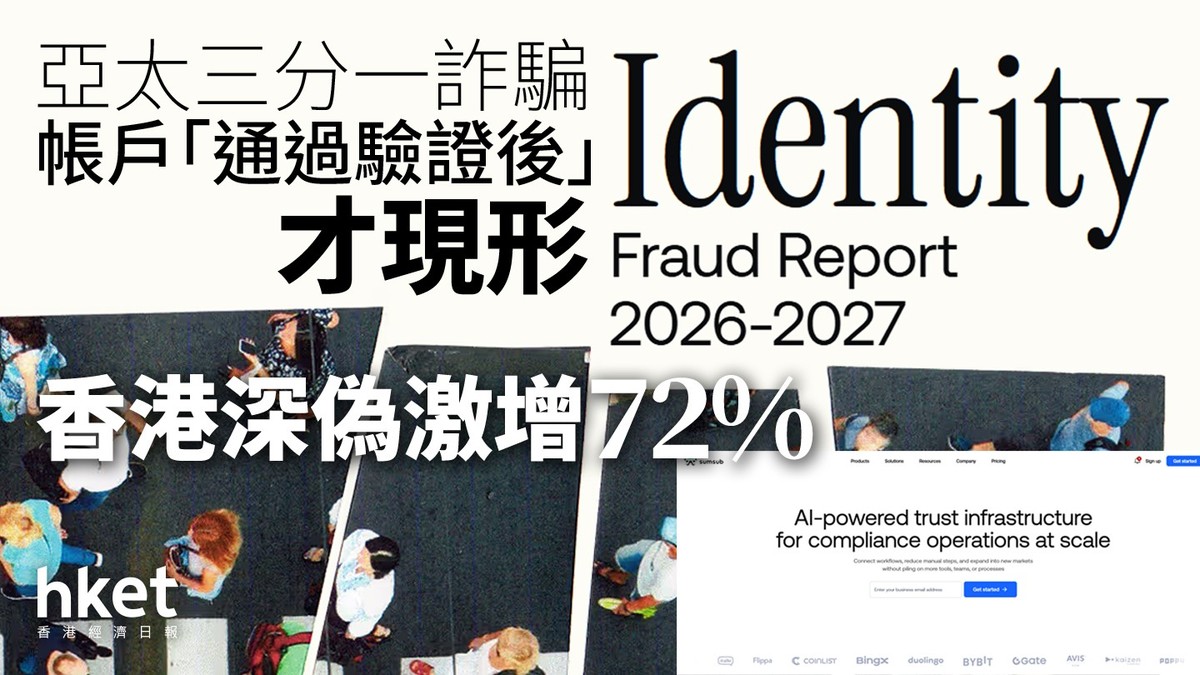
Online fraud is increasingly rampant. AI-supported trust infrastructure Sumsub published its sixth annual identity fraud report for 2026-2027, revealing that the Asia-Pacific region accounts for one-third (33%) of the globally detected scam networks, leading all regions; the region recorded almost 1 million confirmed fraud attempts, also the highest among the six global regions.
Asia-Pacific digital identity infrastructure leads, multiple areas legislate for joint prevention against puppet accounts
Fraud networks are generally controlled by organized scammers and involve multiple interconnected identities, accounts, and devices. In the Asia-Pacific region, approximately 1 in every 40 verified users (2.4%) is related to a detected scam network, with about one-third of these associations appearing only after users successfully pass identity verification, suggesting that some accounts originally verified as legitimate may later be sold or transferred to scammers. These accounts are often used as 'money mules' to receive and transfer stolen funds on behalf of the scammers.
In response to increasingly complex fraud tactics, Sumsub launched the "Fraud Complexity Index" (FCI), which scores each confirmed fraud case based on the tools involved, scale of coordination, and number of fraud tactics used. The report shows that this year the index has risen from 2.1 to 2.2.
Deep fake cases in Hong Kong surged by 72%
The Philippines has the highest number of scam networks in the Asia-Pacific, accounting for 17% of the total in the region; followed by India; and the largest single scam network in the region is located in Thailand, detected with 3,018 interconnected users.
In terms of fraud methods, the Fraud Complexity Index in the Asia-Pacific region rose by 14% year-on-year to 2.09. Hong Kong's Fraud Complexity Index increased by 7% year-on-year to 1.97, with deep fake cases soaring by 72%, far exceeding the average increase of 6% in the Asia-Pacific region. Japan's fraud rate rose by 219% year-on-year to 5.1%, the highest increase in the Asia-Pacific region.
AI agents derive new risks
In recent years, the rise of AI agents has generated new fraud risks. 61% of companies in the Asia-Pacific region have detected or suspected fraud involving AI agents, a higher percentage than other global regions. However, related control measures among Asia-Pacific companies remain limited: only 15% can suspend or revoke access rights for AI agents, while another 40% verify the identity of individuals authorizing AI agents. The ratio of AI agents controlled by scammers found by Asia-Pacific companies is also higher than in other regions, reaching 11%.
In addition, criminals can exploit legitimate AI agents to attack businesses. Among companies that have detected or suspected AI agent fraud globally, nearly half (49%) reported encounters with legitimate AI agents being manipulated or exploited by malicious commands, while 30% had noticed AI agents autonomously deciding to purchase, pay, or transfer funds; however, only 16% of companies reported that such behaviors were successfully intercepted before causing losses.
Consumers in the Asia-Pacific region also have the highest exposure to AI-generated content. 61% of consumers in the Asia-Pacific have encountered AI-generated or manipulated content, the highest percentage globally. Among survey respondents who encountered fraud, 44% indicated that AI-generated content was involved.
Finance and e-commerce are major disaster areas
The finance and e-commerce sectors continue to face higher risks. Globally, 65% of financial service institutions and nearly half of e-commerce and retail companies have detected or suspected fraud involving AI agents. In the banking sector, about one in seven confirmed fraud cases involved suspected AI-generated forged documents, a ratio nearly three times the overall average level of 5%.
Single KYC does not prevent account resale
Many accounts are only sold or misused after legitimate completion of KYC verification, making it difficult to detect underlying connections through single account reviews. Although 29% of Asia-Pacific companies stated that associated scam networks significantly increased detection difficulty (the highest globally), only 25% conduct network analysis. Fraud severely impacts both parties in transactions; Asia-Pacific companies most frequently encounter impersonated businesses or suppliers (42%) and payment deception (40%); among consumers, 79% have encountered fraud in the past year, with half suffering financial losses and 51% unable to recover funds.
In Southeast Asia, organized fraud areas have become highly mobile, swiftly relocating whenever law enforcement takes action, reusing the same infrastructure to continue operations. As of April this year, Nepal has reported saving a total of 612 citizens from online fraud areas across Southeast Asia and bringing them back home. Erin West, founder of Operation Shamrock, pointed out that scammers often recruit real people to open real accounts to conceal their activities, and companies must trace the networks behind the manipulation.
Meanwhile, the Asia-Pacific region also has a solid foundation to respond to these risks. The region has the highest rate of digital identity wallet usage globally, with 50% of consumers having used government digital identity wallets, and 65% expressing willingness to use them. Additionally, banking and financial services remain the most trusted categories of online services, with 74% of Asia-Pacific consumers indicating high or complete trust in them.
Penny Chai, Vice President of Sumsub Asia-Pacific, stated that the region's high penetration rate of government digital identity wallets (50%) and the high trust consumers have in financial services (74%) are key to extending defenses from account opening throughout the entire user lifecycle. Legislative measures have been strengthened across various locations, including Hong Kong establishing a banking information exchange mechanism through the Banking Ordinance (Amendment) Bill 2025, and Singapore and Thailand also legislating to combat puppet accounts. Additionally, Sumsub established the "Agent-based AI Advisory Council" in September to develop practical guidelines for identity verification and supervision of AI agents.
This article is reprinted from Hong Kong Economic Journal, and copyright belongs to the original author and the original media.
免责声明:本文章仅代表作者个人观点,不代表本平台的立场和观点。本文章仅供信息分享,不构成对任何人的任何投资建议。用户与作者之间的任何争议,与本平台无关。如网页中刊载的文章或图片涉及侵权,请提供相关的权利证明和身份证明发送邮件到support@aicoin.com,本平台相关工作人员将会进行核查。


