
Author: Nancy, PANews
The cryptocurrency market has suddenly encountered a "cold wave," and the lending market, like a duck sensing the warming waters of spring, faces dual challenges from capital and demand.
However, lending players have not been idle. As the traditional growth model driven by crypto assets and leverage gradually loses momentum, many players are not retracting their lines but are instead searching for new collateral, sources of funds, and profit spaces.
A layout focusing on the next round of growth is unfolding amidst the market's winter.
From broadening assets to strengthening risk control, liquidity contraction compels transformation
In the face of declining risk appetite and ongoing overall leverage contraction, the crypto lending market is still actively seeking new growth opportunities. Behind the market's counter-trend layout is a persistent financing demand, as well as the maturity of underlying infrastructure and changes in the external environment providing impetus.
On one hand, the market's demand for liquidity has not disappeared. For long-term holders, directly selling assets may mean giving up future appreciation, but operations, investments, and daily expenses still require liquidity. Using crypto assets as collateral to borrow fiat or stablecoins allows for retaining exposure while meeting demand.
Meanwhile, the maturity of the underlying infrastructure has also lowered the barriers for institutions to enter this market. Lending protocols like Morpho and Aave are gradually evolving from DeFi applications to infrastructures accessible for institutions, providing core functions such as lending, clearing, and risk management, enabling more institutions to launch their own branded products quickly using existing protocols without starting from scratch.
Moreover, the gradual clarity of regulatory paths, rising pressure on institutional client retention, and the continuous enrichment of product forms are driving the market to expand its business boundaries and seek new growth points.
The expansion of compliant channels has opened up new market space for lending businesses. On November 18, Coinbase announced it received approval from the New York State Department of Financial Services (NYDFS) to expand its on-chain collateral lending service Coinbase Borrow, based on the Morpho protocol on the Base network, to New York State. Thus, this service now covers all 50 states in the U.S., further expanding its business scope in the U.S. market.
Diversification of collateral is another important avenue. Following protocols like Aave, Jupiter recently announced the launch of a licensed lending market on Jupiter Lend, initially supporting stocks of Bullish listed on the New York Stock Exchange as collateral, enabling users to borrow other assets based on it. Morpho has also recently launched Robinhood stock tokens, allowing users to use stock tokens as collateral to borrow stablecoins; Maple Finance has also revealed plans to provide loans using tokenized stocks as collateral and considers this an important development direction for 2027, aiming to reduce dependence on crypto collateral.
In addition to introducing traditional financial assets, Aave will support native BTC collateral. Aave DAO recently passed a proposal to support native Bitcoin collateral on Aave V4 through Babylon Trustless Bitcoin Vaults (TBV). At that time, Bitcoin holders will be able to lock native BTC through self-custody and borrow assets like USDT and USDC without relying on wrapped tokens, cross-chain bridges, or third-party custody protocols.
Furthermore, controlling risk exposure and optimizing asset structure have also become key focuses for lending protocols. Aave has recently proposed adjustments to the asset allocation of its largest lending market, V3 Core, shifting focus toward more liquid blue-chip collateral assets. According to relevant adjustment plans, collateral assets valued at approximately $1.52 billion, supporting around $1.17 billion in debt, may migrate out of the V3 Core market; Lido is also advancing its lending business with more attention to risk isolation. Its launched Lido Lend, built based on Morpho Blue, plans to go live in the fourth quarter, focusing on low-volatility blue-chip asset trading pairs and controlling risks through market isolation and exit mechanisms.
The crypto asset management platform Abra has partnered with the Intercontinental Exchange (ICE) to launch an institutional digital asset collateral lending service, supporting borrowing dollars against BTC, ETH, and SOL as collateral, with the collateral assets deposited in a segregated custody account at ICE Digital Trust during the loan period, without being re-used to reduce the risks associated with collateral being used multiple times.
It can be seen that as they seek to expand lending scale, each platform is on one hand broadening the range of collateral by introducing traditional stocks, native Bitcoin, and other assets into on-chain lending; on the other hand, they are reducing reliance on single crypto assets and enhancing the market's risk resilience in a volatile environment through adjustments to asset structures and improvements in risk management mechanisms.
The lending market continues to cool, and this round of deleveraging may be healthier
While lending platforms actively explore business expansion, the entire market still has not escaped the predicament of scale contraction and liquidity pressure.
Blockworks data shows that as of November 18, the overall size of the crypto lending market is approximately $71.32 billion, a decline of about 47.5% from last year's peak of $135.78 billion. In just the past month, the market size has decreased by $10.82 billion. Among them, the leading protocol Aave is the largest source of this contraction, with a reduction of $4.04 billion, accounting for about 37.3% of the total market drop; the second and third ranked Morpho and Spark have also seen significant declines, with a combined drop of nearly $2.68 billion.
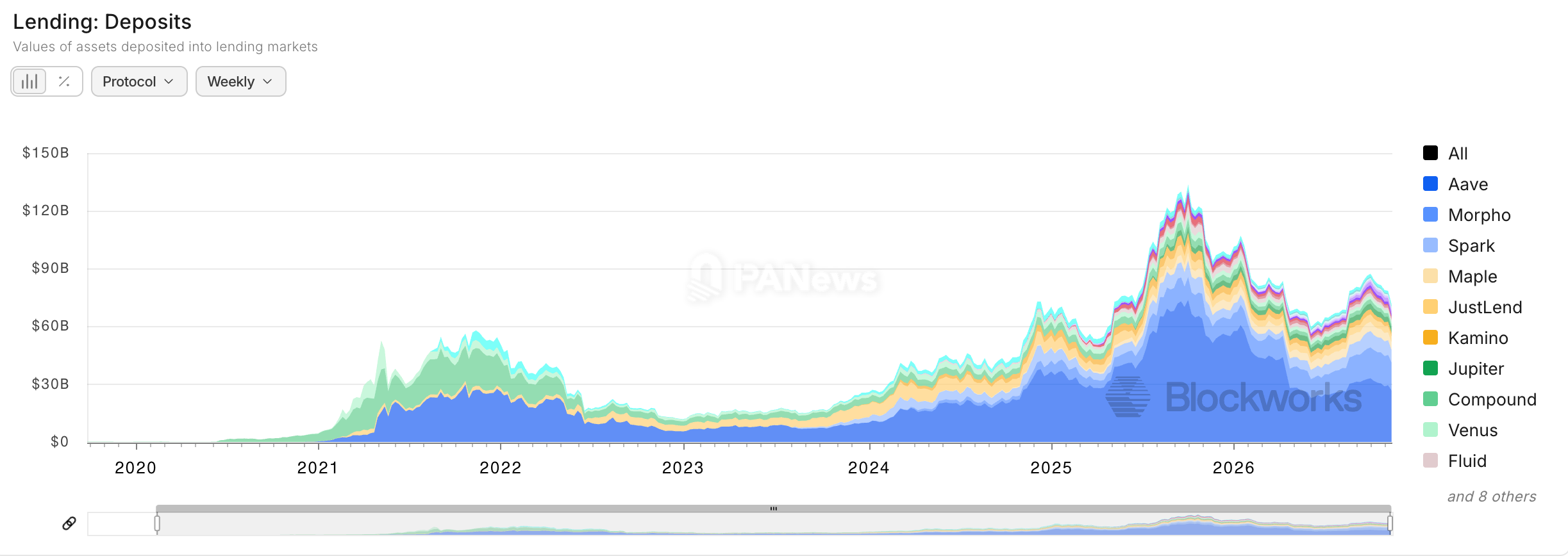
As the market size shrinks, the profitability of lending businesses is also impacted. Currently, the weekly revenue of the crypto lending market is only $2.717 million, a decline of approximately 78.6% from the peak of $12.669 million in 2025.
With both scale and revenue retreating, the market is not only facing shrinking funds, but lending demand and business activity are also cooling simultaneously.
However, compared to the previous bear market, this round of market contraction is somewhat different. A prior report from Galaxy Research pointed out that although the scale of the lending market has significantly shrunk this time, the balance of outstanding loans shows a stable, stepwise declining trend, rather than collapsing sharply in a short time. This relatively moderate pace indicates that the current deleveraging process is much healthier, driven mainly by market participants proactively contracting, rather than a chain reaction caused by forced liquidations or institutional defaults and bankruptcies.
Specifically, declining asset prices are a significant reason for the shrinkage of the lending market scale this time. As prices of major collateral assets like BTC and ETH continue to fall, the dollar-denominated value of collateral within protocols decreases accordingly. Even if users do not actively withdraw funds, the depreciation of collateral valuations will directly lower the accounting scale of the lending market.
Meanwhile, a tightening macro environment further weakens market demand. The two-year U.S. Treasury yield has risen sharply, putting pressure on risk assets and reducing funding risk appetite accordingly. Some funds have shifted from high-risk areas like the crypto market to relatively safe assets, leading to weakened lending demand and net outflow pressure on protocol deposits.
The contraction of stablecoin supply further exacerbates liquidity pressure in the lending market. As an important funding source for on-chain lending, a declining stablecoin scale means reduced dollar liquidity available for lending. Blockworks data shows that since the total supply of stablecoins reached a high of $299.3 billion in March this year, the scale of stablecoins in the lending market has shrunk by over 53%, now amounting to about $5.8 billion, excluding centralized exchanges (CEX).
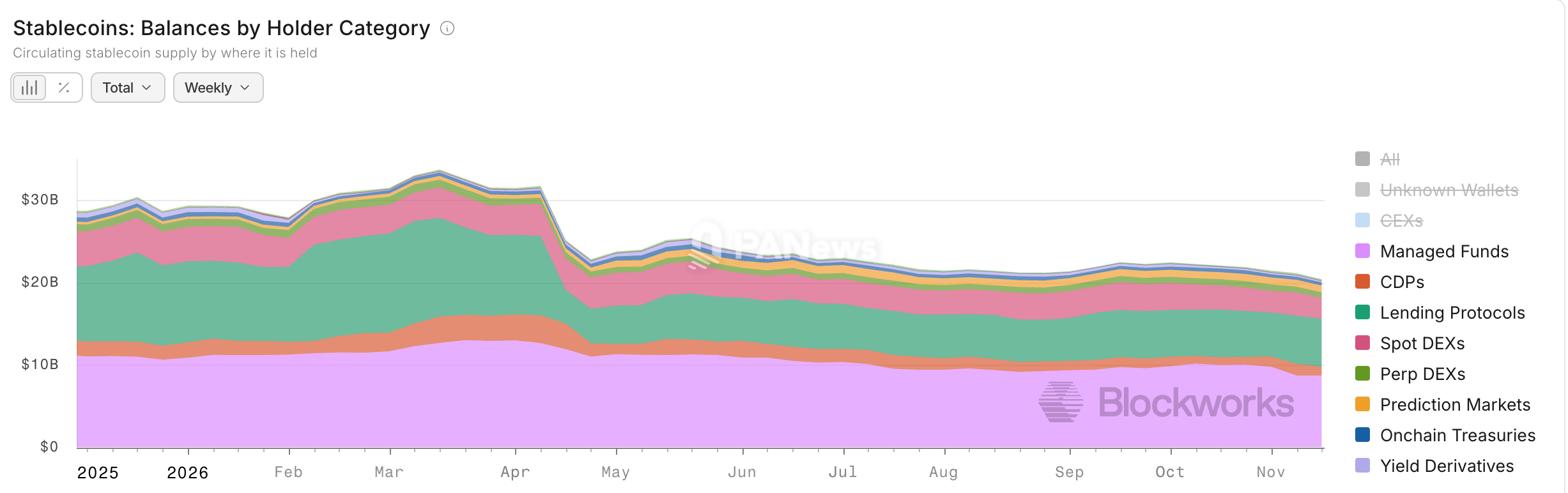
Additionally, large-scale liquidation events and frequent security incidents continue to impact market confidence, while the declining attractiveness of lending yields also weakens the willingness for funds to remain in protocols.
For lending platforms, in the winter of the market, industry competition may no longer be limited to competing on lending scale and yield rates, but may shift to a comprehensive contest of asset supply, institutional capital introduction, and risk management capabilities. Whether they can expand business boundaries while maintaining risk bottom lines and establish a stable, sustainable profit model will be crucial for platforms to cross market cycles.
免责声明:本文章仅代表作者个人观点,不代表本平台的立场和观点。本文章仅供信息分享,不构成对任何人的任何投资建议。用户与作者之间的任何争议,与本平台无关。如网页中刊载的文章或图片涉及侵权,请提供相关的权利证明和身份证明发送邮件到support@aicoin.com,本平台相关工作人员将会进行核查。


