Anthropic’s record IPO may become a catalyst for capital return, but the Federal Reserve's hawkish stance and the risk of economic slowdown still exert pressure.
Written by: Li Jia, Wall Street Insights
Hedge funds’ extreme underweighting of tech stocks is laying the groundwork for a market rebound, and the successful launch of Anthropic's record IPO might be the key catalyst for triggering capital return and driving short covering.
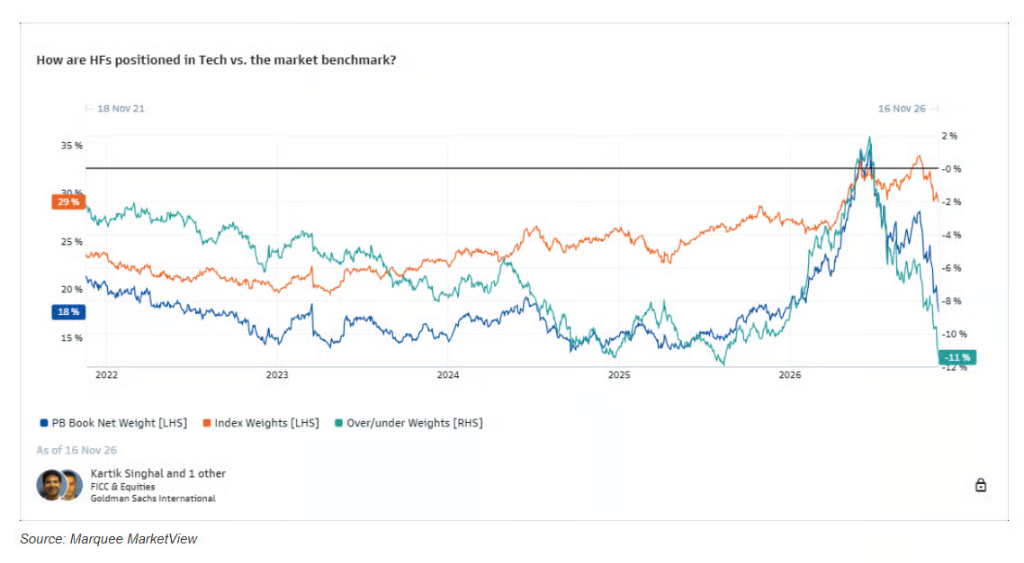
Rich Privorotsky, head of trading at Goldman Sachs, pointed out in Thursday’s morning report that hedge funds’ net exposure to tech stocks is underweight by about 11 percentage points compared to the benchmark index, nearing a five-year low. Meanwhile, market makers' gamma exposure is extremely bearish, while volatility is stabilizing, which may create conditions for a rebound. Nasdaq futures rose nearly 2% in early trading on Thursday.
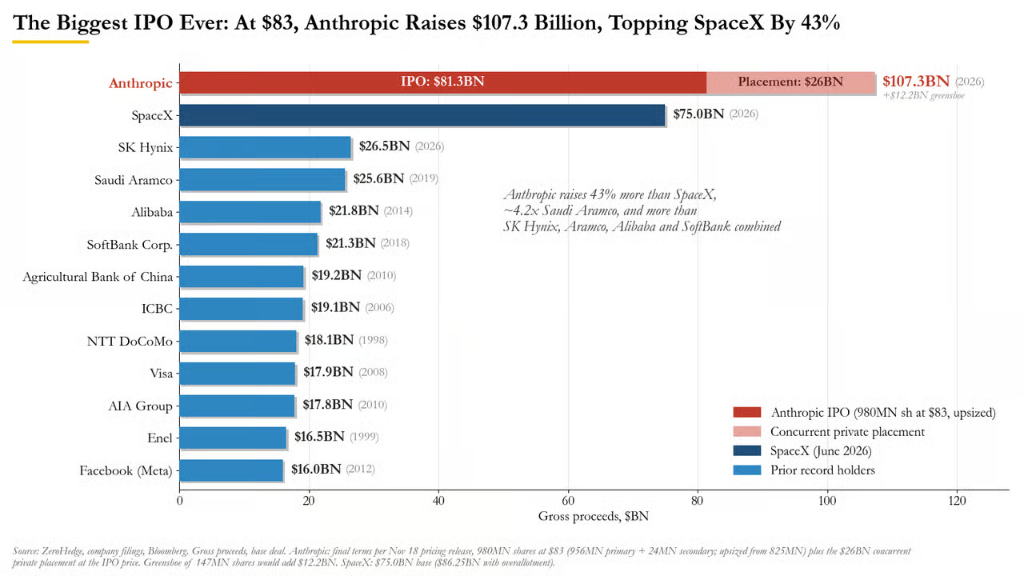
This potential turning point coincides with Anthropic's arrival on Wall Street. The company priced its shares at $83 each on Thursday, above the previously set range limit, raising approximately $81.3 billion through its IPO, totaling $107.3 billion including shareholder placements, setting a new global IPO record. The record subscription demand shows that the market's enthusiasm for leading AI companies remains strong.
However, a rebound in tech stocks does not mean that market risks have dissipated. The Federal Reserve's hawkish stance intertwined with expectations of economic growth slowdown is leading to a game between position repair and macro pressures in the market.
Hedge funds’ tech stock underweighting approaches five-year extreme, short squeeze conditions gradually maturing
Goldman Sachs' latest data on large-scale brokerage reveals that the net weight of tech stocks in hedge fund accounts has dropped to about 18%, while the sector accounts for about 29% in the benchmark index, leading to an underweight of 11 percentage points, nearing extreme levels of the past five years. In contrast, in June 2026, institutional investors briefly overweighed the tech sector.
Goldman noted that the net long-short exposure of tech stocks has decreased to a relatively low level in recent years. Over the past two months, institutional investors have continuously reduced their AI-related positions, reallocating funds to other sectors.
Privorotsky believes that the extreme underweighting has created conditions for a short squeeze. Tech stocks have already undergone significant sell-offs, and as long as they do not continue to fall, investors may be forced to cover their positions.
Technical aspects also provide support: the S&P 500 index is barely holding above the 200-day moving average, market makers’ gamma exposure is extremely bearish, but volatility has been stabilizing recently. Privorotsky believes that market stability may further strengthen stability, attracting funds to re-enter.
Anthropic’s record IPO boosts AI enthusiasm, capital competition becomes market focus
Market traders believe that the concentrated sell-off of gold, cryptocurrencies, copper, and Nvidia stocks this week is partly due to institutional investors reallocating funds for Anthropic’s IPO. The tech stock sell-off and Anthropic’s record financing may be two sides of the same liquidity adjustment.
Anthropic ultimately priced each share at $83, above the previous upper limit of $70 to $78, expanding the offering size from 825 million shares to 980 million shares. The IPO raised approximately $81.3 billion, reaching a total of $107.3 billion including shareholder allocations, surpassing the $75 billion record set by SpaceX in June of this year by about 43%.
Market subscription enthusiasm is high. Vanda Research estimates that net purchases by retail investors on Anthropic's first trading day will be around $250 million. On the Hyperliquid platform, pre-IPO perpetual contracts briefly approached $99 on Tuesday, with a premium of about 19% over the issue price. The subscription multiple for this offering reached 6 times, with the highest allocation ratio for retail investors reaching 20%.
However, Privorotsky also reminds investors to pay attention to valuation risks. Based on an IPO price of $83, Anthropic’s corresponding valuation is about 18 times its annualized revenue of $81.4 billion. Meanwhile, the company’s third-quarter growth rate has already halved, carrying nearly $900 billion in committed expenses, most of which are for computing power procurement. Notably, among the investors holding about $26 billion in Anthropic stock are also suppliers providing it with computing power.
The bond market strengthens against the trend, starting to price in economic slowdown
The recent signals from the Federal Reserve have clearly turned hawkish. Federal Reserve Governor Waller reiterated the case for a 50 basis point rate hike, and meeting minutes indicated that "almost all" members of the Federal Open Market Committee are inclined towards further rate hikes. However, the bond market has seen a decline in backend yields instead, and the yield curve is showing signs of a bull flattening.
Australia's employment data further strengthens signals of economic slowdown. The country saw a decrease of 43,500 in employment in October, far below the market’s expectation of an increase of 25,000, after a decline of 39,300 in September. The unemployment rate rose to 4.9%, the highest level since 2021. The continuous decline in employment for two months has prompted the market to reassess Australia's economic outlook, increasing expectations of rate cuts, leading to a notable drop in two-year government bond yields.
Privorotsky believes that the global bond market is reflecting the risk of growth slowdown ahead of time. Downgrading capital expenditure expectations, falling commodity prices, and easing inflation pressures are collectively driving investors to reassess the interest rate path.
He compares the current environment to the cyclical slowdown at the end of 2018, believing that both have characteristics of later-cycle phases, but the policy implications differ. The current interest rate trends indicate that the market has digested a significant portion of tightening expectations. However, at the end of 2018, the Nasdaq 100 index had retreated about 25% from its peak, and only after severe sell-offs in U.S. stocks around Christmas did the Federal Reserve ultimately pivot.
免责声明:本文章仅代表作者个人观点,不代表本平台的立场和观点。本文章仅供信息分享,不构成对任何人的任何投资建议。用户与作者之间的任何争议,与本平台无关。如网页中刊载的文章或图片涉及侵权,请提供相关的权利证明和身份证明发送邮件到support@aicoin.com,本平台相关工作人员将会进行核查。


