Agentic Commerce Daily #43 | November 19, 2026
Visa has expanded Agentic Ready to the merchant acceptance side, announcing the exploration of expanded partners in the Asia-Pacific ecosystem for transaction pathways; Google has integrated payments into personal Agents. The consumer entry and merchant acceptance capabilities are converging from both ends towards the center.
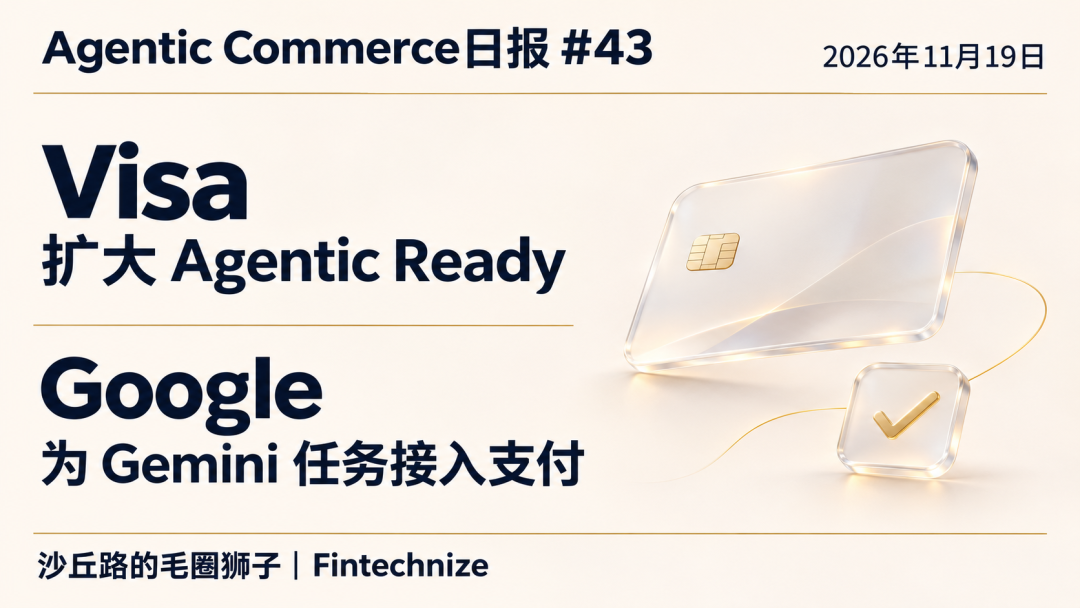
Top Signals | Today's Highlights
1. Visa expands Agentic Ready to the acceptance side, announces Asia-Pacific ecosystem collaboration list
On the evening of November 17, Eastern Time, Visa announced the expansion of Agentic Ready to merchants, payment service providers, acquiring institutions, and business platforms, with over 140 participants in this new phase, including Stripe, Adyen, PayPal, and others.
The previously issuer-centric plan has seen participation from 45 markets and over 175 issuing institutions. The Asia-Pacific announcement on November 18 revealed that this round of regional acceptance plans has over 50 participants, focusing on testing Agent transaction identification, authentication, and processing, helping merchants adjust existing systems.
The Asia-Pacific announcement also highlighted ecosystem collaborators such as Clink, FluxA, and Pivota, exploring product discovery, shopping carts, checkout, and payments together. Combining their publicly available information, Clink focuses on Agent wallets and user authorization, FluxA explores authorization procurement for models, APIs, and other resources, while Pivota builds the product decision-making and order execution layer.
Visa is simultaneously organizing payment institutions and next-generation business infrastructure companies to allow the demand brought by Agents to enter the existing transaction chains of merchants. For startups, the opportunity lies in addressing the specific gaps from purchase intent to order fulfillment, rather than merely achieving a position on a collaboration list.
2. Google connects Gemini tasks to Google Pay, expands free access
On November 17, Google announced that updates to the Gemini task will start being offered for free to users in the United States, Japan, South Korea, Canada, Australia, and India, with advanced features initially opening in the U.S. The new Google Pay integration supports purchases through AP2, with eligible Mastercard and Visa cards using digital tokens, while support for American Express is yet to be launched.
Google stated that as designed, tasks will request confirmation or pre-authorization before purchases, and users can also set spending limits. The announcement did not specify the open regions for Google Pay/AP2, and some websites still require users to complete the final step.
This change further connects shopping suggestions to payments. Google’s existing search, personal information, and card relationships can reduce the steps needed for users to resubmit data across different services. UCP integration remains the next step, and the reliability of the current shopping pathways still depends on specific merchants and payment support.
3. AXS opens billing infrastructure to partners via AI interface
AXS announced on November 18 that it is opening billing discovery, verification, and user-authorized payment capabilities to partners through its MCP servers. Its existing network in Singapore covers over 800 receiving institutions, and related billing services will be gradually integrated; Visa and Mastercard will showcase their respective experiences at the Singapore FinTech Festival, while Grab AI Assistant is in the pilot phase.
AXS has chosen to provide the underlying network, allowing banks, wallets, and other platforms to manage their own AI interfaces. For infrastructure providers with a large number of billing connections, the Agent channel can expand distribution without needing to re-attract all users to their own applications.
4. JPMorgan and Hyundai Card complete financial Agent proof of concept
J.P. Morgan announced on November 18 that it has completed the first phase of a proof of concept with Hyundai Card: Hyundai’s Agent monitors euro liquidity and requests exchange rate quotes for pounds against euros; Kinexys’ Agent verifies identity, digital signature authorization, and execution restrictions, then decides on automatic execution, human review, or rejection. This was completed in a testing environment, with foreign exchange transactions simulated and no actual funds transferred.
This case disassembles cross-institutional Agent collaboration into specific business and control steps. Before a company hands over a financial task, it must have the counterparty verify the agency authority and also retain traceable records; validation work still needs to be done before the trial is ready for formal commercial use.
Products and Implementation
5. Genesys sells Agents independently without requiring migration of contact centers
Genesys launched and officially opened Standalone AI Agents on November 17, allowing enterprises to retain their existing contact centers, phone numbers, and operators while introducing Agents under their own permissions and rules for handling payment services, appointments, and account changes. Pricing is tiered based on the tools needed for the tasks measured in Experience Units. This reduces the binding between adopting Agents and changing core customer service platforms, shifting procurement discussions from the quantity of conversations to the actual costs needed to solve tasks.
6. Stitch integrates Agents into banking operating systems
Riyadh-based Stitch announced on November 18 through a press release the launch of Stitch AI, covering processes like banking product configuration, customer account opening, and collections, and providing tools to build and deploy custom Agents. Agents operate under limited identities, permissions, and amounts, with approvals and operations recorded, and banks can choose internal deployment or private cloud; the announcement did not disclose the list of banks already in production. Embedding into existing operating systems helps to connect AI capabilities with the bank's existing business controls.
7. Savana Acta launches 139 banking operations, requiring human approval before execution
Savana released and opened Acta on November 17, initially supporting 139 banking operations covering customer service, fund movement, cards, and account opening, serving both bank employees and customers. It connects the bank's existing systems, operates within institutional policies and user permissions, and requires personnel approval while retaining auditable records that are tamper-resistant. Integrating cross-system steps into the same conversation provides an opportunity to reduce repeated handovers between bank employees and customers.
8. Perform.AI launches free store compatibility check
Perform.AI introduced the UCP and ACP Readiness Checker on November 18, using 147 fixed rules to check product discovery, checkout capabilities, after-sales information, and connectivity, scoring based on the agreements used by the store, without requiring installation or granting system access. Merchants can modify and retest, but the scoring is diagnostic rather than a certification of agreement or proof of actual purchase success. The maintenance work for the Agent channel has thus gained an entry point for repeated checks.
Transaction Data and Research
9. Cross River discloses nearly $50 million in Agent procurement samples
On November 18, Cross River published an analysis of nearly $50 million in Agent procurement amounts from its platform over six months: the Agent transaction return rate is 3.9%, while traditional transactions stand at 3.4%; after excluding expired cards, the authorization decline rates are 12.5% and 12.2%, respectively. This is a self-reported platform sample from the bank, and the article did not provide specific start and end dates, transaction counts, or methods for matching comparisons, which means no industry-wide safety conclusions can be drawn from it. It provides a closer observation starting point to actual operations than demonstrations and indicates the need for continued comparison of return, decline, and anomaly handling costs.
Daily Thesis | Entry and Acceptance are Converging
Personal Agents grasp user intent, while merchants and payment institutions hold the conditions for whether transactions can succeed. Visa expanding its ecosystem and Google connecting payments both work to shorten the distance between the two; the opportunity for startups is to solidify the existing gaps between authorization, products, orders, and payments.
免责声明:本文章仅代表作者个人观点,不代表本平台的立场和观点。本文章仅供信息分享,不构成对任何人的任何投资建议。用户与作者之间的任何争议,与本平台无关。如网页中刊载的文章或图片涉及侵权,请提供相关的权利证明和身份证明发送邮件到support@aicoin.com,本平台相关工作人员将会进行核查。


