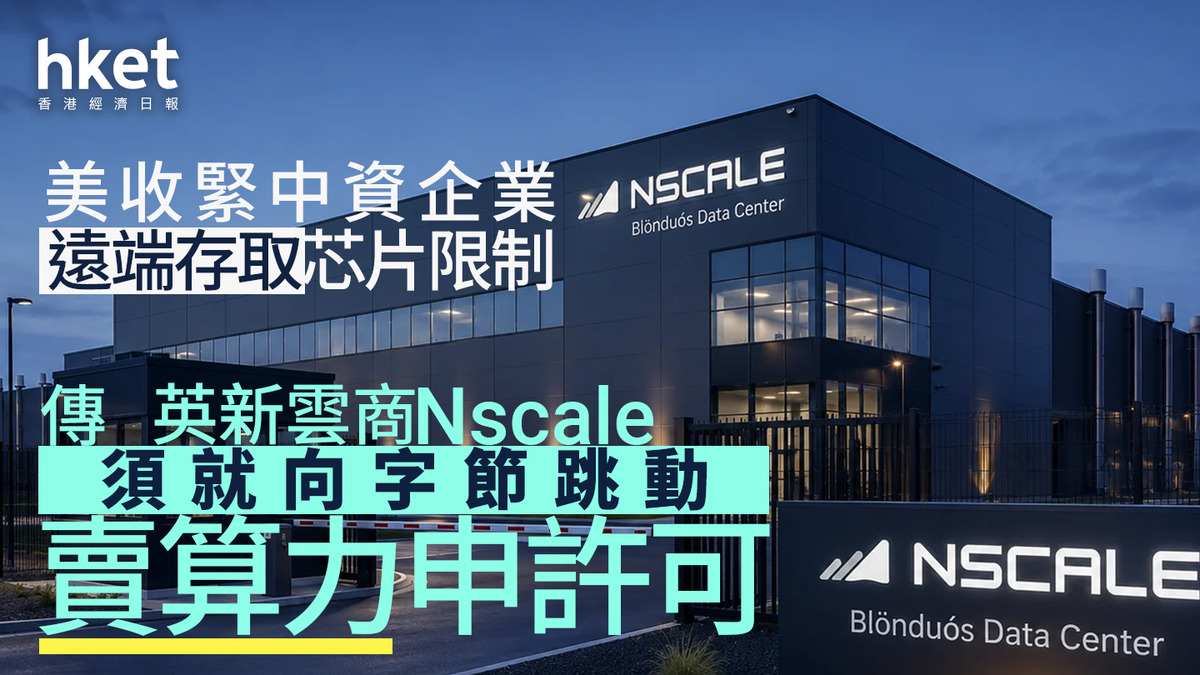
The U.S. expands export control restrictions on Chinese companies to access high-end chips remotely
Nscale providing computing power to ByteDance will face regulatory scrutiny
ByteDance accounts for over 70% of Nscale's revenue last year
The U.S. government recently announced stricter export control measures, including restrictions on Chinese tech companies using U.S. high-end chips through remote access. According to Bloomberg, the agreement for British cloud provider Nscale to sell computing power to TikTok's parent company ByteDance will face stricter regulation.
The report cited anonymous informed sources indicating that Nscale will need to apply for permission to continue allowing ByteDance to use NVIDIA (also known as Nvidia: NVDA) graphics processors (GPUs) deployed in data centers located in countries such as Iceland and Norway.
The report mentioned that although China cannot access NVIDIA's advanced chips domestically, Chinese companies can utilize data centers in other countries to train AI models. The U.S. Department of Commerce is seeking to close related loopholes by requiring data centers to obtain special permits when selling U.S. chip usage rights to customers in countries like China, Russia, and Iran.
The report mentioned that Nscale has 90 days to apply for a license from the U.S. government.
Last year, revenue from ByteDance accounted for 73% of total revenue
The report mentioned that Chinese companies are an important source of revenue for Nscale. Nscale has submitted plans for an initial public offering (IPO) in New York, with most of its sales concentrated among a few customers. According to company documents, last year's revenue was $33 million, with revenue from ByteDance accounting for as much as 73% of total revenue. Subsequently, Microsoft (U.S.: MSFT) and Anthropic PBC (U.S.: ANT) signed agreements with Nscale to acquire larger-scale computing power.
The report mentioned that Nscale declined to comment, citing the company's quiet period due to the proposed IPO. ByteDance did not respond.
This article is reproduced from the Hong Kong Economic Journal, and the copyright belongs to the original author and media.
免责声明:本文章仅代表作者个人观点,不代表本平台的立场和观点。本文章仅供信息分享,不构成对任何人的任何投资建议。用户与作者之间的任何争议,与本平台无关。如网页中刊载的文章或图片涉及侵权,请提供相关的权利证明和身份证明发送邮件到support@aicoin.com,本平台相关工作人员将会进行核查。


