From Bitcoin ETF cost line to IBIT holdings: Are Wall Street giants retreating ahead of time?
Written by: KarenZ, Foresight News
Wall Street may finally be experiencing a feeling that crypto retail investors are most familiar with: being trapped.
At the beginning of 2024, when the first U.S. Bitcoin spot ETF was approved for listing, the entry of traditional financial institutions was once seen as an important sign of Bitcoin's maturation.
Asset management giants like BlackRock and Fidelity placed Bitcoin into securities accounts, allowing investors to buy financial products linked to Bitcoin's price without needing to study private keys, mnemonic phrases, and on-chain transfers.
More than two years later, Bitcoin ETFs have attracted hundreds of billions of dollars in funds, becoming an important channel connecting Wall Street with the crypto market.
However, this time, ETF investors may no longer be the winners looking down at the market from the mountaintop.
$80,000 Bitcoin ETF cost line
Let’s first look at this cost line that has rarely been discussed in the market.
The CryptoETF.today page shows that the 11 Bitcoin spot ETFs it covers have an estimated average holding cost of $80,197, corresponding to a Bitcoin price of about $63,346 at the time of writing, which is approximately 20% below the cost line. Based on this model at this point, the paper loss is around $18.59 billion.
How is this cost line derived? CryptoETF calculates the daily net subscription and redemption amount for each fund and converts it into the number of coins using the weighted average price of Bitcoin for that day based on trading volume. During net subscriptions, the new coins and corresponding amounts are counted together; during net redemptions, the cost of the redeemed coins is deducted based on the fund's original average cost. Finally, the remaining estimated costs of each fund in the sample are summed up and divided by the total number of coins, resulting in the average cost per Bitcoin.
It is worth mentioning that this model does not track the transfer of shares within the exchange and does not deduct management fees paid in coins. Additionally, due to the lack of initial holding cost data for GBTC before conversion, CryptoETF.today did not include GBTC in the cost estimation sample of these 11 funds.
Therefore, this cost line cannot be directly understood as the actual average purchase price for all ETF investors.
The latest financial report from BlackRock's IBIT provides another compelling reference. According to the 10-Q report submitted by IBIT on November 6 for the third quarter of 2026, as of September 30, IBIT held approximately 801,033 Bitcoins, with a book cost of about $65.556 billion and a fair value of about $67.044 billion.
Dividing the book cost by the number of coins gives about $81,839 per coin. This is the book cost of the Bitcoins held by the fund at that time, which is neither the purchase price for each IBIT holder nor can it be used to calculate a particular institution's profit and loss.
This figure is not far from the current estimated $80,197 from CryptoETF.today, but the statistical dates, asset coverage, and cost calculation standards differ, so they cannot be considered as mutually validating.
Some add positions, some retreat
The quarterly holdings disclosed by institutions can help us see another thing: how many Bitcoin ETF shares they held before this round of declines.
In mid-November, several U.S. institutions consecutively submitted Form 13F reports to the U.S. SEC as of September 30, 2026. 13F requires institutional investment managers that meet the reporting threshold to periodically disclose their positions in securities, including Bitcoin ETF shares.
Although this data is as of September 30 and cannot reflect recent changes in positions after the decline of Bitcoin, it provides an important observational perspective: which institutions significantly increased their holdings before this round of decline? Which ones reduced their holdings in the third quarter? And which opted to stand still?
First, let’s look at the situation of BlackRock's Bitcoin spot ETF—IBIT. The 13F report as of September 30 shows that among the top 20 reporting institutions by IBIT market value, 12 increased their holdings compared to the end of the second quarter, 5 decreased, and 3 remained unchanged.
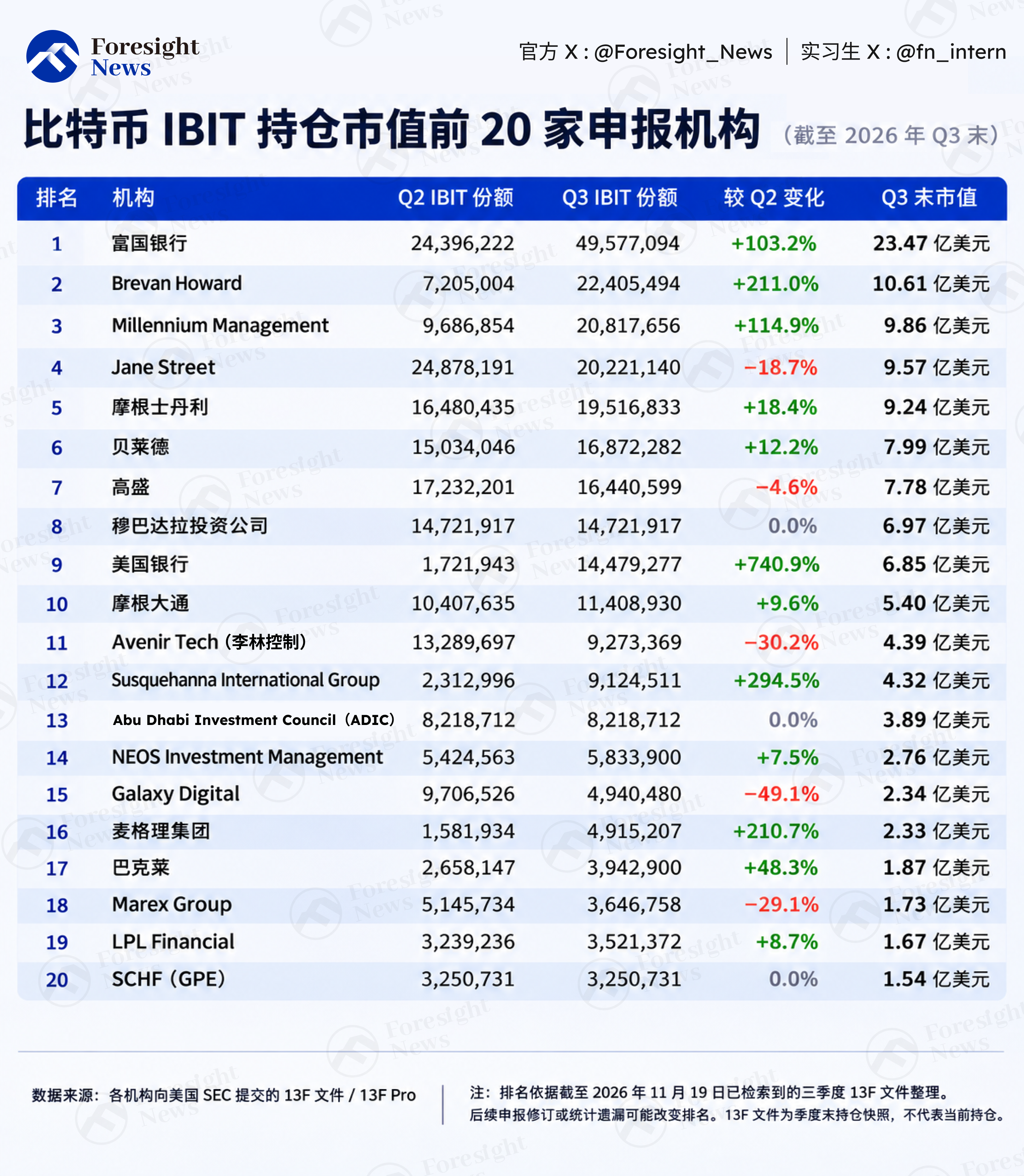
First, let's focus on the institutions that significantly increased their positions.
Among the 20 institutions surveyed, Wells Fargo holds approximately 49.58 million shares of IBIT, with a year-end market value of $2.347 billion, ranking first. Compared to the second quarter, its IBIT holdings increased by about 25.18 million shares, a growth rate of 103.2%, effectively doubling.
Bank of America (BofA) had the largest increase in holdings among these 20 institutions. Its IBIT holdings increased from approximately 1.72 million shares to 14.48 million shares, growing by 740.9%.
Two well-known hedge funds also made significant moves. Brevan Howard's IBIT holdings increased from approximately 7.21 million shares to 22.41 million shares, a growth of 211%, valued at about $1.061 billion at the end of the third quarter; Millennium Management's holdings grew from approximately 9.69 million shares to 20.82 million shares, an increase of 114.9%, with a year-end market value of about $986 million.
In addition, Susquehanna International Group's IBIT holdings grew by approximately 294.5%, Macquarie Group increased by about 210.7%, and Barclays by about 48.3%. Morgan Stanley, BlackRock, and JPMorgan also increased their positions by 18.4%, 12.2%, and 9.6%, respectively.
On the reduction side, Galaxy Digital had its IBIT holdings decrease by about 49.1%, dropping from approximately 9.71 million shares in the second quarter to 4.94 million shares in the third quarter, a reduction of about 4.77 million shares.
Avenir Tech, led by Li Lin, had its IBIT holdings decrease from approximately 13.29 million shares to 9.27 million shares, a decline of 30.2%; Wall Street market-making and trading firm Jane Street reduced by 18.7%, and Goldman Sachs decreased by 4.6%. However, the changes in IBIT for Jane Street and Goldman Sachs should not be viewed in isolation.
During the same period, Jane Street increased its Fidelity FBTC holdings from approximately 890,000 shares to 7.01 million shares, and significantly increased ARKB. Goldman Sachs' FBTC rose from about 106,000 shares to 5.478 million shares. Both reduced their IBIT but increased their holdings of other Bitcoin spot ETFs.
There were also some institutions that chose to remain unchanged. The Abu Dhabi sovereign investment institution Mubadala and the Abu Dhabi Investment Council reported the same IBIT shares as at the end of the second quarter.
Another boundary is that the 13F disclosure refers to the securities holdings managed by the reporting institution, which is not equivalent to the institution's unilateral bets with its own funds. The bank's reporting may involve client assets; trading institutions may also simultaneously use options, futures, or other positions. The number of long positions in IBIT ordinary shares cannot independently indicate an institution's net risk exposure to Bitcoin.
13 net outflows in 11 trading days in November
Compared to delayed quarterly holdings reports, daily fund flows of ETFs can provide more timely clues.
According to Farside Investors data, from November 5 to 13, U.S. spot Bitcoin ETFs experienced net outflows for seven consecutive trading days, totaling about $1.907 billion.
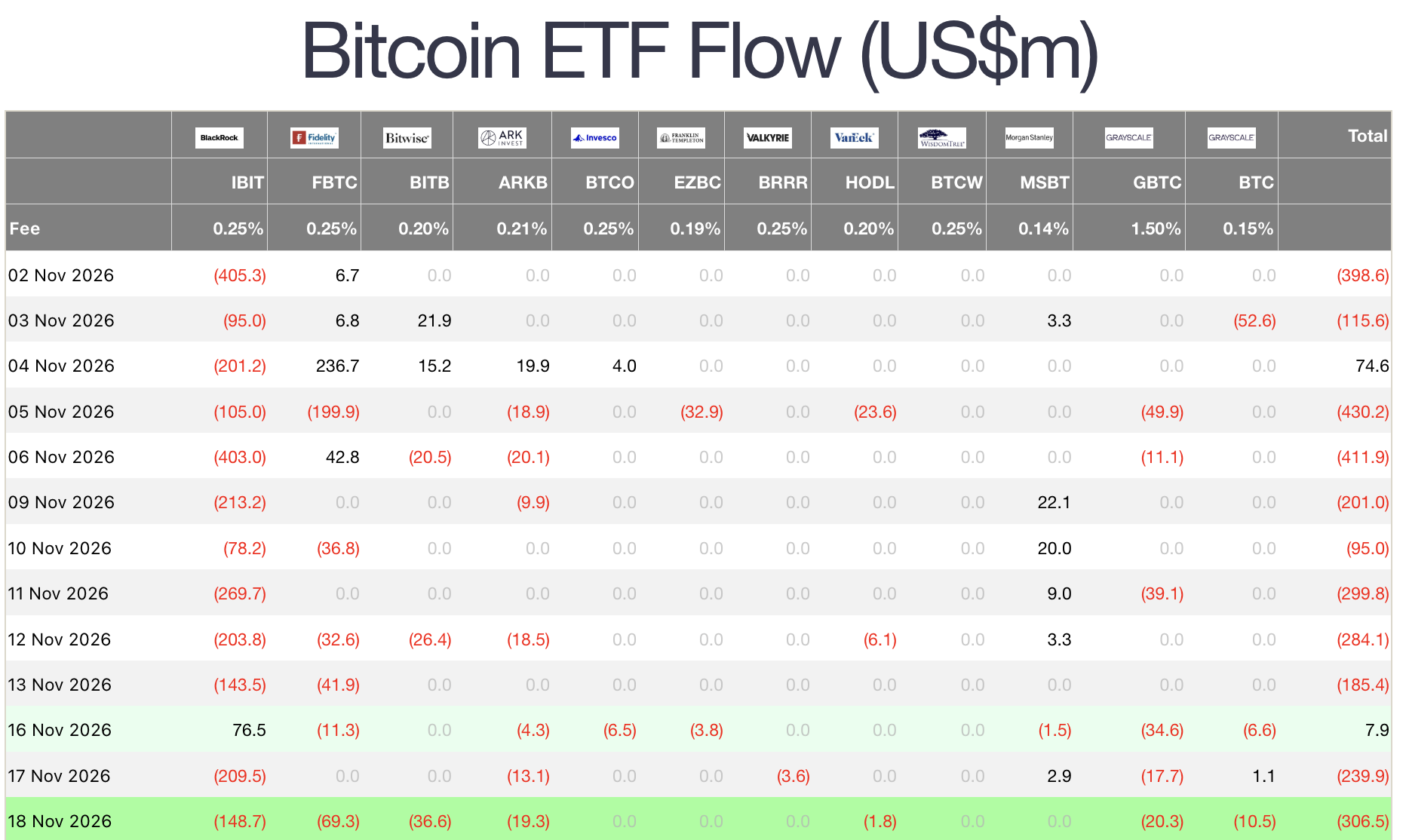
Source: Farside Investors
On November 16, the trend reversed with a net inflow of about $7.9 million: IBIT saw an inflow of about $76.5 million, offsetting outflows from several other products.
However, this influx did not last, as there were further net outflows of about $240 million and $307 million on November 17 and 18, respectively.
This indicates that, as Bitcoin's price fell, the ETF market was indeed facing ongoing withdrawal pressure.
What is truly concerning is the potential reinforcement that may form between price declines and fund outflows: when Bitcoin continues to fall, investors redeem ETFs, and the related asset adjustments may increase market selling pressure, further affecting prices and liquidity. However, this is not a cycle that is destined to happen; the actual impact still depends on the scale of fund flows, market depth, and the execution methods of subscriptions and redemptions.
Conversely, if after the price falls, the net outflows of ETFs gradually slow down or even a sustained net subscription reappears, it means there are still funds willing to assume Bitcoin risks at lower prices.
免责声明:本文章仅代表作者个人观点,不代表本平台的立场和观点。本文章仅供信息分享,不构成对任何人的任何投资建议。用户与作者之间的任何争议,与本平台无关。如网页中刊载的文章或图片涉及侵权,请提供相关的权利证明和身份证明发送邮件到support@aicoin.com,本平台相关工作人员将会进行核查。


