Popular Coins in CEX
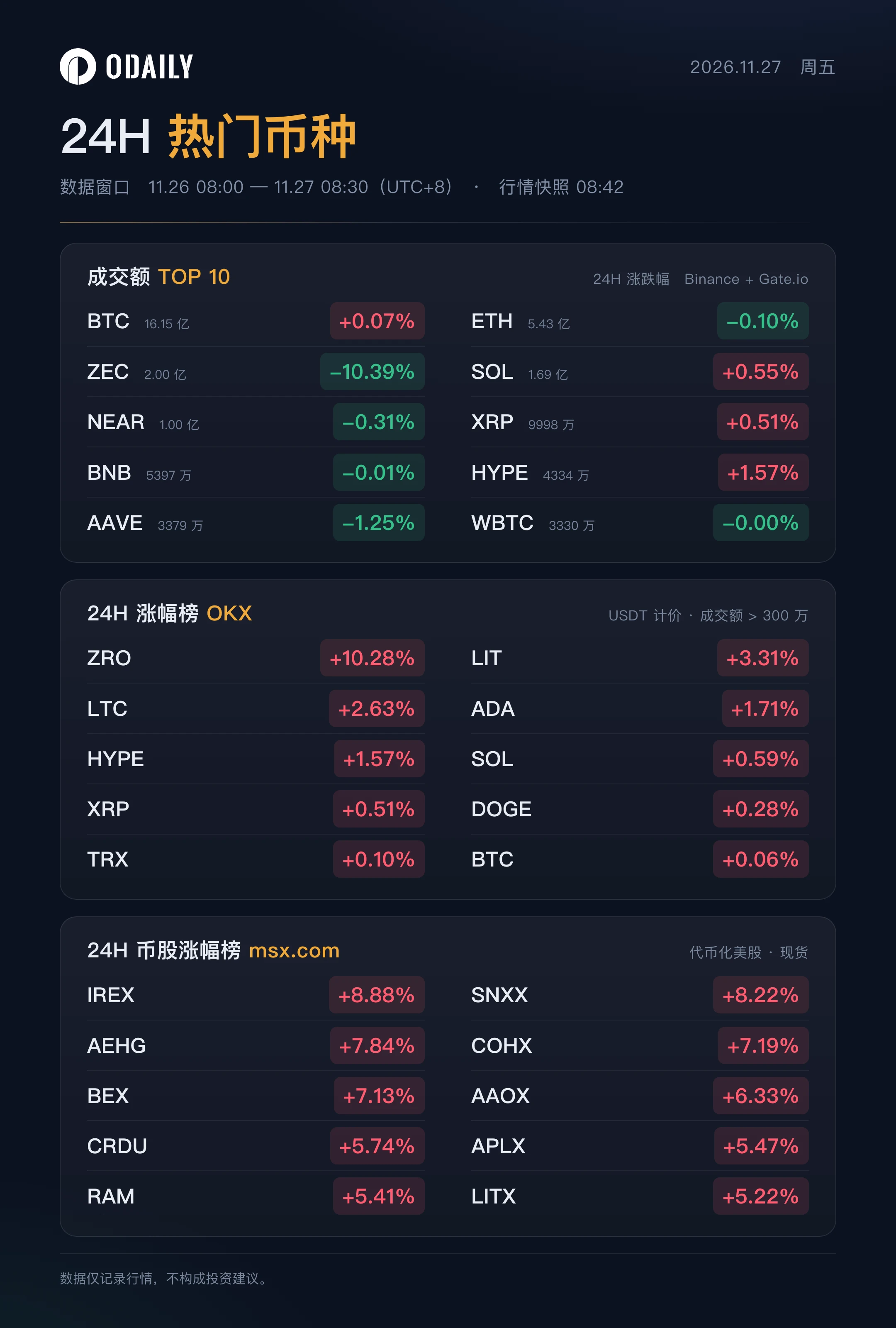
Top 10 CEX Trading Volumes and 24-Hour Price Changes:
- BTC: -0.24%
- ETH: -0.54%
- ZEC: -10.59%
- SOL: +0.30%
- XRP: +0.38%
- NEAR: -0.20%
- BNB: -0.24%
- HYPE: +1.32%
- AAVE: -1.01%
- WBTC: -0.31%
24-Hour Price Increase Ranking (Source: OKX):
- ZRO: +11.81%
- LIT: +2.59%
- LINK: +2.44%
- LTC: +2.40%
- ADA: +1.57%
- HYPE: +1.44%
- XRP: +0.38%
- SOL: +0.30%
- DOGE: +0.21%
- TRX: +0.05%
24-Hour Coin Stock Price Increase Ranking (Source: msx.com):
- IREX: +8.88%
- SNXX: +8.22%
- AEHG: +7.84%
- COHX: +7.19%
- BEX: +7.13%
- AAOX: +6.33%
- CRDU: +5.74%
- APLX: +5.47%
- RAM: +5.41%
- LITX: +5.22%
Headlines
According to blockchain researchers, Chainalysis and Elliptic estimate that over 600 million USD of stolen Binance assets have been transferred via THORChain, with another 342 million USD transferred through mixing services, largely coordinated by the pseudonym Kruw. TRM Labs estimates that THORChain earned approximately 1 million USD in fees during this process. U.S. regulatory authorities accused North Korean hackers of perpetrating this 6.3 billion USD hacking incident that occurred on October 29, of which approximately 2.85 billion USD has been frozen. THORChain co-founder Chad Barraford stated that 98% of transactions are for personal financial freedom and mentioned that if the platform is shut down, criminals will seek other avenues. (Reuters)
The U.S. House Financial Services Committee officially submitted the “2026 U.S. Reserve Modernization Act” (H.R. 8957) to the House of Representatives on November 24, advancing the bill to the full House voting procedure. The bill was passed in committee by a vote of 28-21 on September 16, with all supporting votes coming from Republican lawmakers. The bill requires the U.S. Secretary of the Treasury to establish a strategic Bitcoin reserve within 180 days of the bill's enactment and to establish independent reserves for other cryptocurrencies. Under the terms of the bill, BTC held by the government cannot be sold, exchanged, auctioned, pledged, or otherwise disposed of for at least 20 years, and must regularly publish reserve proof reports, while federal agencies are required to account for their held digital assets.
Galaxy Research retracted its previous judgment on November 25 that the Bitcoin bear market had ended, stating that current market has not shown sufficient historical bottom signals. In a report released on October 26, Galaxy Research had suggested that Bitcoin had bottomed at around 76,540 USD on June 30, 2026, and advised investors to buy and hold. Its main basis for this included Bitcoin retaking the 50-week moving average, reduced selling by long-term holders, and factors such as the Bitcoin halving cycle. However, the latest report indicates that of the 13 historical bottom signals tracked by Galaxy, 11 have yet to be met, and the maximum drawdown for this cycle has been adjusted to 53%.
Industry News
According to SoSoValue data, as of November 25, Eastern U.S. time, the total net outflow of Bitcoin spot ETFs was 453 million USD, marking 7 consecutive days of net outflows. BlackRock’s IBIT had the largest single-day net outflow of 330 million USD, with a historical total net inflow of 61.811 billion USD; Grayscale's Bitcoin Mini Trust ETF BTC had a single-day net outflow of 60.121 million USD, with a historical total net inflow of 2.754 billion USD. As of press time, the total net asset value of Bitcoin spot ETFs was 72.027 billion USD, and the net asset ratio of ETFs was 5.94%, with a historical cumulative net inflow of 51.589 billion USD.
JPMorgan analysts indicated that the Strategy valuation relative to the value of its Bitcoin holdings has recently dropped to about 0.88 times, below the previous low set in late June this year, signaling a "capitulation selloff" in the Bitcoin market. Analysts led by Nikolaos Panigirtzoglou noted in a report released on Wednesday that their graphs compare the enterprise value of Strategy with the dollar value of its Bitcoin holdings, but the report did not clarify the specific computation formula. The relevant indicator adopted by Strategy is mNAV, which is the stock price divided by the dollar value of net Bitcoin holdings per share, while considering the company's debts, preferred equity, and dollar assets.
Zcash lead developer Zakura has called on the community to speed up the halt of new deposits into the old privacy system Sapling and recommend users transfer approximately 300 million USD ZEC to the new system Ironwood. Zakura is led by Zcash co-founder Sean Bowe and developer Dev Ojha. The team estimates that around 400,000 ZEC remains in Sapling, valued at approximately 300 million USD at a price near 755 USD. Zakura stated that future mathematical advancements may enable attackers to forge proofs relied upon by Sapling, but the actual likelihood of a breach is "highly speculative," and urged users to transfer funds while the system is still usable. Ironwood currently holds about 85% of private ZEC, using Halo 2 verification proof without reliance on pairing.
Switzerland's First Spot Bitcoin ETF Launched, Holding 350 BTC
Bitcoin News reported on the X platform that the spot Bitcoin ETF under BIT Asset Management began trading today on the SIX Swiss Exchange, becoming Switzerland's first and reportedly the only spot Bitcoin ETF still trading in Europe according to the asset management company. The fund was launched with 350 BTC, valued at approximately 21 million USD, with an annual fee rate of 0.19%. The Bitcoin held by the fund is stored in isolated cold storage at AMINA Bank, regulated in Switzerland. The ETF trades in USD and Swiss Franc, and qualified investors can also use Bitcoin to purchase fund shares.
Project News
BNB Chain has released a new L1 network white paper, introducing a network architecture designed for high-frequency trading, payments, privacy finance, and autonomous AI agents. The network will adopt a SubBlocks mechanism, pushing transactions in batches before full block generation, and setting up dedicated transaction channels; it will also natively support account abstraction, Passkey authentication, batch transactions, agent permission management, and transaction fee payment. The new network supports BNB and authorized BEP-20 tokens for privacy settlement, and will develop in parallel with the BNB Smart Chain, continuing to use BNB as the native token. The public testnet is still being prepared, with parallel EVM execution and protected transaction ordering through TEE gateways still in the planning stage.
Aave Pro Launches V4 Leverage Trading Feature, First Supporting Ethereum and Avalanche Markets
Aave announced that leverage functionality for Aave V4 markets on Ethereum and Avalanche networks is now live on Aave Pro. Users can now establish leveraged positions through single transactions, expanding risk exposure to supported assets. This feature is supported by Aave V3 Flash Loans and CoW Swap. The first version requires that the collateral assets and borrowed assets in Aave V4 positions be launched in the Aave V3 market on the same network. Once a leveraged position is established, users can adjust leverage levels at any time and track and manage positions via a dedicated Leverage page. Aave stated that more assets and blockchain networks will be supported in the future.
Polygon Labs Expands Open Money Stack to Base Network
Blockchain infrastructure company Polygon Labs has fully deployed its Open Money Stack payment platform to Coinbase's Layer 2 network Base, supporting businesses to make payments in USDC or local currency to cross-border recipients. The platform integrates fiat on/off ramps, embedded wallets, and settlements into a single access point. With the addition of Base, it now covers Polygon Chain, Ethereum, Solana, and Tron. According to DeFiLlama data, the stablecoin scale on Base is close to 5 billion USD. After this integration, businesses making payments to merchants holding USDC on Base can directly deposit funds into the recipient's existing wallet through the same platform, with recipients choosing local currency also able to receive in the same batch.
Investment and Financing
Cournot Completes 5 Million USD Financing, Paper Ventures and Beam Foundation Co-Lead
Cournot announced the completion of 5 million USD financing, co-led by Paper Ventures and Beam Foundation. Cournot previously received investments from YZi Labs and is a third-quarter incubation project of EASY Residency. This round of financing will be used to accelerate core product and technology development, expand integration with blockchain ecosystems like BNB Chain, and promote its application in scenarios such as prediction markets, AI Agent autonomous trading, digital collectibles, parametric insurance, and RWA. The project is an AI-native oracle protocol.
Japanese publicly traded company HODL1 (2345) disclosed on November 24 that its financing plan to raise 6.4 billion JPY, mainly for purchasing and operating ETH, had not obtained exercising funds as of the end of October. The company decided to shift its business focus to AI infrastructure and plans to raise about 2.4 billion JPY through a targeted stock issuance and issuance of new stock subscription rights, mainly for GPU servers and AI infrastructure business, and will no longer arrange for additional ETH purchases. The issuance and exercise price for this financing is set at 69 JPY per share, and if fully exercised, the potential equity dilution rate will reach 186.19%; HODL1 expects to have a cash balance of less than 45 million JPY by the end of October, and financing still requires shareholder meeting approval. The company stated that it will continue to hold and operate existing ETH assets and retain on-chain financial business.
Regulatory Trends
The South Korean Financial Commission plans to set special regulatory provisions for overseas digital payment token issuers in the draft of the “Digital Asset Industry Innovation and User Protection Law.” According to the draft, overseas stablecoin issuers such as Tether and Circle that carry out stablecoin issuance and redemption services for South Korean residents must set up branches or places of business locally and register with the Financial Commission. Related issuers must also separate the funds collected for stablecoin issuance from their own assets and deposit or entrust them to reserve asset management institutions like South Korean banks, which would then invest in bank deposits, government bonds, and other assets as prescribed. The specific scope of reserve assets will be determined by considering the regulatory regime in the issuers' home countries and their stablecoin holdings and circulation volume in South Korea.
Bank of Russia Approves First Set of Cryptocurrency Investor Testing Rules
The Bank of Russia has approved the first set of foundational standards including knowledge testing rules for cryptocurrency. Investors purchasing cryptocurrencies through local brokers or cryptocurrency trading platforms must participate in the test, regardless of whether they are qualified or non-qualified investors. The test is free of charge and consists of 8 questions, covering topics such as cryptocurrency market regulation, the characteristics of different types of cryptocurrencies, information security, the risks of trading operations being frozen, and digital currency price fluctuations; a minimum of 7 correct answers is required to pass. Those who do not pass on their first attempt may retake the test once on the same day, and the retake questions will not repeat those from the first test. Market participants are prohibited from disclosing correct answers to clients. The validity period of passing the test is one year, starting from the completion date of the test or the date of the most recent transaction, whichever is later; no further testing is required during the validity period.
U.S. Congresswoman Maxine Waters stated that she introduced the “Stop TRUMP in Crypto Act” just hours before Trump’s first TRUMP Meme coin dinner, aimed at holding Trump accountable and ensuring the president focuses on his duties. Waters claimed that if the Democrats take control of the House Financial Services Committee in January next year, the committee will investigate Trump’s Meme coins and other cryptocurrency operations, and promote the passage of related legislation to prevent the president from using cryptocurrency operations for personal gain. The bill was formally introduced in May 2025 and has yet to pass.
New regulations in Spain will give the financial intelligence agency Sepblac the power to proactively suspend cryptocurrency accounts suspected of money laundering or terrorist financing without the need for judicial approval, for up to five working days; the agency can also suspend a pending transaction for up to ten working days. The related regulations will officially take effect on January 25, 2027. These measures are all temporary; to continue freezing accounts or blocking transactions after the initial period expires, the prosecutor must obtain judicial approval.
Voices from Figures
Arthur Hayes: If the Fed Does Not Signal a Dovish Shift, the Crypto Market May Face Selloff Pressure
Arthur Hayes stated that if the Federal Reserve does not release dovish policy signals before Friday's market close and before the FOMC meeting's quiet period begins, there may be significant market volatility this weekend. Hayes warned that investors might preemptively sell cryptocurrencies and other highly liquid assets in response to market risks before Monday's opening. Hayes concluded, "To get to heaven, one must first go through hell," and reminded traders to be cautious of risks.
Tom Lee: U.S. Stocks May Have Completed Bottoming, Bounce Might Come Earlier than Fed Policy Shift
Tom Lee, chairman of Ethereum treasury company Bitmine, stated that U.S. stocks have gone through an extremely painful phase, and recent market panic has sharply intensified, possibly indicating that the market bottom has already occurred. Last week, investors fell into a comprehensive "buying strike," unwilling to buy stocks regardless of market news, while the VIX panic index briefly rose to 40. Tom Lee compared the current market conditions to those in 2018, when U.S. stocks bottomed on December 24, and the VIX panic index rose to 36, while the Fed did not signal a policy shift until January 4 of the following year, during which U.S. stocks had already rebounded nearly 8%. This suggests that even without monetary policy support, U.S. stocks may recover first. (CNBC)
Viewpoint: Bitcoin is the Preferred Asset After Financial Liquidity Returns
Mike Howell, founder of CrossBorder Capital, suggested that investors slowly allocate assets such as gold, silver, and Bitcoin, focusing on the investment cycle over the next two years rather than short-term gains. He believes that when the global real economy cools, U.S. Treasury yields fall, and liquidity flows back into the financial system, the market will see a turning point, at which point Bitcoin will be the preferred asset, followed by gold and silver. Mike Howell stated that the global liquidity cycle, which measures credit and capital abundance, peaked at the end of 2025, making it difficult for financial markets to go against the trend; the current market has likely entered a bear market, and the challenging situation for stocks may last until mid-2027.
免责声明:本文章仅代表作者个人观点,不代表本平台的立场和观点。本文章仅供信息分享,不构成对任何人的任何投资建议。用户与作者之间的任何争议,与本平台无关。如网页中刊载的文章或图片涉及侵权,请提供相关的权利证明和身份证明发送邮件到support@aicoin.com,本平台相关工作人员将会进行核查。