Only 3% of fund managers expect it, while stock positions reach an all-time high. Bank of America is the most hawkish on the Federal Reserve: no rate cuts until 2027, and three rate hikes instead.
Written by: Dong Jing, Wall Street View
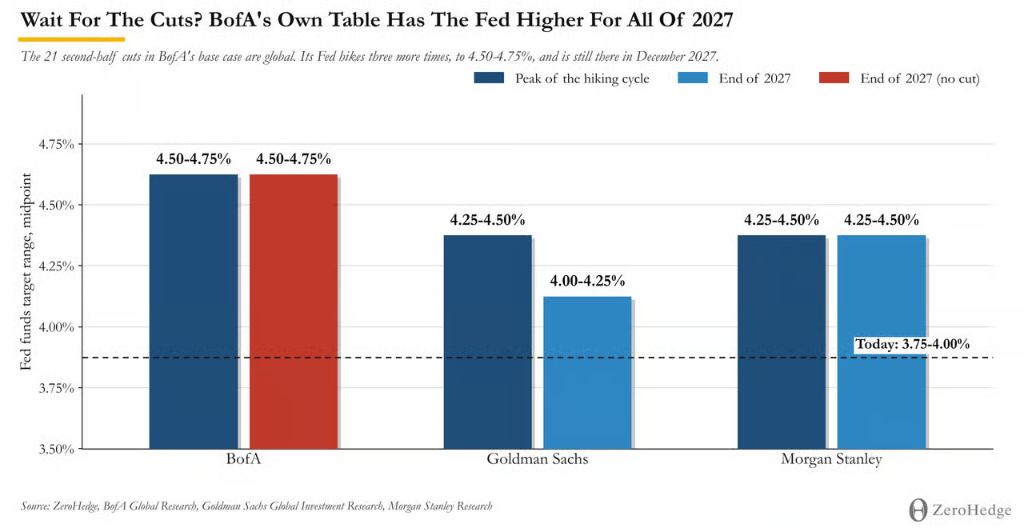
Bank of America Chief Investment Strategist Michael Hartnett's latest 2027 outlook report sets three major scenarios for the S&P 500 index in 2027: a breadth-driven "soft landing" baseline scenario (approximately 7777 points), an "overall bubble" driven by AI and government intervention (approximately 8888 points), and a "hard landing" breakdown scenario that reflects the market's extreme lack of preparedness (approximately 6666 points).
Hartnett believes that the market's current pricing of the macro economy is seriously skewed, with a significant underpricing of the hard landing—Bank of America's November global fund manager survey shows that only 3% of investors expect a hard landing, while the proportions expecting a soft landing and no landing are 50% and 42%, respectively.
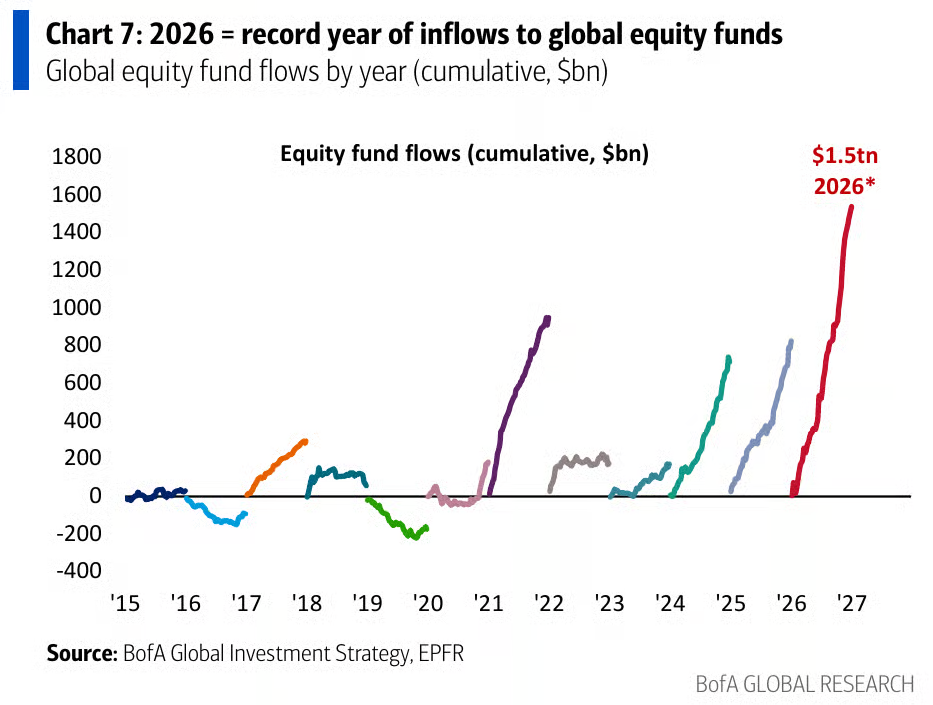
The core basis for this judgment is positioning versus expectations: Asset allocators are generally overweight in stocks and commodities, underweight in cash and bonds, with annualized inflows into stock funds reaching $1.5 trillion in 2026, setting a historical record; at the same time, the sell-side expects nominal GDP growth of 5% to 6% and global earnings growth of 15% to 20%, both based on K-shaped wealth effects and AI capital expenditures as the two major engines, which Hartnett believes are weakening.
On the operational level, Hartnett's tactic is: in the coming months, first preserve capital, wait for the spring rate hike cycle and a peak in the dollar, and then, once Wall Street's narrative shifts from rate hikes to rate cuts, buy cyclical "C" class assets—chips, commodities, cryptocurrencies, especially consumer stocks; at the same time, use "GRAB" as a hedge—government bonds, real estate, AAA-rated assets, and precious metals. These four asset classes are currently underweighted by institutions.
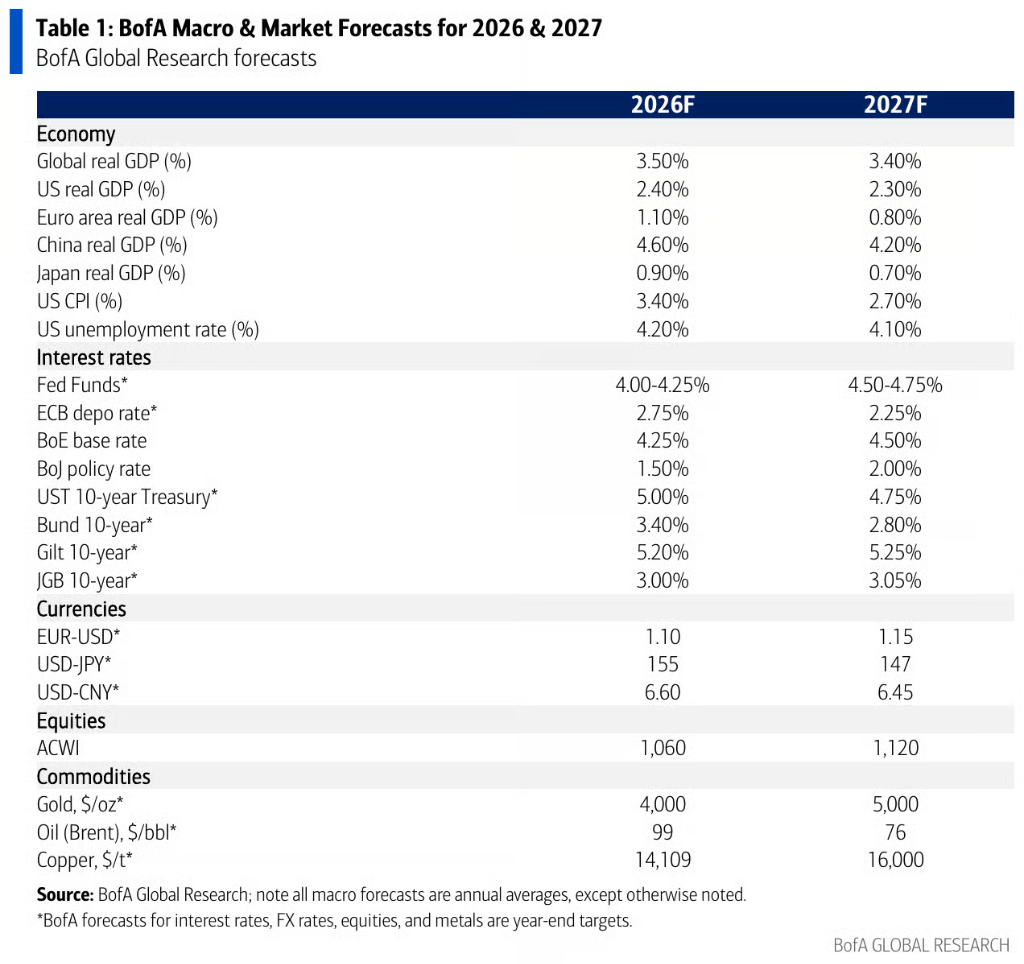
Hartnett also notes that his institution, Bank of America, has an inherently hawkish official forecast: the Federal Reserve will not only not cut rates in 2027, but will instead raise rates three more times, with the federal funds rate remaining between 4.50% and 4.75% at year-end, higher than Goldman Sachs and Morgan Stanley's forecasts, with the so-called "21 rate cuts" belonging to other central banks.
Baseline scenario and three major scenario simulations: soft landing 7777, bubble 8888, hard landing 6666
The report points out that between the three scenarios, the bubble and recession differ by 2222 points, indicating that every 10 percentage point probability migration from "no landing" to "hard landing" roughly corresponds to 220 points of the S&P index.
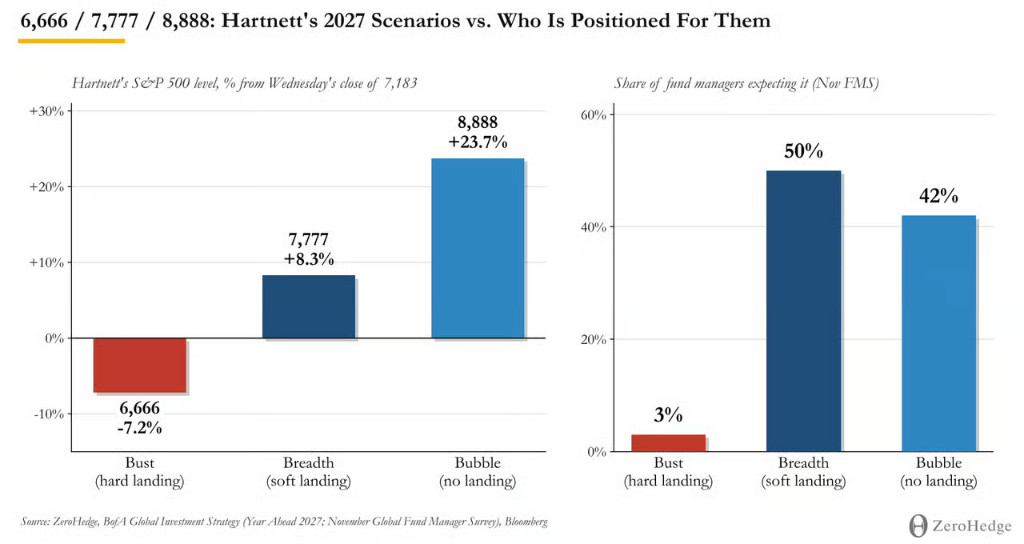
Breadth (Breadth)/ Soft Landing (approximately 7777 points)—waiting for rate cuts, buying "C" class assets. This is the camp that Hartnett belongs to, characterized by positive returns in credit and the stock market in 2027, where the bull market continues but is driven more by breadth than concentration.
The two key questions are "when will the rate hikes end" and "will it end before a recession," with his answer being the second quarter of next year and "yes," because inflation will fall before unemployment rises, and policymakers are too concerned about social consequences to allow a recession. In this scenario, earnings growth will be around 10%, and risk assets will resume an upward trend after the rate hikes end in March to April, with an equal-weight S&P index at 16 times earnings, mid-cap stocks at 14 times, global stocks at 14 times, and global ex-US at 11 times valuations not being expensive anymore.
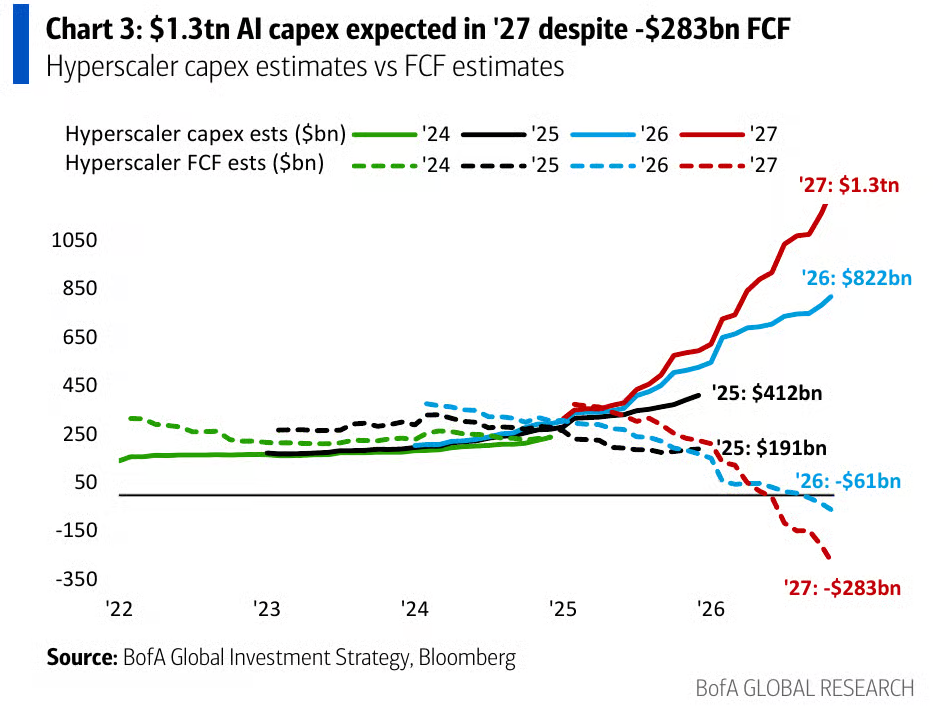
Bubble (Bubble)/ No Landing (S&P approximately 8888 points) —the realization of this scenario requires super-large cloud vendors to further raise their current $1.3 trillion capital spending budget in 2027 (currently, tech giants have free cash flow of -$283 billion).
Trigger conditions include (brought by Washington):
The U.S. government intervenes in the bond market to lower financing costs and credit spreads for the tech industry; the midterm elections do not hinder the expansion of data center capacity by about 100 gigawatts over the next two years; a Democratic-controlled Congress supports AI industries in exchange for universal healthcare legislation; a decline in commodity prices reduces data center construction costs; Generation Z and Generation X maintain a structural habit of buying the dips.
Hartnett believes that until credit events occur or large-scale outflows from tech stocks happen, this scenario is overvalued. The bubble scenario is extremely bullish on tech and extremely bearish on bonds.
Bust (Bust)/ Hard Landing (approximately 6666 points) —this is the risk of complete mispricing in the current market. Hartnett presents three arguments in the report:
- First, no one is expecting it; only 3% of fund managers anticipate a hard landing;
- Second, forecasts are too high; there is a consensus expectation of nominal GDP growth of 5% to 6% and global earnings growth of 15% to 20%, yet the supporting K-shaped wealth and AI capital expenditures are weakening;
- Third, positions are fully loaded, as allocators are overweight in stocks and commodities and underweight in cash and bonds, with stock inflows reaching an annualized record of $1.5 trillion in 2026.
Bank of America believes that once credit spreads widen and unemployment rises, a true bear market will begin. The hedging tool is "GRAB": government bonds, real estate negatively correlated with AI, defensive AAA-rated assets, and precious metals (gold, silver), which are the quickest tools for policymakers to end a recession.
The report also notes that the 6666 points are only 7% lower than Wednesday's close and less than 4% below last Friday's close, 666 points higher than Morgan Stanley's bearish scenario of 6000 points, making it appear moderate as a "real bear market."
Monetary policy expectations: the Federal Reserve will not cut rates this year, terminal rate higher than Wall Street peers
Hartnett's tactical judgment is based on the narrative shift of "from rate hikes to rate cuts next spring." However, Bank of America's forecast table shows that the federal funds rate will be between 4.00% and 4.25% by the end of this year, and between 4.50% and 4.75% by the end of next year; starting from the current 3.75% to 4.00%, this corresponds to three rate hikes, and there will be no rate cuts by the Federal Reserve in 2027. The 21 rate cuts come from other central banks, such as the European Central Bank lowering to 2.25% after one rate hike.
Among the three investment banks, Bank of America has the most hawkish judgment on the Federal Reserve. Goldman Sachs expects rate hikes in December and March of next year, with the first rate cut in December 2027; Morgan Stanley expects the Federal Reserve to stop at 4.25% to 4.50% in March next year and maintain that until 2028; Bank of America is 25 basis points higher than both and maintains that level.
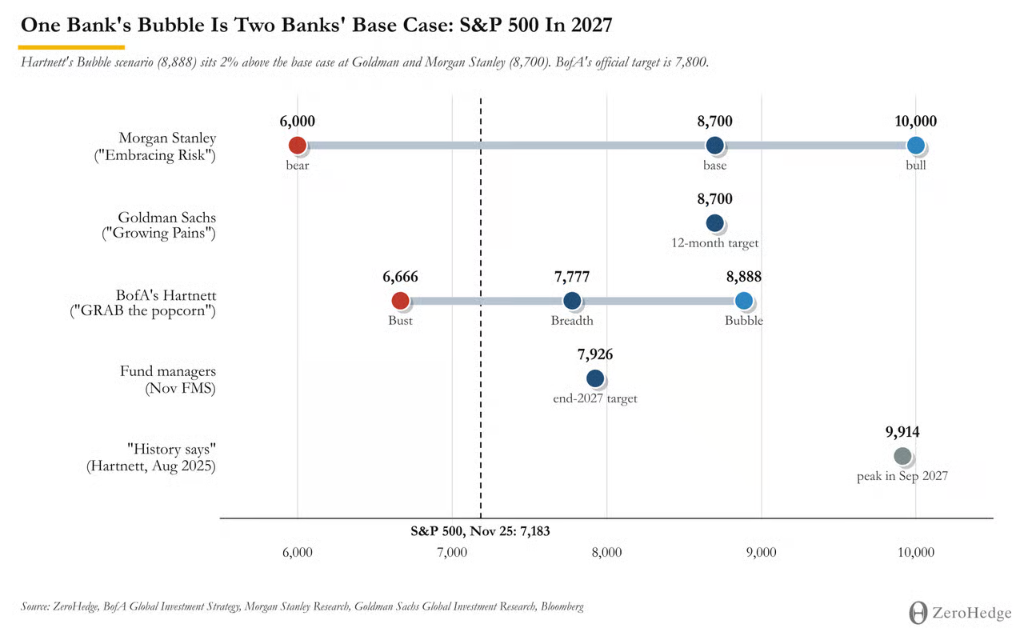
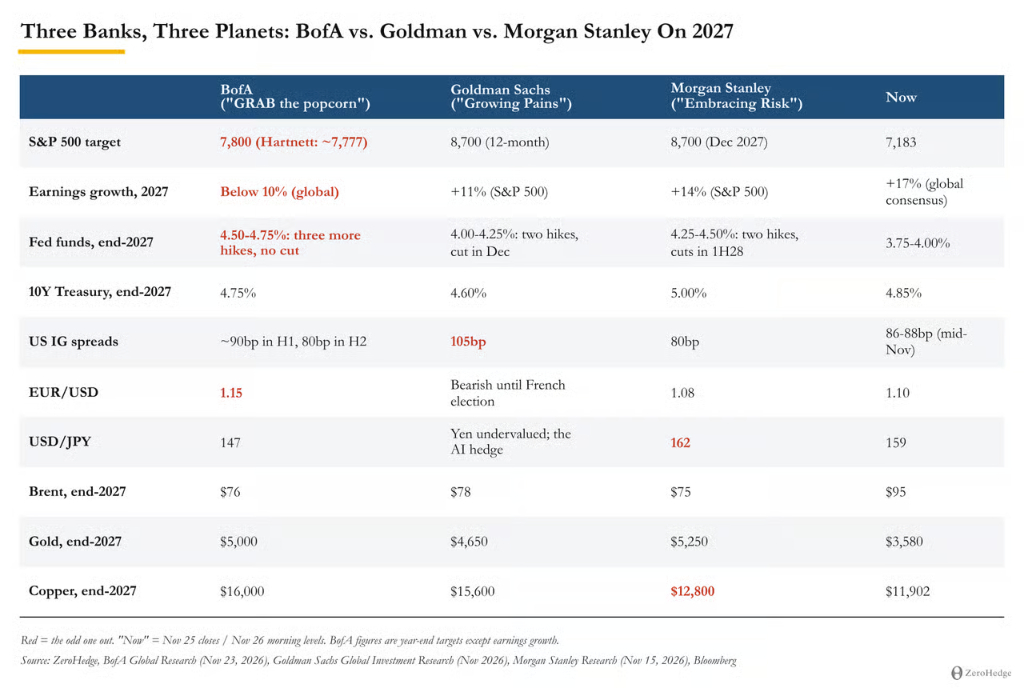
The differences among the three are also evident: Bank of America has the lowest stock forecasts, the lowest earnings forecasts, is the most hawkish on the Federal Reserve, and is the only one wanting to go long on the euro.
By comparison, Goldman Sachs and Morgan Stanley previously released forecasts: Goldman Sachs suggested buying bonds, shorting the euro, and hedging against AI hangover, with a target for the S&P of 8700; Morgan Stanley has the largest overweight in stocks, zero cash, with the same target for the S&P of 8700. Both banks have one index target. And the "baseline scenario" mentioned by Goldman Sachs and Morgan Stanley is 188 points lower than the "bubble" scenario described by Bank of America's chief strategist.
The only consensus among the three is: Brent will close next year in the 70+ dollar range and the currently overlooked gold will rise 30% to 47%. Bank of America expects Brent crude to fall to $76; the dollar to peak in the first quarter; and gold to surge to $5000, with copper prices rising to $16000.
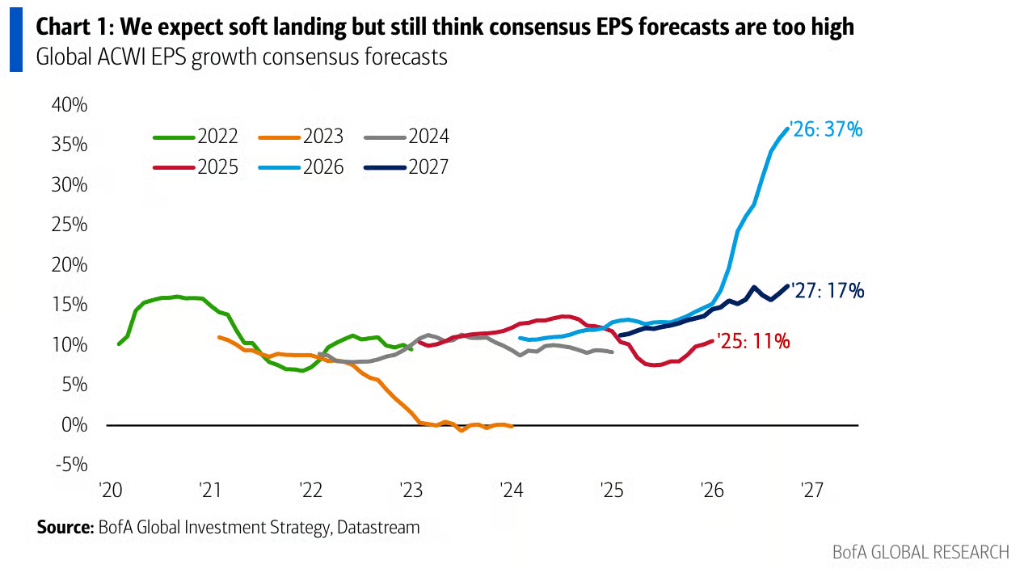
Additionally, the chart that Hartnett placed on the cover shows that sell-side analysts have not read these outlooks: the market consensus expects global earnings growth of 17% next year, down from 37% this year. Bank of America says it's below 10%, Goldman Sachs (calling it a "major halving") says S&P 11%, and Hartnett's own soft landing scenario needs around 10%.
Reversal and pause of the four major trading themes of the 2020s
The report summarizes the four major trading themes that define the 2020s and predicts their divergent fates in the coming year:
- Upcoming reversals in trading:
- ABB (Anyone But Bonds): Previously catalyzed by debt and deficits, the 30-year U.S. Treasury bond price achieved a return of -62%. This trend will reverse next year.
- ABC: Bank of America expects the Chinese stock market to reverse next year.
- Upcoming pauses in trading:
- ABD (Anyone But Dollars): Catalyzed by fears of currency devaluation, Bitcoin and gold achieved annualized gains of 44% and 23%, respectively, before peaking. This trading will hit the pause button in the first half of next year.
- AI (All-In on AI): Catalyzed by disruptive technology, the market value of the Nasdaq has increased by $26 trillion since March 2023. This trading will also be on pause in the first half of next year.
Potential surprises and scares in 2027
The report lists tail risks that could overturn the baseline scenario, with bearish surprises particularly worth being alert to:
- Bullish Surprises: Peace replaces war, leading to a collapse in oil and inflation (thus allowing the Federal Reserve to cut rates in the second half of the year); significant policy improvements in housing and healthcare affordability spark a consumption boom among the general public.
- Bearish Surprises:
- AI credit event: DRAM/chip price plummeting leads to a shrinkage in collateral value, triggering a credit crisis (currently, a large amount of debt is collateralized by the chips themselves).
- Debt-induced recession: As U.S. economic growth slows, concerns about debt cause yields to rise instead of fall, pushing the economy into recession.
- The Federal Reserve gets serious: Wall Street is shocked to find that the Federal Reserve is serious about its 2% inflation target and will not step in to save the market.
A year is long: The unexpected list is more readable than the baseline scenario
The report notes that looking back at 2026, the best trades were long oil and short crypto, long energy and short consumer discretionary, long semiconductors and short telecommunications, long small-cap value and short large-cap growth, long cybersecurity and short defense; winning themes in 2026:
War > Peace, Prosperity > Recession, K-shape > C-shape, Rate Hikes > Rate Cuts, Greed > Fear, AI Issuance > AI Unemployment, IPOs > Buybacks, Concentration > Breadth.
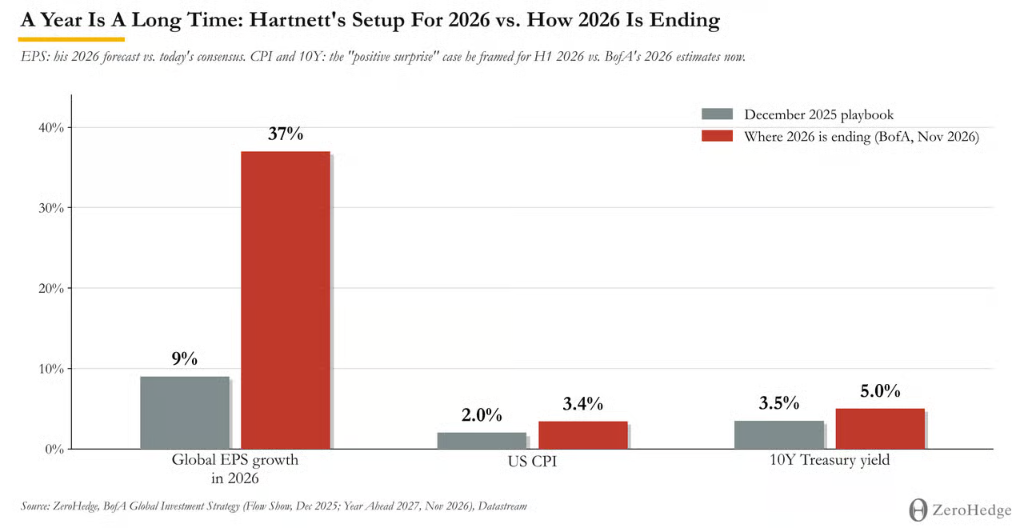
A year ago, the market consensus was "full speed ahead": global earnings were expected to grow by 9%, with the upward scenario for the first half being a CPI drop to 2% and a 10-year yield of 3.5%, along with Federal Reserve easing. The actual earnings growth was about four times what was expected back then, with all other variables reversing.
Hartnett's assertion in December 2025 that "all commodity charts will be the best reverse trade in 2026, just like gold and oil" has been validated; he also suggested shorting bonds of super-large cloud vendors before the market became aware.
But
The lesson is: In August 2025, he pointed out that historically bull markets peak in September 2027, with the S&P at 9914 points; now his bubble scenario ceiling is about 1000 points lower than this level, while the baseline scenario is about 2000 points lower.
The conclusion of the report is: among the three scenarios, a hard landing is the only one not priced in; the 8888 points have only one path—brought by Washington.
免责声明:本文章仅代表作者个人观点,不代表本平台的立场和观点。本文章仅供信息分享,不构成对任何人的任何投资建议。用户与作者之间的任何争议,与本平台无关。如网页中刊载的文章或图片涉及侵权,请提供相关的权利证明和身份证明发送邮件到support@aicoin.com,本平台相关工作人员将会进行核查。