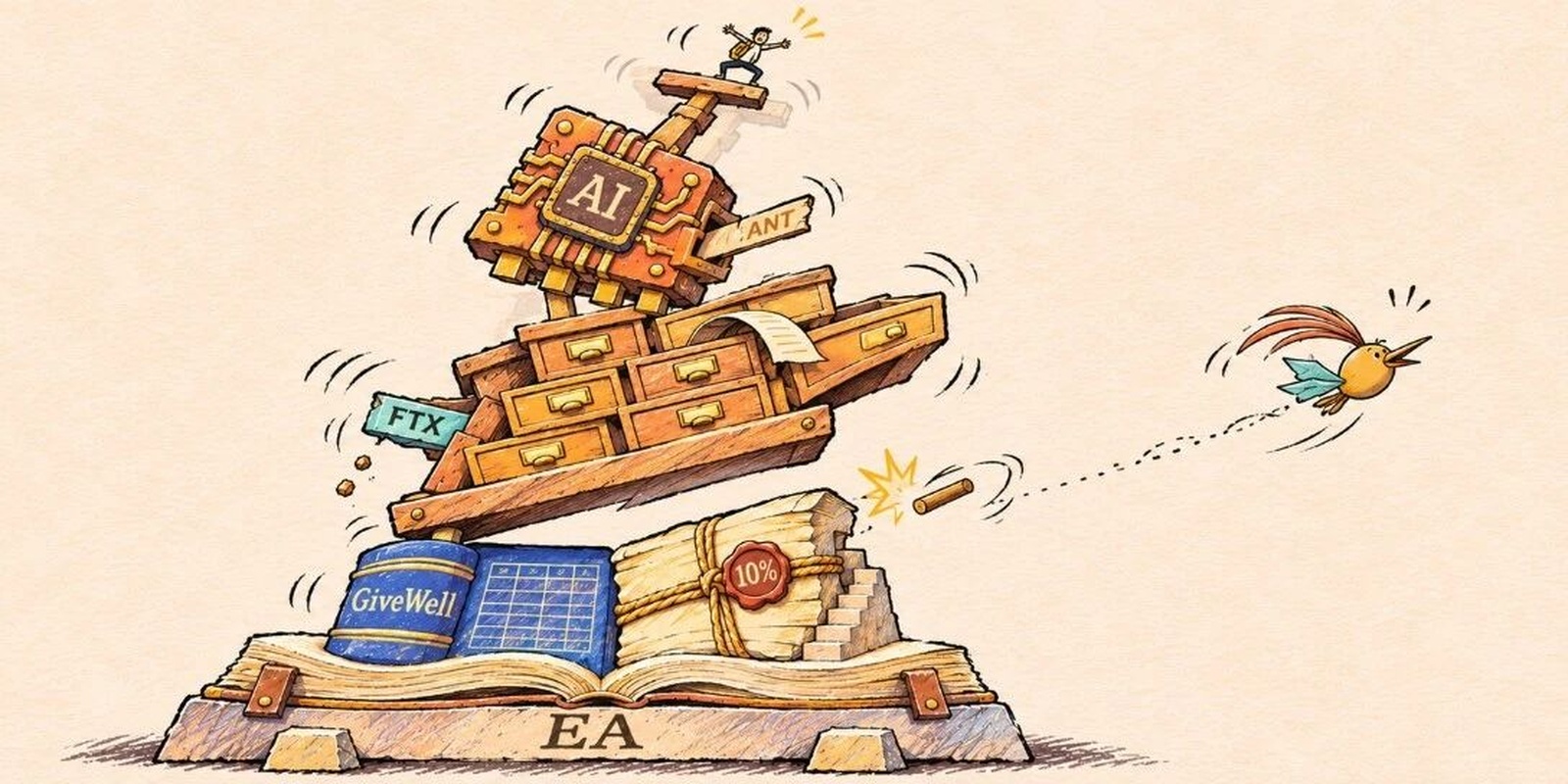
The committee removed the clause about utilizing Federal Reserve resources to buy cryptocurrencies, and Polymarket's betting on the likelihood of establishing a national reserve by the end of the year is now only 4%.
Written by: Maher, Foresight News
On November 24, Eastern Time, the U.S. House Financial Services Committee officially submitted the full replacement amendment text and committee report (Report No. 119-894) of the "2026 U.S. Reserve Modernization Act" (H.R. 8957) to the entire House, and the bill was subsequently included in the Joint Agenda No. 789.
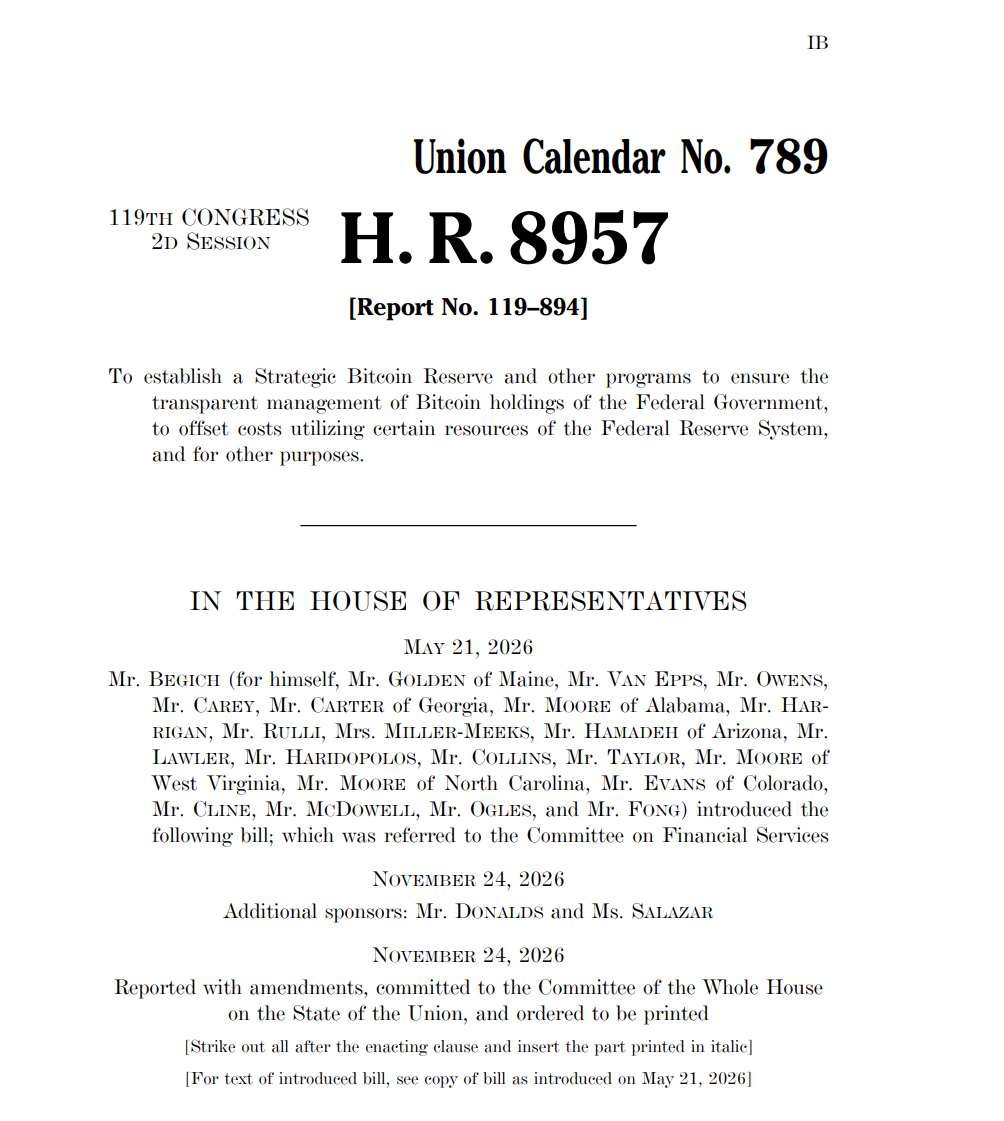
In stark contrast to the market's previous bets on "sovereign gold and silver purchase support," the committee deleted the entire text of the original bill in the amendment and rewrote the clauses, directly cutting the core expression of "utilizing specific resources of the Federal Reserve System to offset costs" from the original long title.
This means that this highly anticipated strategic Bitcoin Reserve bill has been drastically reduced to a "zero new budget, centralized custody of federally confiscated Bitcoin, and in principle locked for 20 years" asset management plan.
Cutting off the Federal Reserve's purse, sovereign buying returned to "depressurization"
H.R. 8957 was initially proposed by Alaska Republican Representative Nicholas J. Begich on May 21 of this year, with original cosponsors totaling 21 (including Maine Democratic Representative Jared Golden). On November 24, two additional cosponsors, Byron Donalds and Maria Elvira Salazar, were added, bringing the total to 23.

The bill's sponsor, Republican Representative Nicholas J. Begich
Despite the bipartisan appearance, the bill passed through the Financial Services Committee on September 16 with a partisan vote of 28 to 21.
The real decision on market pricing logic comes from the "funding red line" drawn by fiscal hawks in the amendment:
- Complete exclusion of "Federal Reserve buying" completely out of the picture: The original bill's long title clearly included "utilizing specific resources of the Federal Reserve System to offset costs," but the amendment directly rephrased the title at the end and cut out that expression, blocking the market's most anticipated shortcut for purchasing Bitcoin without fiscal appropriations.
- Debt, tax increases, or pledging prohibited for purchasing Bitcoin: Article 9 only requires the Secretary of the Treasury and the Secretary of Commerce to jointly assess a "budget-neutral" acquisition path within 180 days after the bill takes effect (i.e., not raising federal debt in nominal or real terms, not requiring new appropriations, and not imposing net costs on taxpayers and federal agencies), and to submit a report to the Senate Banking and Finance Committees and the House Financial Services and Fundraising Committees on schedule; Article 9(d) explicitly states that this law does not authorize borrowing, financing, using U.S. digital assets or other assets as collateral, raising taxes, or using deficit spending to purchase Bitcoin.
- Priority for enforcement funds and victim restitution: The bill strictly limits "qualified Bitcoin" to those that are federally owned and have no other legal designated use; Articles 3(5) and 7(d) expressly maintain the priority effectiveness of Titles 31 U.S.C. § 9705 (Treasury Department confiscation fund), Title 28 U.S.C. § 524(c) (Department of Justice confiscation fund), and the drug forfeiture law, meaning that enforcement sharing and crime victim restitution are prioritized, and only the remaining part enters the reserve.
So, how many stockpiles of BTC does the U.S. government really hold?
As the White House has yet to release an official audit, which is precisely why Articles 6 and 7 of the bill require accounting and the establishment of reserve verification, the market mainly relies on third-party tracking.
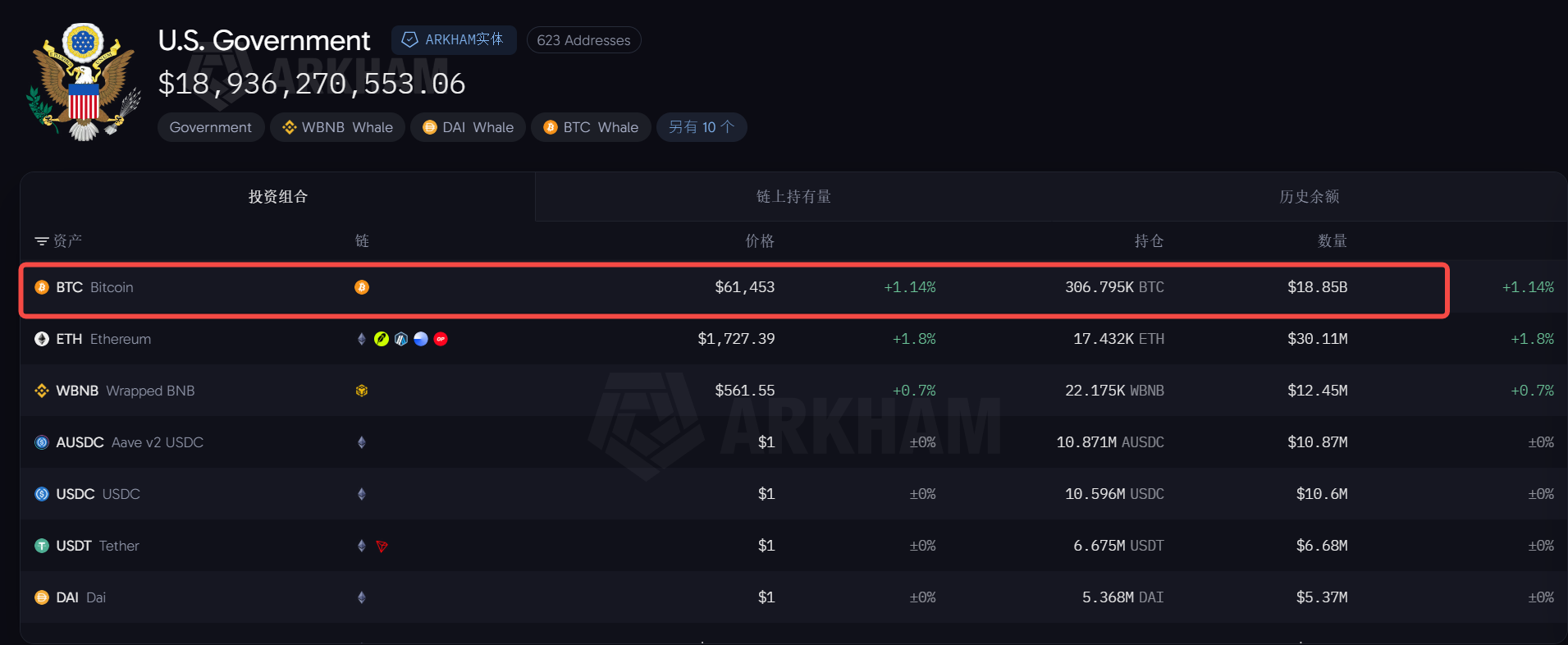
As of November 2026, on-chain data from Arkham shows that U.S. government addresses hold a total of 306,795 BTC (approximately $18.85 billion).
If counting the assets currently in civil forfeiture proceedings (such as the Prince Group case involving approximately 127,300 BTC), CoinGecko's broad measure of holdings rises to 329,693 BTC, accounting for about 1.57% of the total Bitcoin supply.
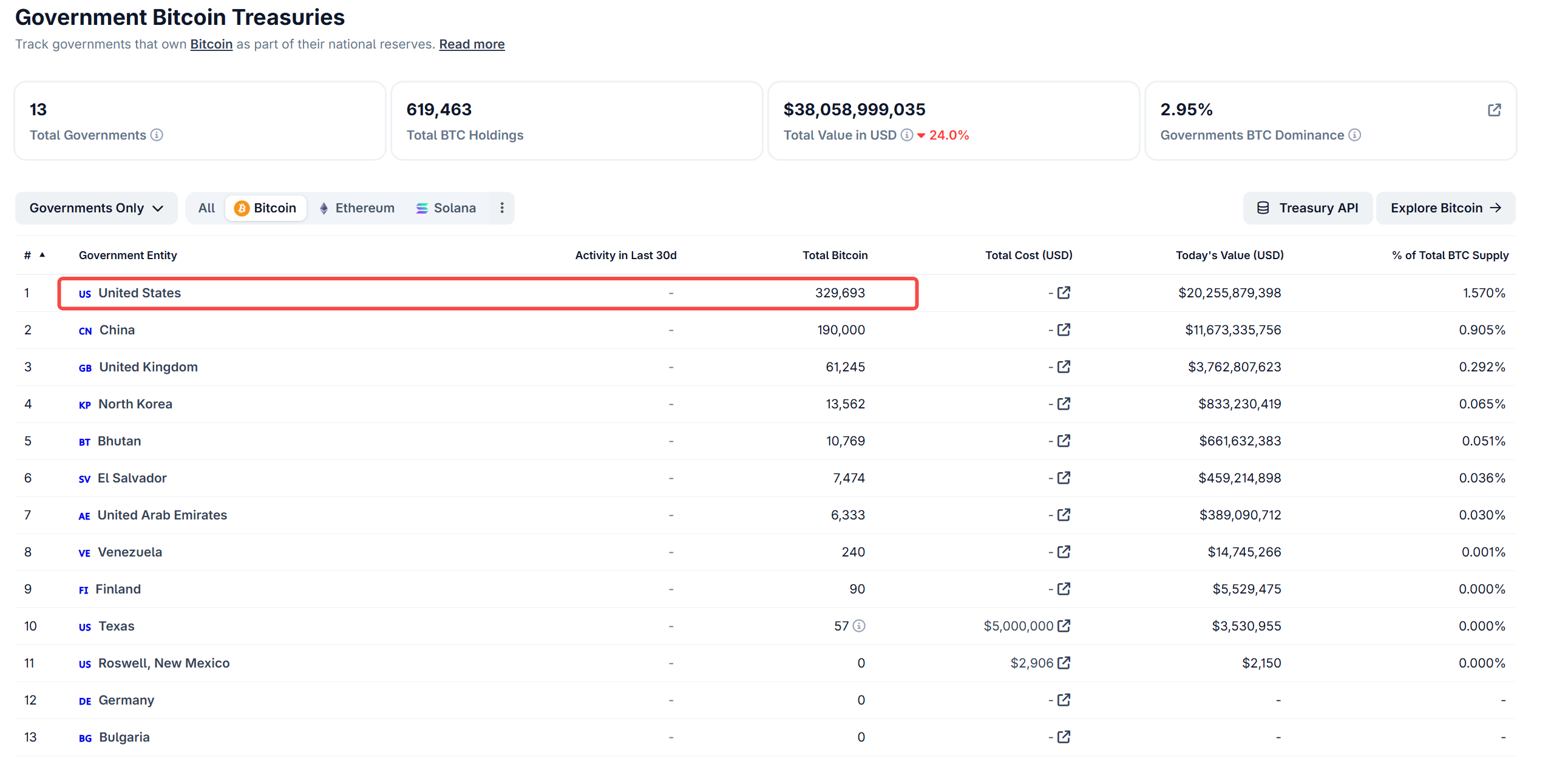
However, these holdings mainly stem from law enforcement confiscations from cases like Silk Road and the Bitfinex hack, and after deducting assets pending judicial processes and victim restitution shares, the final "net locked volume" that can be allocated into strategic reserves will still be significantly lower than the total book value.
In simple terms, Washington is willing to equate Bitcoin with traditional gold reserves in the legislative recognition of Article 2, providing a resonant political status to crypto voters, but absolutely unwilling to have taxpayers spend a dime to lift the cryptocurrency industry.
For the secondary market, the real significance of this bill is not a "trillion-level incremental sovereign buying," but rather the removal of U.S. government's confiscated Bitcoin from circulation in the medium to long term (in principle, at least 20 years).
Crypto assets "dual track system"
According to Articles 4 and 7, the Secretary of the Treasury must establish "Strategic Bitcoin Reserve" and "Digital Asset Stockpile" under the Treasury Department within 180 days after the bill becomes effective.
All federal agencies must report all digital asset accounts within 60 days (updated annually thereafter), and during the transition period before the establishment of the twin reserves, disposal rights are essentially frozen (except for national security, legal requirements, court orders, and victim restitution), and asset transfers must be completed within 30 days after the establishment of the twin reserves, with ownership transferring to the Treasury Department.
However, compared with the twin reserve clauses, the bill can be considered an official endorsement of the "dual track system for crypto assets"—Bitcoin ascends, while altcoins are relegated to fuel.
Bitcoin enjoys "Treasury-level" treatment
Article 5 stipulates that all Bitcoins deposited in the strategic Bitcoin reserve must be held for at least 20 years from the effective date of the act, during which they may not be sold, exchanged, auctioned, or encumbered with rights; within the two years prior to the expiry of the 20-year term, the Secretary of the Treasury must submit to Congress proposals for continued holding or gradual release, and upon expiration, proposals for selling no more than 10% of the total reserve every two years (considering factors such as federal budget deficits, market impact, and asset diversification).
At the same time, Article 6 mandates the Treasury Department to establish a public reserve proof system for cryptocurrency, annually disclosing total holdings, transaction details, and private key control status, verified by independent third-party crypto auditors, and subject to periodic supervision by the U.S. Government Accountability Office (GAO).
Non-Bitcoin assets have no lock-up period and can be "liquidated for cash"
Other crypto assets classified under the "digital asset stockpile" do not enjoy the 20-year lock-up protection and are not within the mandatory reserve proof audit scope; the Secretary of the Treasury may sell them at an opportune time as long as he follows the public rule-making procedures.
According to Article 4(d)(3)(B), the proceeds from asset disposal are to be prioritized for covering the operational costs of the twin reserves, with any surplus remitted to the Treasury to reduce federal debt; Article 9(b)(2)(A) directly lists "selling or exchanging non-Bitcoin assets in the stockpile" as a key assessment scheme for budget-neutral Bitcoin acquisitions.
It is worth noting that the so-called "20-year ironclad ban on sales" is not without loopholes.
First, Articles 4(d)(3)(A) and 4(f)(2) reserve the authorization for "the Secretary of the Treasury to sell Bitcoin once it is determined to be in the U.S. interest and public sale rules are issued (disclosing the sale schedule algorithm and maximum selling amounts)," creating a legal tension with the 20-year ban in Article 5, in addition to Article 5(d) requiring the Treasury Department to submit a report to Congress within a year of the bill's enactment regarding "conditions for early release of locked Bitcoin and exceptions for national security and financial stability," essentially reserving a legal escape hatch for future fiscal crises.
Second, Article 4(e) separately defines forked coins and airdrops: these assets are only locked for 1 year, and after the term is completed, the Treasury Department retains the dominant chain assets according to the "highest publicly traded market value" standard, and has the right to directly auction or sell off non-essential forked assets (unless determined by the Commerce Department and industry experts to have unique strategic utility).
If Bitcoin faces another split in the future, the U.S. Treasury, holding a large amount of BTC, will directly possess "off-chain adjudication rights."
In addition to asset lock-up, the latter half of the bill includes the most concerning "anti-snitching" immunity for the crypto circle.
Article 10 directly addresses the historical concerns of the crypto community regarding the 1933 U.S. Executive Order 6102 (mandatory confiscation of private gold), explicitly prohibiting the federal government from confiscating or infringing upon the legal property rights of any individuals and entities concerning crypto assets based on this law, and solemnly confirming in the form of "Congressional opinion": individuals' right to self-custody of private keys is the cornerstone of financial sovereignty, privacy, and personal freedom in the digital age.
Potential failure by year-end
In the House parliamentary process, the bill's inclusion in the agenda does not guarantee a scheduled vote; it still needs to pass through four hurdles: the House Rules Committee's regulations, a vote by the whole House, passage in the Senate with identical text, and presidential signature.
It is worth noting that the 119th Congress will terminate its term on January 3, 2027, and any bills that have not completed their procedures will automatically reset.
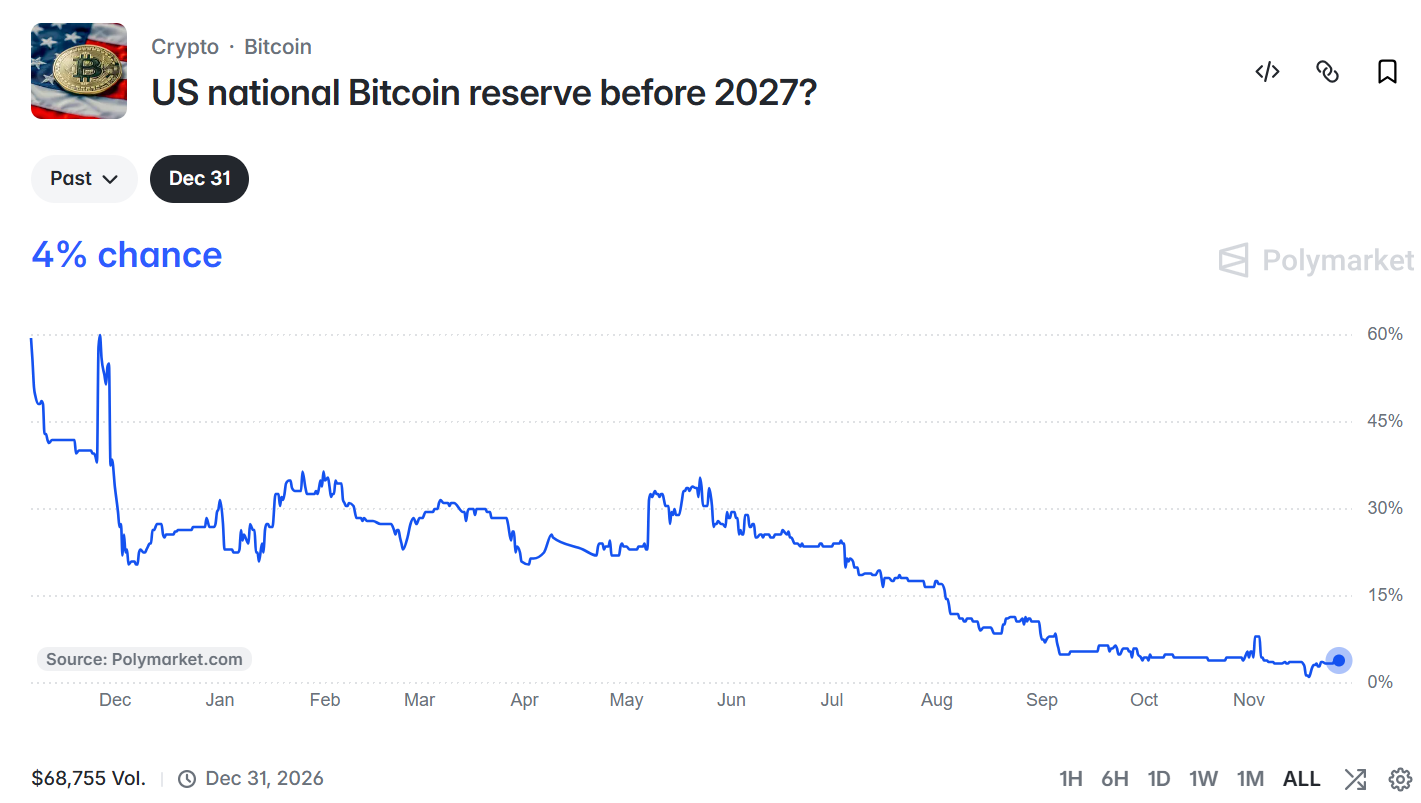
The prediction market has already voted with real money. As of November 27, on Polymarket's prediction market for "the U.S. establishing a national Bitcoin reserve before 2027," the probability of "Yes" has fallen to about 4%, significantly down from 34% when the bill was proposed in May of this year (note: the settlement conditions of that market do not completely correspond to the outcome of H.R. 8957). Despite the total transaction amount being only about $68,800 and liquidity being thin, it still reflects market's extreme pessimism about legislation by year-end.
The more realistic political headwind is that, with the Democratic Party regaining control of both chambers in the midterm elections on November 3, they will officially take over the 120th Congress on January 3, 2027, while all 21 opposing votes from the committee for this bill came from Democrats.
This means that if this bill fails to miraculously pass, restarting legislation next year will not only be challenging in terms of reactivating the purchasing pool but will also face significantly increased resistance.
免责声明:本文章仅代表作者个人观点,不代表本平台的立场和观点。本文章仅供信息分享,不构成对任何人的任何投资建议。用户与作者之间的任何争议,与本平台无关。如网页中刊载的文章或图片涉及侵权,请提供相关的权利证明和身份证明发送邮件到support@aicoin.com,本平台相关工作人员将会进行核查。