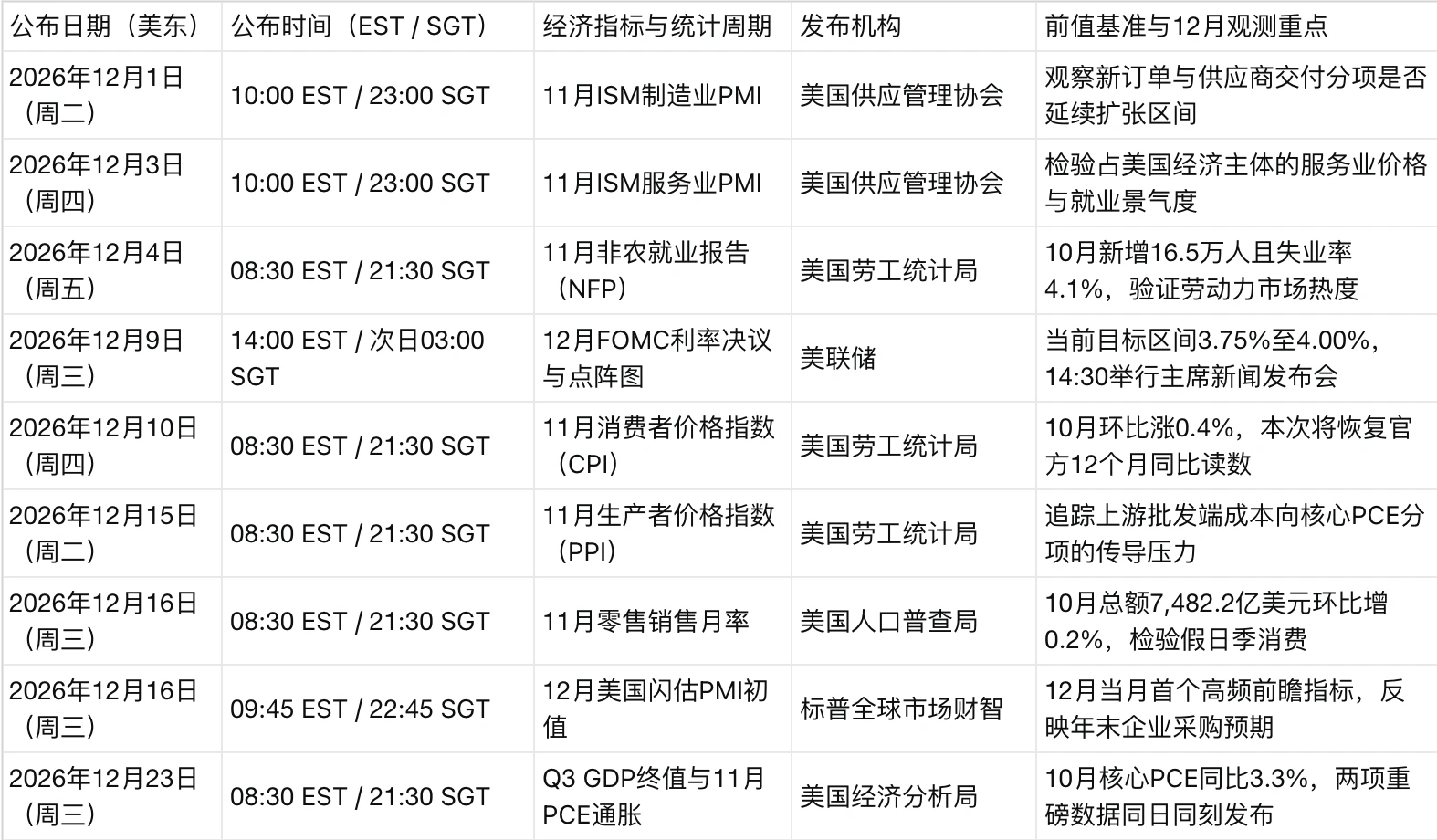
In December 2026, the release window for key macroeconomic data in the United States is highly concentrated in the first four weeks, with the November non-farm employment report scheduled for release on December 4 at 08:30 Eastern Time (21:30 Singapore Time) and the last Federal Open Market Committee interest rate decision of the year set for December 9 at 14:00 Eastern Time (03:00 Singapore Time on December 10, crossing into the next day). The November Consumer Price Index follows closely, with its release on December 10 at 08:30 Eastern Time (21:30 Singapore Time). The November Personal Consumption Expenditures Price Index and the third estimate for the third quarter 2026 Gross Domestic Product will be announced simultaneously on December 23 at 08:30 Eastern Time (21:30 Singapore Time). It’s worth noting that the December interest rate decision is released a full 18.5 hours before the November Consumer Price Index, meaning that the Federal Reserve's decision-makers will vote at year-end and update their economic forecast summary without yet having seen the official year-on-year reading for November consumer inflation.
As Daylight Saving Time in the United States ended on the first Sunday of November 2026, the entire month of December will operate under Eastern Standard Time (UTC-5), maintaining a fixed 13-hour time difference with Singapore (UTC+8). The federal funds rate target range around 3.75% to 4.00%, the addition of 165,000 jobs in October, and the year-on-year inflation of 3.3% for core Personal Consumption Expenditures will directly determine the liquidity pricing of US Treasury yields, the US dollar index, and crypto assets as nine key official indicators are released in December.
Key Points
Based on the official schedule released by the U.S. Bureau of Labor Statistics, Federal Reserve Open Market Committee, U.S. Bureau of Economic Analysis, and U.S. Census Bureau as of November 26, 2026, December macro trading will revolve around three key timelines: The first week opens with manufacturing and services PMI reports on December 1 and December 3, followed by the November non-farm employment report on December 4. The second week brings a policy climax with the meeting and release of the quarterly dot plot on December 8-9, followed by the November Consumer Price Index on December 10. The third to fourth weeks finish with the Producer Price Index on December 15, Retail Sales and Flash PMI on December 16, and the Personal Consumption Expenditures inflation and final GDP estimate for the third quarter on December 23.
Regarding data base and statistical caliber, on October 28, the Federal Reserve maintained the federal funds rate target range at 3.75% to 4.00% with a vote of 10 in favor and 2 against, after raising it by 25 basis points on September 16, while two committee members advocated for another 25 basis point increase in the October meeting. The latest benchmark shows that the number of non-farm jobs increased by 165,000 in October, significantly higher than the previous 12-month monthly average of 48,000, with an unemployment rate of 4.1%; the overall and core Personal Consumption Expenditures Price Indexes both rose by 3.8% and 3.3% year-on-year, respectively; total retail sales reached $748.22 billion in October, with a month-on-month increase of 0.2%; however, due to the absence of survey data from October 2025 caused by a government funding interruption, the consumer price index for October was unable to release a year-on-year change rate, and the report for November on December 10 will restore the official year-on-year inflation reading.
Complete Schedule for U.S. Macro Data in December 2026
Starting in December, all morning data released by U.S. federal statistical agencies will go live on time at 08:30 EST, corresponding to 21:30 Singapore time, occurring one hour before the regular U.S. stock market opens; industry association survey indicators will typically be released between 09:45 and 10:00 EST, corresponding to 22:45 to 23:00 Singapore time; only the Federal Reserve's interest rate decision and quarterly economic forecast summary will be released at 14:00 EST, corresponding to 03:00 Singapore time the next day, representing a cross-day risk event in the early hours of the Asian trading session.
In addition to the nine monthly and quarterly core indicators mentioned above, traders will also need to continuously track the number of initial jobless claims released by the U.S. Department of Labor every Thursday at 08:30 EST (21:30 Singapore time), as well as the regional manufacturing surveys and inflation expectations released by the New York Federal Reserve before the FOMC meeting's quiet period, as auxiliary references for high-frequency liquidity adjustments.
Focus for the First Half of the Month: Non-Farm Employment, FOMC, and the 18.5 Hour Time Gap in CPI
The trading focus for the first two weeks of December will be dominated by employment data and monetary policy decisions. The initial industry surveys will be released by the Institute for Supply Management on December 1 and December 3 for the November manufacturing and services PMI, followed by the November non-farm employment report released by the U.S. Bureau of Labor Statistics on December 4 at 08:30 EST. Looking back at the October report, U.S. non-farm employment increased by 165,000 in a single month, 3.44 times the previous 12-month monthly average increase of 48,000, with part-time employment due to economic reasons increasing by 339,000 to 4.8 million, while the unemployment rate remained stable at 4.1%. As December 4 is the last official employment report before the December FOMC meeting, the month-on-month growth rate of wages and fluctuations in the unemployment rate will directly affect the implied probability pricing of interest rate paths for December 9 in the CME interest rate tools.
Subsequently, from December 8 to 9, the Federal Reserve will hold its eighth and final regular monetary policy meeting of 2026. According to the official agenda, the policy statement and the quarterly economic forecast summary will be announced on December 9 at 14:00 EST (03:00 Singapore time on December 10, crossing into the next day), with the Federal Reserve Chairman's press conference starting at 14:30 (03:30 Singapore time). This timing creates a rare policy information window: the FOMC's announcement of its interest rate decision will come exactly 18.5 hours before the release of the November Consumer Price Index (December 10 at 08:30 EST). Meanwhile, the absence of survey data for October 2025 resulted in only a month-on-month increase being released in the October report on November 10, 2026 (overall month-on-month 0.4%, core month-on-month 0.3%), with no year-on-year increase published; however, due to the complete survey samples for November 2025, the report for November on December 10 will restore the official year-on-year inflation rate, thus providing the market with the missing month’s year-on-year calibration coordinates on the day after the FOMC decision.
Focus for the Second Half of the Month: Retail Sales, Flash PMI, and the Dual Data Resonance on December 23
After the FOMC meeting, the market's focus will shift to terminal consumer resilience and the verification of fourth-quarter economic momentum in the third week of December. The Producer Price Index for November, released at 08:30 EST on December 15, will reveal marginal changes in wholesale prices for energy, food, and core services. As the sub-items in the Producer Price Index, including healthcare, airline tickets, and financial services, are directly used to calculate the Personal Consumption Expenditures Price Index, this data often triggers debt market adjustments for the inflation readings on December 23.
December 16 will see a dual data release: firstly, at 08:30 EST (21:30 Singapore time), the U.S. Census Bureau will release retail sales data for November, assessing the genuine consumer performance during the Black Friday and Thanksgiving promotional season. The total retail sales for October had reached $748.22 billion, with a month-on-month increase of 0.2% and a year-on-year increase of 6.8%, while core retail sales excluding automobiles saw a month-on-month growth of 0.6%; then, 75 minutes later at 09:45 EST (22:45 Singapore time), S&P Global Market Intelligence will release the preliminary value of the Flash PMI for December, providing the first high-frequency reading that reflects December's business orders and input costs. The related economic divergence logic can be compared to the November Flash PMI Interpretation and Federal Reserve Beige Book Economic Observation.
The last major macroeconomic day before the Christmas holiday falls on December 23, Wednesday, at 08:30 EST (21:30 Singapore time), when the Bureau of Economic Analysis will simultaneously release the third estimate of the third quarter 2026 Gross Domestic Product (including corporate profit revisions) and the November Personal Income and Expenditures report. In the report released on November 25, the nominal personal consumption expenditures increased by $63.8 billion (with goods increasing by $11.8 billion and services by $52.1 billion), but after adjusting for inflation, real personal consumption expenditures decreased slightly by $5.8 billion (a decline of less than 0.1%), and the personal savings rate fell to 4.1%. The personal consumption expenditures price index, which is the most important indicator for the Federal Reserve, rose by 3.8% year-on-year, while the core Personal Consumption Expenditures Price Index, excluding food and energy, rose by 3.3% year-on-year. For more information on inflation structure dissection, further reference can be found in the October PCE Inflation Preview.
Caliber Analysis: Why CPI and PCE Often Provide Diverging Signals Alongside Two Employment Surveys
When interpreting the concentrated data for December, macro traders are most prone to misjudging the policy direction due to the confusion of statistical calibers. For example, both the Consumer Price Index and the Personal Consumption Expenditures Price Index recorded a core month-on-month increase of 0.3% in October 2026, but there are significant differences in weight allocation, coverage, and base period continuity, leading to drastically different year-on-year readings and policy weight. Similarly, the non-farm employment report released on the first Friday of each month is actually composed of two independent sampling surveys, and it is normal for monthly readings to diverge in direction.
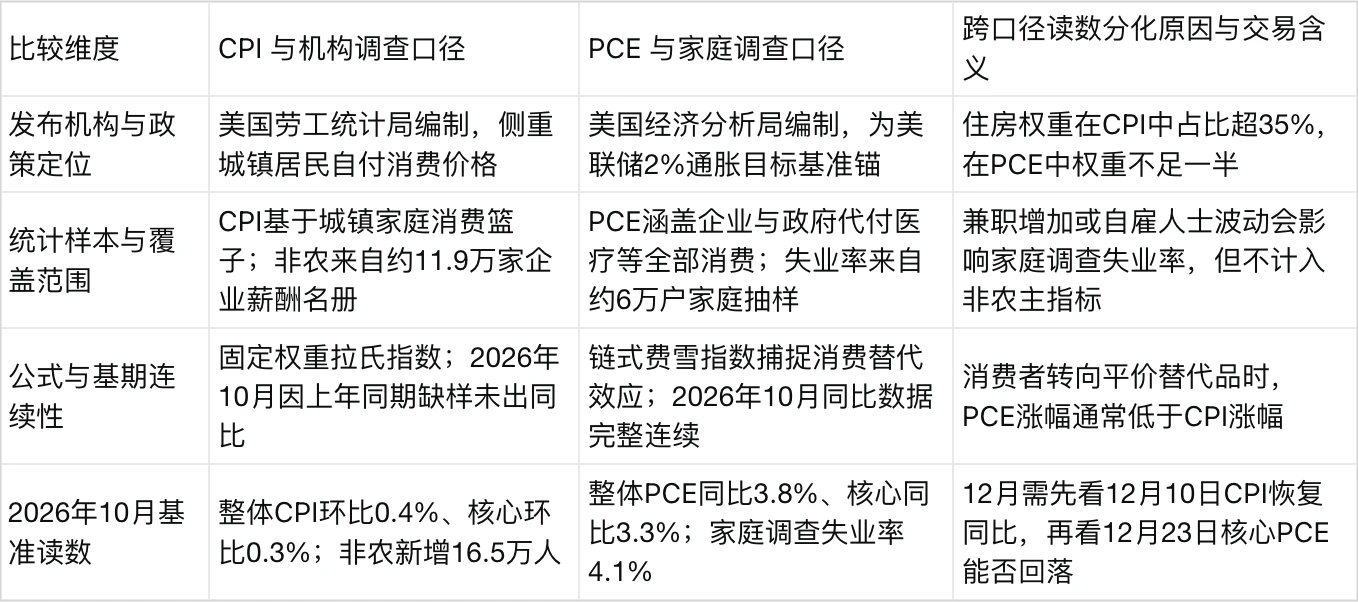
On the cross-asset pricing level, the U.S. Department of the Treasury treasury yield curve and the Intercontinental Exchange U.S. dollar index often respond in stages to the above data, while the Chicago Board Options Exchange Volatility Index and spot and perpetual contracts for crypto assets tend to see implied volatility rise around the data release. Traders observing the impact of macro events on US dollar liquidity and the crypto market can track multi-asset correlations through comprehensive trading platforms such as MEXC, and understand the interaction mechanism of exchange rates and risk assets in conjunction with the impact of a strong dollar on assets. If there is a need to monitor the fluctuations of mainstream tokens and cross-market trends in real-time during the key data window of December, you can directly visit check MEXC real-time coin prices for dynamic quotes.
Exclusive Views from the MEXC Editorial Team
The most prominent structural feature of the macro calendar for December 2026 is not a single data point exceeding expectations, but rather the misaligned timing between policy decision points and key inflation data releases. When the Federal Reserve announces its interest rate decision and updated economic forecast summary at 14:00 on December 9, 2026, the November Consumer Price Index will not officially be released until 18.5 hours later at 08:30 on December 10, while the most scrutinized November Personal Consumption Expenditures Price Index will not be unveiled until two weeks later on December 23. Given that there were already two dissenting votes for raising rates by 25 basis points in the October 3.75% to 4.00% interest rate decision, this time lag in information means that the median in the December 9 dot plot and the Chairman's press conference remarks will predominantly rely on the non-farm employment data from December 4 and the existing inflation base from October.
The second trading trap to be vigilant about is the amplifying effect of reduced holiday liquidity on the dual data release on December 23. December 23, Wednesday, is only one complete trading day away from the Christmas holiday market closure, and market makers from European and American institutions are generally entering the year-end reduction and book locking phase, causing a significant decrease in market depth compared to the beginning of the month. However, on this day at 08:30 EST, the Bureau of Economic Analysis will release two heavyweight reports—the third estimate of third-quarter GDP and the November Personal Consumption Expenditures inflation report—simultaneously. If the core year-on-year reading for Personal Consumption Expenditures deviates from the benchmark of 3.3% in October, the thin year-end market could amplify the short-term interest rate and risk asset's momentary slippage.
Throughout the rhythm distribution of December, the trading focus in the first two weeks concentrates on the non-farm employment data on December 4 and the interest rate decision and inflation double whammy on December 9-10. The third week will be anchored by the retail sales and Flash PMI on December 16 for fundamental verification, while the fourth week must guard against the tail-end volatility caused by the dual data coupled with year-end liquidity reduction on December 23. In terms of regulatory compliance, as the U.S. Securities and Exchange Commission continues to advance the regulatory alignment of spot crypto assets with traditional financial infrastructure, the marginal pricing weight of macro interest rate expectations on the flow of digital assets has further strengthened.
Frequently Asked Questions
When will the U.S. non-farm employment data (NFP) for December 2026 be released?
The November U.S. non-farm employment report to be released in December 2026 is scheduled for December 4, Friday, at 08:30 EST, which corresponds to 21:30 Singapore time. Previously, the U.S. Bureau of Labor Statistics reported an increase of 165,000 non-farm jobs in October, with an unemployment rate of 4.1%.
When will the Federal Reserve FOMC interest rate meeting be held in December 2026, and what time will the interest rate decision be announced?
The Federal Open Market Committee meeting in December 2026 is scheduled to be held from December 8 to 9, and the interest rate decision statement and quarterly economic forecast summary (including the dot plot) will be announced on December 9, Wednesday, at 14:00 EST, corresponding to 03:00 Singapore time on December 10 (crossing into the next day). The current federal funds rate target range is 3.75% to 4.00%.
When will the U.S. CPI and PCE inflation data for December 2026 be released respectively?
The November Consumer Price Index (CPI) will be released on December 10, Thursday, at 08:30 EST (21:30 Singapore time) by the U.S. Bureau of Labor Statistics, while the November Personal Consumption Expenditures Price Index (PCE) will be released on December 23, Wednesday, at 08:30 EST (21:30 Singapore time) by the U.S. Bureau of Economic Analysis. Due to missing survey data for October 2025 leading to the absence of year-on-year CPI for October 2026, the November CPI report on December 10 will restore the year-on-year inflation reading for 12 months.
Why is the time in the Eastern U.S. in December 2026 13 hours behind Singapore time?
Daylight Saving Time in the United States ended on the first Sunday in November 2026, and throughout December, the Eastern U.S. will observe winter standard time (EST, or UTC-5), while Singapore operates on UTC+8 year-round, resulting in a fixed 13-hour difference between the two locations. Therefore, the economic data released at 08:30 in Eastern U.S. time corresponds to 21:30 that evening in Singapore, while the Federal Reserve decision released at 14:00 in Eastern time crosses into the next day at 03:00 in Singapore.
Why is December 23, 2026, considered the most crucial macro trading day of the year-end?
The U.S. Bureau of Economic Analysis will release simultaneous reports on the third estimate of the third quarter 2026 Gross Domestic Product and the November Personal Income and Expenditures report (including PCE inflation) on December 23, Wednesday, at 08:30 EST. Due to the proximity of this day to the Christmas holiday and the thinning market-making liquidity, the simultaneous release of these two heavy-weight reports is likely to trigger short-term volatility across different assets.
Will the Federal Reserve be able to see the official CPI data for November before voting on December 9?
No, the FOMC interest rate decision will be announced at 14:00 EST on December 9, 2026, which is 18.5 hours earlier than the release of the November CPI at 08:30 EST on December 10. Therefore, during the December meeting, the Federal Reserve can only base its policy decisions on the November non-farm employment report published on December 4, the already disclosed October CPI and October PCE data, and internal high-frequency models.
Disclaimer
This article is for general informational purposes only and does not constitute investment advice, financial advice, legal advice, tax advice, or any trading recommendation. The schedule and benchmark data referenced in the article are as of November 26, 2026, and the time zone conversions, data release intervals, and growth multiples are derived from the publicly available schedules and historical reports of various U.S. federal statistical agencies. The market pricing expectations and institutional forecasts cited do not represent actual results, and official statistical agencies reserve the right to adjust release dates or revise historical data due to unforeseen circumstances. The related products involving crypto assets, foreign exchange, government bonds, and stock indices carry significant price volatility risks, and high-leverage trading may result in losses exceeding initial principal amounts. Readers should verify the official latest schedules independently prior to major macro data releases and make their own judgments based on their financial conditions and risk tolerance and consult qualified professionals when necessary. MEXC operates in compliance with legal regulations and does not provide services to residents of restricted areas.
免责声明:本文章仅代表作者个人观点,不代表本平台的立场和观点。本文章仅供信息分享,不构成对任何人的任何投资建议。用户与作者之间的任何争议,与本平台无关。如网页中刊载的文章或图片涉及侵权,请提供相关的权利证明和身份证明发送邮件到support@aicoin.com,本平台相关工作人员将会进行核查。