Author: AiPlot Research Institute
Focus: RWA / Digital Assets / In-depth Analysis of Financial Infrastructure
Website: https://aiplot.com/?utm_source=aicoin
Community: https://t.me/+IIYMcJigBAo4Mjg1
Hong Kong CMU Digital Asset Platform and SBI Solana Global are Working on the Same Problem
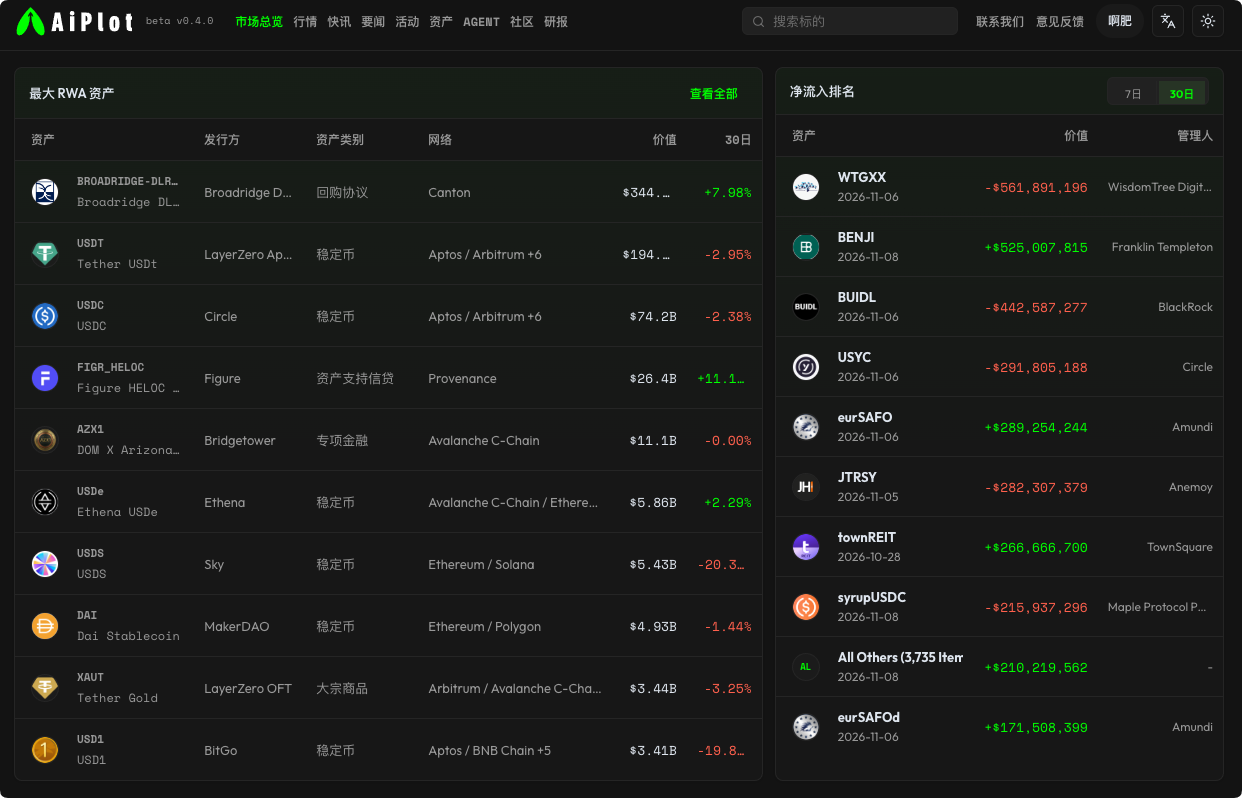
In the past two years, the most common news in the RWA market has been "a certain asset has been tokenized." Bonds are on-chain, funds are on-chain, stocks are on-chain, gold is on-chain, and real estate and private credit are also beginning to seek on-chain expressions.
However, the real-world financial market is not solely composed of assets themselves. For assets to flow realistically, there is also a need for registration, custody, trading, clearing, settlement, and cash payments. Without these links, tokenization may merely add a new representation of assets without altering the operational efficiency of financial markets.
Recently, three pieces of market news have demonstrated the structural changes occurring in RWA:
- SBI Holdings, Sumitomo Mitsui Financial Group, and the Solana Foundation are promoting SBI Solana Global, aiming to develop stablecoin payments, financial asset tokenization, real-world asset tokenization, and on-chain asset management;
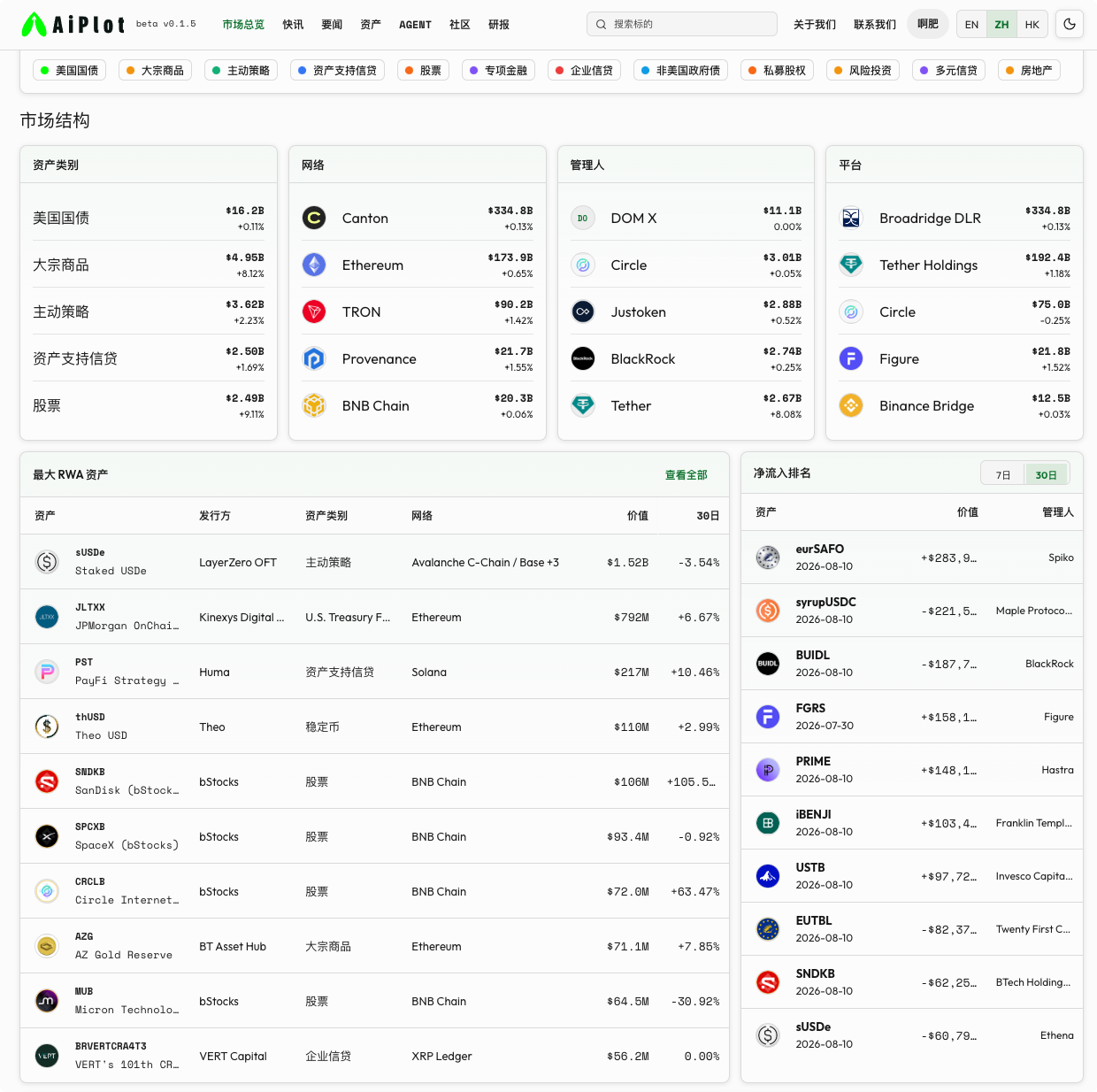
- The total scale of RWA tracked by RWAWeekly decreased by approximately $2.74 billion in one month, with about $1.73 billion coming from adjustments to the statistical coverage, while the scale of continuously tracked products decreased by approximately $805 million over the month;
- The Hong Kong Monetary Authority officially launched the CMU Digital Asset Platform, incorporating bond issuance, registration, clearing, settlement, interest payment, and redemption into a market infrastructure based on distributed ledger technology, and adopting on-chain atomic delivery versus payment models.
These three pieces of information collectively illustrate:
The next stage of RWA is not about continuing to find more assets to go on-chain, but about building the financial infrastructure that can support these assets.
1. Why "On-Chain Assets" is Just the Starting Point for RWA
A traditional bond involves at least several stages from issuance to final redemption. The issuer needs to register the bond, investors need to complete subscriptions, custodians need to record holdings, the secondary market needs to process transactions, clearing institutions need to confirm delivery, cash systems need to complete payments, and the issuer must handle interest payments and maturity redemption.
If the bond is simply made into an on-chain token but registration, custody, cash payments, and final settlement still wholly depend on another system, financial institutions will still need to verify across multiple ledgers.
This can lead to several issues:
- Asset records and cash records are not in the same system;
- There is still a time lag between transaction confirmation and final delivery;
- Institutions need to rely on multiple intermediaries for data transmission;
- Cross-border transactions face different market operating hours and settlement rules;
- After asset tokenization, existing operating costs and counterparty risks may not disappear.
Therefore, the value of RWA cannot be measured solely by "whether there is a token." A more important question is whether the token has entered into genuine issuance, trading, settlement, and asset management processes.
The Bank for International Settlements defines tokenization as: generating and recording a digital representation of traditional assets on a programmable platform. The keywords here are "record" and "programmable platform," rather than just "issuing tokens." Only when assets, cash, and market rules can function collaboratively can tokenization further change the financial market infrastructure.
2. The Significance of Hong Kong CMU DAP: From Issuing a Product to Transforming the Entire Bond Process
On November 25, 2026, the Hong Kong Monetary Authority officially announced the launch of the CMU Digital Asset Platform. This platform is developed and operated by CMU OmniClear on behalf of the Monetary Authority and serves as a distributed ledger technology platform for the Central Money Market Unit (CMU).
The focus of CMU DAP is not to launch a new tokenized bond, but to cover the complete lifecycle of debt securities. According to the announcement from the Hong Kong Monetary Authority, the platform supports a paperless process for primary issuance of debt securities, secondary trading, clearing, settlement, interest payments, and maturity redemption, while also supporting the tokenization of traditional debt securities.
This signifies that Hong Kong is advancing RWA from the product level to the infrastructure level.
The first batch of directly participating institutions includes Bank of China Hong Kong, Bank of Communications Hong Kong, Cinda International, China Construction Bank Asia, China Merchants Bank, Societe Generale, DBS Hong Kong, Industrial Bank, Standard Chartered Hong Kong, and HSBC Hong Kong.
Participants include both local and Chinese-funded banks as well as international financial institutions. This participation structure is important because the bond market infrastructure can only achieve network effects if it is jointly used by custodians, underwriters, banks, trading institutions, and investors.
CMU OmniClear also stated that the platform has already validated related capabilities through pilot transactions of tokenized foreign exchange fund notes earlier in 2026. This indicates that the project has moved from concept validation into the actual operational stage of market infrastructure.
3. The Key Technological Change: Atomic DvP
CMU DAP adopts on-chain atomic Delivery versus Payment, which is the atomic "securities payment versus delivery" settlement model.
Simply put, securities delivery and cash payment must either be completed simultaneously or not at all. The system will not first deliver bonds to the buyer and then require the seller to wait for cash; nor will it allow the buyer to pay first without confirming the final delivery of the bonds.
In traditional settlements, securities and cash ledgers are usually maintained by different systems. Both parties in a transaction need to rely on clearing and custodial institutions to complete cross-system coordination. The goal of atomic DvP is to bind asset delivery and payment conditions in the same programmable transaction logic.
This may bring improvements in three areas.
First, reduce settlement risk. Securities and cash are only transferred when conditions are met at the same time, reducing the risk that one party completes delivery while the other has not completed payment.
Second, lower reconciliation costs. Transaction, holding, and payment statuses can be triggered by the same transaction process, reducing manual verification and inconsistencies across multiple systems.
Third, enhance flexibility in settlement timing. CMU DAP connects directly to real-time payment and settlement systems and central bank digital currencies, and supports multi-currency 24-hour settlement using cash tokens.
Of course, just because 24-hour technology is available does not mean all markets are open 24 hours. Actual operations still require regulatory rules, risk control from participating institutions, liquidity arrangements, and cross-border legal frameworks to support.
4. The Often Overlooked Other Half of Bond Tokenization: Cash
Many RWA projects only showcase the asset side while giving little discussion to the cash side.
Assuming a bond has been tokenized, but the purchaser still needs to make payments through the traditional banking system, and after the transaction is complete, they have to wait for the custodian to confirm that the securities have arrived, then the on-chain asset still relies on traditional cash and settlement systems.
This does not mean that tokenization lacks value; rather, it indicates that there is still no complete integration between the asset side and the cash side.
The Hong Kong Monetary Authority's design of CMU DAP simultaneously considers the connection with RTGS, central bank digital currencies, and cash tokens. This enables the platform not only to record tokenized bonds but also to handle synchronous transfers between bonds and settlement funds.
This is also a continuation of the progress made in the previous Project Ensemble. In 2025, the Hong Kong Monetary Authority launched the Ensemble TX pilot, focusing on exploring real value transactions between tokenized deposits and digital assets, with initial applications including tokenized money market fund transactions and corporate liquidity and cash management.
By November 2026, Ensemble TX had entered the tokenized central bank currency 24/7 settlement phase, with more participating banks and industry pioneers.
Thus, Hong Kong's RWA route is forming a relatively clear structure:
The assets are represented by tokenized securities, transactions are supported by digital platforms, and cash is settled by tokenized deposits or central bank currencies.
Only with the cooperation of all three can the on-chain financial market go beyond being just an asset showcase layer to a settlement network that can handle real transactions.
5. The Signal from SBI Solana Global: Public Chains Are Competing for Financial Issuance and Distribution Entry
During the same period, SBI Holdings, Sumitomo Mitsui Financial Group, and Solana Foundation announced that SBI Solana Global has begun operations.
According to the official press release from SBI, the joint venture platform focuses on four areas: stablecoin payment infrastructure, financial asset tokenization, real-world asset tokenization, and on-chain asset management.
The official document also clearly states that the platform aims to connect payment, issuance, distribution, and asset management on-chain, starting from Japan and expanding to Asian and global markets.
This represents a clear distinction from pure public chain marketing. SBI and SMBC Group bring networks of financial institutions and customer outreach capability, while Solana Foundation provides public chain infrastructure and ecosystem connections. The cooperation is not solely about issuing a single asset on Solana but aims to create a continuous business process integrating payment, asset issuance, and asset management.
However, this matter needs to avoid a common misinterpretation.
The group asset scale, customer base, or financial resources of SBI and SMFG do not equate to the scale of RWA that has already gone on-chain, nor do they represent that the Solana network has achieved an equivalent amount of on-chain transaction volume. They more accurately represent potential distribution capabilities, institutional resources, and future business entries.
Similarly, the establishment of SBI Solana Global does not mean that all future issued bonds, funds, and RWA will use SOL as investment assets, or that all value will directly transmit to the SOL token price.
For Solana, what truly needs to be observed is not the market sentiment on the day of the press release, but whether the following outcomes occur in the future:
- Real financial assets are continuously issued and remain on-chain;
- Genuine settlement volume appears between stablecoin payments and tokenized assets;
- Financial institutions and companies generate ongoing demand for on-chain asset management;
- Multiple issuers and applications can share the same liquidity and compliance infrastructure.
If these events occur, the value of public chains will be reflected more in the utilization rates of financial infrastructure rather than simply as trading hotspots.
6. The Decline in the Total Scale of RWA Does Not Mean Infrastructure Construction Has Stopped
Market data shows that as of November 25, the tracked total scale of RWA was approximately $20.45 billion, a decrease of about $2.74 billion from the end of October.
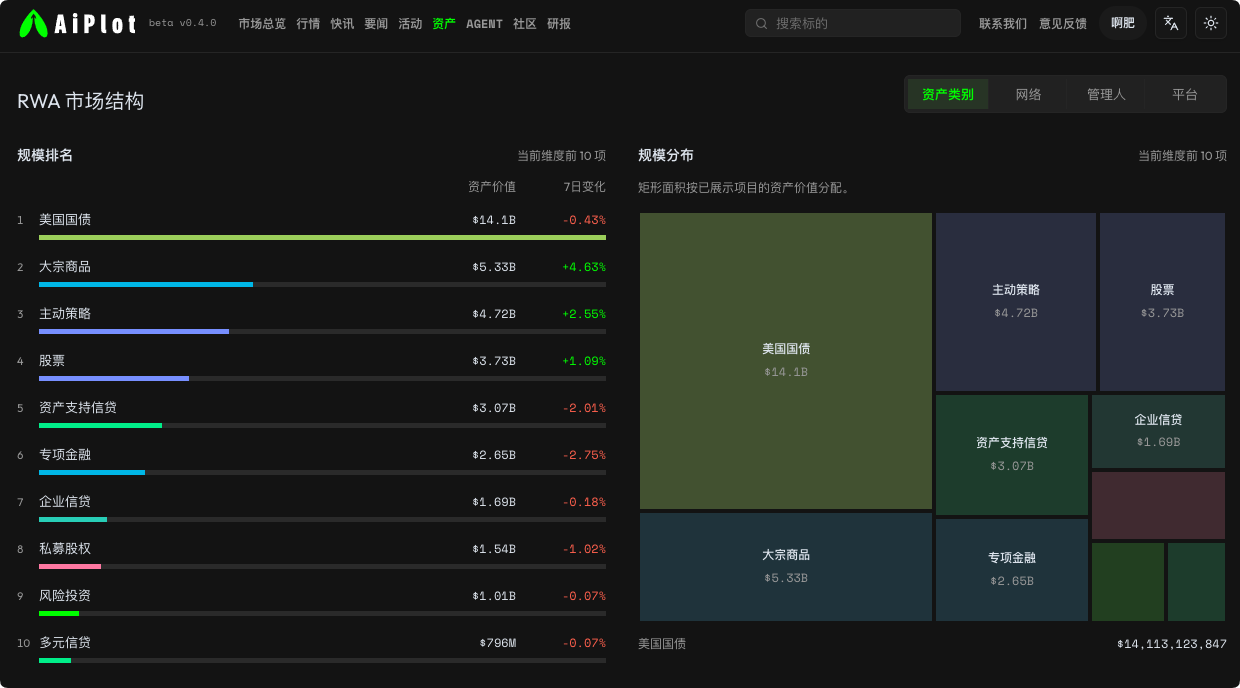
If one only looks at the total, it is easy to draw the conclusion that "capital is leaving RWA on a large scale." However, upon dissection, the decrease of about $1.73 billion primarily stems from statistical coverage adjustments; for products tracked continuously throughout the month, the scale decreased by approximately $805 million.
This indicates that changes in total scale encompass at least four factors: statistical scope adjustments, addition or removal of products, underlying asset price or NAV changes, and genuine subscriptions and redemptions.
Thus, the short-term decline in the scale of the RWA market is not contradictory to Hong Kong's construction of settlement platforms or Japanese financial institutions engaging in on-chain business. The two observe different levels:
- RWA scale reflects the asset balance under a certain statistical caliber;
- Net flow reflects changes in funding over a period;
- CMU DAP reflects the capabilities of market infrastructure;
- SBI Solana Global reflects the construction of institutional issuance and distribution networks.
Asset balances can fluctuate in the short term, but infrastructure construction may continue. Even during periods of declining market scale, institutions may place greater emphasis on standardized settlement, custody, and clearing capabilities, as these determine whether future products can be scaled.
7. Hong Kong and Japan Represent Two Complementary RWA Routes
The route of Hong Kong's CMU DAP is based on financial market infrastructure. It first addresses registration, custody, issuance, clearing, and settlement in the bond market, then expands to funds and other RWAs.
SBI Solana Global's route, on the other hand, starts from institutional business and public chain ecology. It hopes to connect stablecoin payments, asset tokenization, and on-chain asset management before expanding from Japan to Asia and the global stage.
These are not competitive relationships, but rather constructions at different positions within the RWA ecosystem:
- Hong Kong emphasizes core infrastructure of regulated financial markets;
- SBI Solana Global emphasizes networks of financial institutions, public chains, and cross-border distribution;
- Both ultimately need to resolve authenticity of assets, investor qualifications, cash settlement, and cross-market interoperability.
The market that will be truly competitive in the future may not necessarily be the one that issues the most tokens, but rather the one that can most smoothly connect issuance, trading, cash settlement, and asset management.
Conclusion: The Next Competition for RWA is "Who Can Fix the Dock"
The recent decline in the total scale of RWA should not be simplistically interpreted as the industry losing value. Changes in data standards have explained a significant portion of this, and the actual decline in continuously tracked products does not represent all asset categories and institutions withdrawing.
More importantly, financial institutions and regulatory agencies are building deeper capabilities: Hong Kong launched CMU DAP, incorporating the full lifecycle of bonds into a digitized market infrastructure; SBI, SMFG, and Solana Foundation are attempting to connect stablecoin payments, asset tokenization, and on-chain asset management.
This indicates that RWA is transitioning from a "competition of asset issuance" to a "competition of financial infrastructure."
A truly mature RWA market needs to possess three capabilities simultaneously: assets can be reliably registered, transactions can be securely settled, and cash can be delivered synchronously with assets.
Ultimately, the value of RWA lies not in how many tokens are on-chain, but in whether those tokens can continuously circulate within compliant, traceable, and settled infrastructures, engaging in real financial activities.
For more data and analysis, please follow Aiplot:
https://aiplot.com/?utm_source=aicoin
📖 Community Discussion:
- Telegram:
https://t.me/+IIYMcJigBAo4Mjg1
The content of this article only represents the author's personal views and does not represent the stance of this platform. The views, conclusions, and suggestions in the article are for investor reference only and do not constitute any investment advice related to this platform. The market has risks, and investment requires caution.
免责声明:本文章仅代表作者个人观点,不代表本平台的立场和观点。本文章仅供信息分享,不构成对任何人的任何投资建议。用户与作者之间的任何争议,与本平台无关。如网页中刊载的文章或图片涉及侵权,请提供相关的权利证明和身份证明发送邮件到support@aicoin.com,本平台相关工作人员将会进行核查。