Last week, we just discussed the article titled ChatGPT Wallet Teams Up with Visa: Does the Agent Economy Still Need Stablecoins?, and Visa has personally stepped in to provide an intriguing answer.
On November 22, Cuy Sheffield, head of Visa Crypto Labs, announced the launch of the experimental AI Agent wallet Visa CLI. Unlike the earlier focus on "helping humans shop with cards," Visa CLI allows cardholders to verify their identities using their bank cards. After connecting to their AI Agent, the Agent can use stablecoins for API call fees and can also enter task markets like Taskmarket to undertake paid work such as research and content creation, earning USD stablecoin Open USD (OUSD) directly upon completion and acceptance.
When looking at another set of numbers revealed during Visa's fiscal Q4 earnings call for 2026, it's clear this move is not spontaneous: as of late October, Visa's stablecoin settlement business has achieved an annualized operational scale of over $25 billion, a tenfold increase from around $2.5 billion a year ago, and far exceeding the $7 billion from March of this year.
As AI Agents gradually cross the dual income and expenditure loop of "taking orders, receiving payments, and paying out," the industry faces not just a battle over choosing between bank cards and stablecoins:
A system of identity verification, authorized boundaries, and monetary control centered around non-human economic entities is being forced to come to the forefront.
1. What is Visa CLI Trying?
Looking closely at the design of Visa CLI, one finds its approach very pragmatic.
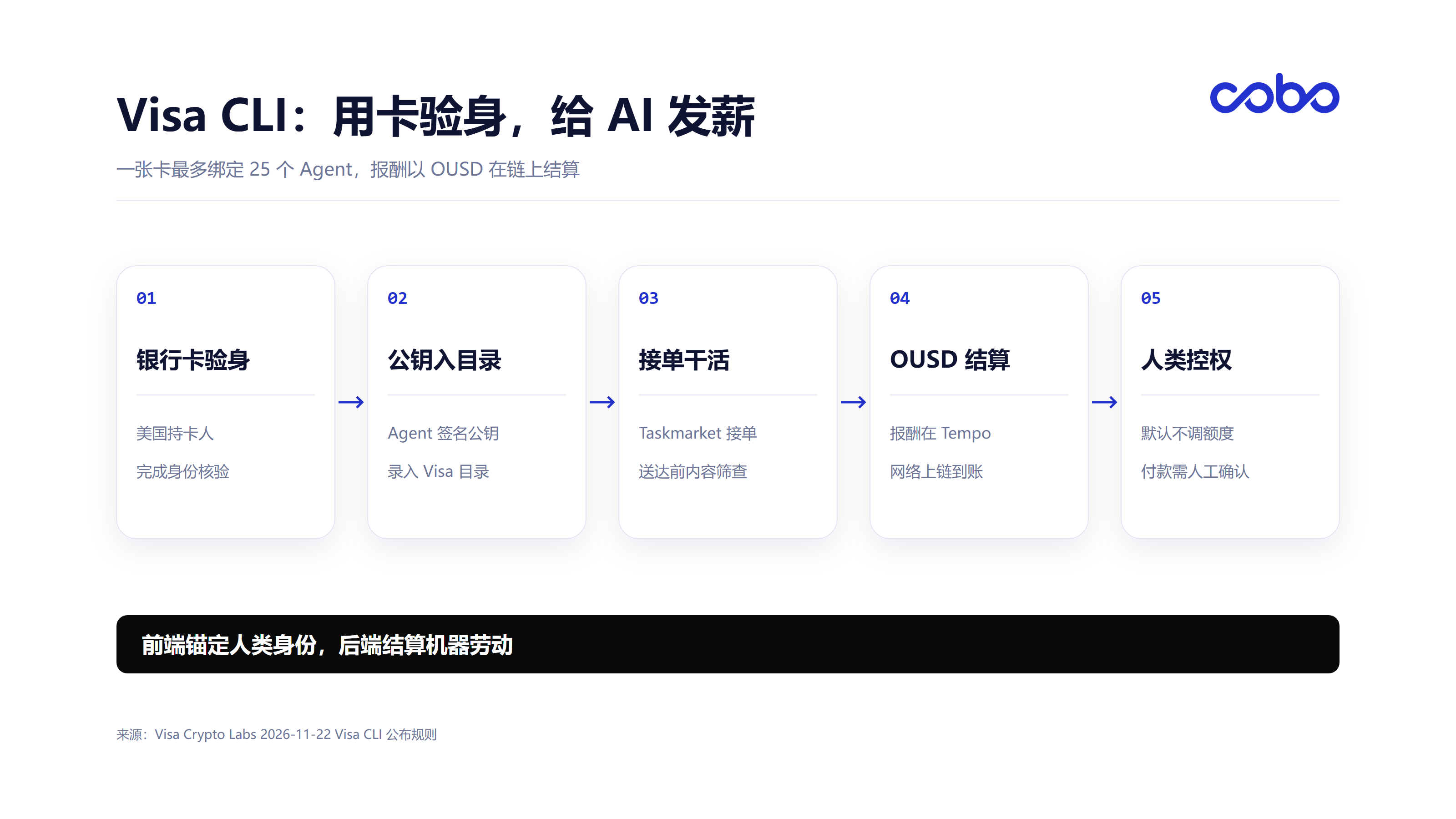
This set of products is still in an invitation-only experimental phase, open to qualifying US Visa cardholders. Users complete card verification using a one-time code from their issuing bank, allowing them to integrate Agent applications like Claude Code and Codex into Visa CLI.
Subsequently, the Agent will receive an independent signing identity, with its public key registered in the Visa Agent Directory, to initiate payment requests, undertake tasks, or prove identity to service providers in the future.
Notably, when actual fund transfers occur, Visa CLI uses OUSD stored in the user's wallet rather than directly deducting from the linked bank card.
In other words, this design effectively separates two issues: one side is identity verification and authentication requests, while the other side is funds payment and settlement.
The identity layer utilizes the Trusted Agent Protocol (TAP), pushed by Visa and Cloudflare. When an Agent makes an HTTP request, it must sign the request content with its private key. The receiver verifies the request against the public key listed in the Visa Agent Directory to determine which registered Agent the request is coming from and whether the request content has been tampered with during transmission.
The funds payment layer connects to the Machine Payments Protocol (MPP) jointly launched by Stripe and Tempo. When an Agent makes API calls or uses digital services, the server returns payment requirements, and the Agent settles in OUSD within the preset limit on the Tempo network and receives corresponding services.
Moreover, the most imaginative change in Visa CLI is its integration with Taskmarket.
Previously, Agents calling external APIs were typically only payers; now, they can search for paid tasks in the market and pick jobs themselves, completing research or content delivery. Upon acceptance, their rewards directly enter the user's on-chain wallet as OUSD, which also means that the Agent economy has, for the first time, formed a prototype of "revenue—consumption" on a track built by mainstream financial giants.
Objectively, this architecture isn’t something Visa developed from scratch. Visa controls the identity protocols, Agent Directory, and product access, integrating different segments of infrastructure such as VGS (card credential custody), Turnkey (key enclaves and wallet strategies), Bridge (OUSD issuance), and Tempo (payment settlement chain) underneath.
However, it is precisely this "assembly model" that has produced significant pressure on crypto-native camps. Visa already holds billions of card credentials, a mature merchant network, and a massive developer ecosystem. Now, leveraging the combination of TAP + MPP + OUSD + Tempo, it rapidly fills the low-cost on-chain payment track.
From this perspective, for crypto-native public chains like Arc focusing on stablecoin payments, if they cannot open differentiated ideas within the crypto ecosystem—such as more open multi-chain liquidity, DeFi composability, and neutral network effects—simply concentrating on existing commercial payment scenarios and confronting giants directly may lead to traditional markets being swallowed by giants like Visa and Stripe.
2. A Bottleneck Arriving Earlier than the Track Dispute: From KYC to KYA
Stepping beyond the track games of public chains and giants, when Agents start making frequent payments and collections, a more immediate reality bottleneck is emerging: from the perspective of counterparties and financial institutions, how can they confirm who this program really is and whether it can be trusted?
It is important to understand that the foundation of modern financial systems is KYC (Know Your Customer). Regardless of how many hands the money passes through, you can always trace it back to a specific natural person or registered legal entity to bear legal responsibility, but self-running Agents break this premise.
For an API service provider, it needs to know which Agent the request is coming from; for a task market, it needs to confirm whether the results submitted are from the previously agreed Agent; and for a bank or payment institution, it must clarify who this Agent is acting on behalf of? Has it really obtained the necessary authorization?
This is also the direct reason why KYA (Know Your Agent) is beginning to enter regulatory sight.
Just three days before Visa CLI was unveiled, Ravi Menon, Managing Director of the Monetary Authority of Singapore (MAS), delivered a speech at the 2026 Singapore Fintech Festival, clearly stating that in the next phase of working on SAFR (Safeguards for Agentic Finance at Runtime), they would promote industry collaboration to develop KYA protocols.
Regulators are concerned about very specific issues. When AI Agents frequently engage in financial transactions, or when users even give their financial account login credentials directly to individual Agents, financial institutions simultaneously face three blind spots: they do not know whether it remains under the customer’s full authorization, whether its operations deviate from the original instructions, and even more, they do not know who will be responsible in the event of operational errors or unauthorized transactions.
According to the framework outlined by MAS, a qualified KYA protocol must clearly explain at least four things to financial institutions before a transaction occurs:
Identity and Belonging: Who this Agent is and which actual customer or corporate entity is behind it; Authorization Limits: How much funds it is allowed to use and what operations it can perform; Task Scope: Under what business instructions and constraints this transaction is occurring; Trustworthy Endorsement: Whether its code sources, operational compliance, and historical records have verifiable credentials.
Looking back at Visa CLI, it actually conducted a lightweight KYA experiment on the consumer side—using a real-name authenticated bank card as an anchor point to issue directory public keys to personal Agents, reconnecting "software behavior" back to "human identity." As long as service providers verify and find that the corresponding TAP public key is unregistered, suspended, or revoked, the request will be directly denied before settlement, preventing any deductions.
Regardless of whether funds flow through traditional card organizations or public chains in the future, Agents without clear identities and verifiable authorizations cannot genuinely connect to mainstream financial networks.
3. Moving Beyond Personal Sandboxes: How to Manage Corporate-level Multi-Agent Funds?
However, if we shift the scenario from "individuals allowing AI to take on small tasks to earn some OUSD" to real corporate-level operations, the boundaries of Visa CLI quickly become apparent.
This is because Visa CLI's current design revolves entirely around individual users, for example, verifying with a qualifying personal Visa card from the US (prepaid and corporate cards are not supported). A single card can associate with up to 25 Agents; users must set spending limits for each Agent individually, and by default, manual confirmation is required for each payment, only allowing small automatic transactions under specific conditions.
This mechanism might be sufficiently secure for individual users trying it out, but in a corporate production environment, issues become significantly more complex.
A company may have dozens or hundreds of Agents running simultaneously in procurement, finance, marketing, development, and supply chain, facing different counterparties, belonging to different budget pools, and having entirely different approval chains. Clearly, it is impossible to unify everything with a personal bank card or require financial managers to click confirm every time.
Large models might misunderstand tasks; external web pages might contain malicious prompts, and the operating environment might be compromised. If permissions are only written in the prompts, whether the Agent adheres to the rules ultimately depends on how the model interprets those commands.
Thus, the enterprise-level Agent economy cannot rely solely on identity declarations at the protocol layer; it must encode KYA-required permissions and boundaries directly into the underlying wallet's cryptography and risk control engine.
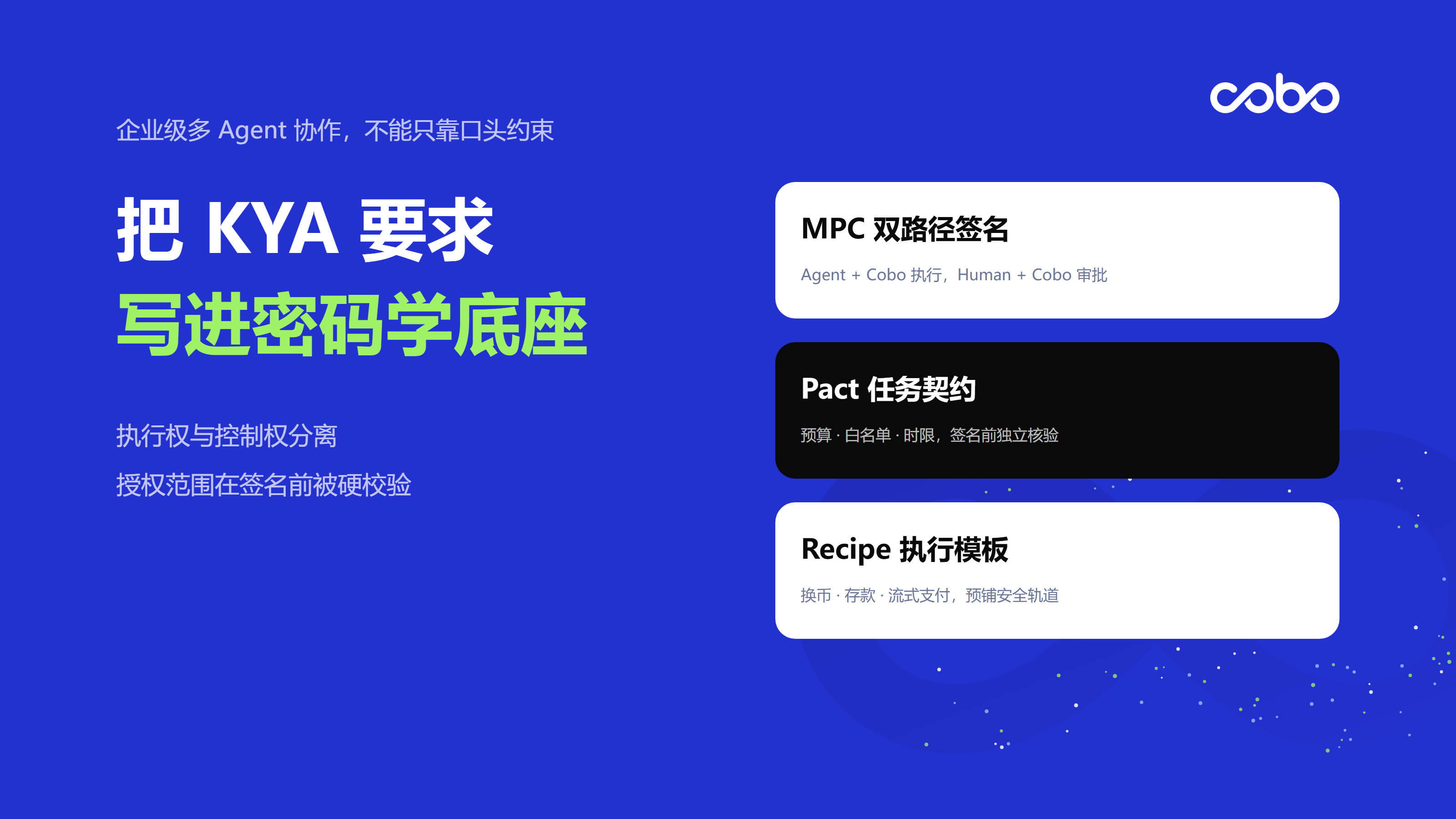
For example, taking the engineering approach of Cobo Agentic Wallet, the core method is to completely separate the "execution rights" of the Agent from the "fund control rights" of the enterprise.
At the underlying key level, it avoids single point failures through MPC dual-path signing. The Agent's operational environment does not retain complete private keys; day-to-day receipts and payments within the authorization scope are completed collaboratively by the system, while any large allocations or core changes trigger a return to the manual approval path. Even if the sandbox is compromised or faces malicious inducement, no single node can misappropriate the funds.
On the next layer, via the Pact task contract framework, natural language instructions are transformed into machine-enforceable rules, with budget limits, whitelists, allowable interaction contracts, and expiration conditions directly encoded into the risk control engine. Each transaction must undergo independent verification before signing, effectively materializing the KYA-emphasized "authorization limits" and "task scope" as non-circumventable code gateways.
When business transcends a simple transfer involving on-chain exchanges or complex contract calls, predefined templates (Recipes) are used to narrow parameter spaces, reducing the risk of Agents accidentally interacting with high-risk contracts due to hallucinations. Combined with prior on-chain compliance screening, the funds flow of multiple Agents can safely integrate into the enterprise's existing financial system.
Final Thoughts
Based solely on this experiment with Visa CLI, it is still insufficient to prove that Agents have become independent commercial entities.
However, when connecting recent events, from the integration of ChatGPT Wallet with traditional bank cards, to Visa CLI's bridging of TAP and MPP, settling with OUSD on the Tempo chain, and the Monetary Authority of Singapore beginning to draft KYA protocols, the evolution of Agent payments is faster than many anticipated.
In the future, an Agent may use tokenized credit cards for consumption, while settling with stablecoins during machine cooperation. Essentially, this is just routing choice in different scenarios; after all, there can be many payment tracks, and settlement assets may vary according to context.
However, in a commercial network where multiple Agents operate automatically, it is crucial to swiftly establish infrastructure that embeds identity verification, permission boundaries, and risk control execution into the underlying architecture to catch the upcoming scale of institutional funds.
This is a proposition that the entire industry needs to contemplate.
免责声明:本文章仅代表作者个人观点,不代表本平台的立场和观点。本文章仅供信息分享,不构成对任何人的任何投资建议。用户与作者之间的任何争议,与本平台无关。如网页中刊载的文章或图片涉及侵权,请提供相关的权利证明和身份证明发送邮件到support@aicoin.com,本平台相关工作人员将会进行核查。