KuCoin announced that it will delist Monero (XMR) on November 30, affecting spot trading, trading bots, exchanges, and other services. The withdrawal window is tentatively set to close on December 31. This is not the first time Monero has been delisted by a mainstream exchange, nor will it be the last. Whenever a similar event occurs, market discussions quickly shift to price fluctuations, but the real questions worth asking don't lie there.
The core value proposition of Monero is transaction privacy: it automatically hides the sender, receiver, and transaction amount. Centralized exchanges must operate within a regulatory, compliance, and risk management framework, requiring them to identify users, monitor the source of funds, and cooperate with suspicious transaction reports when necessary. There is a long-term structural contradiction between the two. Privacy coins seek to minimize the public disclosure of transaction information; trading platforms need to meet anti-money laundering and know-your-customer requirements; regulatory agencies want the ability to track suspicious funds; users wish for their assets and trading activities not to be overly monitored. It is difficult to fully satisfy all these demands at the same time.
Delisting is not an accidental event, but a choice under compliance pressure
The delisting of privacy coins by mainstream exchanges is usually not due to technical issues or lack of liquidity, but the result of weighing compliance costs against risk and benefits. As regulators become stricter towards privacy-enhanced crypto assets, the potential penalties, banking channel restrictions, and audit pressures faced by exchanges will significantly increase. For platforms, continuing to support XMR means higher compliance costs and risks of being restricted in certain jurisdictions. Delisting can reduce this risk exposure, even if it results in a short-term loss of some users and trading volume.
The design of Monero itself creates tension with the compliance logic of exchanges. It does not provide optional transparent addresses and inherently makes transactions non-publicly traceable. In decentralized contexts, this is a functional feature; in centralized trading platforms, it becomes a compliance barrier. Exchanges need to be able to explain the source and destination of funds to regulatory bodies, but Monero's default privacy feature makes it difficult to meet this requirement at a low cost. Therefore, delisting is more a risk management decision made by the platform under the current regulatory environment rather than a denial of Monero's technology itself.
The path of privacy protection is diversifying
If trading channels for privacy coins continue to narrow in mainstream centralized exchanges, the methods to achieve privacy protection may become divergent. One path is towards greater on-chain autonomy: users increasingly rely on non-custodial wallets, decentralized trading protocols, and peer-to-peer exchanges, reducing reliance on centralized platforms. This path is technically feasible but poses a higher operational threshold for ordinary users, and liquidity becomes more dispersed. Another path is that privacy features gradually become marginalized, only used in specific scenarios or small communities, while mainstream trading and market pricing occur more frequently with compliance-friendly assets.
Currently, both paths are occurring simultaneously. Some users have already shifted their holdings and trading of Monero to non-custodial environments, completing exchanges through decentralized protocols or over-the-counter methods. Another group of users has chosen to exit before the delisting due to limited withdrawal windows and declining liquidity. These two behaviors are not contradictory; they reflect different users' intensities of privacy needs and operational capabilities. For users who only wish to trade on exchanges, the availability of privacy coins is decreasing; for users willing to bear higher operational costs, on-chain privacy tools remain available.
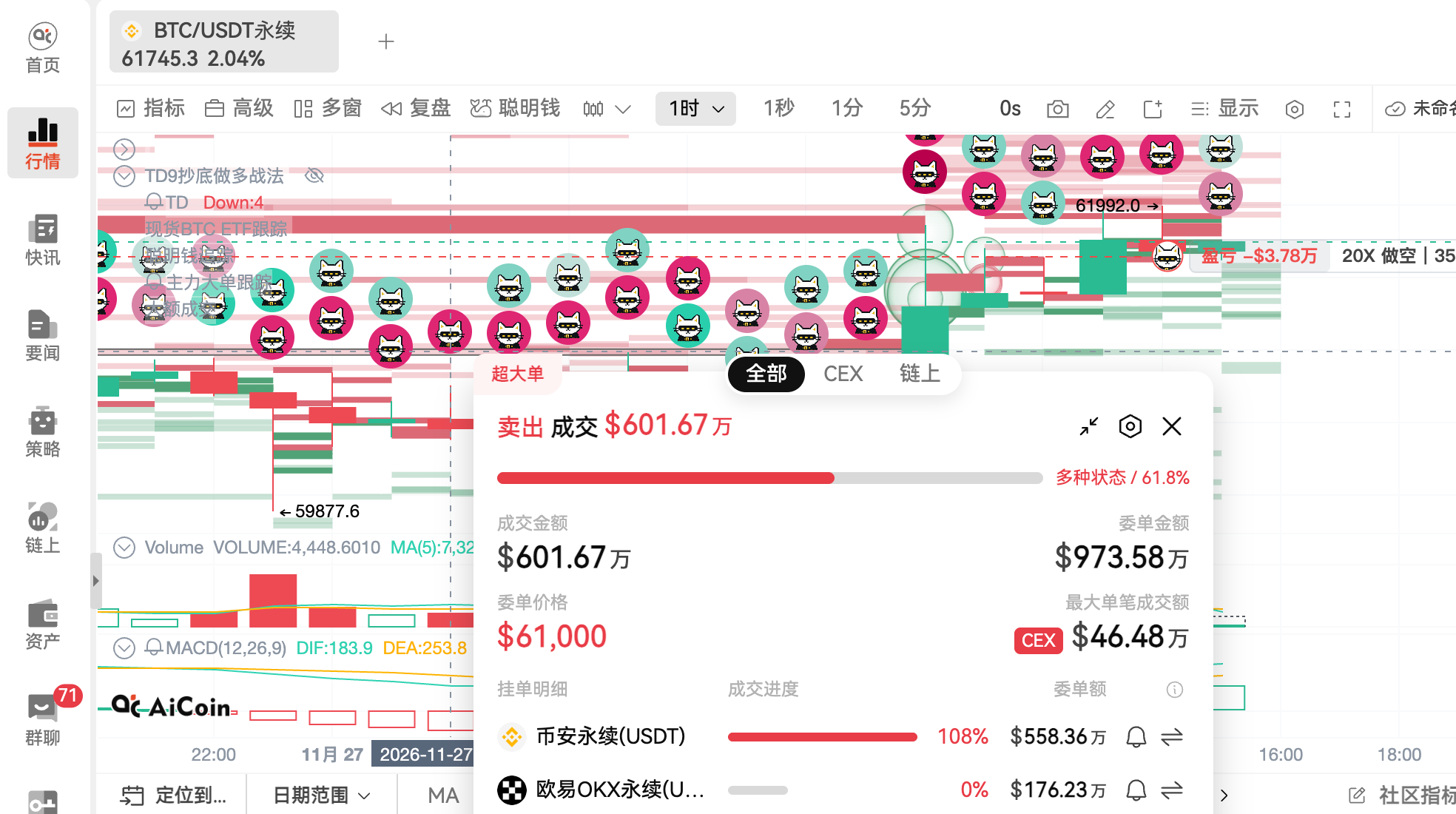
In observing the actual trading activity and capital flow of such assets, some users use market tools to check significant on-chain transactions or changes in depth across different platforms. For example, features like smart money and large transaction tracking provided by platforms like AiCoin can help observe whether substantial capital shifts occur before and after delisting, but this data alone can only reflect actions that have already happened and cannot directly serve as a trading basis.
The real contradiction is not in technology, but in systems
The delisting of Monero highlights a deeper issue: how the crypto industry handles assets characterized by non-auditability while pursuing auditable financial infrastructure. In traditional financial systems, the balance between privacy and compliance is achieved through identity verification, transaction monitoring, and suspicious reporting mechanisms. Privacy coins in crypto assets attempt to reduce the applicability of these mechanisms on a technical level, conflicting with the anti-money laundering frameworks in most jurisdictions.
This conflict will not disappear because of the delisting by any single exchange. As long as regulators require exchanges to have identification and reporting capabilities, assets that are by default non-traceable will face higher thresholds for listing. Possible future changes include: more exchanges adopting restrictive measures on privacy coins, certain jurisdictions imposing additional compliance requirements on privacy coin trading, and the evolution of privacy technology itself towards optional transparency or compliance-friendly directions. All these changes will require time to validate.
For ordinary users, it is essential to distinguish between two things. First, the trading convenience of Monero in centralized exchanges is declining, which is a real outcome of the compliance environment. Second, the demand for privacy protection has not disappeared; it has simply shifted from spot trading within exchanges to non-custodial wallets and decentralized protocols. Both points are valid simultaneously and do not negate each other.
KuCoin's delisting timeline has been set, with spot trading ceasing on November 30 and the withdrawal window open until December 31. After this date, if users still wish to hold or trade XMR, they need to assess the operational risks and liquidity status in non-custodial environments themselves. The delisting does not change the technical characteristics of Monero, but it will change the cost and manner in which ordinary users come into contact with it.
Whether the crypto industry can still accommodate genuine default privacy ultimately depends on the dynamic balance between the regulatory framework, compliance costs of exchanges, and actual user demand. Currently, this balance still leans towards stricter auditability. The delisting of Monero is a specific case in this trend, not an isolated event.
The above content is based on publicly available information and is intended for market observation and analysis, not constituting any investment advice. Privacy coins and related trading carry regulatory, liquidity, and technical risks; please make independent judgments based on your own circumstances and pay attention to the latest disclosures from relevant platforms and regulatory agencies.
免责声明:本文章仅代表作者个人观点,不代表本平台的立场和观点。本文章仅供信息分享,不构成对任何人的任何投资建议。用户与作者之间的任何争议,与本平台无关。如网页中刊载的文章或图片涉及侵权,请提供相关的权利证明和身份证明发送邮件到support@aicoin.com,本平台相关工作人员将会进行核查。