Author: Kristrey, blocmates
Translated by: Deep Tide TechFlow
Deep Tide Introduction: In August of this year, a group of traders used on-chain tokenized stocks and meme coin pools to artificially squeeze the price of HIMS stock, pushing it up 4.5 times on a weekend when liquidity was thin. This incident exposed a critical flaw in the current tokenized RWA's reliance on traditional AMM for price determination, causing its price to often be completely disconnected from the real world.
The decentralized exchange Metric proposed the "Active Liquidity Pool" mechanism, completely decoupling the asset pricing authority from the pool's fund inventory. By introducing independent quoting contracts and adaptive liquidity ranges, on-chain RWA can track real-world prices in real-time without waiting for arbitrageurs, filling a key infrastructure gap for on-chain stocks and large trades.

In late August, a group of traders attempted to launch a "short squeeze" on the tokenized stock of the low-priced US stock HIMS.
Their idea was quite simple: pair a meme coin with the tokenized stock to form a liquidity pool, and then buy as many tokens as possible to “control” the supply, thereby pushing the on-chain price of HIMS higher.
Since this action occurred over a weekend, the price of HIMS in the pool soared to $132.64, while its actual stock price at last Friday's close was only $28.84.
However, this group overlooked one critical fatal fact: the token supply of HIMS stock on-chain accounted for only a tiny fraction of the total circulating shares in the real world.
On Monday morning, after the US stock market opened, the issuer of the tokenized stock quickly minted new tokens and ruthlessly arbitraged between the real stock price and the on-chain price, instantly bringing HIMS’s price back to reality and re-establishing parity with the real world.
The core lesson of this story isn't about the farce of trying to short squeeze a Nasdaq-listed stock itself.
What it truly exposes is that the vast majority of tokenized stocks in today's on-chain trading still adhere to the traditional automated market maker (AMM) architecture used for many years in DeFi, where the price of an asset is entirely dependent on the inventory ratios of the two tokens in the liquidity pool.
This mechanism effectively severs the price relationship between real-world assets (RWA) and their on-chain mirror versions, making tokenized assets seem like they exist in a parallel isolated universe.
However, if at that time the HIMS stock had been stored in Metric's Active Liquidity Pool, such an outrageous price spike and dislocation would have been impossible from the start.
What is Metric?
Metric (@metricxyz) is an innovative decentralized exchange that introduces the core design concept of "Active Pools," under which the asset pricing mechanism and liquidity provision are completely decoupled into two independent components.
This Active Pool design precisely addresses the price disconnection between real-world asset prices and tokenized assets in DeFi pools, which are traditionally easily distorted by localized single trading actions.
But one might ask: Given that oracle networks already exist, why does this dislocation phenomenon still occur? Aren't oracles precisely the bridge connecting DeFi with the external real world? The answer is: that remains at the theoretical level.
In Uniswap v2-style pools, pricing comes entirely from the inventory ratios of assets within the pool; while in v3 and v4 types of concentrated liquidity pools, pricing is sourced from the currently recorded tick points and the available liquidity depth within that price range.
Regardless of which traditional form it takes, the crux lies in: unless a trader or arbitrageur actively initiates a trade to take advantage of the price difference, the quotes within the pool will not move on their own.
In contrast, Metric's Active Pool can achieve accurate pricing of tokenized US stocks, foreign exchange, gold, and mainstream cryptocurrencies by directly integrating with oracle data sources or custom pricing logic, ensuring that the pool's quotes remain in sync with the real world regardless of whether external arbitrageurs intervene.
Operational Principles of Active Liquidity Pools
Unlike conventional AMMs, Active Pools completely separate asset prices from the actual fund inventory in the pool. Since accurate pricing is the key to unlocking new possibilities, let's first see how pricing is achieved.
Price Provider
Within Metric's liquidity pool, asset prices are calculated by an on-chain smart contract called the "Price Provider," which directly returns a complete quote including the bid price, ask price, and reference price.
The Price Provider contract can obtain prices from various different sources, the most intuitive of which is directly connecting to decentralized oracle networks like Chainlink or Pyth, closely tracking the real-time market price of off-chain real assets.
Additionally, the contract can execute more advanced complex logic, such as reading the mid-prices or time-weighted average prices (TWAP) from other DEXs, the real-time exchange rates of staked assets or vaults, custom mathematical models for options, prediction markets, or synthetic assets, and even professional trading strategies such as grid trading, limit orders, deep OTC, or volatility adaptive orders.
Regardless of the underlying calculation logic employed, the liquidity pool itself will not arbitrarily form its own price viewpoint; instead, this heavy and critical pricing responsibility is completely transferred to the Price Provider smart contract.
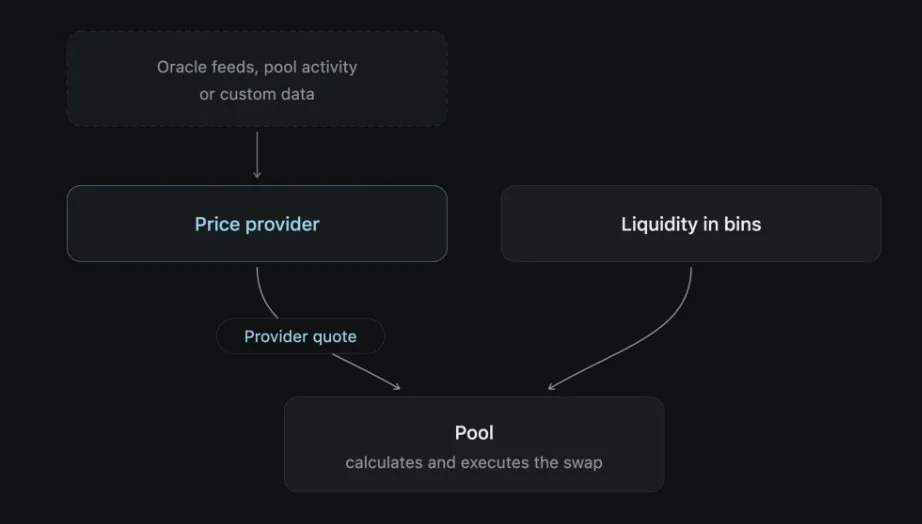
However, even with absolutely precise prices, if there are no liquidity providers (LPs) willing to deposit funds into the pool, that is meaningless for traders. This is where the "Liquidity Bins" come into play.
Liquidity Bins
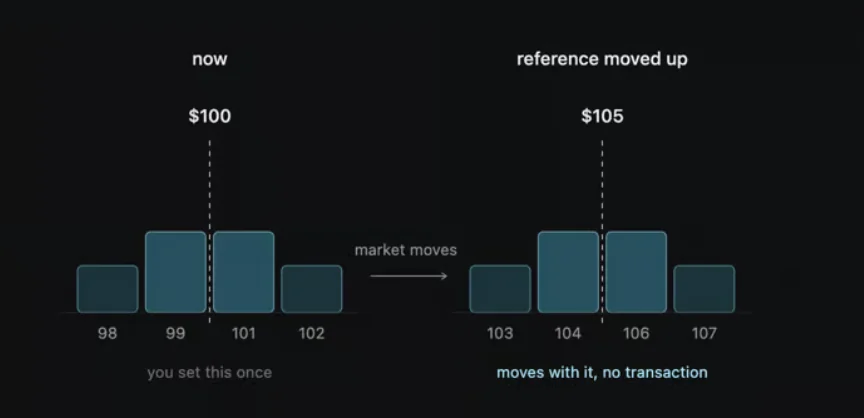
On Metric, liquidity automatically tracks the benchmark reference price given by the aforementioned Price Provider contract and is distributed across various liquidity bins centered around these benchmark prices. Each bin represents a certain price deviation range relative to the pool's benchmark reference price, usually expressed as a percentage.
Let’s assume the current trading market price of ETH is $2,000, and as an LP, you are willing to sell at a level 2% above the real price, while simultaneously willing to buy at a level 2% below the real price. This means you will set the ask at $2,040 and the bid at $1,960.
If an extreme one-sided market suddenly occurs overnight, and ETH soars to $3,000. In a traditional Uniswap v3 concentrated liquidity pool, your position would be instantly blown out, leaving you with a stack of passively devalued one-sided assets, helpless.
But in Metric's Active Pool architecture, your liquidity bin will dynamically follow the reference price, with the originally preset rules still strictly in effect: it remains a symmetric range of 2% on both sides of the price, meaning your sell order will now automatically adjust to $3,060 and your buy order to $2,940.
In short, as long as the real market price moves, these liquidity bins will automatically drift alongside, ensuring that even if no actual trades occur within the token pool, liquidity will never drift out of the effective range.
Final Outcomes: Reshaping Experiences for All Parties
Imagine this: a reader browsing the latest health column stumbles upon content sponsored by the men's health company HIMS, mentioning the outstanding effects of Finasteride and Minoxidil in treating hair loss.
After browsing the company's official website and completing an online questionnaire, the reader is deeply moved by its business model and is optimistic about the company’s development prospects, deciding to buy its stock during the dip.
Due to some profound reasons related to hair loss, this gentleman happens to have quite a bit of research on cryptocurrency and tokenized stocks, so he decides to directly open his Robinhood wallet on his phone to purchase this on-chain stock.
He selects the HIMS token on the interface, enters the purchase amount, and then clicks exchange; however, the final transaction quote that pops up on the screen is not the price he saw on the market board 5 minutes ago. This price is somewhat disappointing, though not outrageously unacceptable, enough to raise suspicion.
For the average retail investor with a small amount of capital, such a minute price difference may not cause excessive alertness; but it’s this omnipresent price difference that drags LPs in traditional DeFi pools into an endless painful abyss: since prices cannot update automatically, arbitrageurs are always lurking to exploit the profits, forcing LPs into a vicious cycle of frequently rebalancing positions and incurring impermanent losses.
However, if the HIMS token were stored in Metric's Active Liquidity Pool and the Price Feed was set to faithfully track the real-time stock price of the physical world, then all parties involved in the ecosystem would have a strikingly different and more satisfactory experience:
For LPs, the biggest advantage of providing liquidity to the active pool is that your position can always remain within the profitable price range, and the transaction fee earnings generated will be directly retained within the liquidity bins, automatically compounding into your initial position.
Since there’s no need to manually extract earnings or reposition defenses, LPs can save on the high gas transaction costs associated with repeated operations. Of course, this mechanism cannot protect LPs from the systemic risks of significant declines in the underlying assets themselves or the potential exposure to attacks from high-frequency arbitrageurs when the pool's reference price is not updated in time, as well as other relevant risks and safety mechanisms outlined.
For traders, they can enjoy fair asset prices closely aligned with real market prices without paying any hidden frontend service fees or additional slippage, only bearing the reasonable bid-ask spread between the reference price and trading prices, from which Metric only takes a tiny percentage as protocol fees.
Although Metric has not entirely eliminated all inherent risks in financial markets, it has built a crucial infrastructure puzzle piece for the future we are heading towards: in that future, tokenized RWA will become trusted, reliable financial instruments that can be traded around the clock without fear that a few degens will manipulate fragile liquidity pools at the whim during thin liquidity weekends.
✍️ Kristrey (@Kristrey0x)
免责声明:本文章仅代表作者个人观点,不代表本平台的立场和观点。本文章仅供信息分享,不构成对任何人的任何投资建议。用户与作者之间的任何争议,与本平台无关。如网页中刊载的文章或图片涉及侵权,请提供相关的权利证明和身份证明发送邮件到support@aicoin.com,本平台相关工作人员将会进行核查。