1. Half-Day Market After Thanksgiving: Trading Volume Decreases, Price Fluctuations Are More Easily Amplified
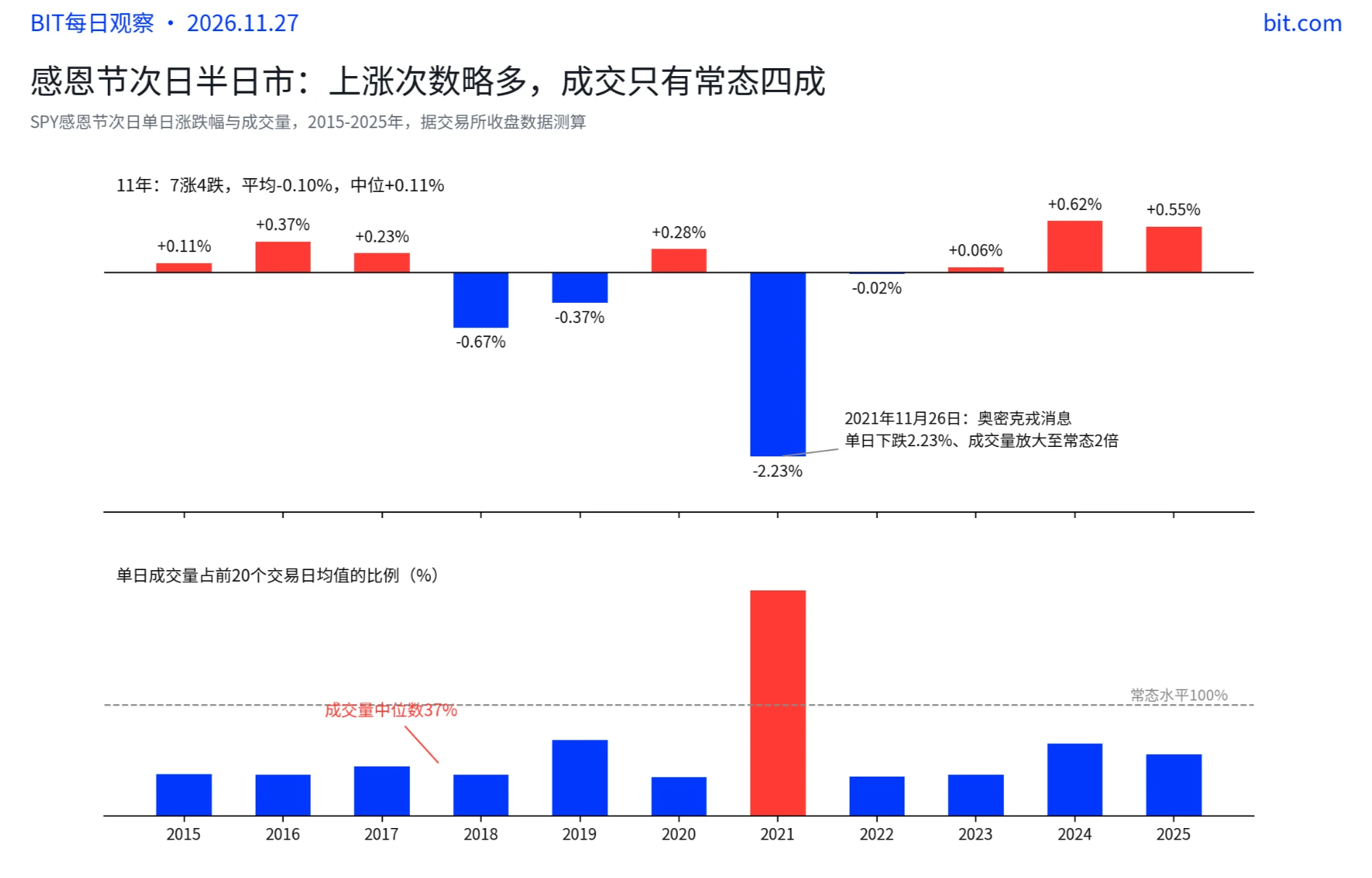
Today, the U.S. stock market closed early due to the traditional arrangements after Thanksgiving, with trading from 9:30 AM to 1:00 PM Eastern Time, corresponding to 10:30 PM to 2:00 AM Beijing Time. The normal trading hours of 6.5 hours were compressed to 3.5 hours. This half-day trading window after Thanksgiving is inherently a period with relatively light trading volume throughout the year. According to closing data from the exchange, in the 11 Thanksgiving days from 2015 to 2025, SPY rose 7 times and fell 4 times, with an average performance of approximately -0.10% and a median of about +0.11%, slightly leaning towards an upward direction but with a very small amplitude; the average figure is negatively biased mainly due to the drop on November 26, 2021, when the S&P 500 plummeted more than 2% due to news about the Omicron variant, with trading volume doubling to the norm. In contrast, a more stable characteristic is that the trading volume is significantly below normal levels: in the past 11 years, the median trading volume of SPY on the day after Thanksgiving was only about 37% of the average of the previous 20 trading days, with most years falling within the range of 35% to 45%.
Therefore, it cannot be simply interpreted today as a bullish signal just because "there are more historical up days." In a low trading environment, the depth of market orders decreases, and the same amount of capital is more likely to push prices further. Stop-loss orders, algorithmic trading, and concentrated adjustments at the end of the trading day can also amplify the volatility in the last hour. This is especially true for technology stocks: if the Nasdaq or Nvidia experiences a rapid rise during the day, we need to continue observing whether the trading volume follows and whether the rise spreads from leaders to more technology stocks; if there is a sudden drop during the day, we also need to see whether it is accompanied by a broader decline in risk assets.
The half-day market after Thanksgiving is more suitable as a window for observing changes in sentiment and positions; real judgments about meaningful directions will have to wait until next week when full trading resumes. By then, as trading normalizes, it will be clearer whether the market continues to buy technology stocks or reduces positions on a rebound.
2. December Rate Hike May Bring a Rebound, But Decisions on Two or Three Hikes Next Year Will Determine Rebound Scope
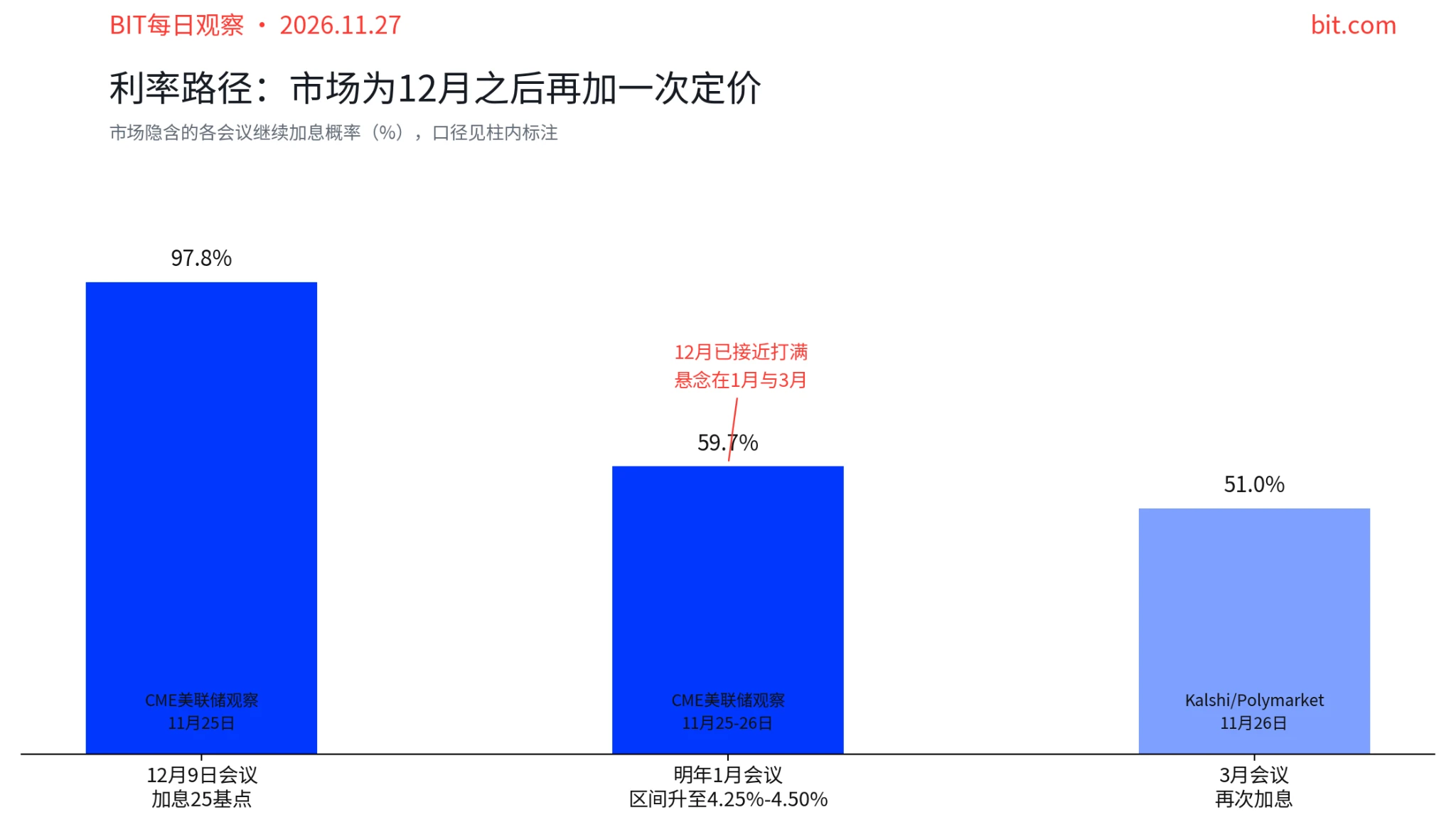
The market has largely priced in a 25 basis point rate hike in December, but what is truly worth watching is whether the market will continue to price in hikes afterward. As of the data from interest rate futures on November 26, the target rate after the December meeting entering the 4.00% to 4.25% range is nearly confirmed, with the probability given by the CME FedWatch reaching 97.8%; for the January meeting next year, the probability that the target range will rise to 4.25% to 4.50% is about 59.7%, indicating that the market has not stopped the tightening narrative in December; by March, the possibility of further rate hikes has also entered the trading range, with a predicted probability slightly above fifty percent under market estimates. Goldman Sachs and Morgan Stanley both expect the Fed to hike once in December and once in March, with a peak target range of 4.25% to 4.50%.
This will directly affect the performance of technology stocks after the December rate hike. If the hike occurs as expected, but the Fed's wording is not more hawkish than the market anticipates, and the expectations for hikes in January and March begin to recede, then technology stocks that have already priced in the rate hike pressure may experience a round of "sell the expectation, buy the fact" rebound. Conversely, if traders continue to push the rates for January and March upwards after the December hike, it will be difficult to sustain a rebound as the negative impact of the December hike dissipates, and long-term U.S. Treasury yields may continue to suppress high-valuation technology stocks.
Recent economic data indicates that the expectations for further rate hikes are not unfounded. The core PCE rose 3.3% year-on-year in October, higher than the expected 3.2%, the highest since November 2023; the overall PCE rose 3.8% year-on-year; the GDP revision for the third quarter was adjusted up to 4.3%, and personal income grew by 0.7% month-on-month in October. With persistent inflation and resilient growth, the market naturally shifts its attention from "whether to hike in December" to "how many more times will there be hikes by 2027." The yield on the 10-year U.S. Treasury bond closed at 4.869% on November 25, still at a high level, with pressure from the cost of capital on technology stock valuations not dissipating due to the anticipated December rate hike.
Thus, what truly needs to be monitored after the December meeting is whether the interest rate pricing for January and March has retraced. If the expectations for further rate hikes noticeably cool down, the rebound potential for technology stocks will be larger than just from the "December rate hike." If the market continues to price in two or three rate hikes next year, the rebound is more likely to stay at the level of valuation recovery.
3. Hang Seng Index Rebounds After Seven Consecutive Drops; 21.3 Billion Net Sell-off from Southbound Investors Needs Verification
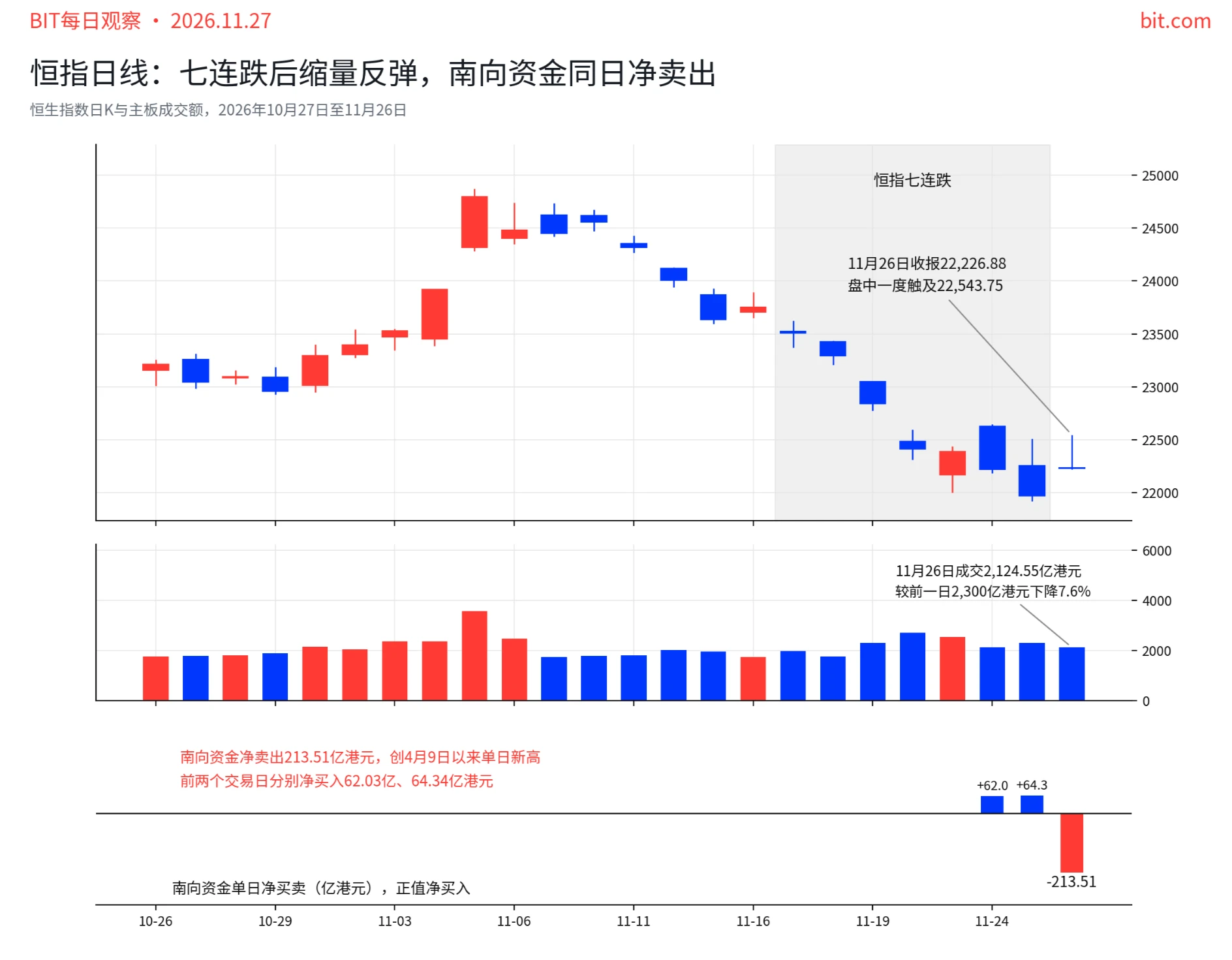
On November 26, the Hang Seng Index finally ended its seven-day decline, rising by as much as 577 points during the session to 22,543.75 points, and ultimately closing at 22,226.88 points, up 1.19%, re-crossing the 22,000 point mark; the Hang Seng Tech Index rose 1.16%, closing at 3,417.38 points, ending a consecutive downtrend of 11 trading days. The prior continuous decline had accumulated strong technical recovery momentum, making the significant rebound not surprising.
However, the change in the funding environment did not keep pace. On that day, the main board trading volume in Hong Kong was approximately HKD 212.455 billion, a decrease of 7.6% from the previous day; there was a net sell-off of HKD 21.351 billion from southbound funds, of which a net sell-off of HKD 10.598 billion from Stock Connect (Shanghai) and a net sell-off of HKD 10.753 billion from Stock Connect (Shenzhen), marking the highest single-day net sell-off since April 9. In the two trading days prior, southbound funds had net bought HKD 6.203 billion and HKD 6.434 billion respectively, showing a clear change in funding direction on the day of the rebound. Zhongtai International expressed in a morning report on November 27 that the rebound on the 26th may have been primarily driven by technical buying and short covering, with limited willingness for capital to chase higher prices, thus expecting a decline in the Hong Kong stock market today, with the Hang Seng Index finding support at 22,000 points and the Hang Seng Index night futures closing at 22,117 points, 110 points lower. This view only represents the judgment of the relevant institution.
This means that the current Hong Kong stocks resemble an index that has stopped declining first, while the funds are still observing. If the Hang Seng Index continues to rise today, it will be necessary to see if trading volume can increase, if southbound funds can return to net inflows, and if the Hang Seng Tech Index can hold yesterday's rebound position; only when the index, trading volume, and funds begin to coordinate with each other, will the market gain the conditions to transition from deep recovery following declines to an improvement trend. If the index opens higher but the trading volume does not keep up, and southbound funds continue to sell, this round of upswing will still be closer to sentiment restoration; from an observational perspective, "whether big funds have stayed" is more deserving of an answer than "whether the Hang Seng Index has re-crossed the 22,000 point mark."
4. Nvidia B300 for Sale; AI Market Begins to Face "Who Ultimately Buys the Chips"
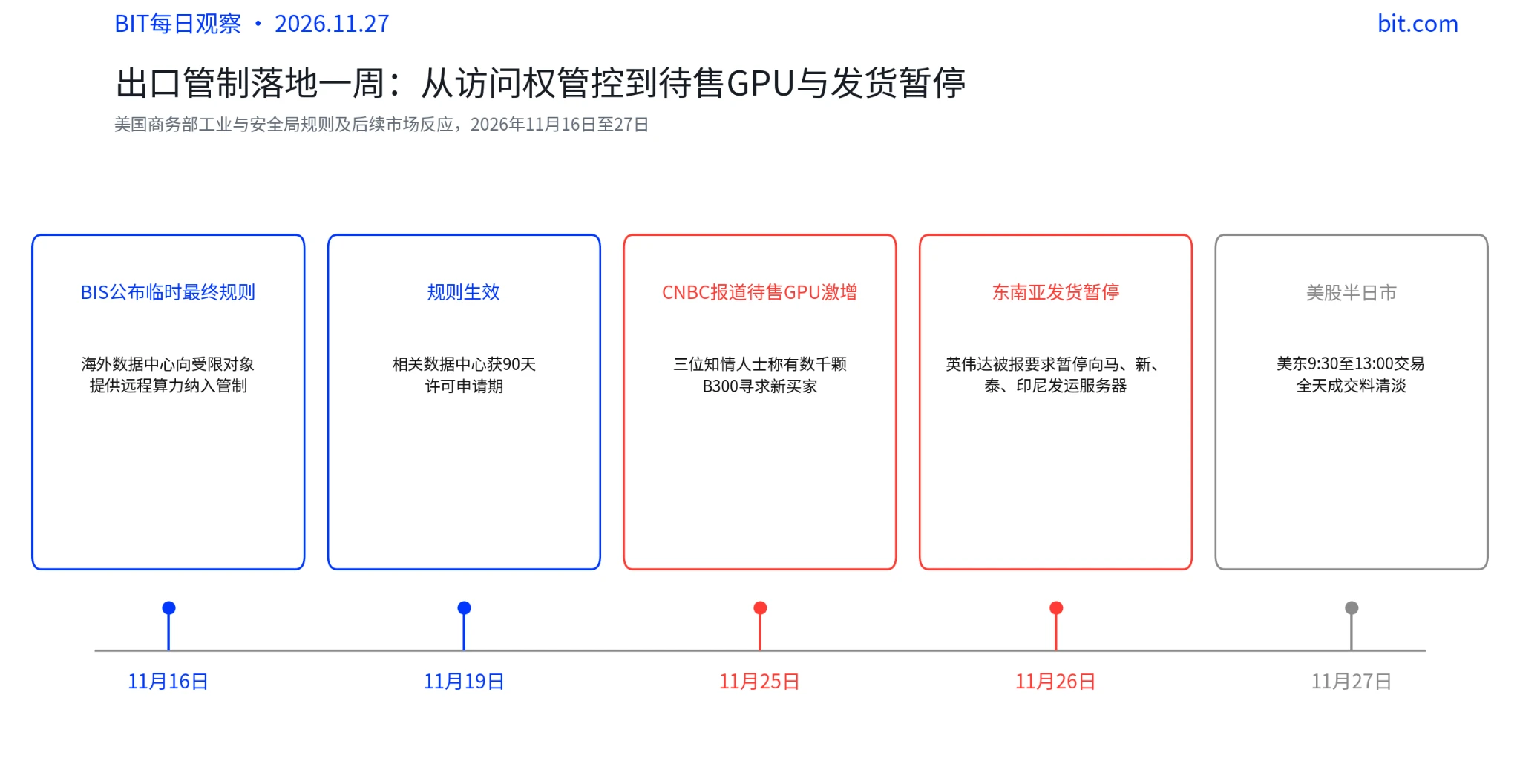
Interest rates affect the valuation of AI assets, while Nvidia's recent supply chain news touches on deeper fundamental issues: whether advanced GPU production can smoothly meet the ultimate demand from data centers. On November 16, the U.S. Department of Commerce's Bureau of Industry and Security issued a temporary final rule effective November 19, restricting foreign data centers from providing remote computing power to restricted entities, effectively blocking the path for Chinese companies to use advanced chips through third-party data centers. CNBC subsequently reported on November 25 that three insiders said the number of Nvidia GPUs available for sale in the market increased abnormally following the announcement of the new regulation, involving thousands of B300s; the head of the AI infrastructure trading platform GPU Mart stated that some sellers explicitly indicated that their sales were related to the new regulation. Nvidia declined to comment.
A second piece of news emerged from the supply chain. According to reports from CCTV Finance, Yicai, and other media on November 26, Nvidia has requested its manufacturing partners to suspend shipments of servers equipped with its chips to Malaysia, Singapore, Thailand, and Indonesia. Manufacturers such as Dell and Supermicro have notified buyers from the four countries, with no clear timeline for resumption. Nvidia's subsidiary in Singapore is expected to generate revenue of USD 104 billion in 2025, a 72% year-on-year increase, holding a significant weight in its revenue structure. The combination of these two pieces of news has shifted the market's focus from solely Chinese market demand to the concern over whether export restrictions will impact Nvidia's entire delivery chain through overseas data centers, server manufacturers, and channel inventories.
It is still premature to equate this news simply with a decline in Nvidia's demand. Policy changes leading to certain projects adjusting equipment and short-term inventory appearing in channels could merely be localized disturbances. What fundamentally needs to be cautious about is if the inventory available for sale continues to increase, significantly affecting server manufacturers' procurement, data center deployment, and the next round of capital expenditure. Once this transmission occurs, the AI hardware market will need to shift from "how much can capital expenditure still grow" to "can capital expenditure truly convert into GPU utilization and revenue." In the first complete trading week after the holiday, tracking the B300 inventory movement, server orders, data center capital expenditure, and Nvidia's delivery guidance with major server manufacturers will be more worthwhile than just monitoring the rebound of individual chip stocks: if these variables remain stable, the current news is more of a policy disturbance; if orders and capital expenditure adjust synchronously, then AI hardware stocks will need to face new fundamental pricing.
5. Jack Ma Appears at Tsinghua Unigroup; Spin-off Listing Enters a New Focus Window
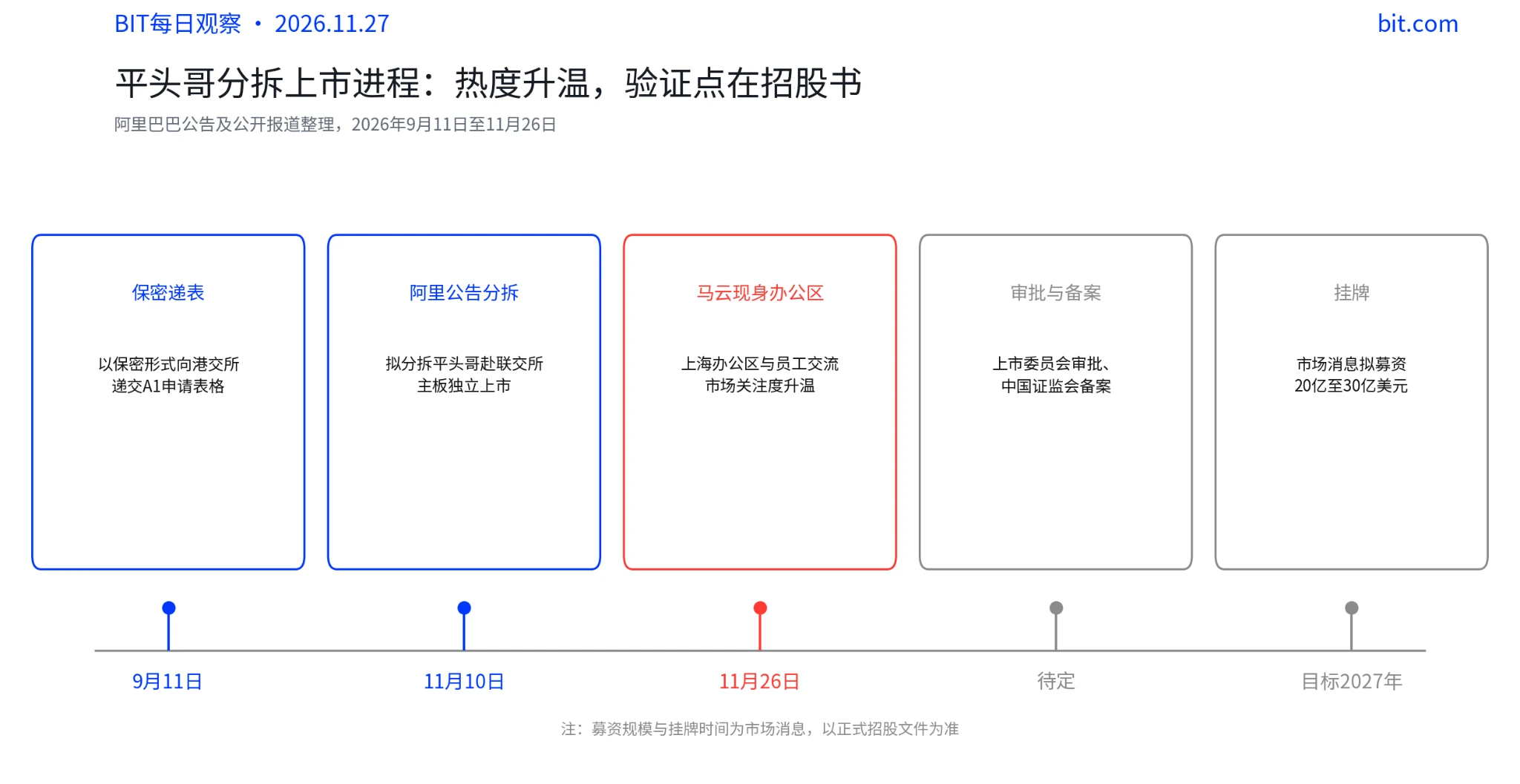
On November 26, Jack Ma appeared at the Shanghai office of Tsinghua Unigroup, a chip business under Alibaba, interacting with employees and taking photographs. This news coincided with the advancement stage of Tsinghua Unigroup's spin-off listing, quickly attracting market attention and making domestic chips, AI computing power, and Alibaba's AI ecosystem the focal point of capital discussions once again.
On the timeline, Alibaba announced on the evening of November 10 its intention to spin off its wholly-owned subsidiary Tsinghua Unigroup (Shanghai) Technology Co., Ltd to independently list on the main board of the Hong Kong Stock Exchange. The Stock Exchange has confirmed that the spin-off can proceed; Tsinghua Unigroup had previously submitted an A1 application form confidentially on September 11. The subsequent steps will still need to complete approval by the listing committee and registration with the China Securities Regulatory Commission, with the global offering scale, issuance structure, and Alibaba's final shareholding ratio all awaiting confirmation in formal documents. Market news suggests that Tsinghua Unigroup could raise USD 2 billion to 3 billion and aims for listing by 2027. Morgan Stanley's estimates from January this year provided a potential valuation range of about USD 25 billion to 62 billion, while insights from persons interviewed by 21st Century Business Herald gave a range of USD 20 billion to 30 billion, with these figures merely serving as reference before the prospectus and market pricing are finalized.
For the secondary market, the real valuable information moving forward will be the listing timeline, chip product revenues, major clients, R&D investment, gross margin, and profitability. Jack Ma's presence has elevated market attention, but the subsequent prospectus and listing process will provide more concrete pricing basis for this attention. While the overall funding environment in Hong Kong remains weak, IPOs, earnings reports, and industry events can still allow individual stocks to move independently; how long the market can sustain this momentum depends on whether these fundamental data points can be realized one by one.
6. After December Rate Hike, Rebound Space Looks at Whether Expectations Continue to Move Forward
Putting today's several main lines together, the market is currently in a transition phase. The December rate hike has been fully traded in, and if there is a "sell the expectation, buy the fact" post-meeting, it may leave short-term rebound space for technology stocks; concurrently, the pricing for continued hikes in January (about 60%) and March (about 50%) limits the height of valuation recovery. The AI hardware chain is starting to face new variables concerning inventory and delivery, and the rebound in Hong Kong stocks has yet to receive confirmation from southbound funds. The directions of several clues are inconsistent, making the error in piecing together a narrative of rises and falls potentially large.
Therefore, the half-day market today should not lead to a single conclusion. Half-day trading after Thanksgiving typically sees light trading volume; although the historical up days are slightly more than the down days, there is no stable directional advantage; the Hong Kong stock market rose 1.19% yesterday, but southbound investors had a net sell-off of HKD 21.351 billion; the industrial logic of the AI sector remains intact, but Nvidia has added the new variables of B300 for sale and delivery limitations. Prices are recovering, but funding and fundamentals are still awaiting confirmation.
In the next few trading days, clear variables worth continuously tracking include: in the U.S. market, observing if the Nasdaq rebounds while the 10-year Treasury yield retreats, and whether the interest hike expectations for January and March can cool down after the December hike; in the Hong Kong market, watching if southbound funds can return, and whether the Hang Seng Tech Index can hold its rebound position; for AI hardware, assessing whether there are substantial changes in Nvidia orders, GPU inventory, server delivery, and data center capital expenditure. If the December rate hike occurs as expected, and future expectations begin to cool, while profits and capital expenditure continue to realize, then this round of rebound may transition from technical recovery to a more sustained market; if the market continues to bet on one or two more hikes next year, combined with inventory pressure in the AI hardware chain, the index rebound will face dual constraints from valuation and funds.
Today, with only 3.5 hours of trading in the U.S. stock market, important answers may not arrive before 2 AM. Next week, when normal trading resumes, whether the market will continue purchases will be the most worthwhile answer to watch in this round of rebound.
Disclaimer:
The content of this article is for general information and market commentary purposes only, compiled from publicly available information as of the time mentioned in the article. Relevant market data, expectations, and probabilities may change in response to market conditions. The views and investment strategies of third-party institutions, analysts, or other individuals cited in the text only represent those relevant third parties at a specific time and do not represent BIT's views or recommendations. This article does not constitute investment advice, investment research, solicitation, offering, or a recommendation for any security, investment product, or trading strategy, nor should it be regarded as the basis for any investment decision. Financial markets carry risks, and securities prices and market performance may fluctuate; past performance and historical market trends do not represent or guarantee future results. Investors should assess relevant risks independently based on their individual circumstances and seek professional counsel when necessary. BIT's Hong Kong stock trading services are not offered to residents of Hong Kong or other restricted jurisdictions.
免责声明:本文章仅代表作者个人观点,不代表本平台的立场和观点。本文章仅供信息分享,不构成对任何人的任何投资建议。用户与作者之间的任何争议,与本平台无关。如网页中刊载的文章或图片涉及侵权,请提供相关的权利证明和身份证明发送邮件到support@aicoin.com,本平台相关工作人员将会进行核查。