Author: Zuo Ye, Zuo Ye Wai Bo Mountain
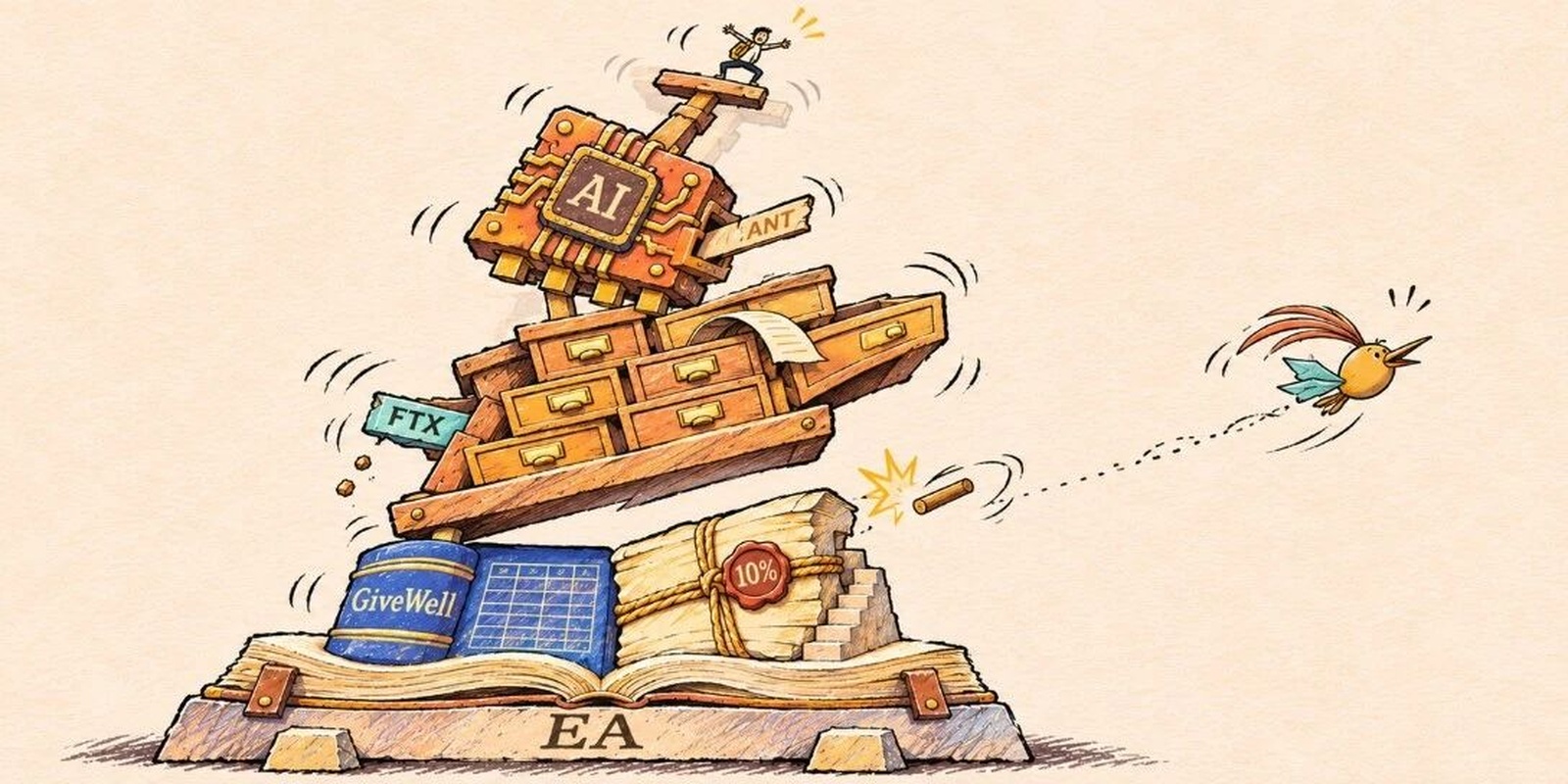
Fame brings troubles, and SBF cannot find peace in prison.
First, Anthropic went public, and onlookers imagined SBF's $500 million investment from back in the day; if it successfully reaches an IPO, will it bring a better future for crypto and AI?
Then, Netflix's documentary "The Altruists" was released, and what SBF thinks remains unknown to the world, but CZ and others are jumping around, reminiscent of Charlotte's wedding in "Autumn Elegy."
Some are outside, but the people want them inside; some are inside, but the people want them outside.
Since you left, only lingering resentment remains
SBF is certainly a sinner, guilty of embezzling user funds, and even today, debt resolution has not completely ended. However, whenever the industry cools down, there are always people who nostalgically remember.
If one must find a reason for this, the spirit of innovation might be the best choice.
SBF's view of finance is not limited to "gambling mentality"; he seriously considered how to promote both the upper echelons and the public in the crypto industry. Unlike Trump's takeover of the crypto space, SBF-led FTX actively sought to seize leadership in financial development.
Rewind to 2022: UST collapsed first, and FTX did not create panic or FUD; SBF attempted to emulate Morgan in 1907, playing the role of a savior as a lender of last resort amid panic.
Coincidentally, after a CoinDesk report triggered the collapse of FTX, Binance also attempted to save the industry, establishing a $1 billion SAFU fund and jointly launching an industry recovery fund, IRI, aiming to raise over $1 billion.
The final result speaks for itself; the industry has yet to recover.
Binance did not save the industry, and FTX and SBF even destroyed it, yet some still dare to hope for Trump's pardon of SBF, which is quite thought-provoking.
Ultimately, we have a sense of humiliation regarding the industry under the shadow of AI; we are discontent with leaders who flatter compliance; we need some spiritual sustenance to survive in the harsh realities of Fintech, payments, and meme gambling.
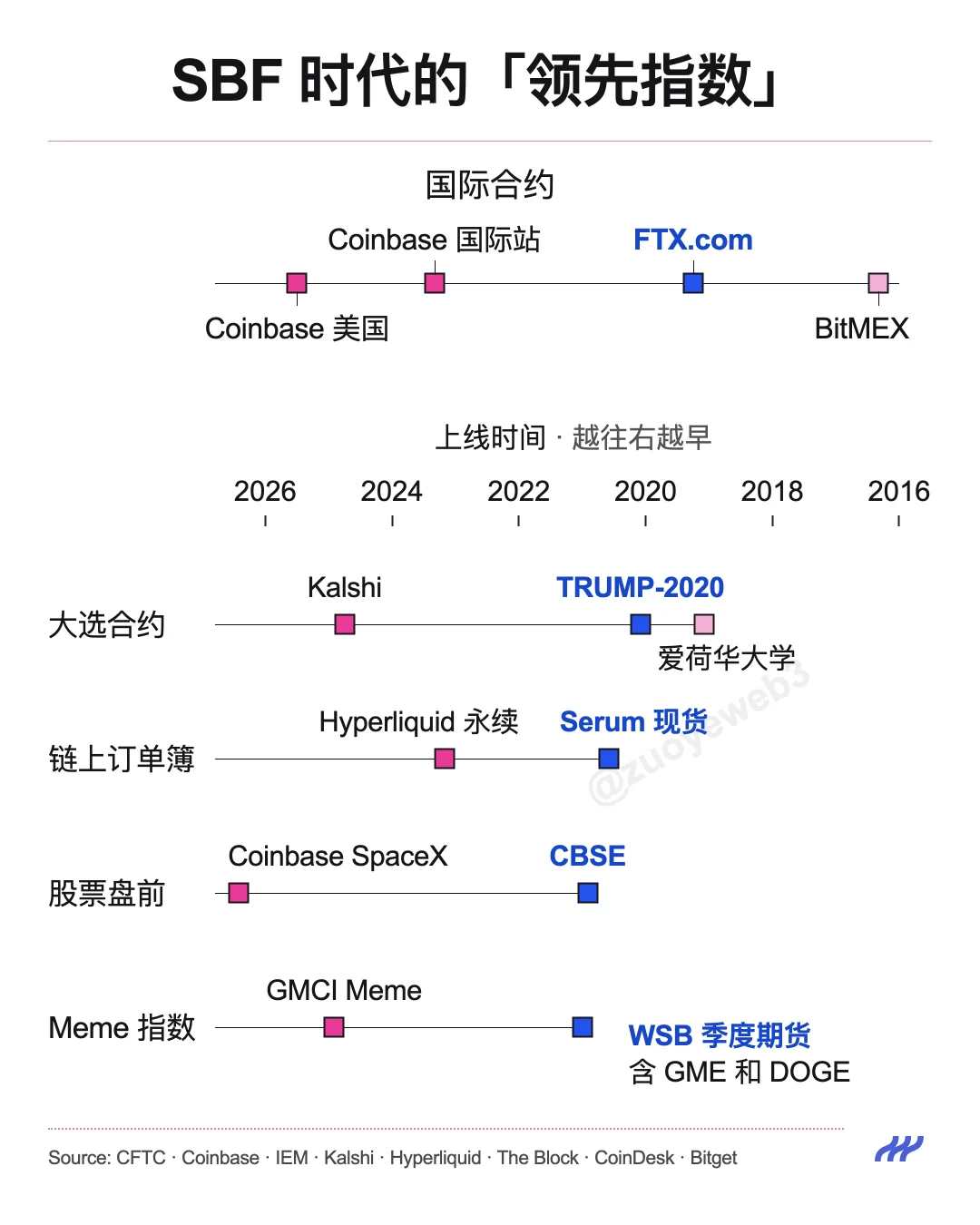
Image: Briefly reaching the future
Looking back at SBF's crypto journey from 2017 to 2022, FTX at least led the industry trends in five dimensions: prediction markets, Perp DEX, pre-market contracts, tokenized stocks, and internationalization.
Arthur Hayes pursued financial engineering products (perpetual contracts, hedging stablecoins), while SBF considered the future of the crypto industry entirely from a liquidity perspective.
In a recent interview, SBF talked about why he could continuously innovate, replying, "Liquidity generates liquidity." Most users do not care about funding rates, premiums, or other market costs; a good user experience and wealth effect will mutually promote each other.
This certainly stems from SBF's personal background as a trader, as well as Alameda's roots in market-making, but there are many entry points in the market. After SBF, we have seen the collective credit bankruptcy of VC tokens in 2024 and the poor performances of many market makers like Web3Port.
The obsession with liquidity is no less than Anthropic's blind belief in Scaling Law; a priori is always more significant than a posteriori, and only by penetrating a single point can one monopolize the market. Ultimately, FTX perished from lack of liquidity, and profit and loss derived from the same source.
The slogan for the FTX App at one time was "Trader for Trader." I do not want to say Jeff is an imitator, but FTX indeed had more originality than Hyperliquid; when you capture user interest in Trump's election, you naturally launch binary options and place them on the main site (international site).
We forever miss an industry where new mechanisms emerged daily, which might be SBF's spiritual legacy, at least more creative than "$I’ve arrived," "$Bull is coming."
Looking back at a distance, old friends are long gone
SBF was once a revolutionary but ultimately betrayed the revolution.
The revolution in products can only seize the market; the revolution in financial leadership must have a hard enough banner. FTX introduced new mechanisms daily, while SBF went to Congress to discuss regulation, traveling the world for sponsorships. None of this was upheld by decentralization slogans, but by a set of values that could persuade both Wall Street and Washington: making money is for doing good, and crypto is a means, not a casino.
Therefore, when SBF fell, it was not just an exchange that collapsed, but also the crypto industry's only chance to approach mainstream narrative.
Today's crypto industry, regardless of direction, is essentially comprised of small-time figures, but the turning point of all this happens to be SBF's personal decline.
When SBF was questioned by Congress, he was the focus of the world; when FTX collapsed, the industry's image plummeted. Subsequently, there remained only a long road of debt resolution and restructuring—neither can you expect Satoshi Nakamoto to appear, nor can you hope that Vitalik's PoS pathway is entirely correct.
Truly hard to bear, a16z and others followed Vitalik's personal vision to invest over a hundred billion dollars into LST, ZK, and L2, only for the Web3 vision to downgrade to the intersection of FinTech and payments, commonly known as the urban-rural junction.
This shouldn’t have been the case; the metaverse made Zuckerberg an epic joke, but EA (effective altruism) nearly replaced the dark enlightenment of Peter Thiel and Nick Land, becoming the most dominant mainstream ideology in Silicon Valley's tech circle.
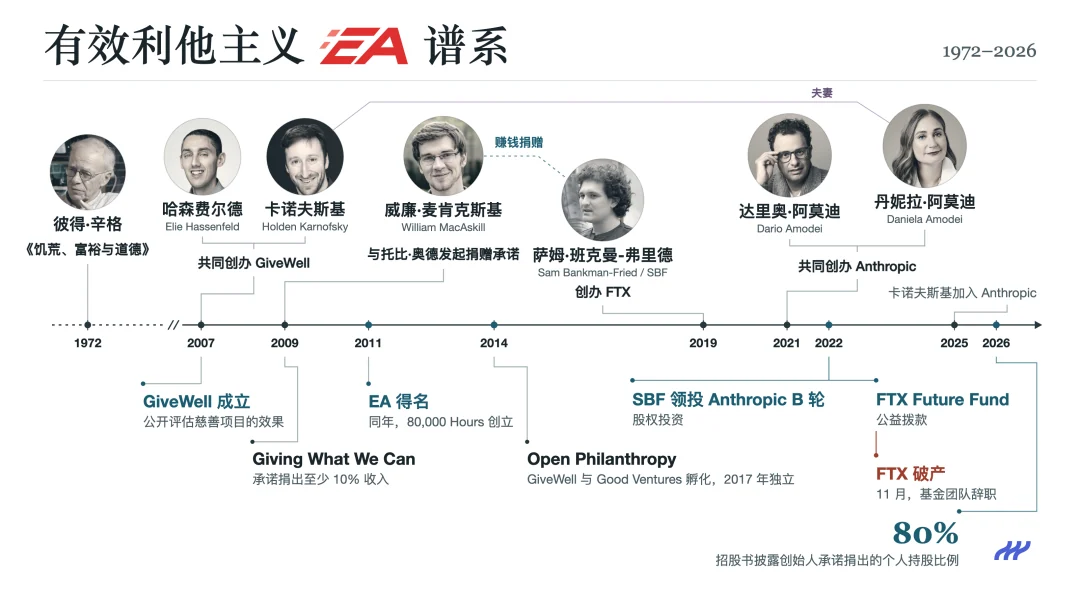
Image: Making finance for charity
This is no joke; SBF's guide into finance was McKinsey, and what he believed in was EA. The essence of thought is that to save people, one must first make money, using capitalistic means to transform the world for good, able to empathize with capitalists while also using their money to help others.
At that time, EA proponents for Silicon Valley tycoons were akin to consultants for local officials.
Altruism is the motive for good; effective altruism is precise calculation, while the financial industry is precisely the most profitable field.
The founder of Anthropic, Amodei, had donated to the EA organization GiveWell back in 2009 and published an article detailing his ideological journey, while Daniella Amodei married one of the founders of GiveWell, Krawowski.
Returning to Anthropic's Series B financing, SBF invested not because he endorsed AI, but because he recognized Amodei's EA identity. This is the funding loop within the EA circle; if nothing goes wrong, SBF would play the role of Peter Thiel, leading the EA gang to rise in Silicon Valley.
Sadly, when nothing goes wrong, it leads to calamity; after SBF's collapse, the public image of EA also completely shattered. Although Facebook co-founder Dustin Moskovitz desperately held on, Amodei and others have gradually distanced themselves.
McKinsey briefly became an advisor to the FTX Future Fund and lived a comfortable personal life after receiving donations from SBF, but all this crumbled abruptly, as if waking from a dream, along with it disappeared the dream of crypto's resurgence.
It can be said that the collapse of SBF and EA led the crypto industry in the US into a very awkward position. Crypto does not lack political strength; in 2024, Fairshake poured money into elections, and stablecoin legislation was cleared, yet having money and votes without spirit means that decentralization can unite all humanity but cannot develop its ideology out of this, resulting only in being co-opted, which EA should have shouldered as the mission.
Latercomers have not tried— the "Genius Act" was implemented, and stablecoins finally earned a name; Armstrong led Coinbase to the forefront, working for over a year for the "Clarity Act," bargaining with banks for stablecoin yield terms, only to withdraw support at the last minute, and in a procedural vote in September, only managing to secure 50 votes, falling 10 votes short and turning to the SEC and CFTC.
The difference is here: SBF spoke in Congress about what crypto can bring to the world, while Armstrong talked about what Coinbase can do in business; the former wanted to be the rule-maker, while the latter could only lobby for the rules. Stablecoins entered the system, but the narrative of crypto did not follow, and stablecoins ended up suffering for it.
The industry that is co-opted is only entitled to the narratives that are allocated to it.
You might think A\ is delusional, but pushing toward the world requires being uniquely different; now crypto is no longer trendy or seen as a threat by the mainstream.
Now looking at the conspiracy groups on BSC circling around CZ, and then CZ getting whipped like a top by Americans, there are only feelings left, will there be a next SBF?
We do not hate or hope for any one person but are waiting for the next opportunity, the next wave; revolutionaries are forever young.
免责声明:本文章仅代表作者个人观点,不代表本平台的立场和观点。本文章仅供信息分享,不构成对任何人的任何投资建议。用户与作者之间的任何争议,与本平台无关。如网页中刊载的文章或图片涉及侵权,请提供相关的权利证明和身份证明发送邮件到support@aicoin.com,本平台相关工作人员将会进行核查。