From T-bill to Apollo credit: Pendle is aggregating all yields from the real world.
Written by: Stacy Muur
Translated by: AididiaoJP, Foresight News
The stablecoin market has reached a scale of 310 billion dollars, with most of the funds just quietly sitting there without any yield.
But this is changing as real-world yields begin to go on-chain, including government bond interest, private credit returns, and monthly dividends from NASDAQ-listed instruments. Assets that were once locked behind brokerage and institutional channels are now being tokenized through a series of protocols, allowing any DeFi user to access the same returns.
However, there is a problem.
The yield on these assets is volatile and not a fixed number. This month you might get 11%, next month it could drop to 9%. If you are a fund or treasury manager, you cannot plan around an ever-changing interest rate.
This is the gap that @pendle_fi fills. When these tokenized RWA assets arrive on Pendle, the protocol gives you a choice: lock in a fixed rate you can rely on or bet on the trend of the floating rate. The same asset, and you can choose different risk appetites.
The macro backdrop also supports this:
- Tokenized RWA on public chains broke 23.6 billion dollars in March, growing 66% since January;
- JPMorgan predicts that yield-based stablecoins could capture 150 billion dollars;
- Bank of America CEO warns that 6.6 trillion dollars in deposits could flow into stablecoins.
The traditional banking sector has now regarded on-chain yields as a real competitive threat. Financial bigwigs have already deeply integrated with Pendle:
- Apollo's 785 billion dollar credit fund routed to Pendle via Ember;
- Strategy's STRC dividends tokenized on Pendle through Saturn and Apyx;
- Paxos has placed its regulated treasury-backed stablecoin on Pendle, with TVL exceeding 120 million dollars in less than two months;
- Ethena's routed TVL through Pendle surpasses any other DeFi protocol, peaking at 4.71 billion dollars.
Here are the products currently launched on Pendle and their respective significance.
Strategy's STRC dividends can now be traded on Pendle
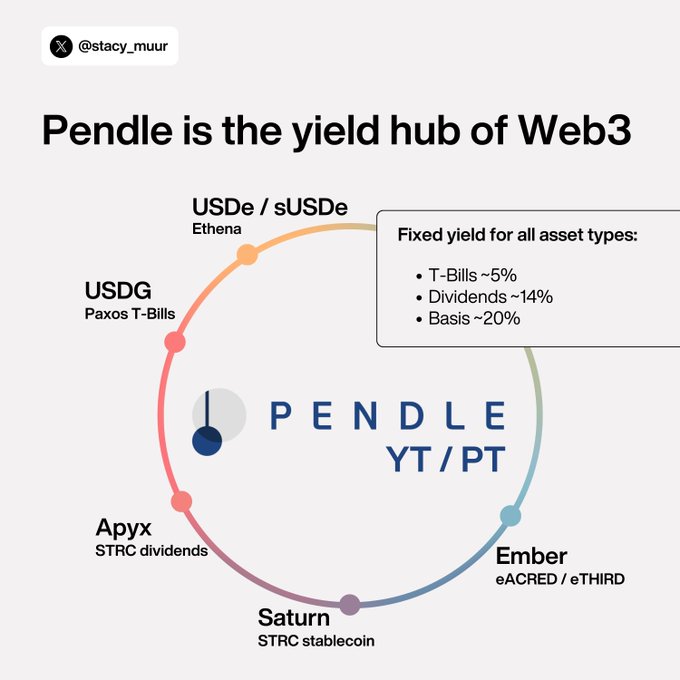
STRC is a preferred stock issued by Strategy (formerly MicroStrategy) listed on NASDAQ. It is similar to bonds; after you purchase it, Strategy pays a monthly cash yield of 11.50% annualized return. Strategy uses the funds raised from the sale of STRC to buy Bitcoin, essentially bridging the traditional stock market and Bitcoin accumulation. This rate started at 9% last July and has been raised seven times, stabilizing at 11.50% since March.
Two independent teams observed the monthly cash flow and decided to build stablecoins around it, tokenizing the dividend payments so that DeFi users could obtain the same yield without a brokerage account. Both chose Pendle as the venue for users to trade their yields.
Saturn launched its mainnet on April 8, currently with approximately 45 million dollars in deposits:
- USDat is the base layer, minted 1:1 with USDC, tokenizing government bonds as backing through M0 (partners include Galaxy, Securitize, Clear Street);
- sUSDat is the yield layer: staking USDat triggers Saturn to allocate part of the backing assets into STRC, passing the monthly dividends to holders at approximately 11% APY.
Yield pathway: BTC → MSTR equity → STRC preferred stock dividends → sUSDat
Saturn's pool on Pendle attracted 5 million dollars in TVL on its first day.
Apyx takes a different approach. The team also operates DeFi Development Corp (NASDAQ: DFDV), the first SOL digital asset treasury company:
apyUSD collects STRC (11%) and SATA (12.5%) dividends, holding them off-chain, converting monthly cash payments into assets, and routing them to the treasury.
Growth on Pendle: from zero to a total TVL of 82.6 million dollars within 47 days (averaging about 1.76 million dollars daily), with the apyUSD pool alone reaching 44.7 million dollars.
Why did both choose Pendle? Because STRC dividends can be volatile, Strategy adjusts interest rates every month. If you manage real capital, you cannot allocate it to a yield that may change at any moment, whereas Pendle's PT/YT split allows you to lock in rates. This is why the entire STRC ecosystem has already concentrated in Pendle before any corresponding infrastructure exists elsewhere.
Apollo's 840 billion dollar credit fund can now be accessed through Pendle
Apollo is one of the largest asset management companies in the world, managing over 840 billion dollars in assets. They operate large-scale credit funds, including lending to corporations, supporting real estate transactions, and building debt portfolios. Typically, these assets are entirely closed off to retail; you need to be an accredited investor or institution to gain access.
Ember Protocol found a way to bring this yield on-chain. Ember is a treasury platform that packages yield strategies from traditional finance, CeFi, and DeFi into tokens that can be used within the DeFi ecosystem. For its largest product, they directly approached Apollo.
The actual pathway for yields flowing from Apollo's credit fund to Pendle users is as follows:
- The Apollo credit fund is at the base level, covering direct lending to corporations, asset-backed positions, and structured credit, all off-chain;
- Securitize tokenized the fund into ACRED, enabling its on-chain existence (Securitize has processed over 4 billion dollars in tokenized assets to date);
- Ember wrapped ACRED into an ERC-4626 treasury as eACRED, which is a key step in making it composable with DeFi protocols;
- Pendle splits eACRED into PT/YT, allowing users to choose between locking in a fixed rate for Apollo's entire credit portfolio or trading a floating rate.
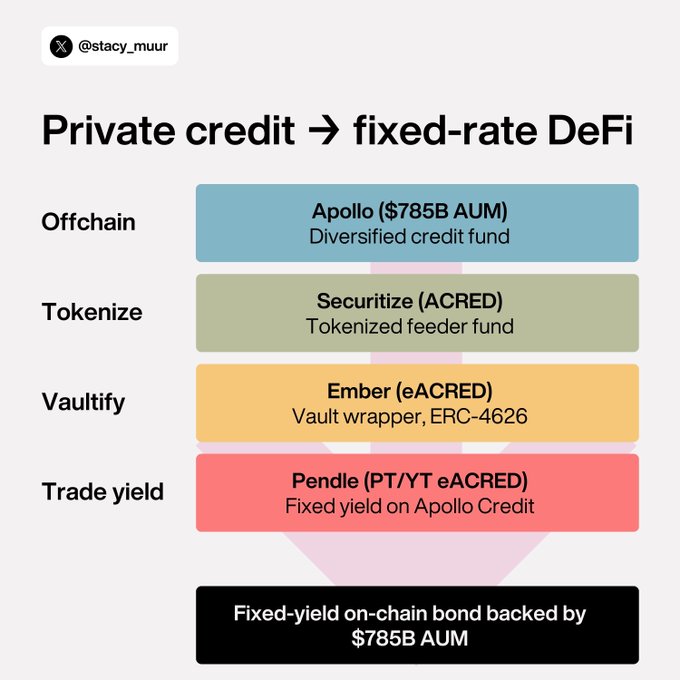
The final product is an on-chain fixed-rate bond backed by one of the world's largest asset management companies, accessible to anyone with a wallet. No KYC threshold, no intermediaries. Two years ago, these channels didn't exist. Now they are settling real capital daily.
Ember also runs two additional products on Pendle: eEARN (a custodial stablecoin strategy where you can receive a fixed rate without actively managing positions) and eTHIRD (their Third Eye treasury, currently providing 20.66% APY for USDC through cross-chain basis trading with MON and ENA).
USDG brings regulated treasury yields to Pendle
USDG is a stablecoin built by Paxos, backed by U.S. Treasuries. Unlike most stablecoins that merely hold reserves and stop there, USDG actually generates yield from these Treasuries and operates under the strictest regulatory oversight in the field:
- Supervised by the Monetary Authority of Singapore (MAS);
- Complies with MiCA’s European distribution requirements;
- Market capitalization of approximately 2.14 billion dollars;
- Over 100 distribution partners, including Kraken, Robinhood, OKX, Mastercard, and Anchorage.
When the GENIUS Act proposes reserve and audit requirements in July 2025, Paxos has already built USDG to meet those standards, putting it ahead of nearly all competitors still retrofitting for compliance.
Integration with Pendle marks a significant advancement as this is the first time the protocol directly interacts with an asset issuer bringing tokenized products on-chain. The effects are quickly evident:
- TVL surpassed 100 million dollars in the first month after launch;
- Paxos and Global Dollar Network raised the pool incentives from 150,000 dollars to 390,000 dollars after seeing demand;
- The pool currently exceeds 120 million dollars.
This means in practice: you can trade fully regulated, audited government debt as unpermissioned yield derivatives on Pendle. With just one wallet, you can lock in a fixed rate on Treasury yields. This is the access that institutional fixed income departments have sought for years but never had a clean avenue to obtain.
Ethena's supporting assets become more complex, which actually benefits Pendle
Pendle has one of the strongest partnerships in DeFi with Ethena: peak TVL of 4.71 billion dollars, monthly trading volume of 5.54 billion dollars in September 2025, and peak swap fees of 3.6 million dollars in April 2024. BlackRock's BUIDL now supports Ethena's USDtb, indicating the level of importance traditional finance places on this relationship.
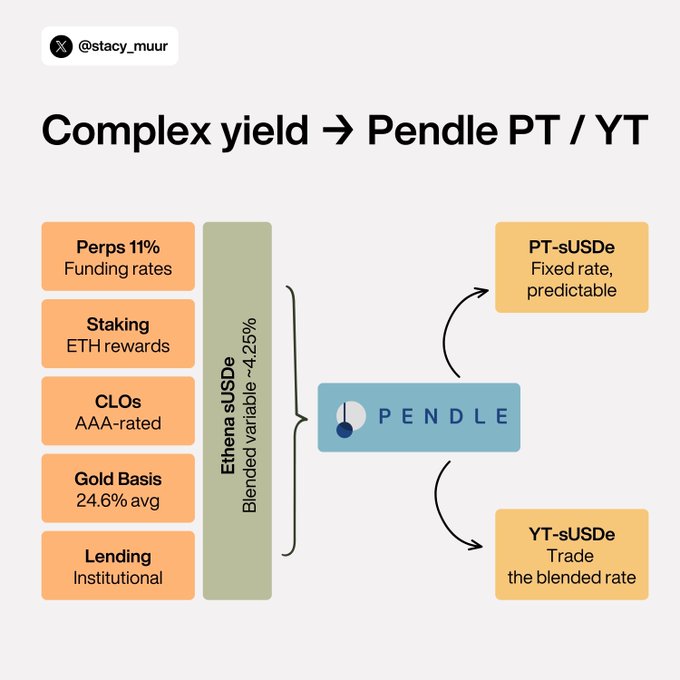
But what is changing is that: the yield from sUSDe was primarily derived from one source — the funding rates of crypto perpetual contracts. Now Ethena has diversified into:
- CLOs and corporate bond exposure;
- Gold and commodity basis positions;
- Institutional lending.
Why is this important for Pendle? Because each new source of yield changes the blended rate of sUSDe. And on Pendle, traders price their expectations of that rate through PT/YT. Therefore, they are no longer just betting on the trend of funding rates but pricing the entire yield portfolio in one number.
If you have ever traded rates in traditional finance, this will feel familiar — it is essentially an interest rate swap on a diversified credit portfolio, only permissionless and settled on-chain. As Ethena's supporting assets become increasingly diversified, the trading environment on Pendle also becomes richer.
GENIUS and CLARITY acts may make Pendle the default place for stablecoin yields
Before discussing the legal content, just look at the yield gap, as this spread explains everything about why capital flows:
- Chase savings account: 0.01% APY
- USDC from Coinbase/Kraken (end of 2025): 3.5–5%
- On-chain yields through Pendle PTs on STRC and Treasury protocols: up to 11%
This gap is precisely the power that pulls deposits on-chain. And two legislative measures are about to make this gap even more significant for Pendle's positioning.
The GENIUS Act (especially section 4(a)(11)) states that stablecoin issuers paying any form of yield or interest to holders is illegal. But the wording only targets the issuers. It does not include exchanges, nor does it include DeFi. This is why Saturn's sUSDat and Paxos' USDG can generate returns through Pendle without encountering legal issues — the yields come from market mechanisms, not direct payments from issuers.
The CLARITY Act is what everyone should pay attention to. It proposes to extend the same prohibition to "any digital asset service provider," which would directly target stablecoin rewards from centralized exchanges. If this bill passes, the scenario of Coinbase and Kraken offering 4% USDC yield could come to an end.
Pendle's architecture is crucial here. When someone purchases PT-USDG, the returns come from price discovery of a permissionless AMM, with no entity paying “interest”. GENIUS prohibits issuers, CLARITY aims to prohibit exchanges, and Pendle fits none of those definitions as it is a market rather than a service provider. If rewards at the exchange level are restricted, Pendle may become the primary venue for fixed returns denominated in dollars still existing on-chain.
Where does all this ultimately lead?
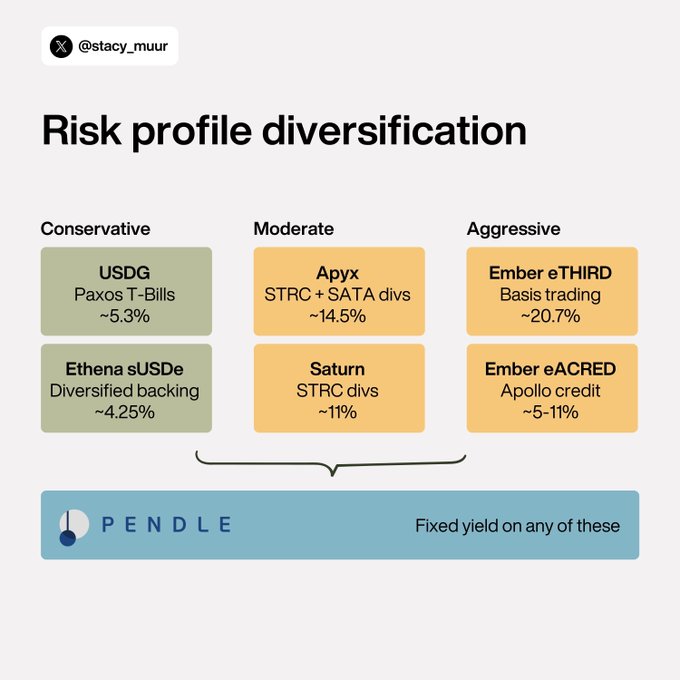
If you rank all products currently launched on Pendle by risk level, the range is incredibly striking:
- Conservative: USDG approximately 5.3% fixed yield (Paxos Treasuries), Ethena sUSDe approximately 4.25% blended yield
- Neutral: Apyx approximately 14.5% (STRC/SATA dividends), Saturn approximately 11% (STRC)
- Aggressive: Ember eTHIRD approximately 20.7% (basis trading), eACRED 5–11% (Apollo private credit)
So far, 69.8 billion dollars in yields have been settled. Grayscale has retained PENDLE (financial sector) in its observation list for the second quarter of 2026, while cutting consumer projects.
Four entirely different risk profiles — government bonds, private credit, NASDAQ-listed dividends, custodial multi-asset strategies — all converge on the same protocol because they all need one thing: a way to transform variable yields into something the treasury can actually underwrite. U.S. Treasury Secretary Bessent called a 2 trillion dollar stablecoin market cap "very reasonable." BlackRock's BUIDL has already supported Ethena's USDtb.
Capital is no longer waiting for permission; it is already flowing, and Pendle is where it goes to become fixed rate.
免责声明:本文章仅代表作者个人观点,不代表本平台的立场和观点。本文章仅供信息分享,不构成对任何人的任何投资建议。用户与作者之间的任何争议,与本平台无关。如网页中刊载的文章或图片涉及侵权,请提供相关的权利证明和身份证明发送邮件到support@aicoin.com,本平台相关工作人员将会进行核查。


