In 2025, if you want to understand the deep pulses of the crypto world, you must shift your focus from the noisy token prices to the underlying architectures that will determine the future. Currently, the entire industry is evolving along two distinctly different technological paths: Modular and Integrated. This silent competition not only defines the flow of capital and developers but is also shaping the future form of blockchain applications.
This is not a simple technological iteration, but a philosophical debate about "how to build the digital world."
Modular Paradigm: An Open, Composable "Lego" World
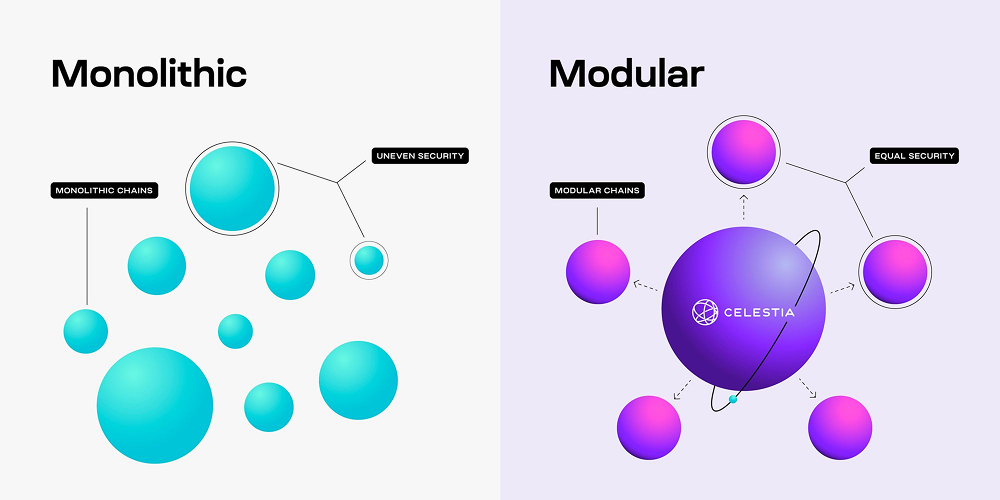
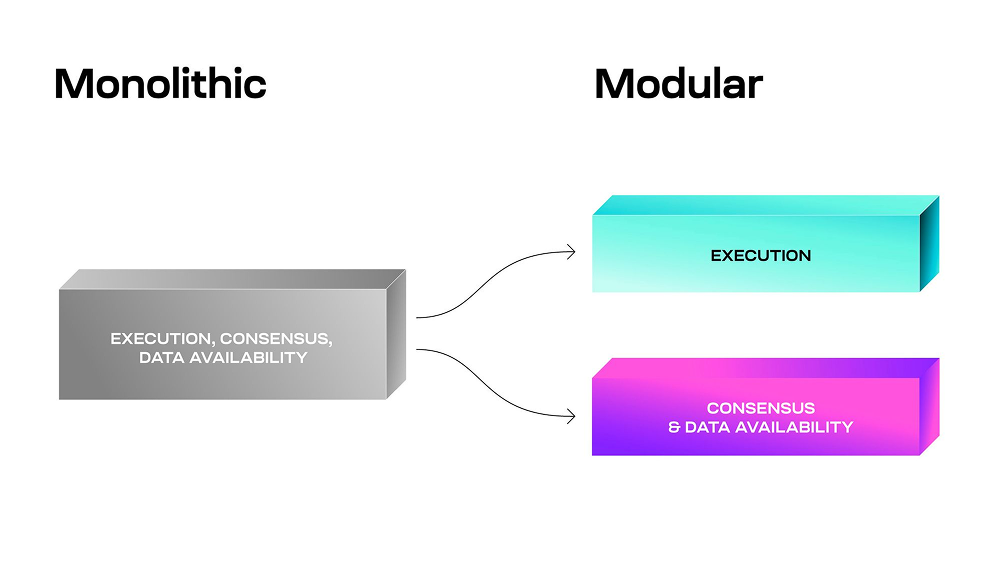
The logic of modular architecture is a refined "surgery" on the core functions of blockchain. It disassembles a large and cumbersome system into four independently upgradable and replaceable "modules": execution, settlement, data availability (DA), and consensus.
The Ethereum ecosystem is the best annotation of this paradigm. Here, the Ethereum mainnet takes a backseat, focusing on its most proficient and crucial task—serving as the ultimate settlement layer and security arbitrator for the entire ecosystem. Meanwhile, the heavy transaction processing tasks are delegated to hundreds of Layer 2 solutions.
The key catalyst for this transformation is the independence of the data availability (DA) layer. Dedicated DA networks represented by Celestia, as well as restaking solutions like EigenDA, have significantly reduced the data cost of launching a new chain. This is akin to providing cheap and abundant raw materials for a "chain-building factory," directly leading to an explosion of application chains (App-chains).
The core appeal of modularity lies in "sovereignty" and "flexibility." Developers can select the most suitable components for their applications, just like assembling a high-performance PC, without being constrained by any single public chain.
However, a world constructed from countless "Lego" blocks inevitably faces its inherent challenges. Liquidity fragmentation is currently the most troublesome issue, with users' assets and attention scattered across isolated L2s. Poor cross-chain experiences act like invisible walls, hindering the seamless integration of the ecosystem. An open world also means greater complexity.
Integrated Paradigm: An Efficient, Closed "Apple" System
If modularity is the open Android, then integration is the closed iOS. Integrated public chains represented by Solana adhere to a different philosophy: extreme vertical integration.
It does not layer functions but chooses to tightly couple all core aspects—execution, settlement, DA—within a single system, and then squeezes hardware performance to the limit through technologies like parallel processing. This design results in astonishing speed and extremely low transaction costs.
The advantage of an integrated architecture is its simplicity and efficiency. For applications that need to handle massive high-frequency interactions—such as DePIN, on-chain games, or social media—it provides an almost perfect operating environment. Here, the user experience is unified and smooth, with no complex cross-chain operations and no high gas fees. This positions it favorably in the race to capture the next billion C-end users.
Of course, this "powerful and fast" model comes at a cost. To achieve high performance, integrated chains have extremely stringent hardware requirements for validating nodes. This naturally raises the threshold for participating in network validation and makes the degree of decentralization a long-term topic of scrutiny and discussion in the industry. Although technologies like Firedancer are improving this situation, the trade-off between "performance and decentralization" remains a challenge that integrated architectures must confront.
Conclusion: From Route Competition to Market Division
So, how will this architectural competition conclude?
Current signs indicate that this is likely not a "winner-takes-all" war, but a profound market division. The two architectures are serving distinctly different needs in their respective areas of expertise.
The modular ecosystem, with its security foundation and high customizability, is becoming a natural home for high-value finance (DeFi), institutional solutions, and complex application chains. It resembles a powerful backend serving professional developers.
Integrated public chains, on the other hand, are capturing the minds of large-scale consumer applications with their seamless user experience and low costs. They resemble a smooth frontend directly aimed at massive users.
The future blockchain world is likely to be a heterogeneous multi-chain coexistence. A user might play games on Solana and then securely transfer high-value assets obtained in-game through a cross-chain bridge to a wallet based on Ethereum for safekeeping or DeFi operations.
Therefore, the next core question for the industry will shift from "which architecture is better" to "how to enable different architectures to work better together." Interoperability protocols will become the key infrastructure connecting these value islands.
For those of us involved, understanding the essential differences and applicable scenarios of these two paradigms is more important than simply taking sides. Because this is no longer a matter of who is right or wrong, but about how to build a more diverse, more powerful digital future that can serve more people.
免责声明:本文章仅代表作者个人观点,不代表本平台的立场和观点。本文章仅供信息分享,不构成对任何人的任何投资建议。用户与作者之间的任何争议,与本平台无关。如网页中刊载的文章或图片涉及侵权,请提供相关的权利证明和身份证明发送邮件到support@aicoin.com,本平台相关工作人员将会进行核查。