The Bitcoin mining industry is facing the most severe economic crisis in its 15-year history. As of the time of writing, the Bitcoin price is fluctuating around $92,870, down 27.67% from the October high of $126,000. This adjustment has directly led to a collapse in mining profitability, with the current hash price rate at 1,075 Eh/s, remaining at a high level. Industry analysis shows that miners are in "the harshest profit environment ever," with most operators' daily income falling below production costs, and the payback period for new generation mining machines extending to over 1,000 days. Miners may be forced to sell Bitcoin in large quantities to maintain cash flow, which could create a vicious cycle, further driving down Bitcoin prices.
Profit Margins Continue to Deteriorate, Hash Price Drops to Structural Low
The collapse of mining profitability has persisted for four months. A report from JPMorgan indicates that in November, miners' average daily block reward income was only $41,400/EH/s, a decrease of 14% month-on-month and 20% year-on-year. The current hash price is stable in the range of $38.3–39.44 per PH/s, just slightly above the breakeven line of $40 per PH/s. If it falls below this line, a large number of miners will have to shut down to avoid losses.
Although the total network hash rate slightly declined by 1% to 1,074 EH/s in November, it is expected to continue rising to over 1,100 EH/s in December, leading to intensified competition and severely diluted income per unit of hash power. TheMinerMag points out that this is not a short-term fluctuation but a structural low. Mining difficulty is expected to rise to 1.5056 trillion in December, further compressing profit margins. Small miners are earning only $0.0334 per TH/s daily, the lowest since 2023. Publicly listed mining companies like CleanSpark have recently decided to repay in full the credit line obtained from Coinbase using Bitcoin as collateral, symbolizing that the mining community has generally shifted towards deleveraging, prioritizing cash retention, and enhancing liquidity, rather than continuing aggressive operational expansion.

Bitcoin Price Adjustment Amplifies Mining Pressure
Bitcoin has further dropped from the November high of $110K to a low of $83K in early December, before rebounding to the $92.9K range. The price drop of about 18% directly erodes miners' income, as mining rewards are tied to BTC prices. The payback period for new generation mining machines has exceeded 1,000 days, while there are only about 850 days left until the next halving (expected in 2028), meaning most miners will struggle to recoup their investments before the halving.
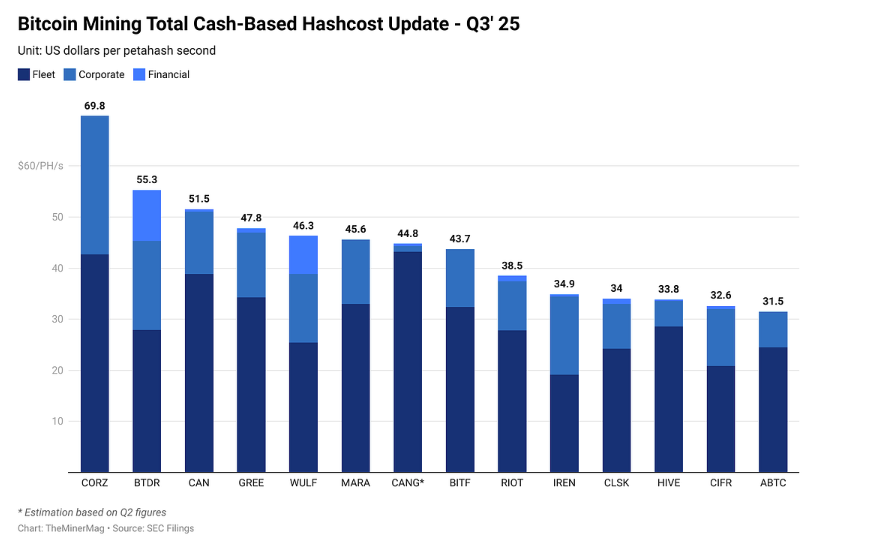
The industry’s balance sheets are responding to the deteriorating environment. In November, the total market capitalization of publicly listed mining companies evaporated by 16%, dropping to $59 billion. Many miners are attempting to diversify their income by turning to AI/HPC high-performance computing, but in the short term, they still cannot escape their severe dependence on Bitcoin prices.
If Miners Sell Bitcoin in Large Quantities
The profit crisis may force miners to accelerate the sale of their holdings, posing greater downside risks to prices. On November 6, miners sold 1,898 BTC at an average price of $102,600, and even a dormant miner wallet that had been inactive for 14 years transferred out 150 BTC, further increasing market supply pressure.
Historically, miner sell-offs have often amplified price declines. Currently, financing rates have turned negative, and market bearish sentiment is rising. If the sell-off continues, Bitcoin may test the $83,000 support level again, creating a vicious cycle of "price drop → profit deterioration → more sell-offs."
Mining Stocks Under Significant Pressure, Rebound Fails to Mask Fundamental Crisis
Since mid-October, the stock prices of the mining sector have collectively plummeted:
- MARA Holdings (MARA) has fallen 50% from its peak, now at $11.91;
- CleanSpark (CLSK) is down 37%, now at $13.70;
- Riot Platforms (RIOT) has decreased by 32%, now at $15.22;
- HIVE Digital Technologies (HIVE) has seen the largest drop of 54%, now at $3.16.
Bitcoin mining is experiencing its most severe period in 15 years, with profits hitting historical lows, potentially forcing miners to continue selling Bitcoin, which may drive prices further down. As difficulty continues to rise and the next halving approaches, miners must significantly improve efficiency or diversify their operations; otherwise, more machines will be forced offline. This round of adjustments is not a short-term fluctuation but a profound structural challenge. Investors need to closely monitor miner wallet dynamics and the intensity of sell-offs to assess the subsequent downside risks for Bitcoin.
Join our community to discuss and grow stronger together!
Official Telegram community: https://t.me/aicoincn
AiCoin Chinese Twitter: https://x.com/AiCoinzh
OKX benefits group: https://aicoin.com/link/chat?cid=l61eM4owQ
Binance benefits group: https://aicoin.com/link/chat?cid=ynr7d1P6Z
免责声明:本文章仅代表作者个人观点,不代表本平台的立场和观点。本文章仅供信息分享,不构成对任何人的任何投资建议。用户与作者之间的任何争议,与本平台无关。如网页中刊载的文章或图片涉及侵权,请提供相关的权利证明和身份证明发送邮件到support@aicoin.com,本平台相关工作人员将会进行核查。