The world is ready to embrace the era of programmable digital finance.
Written by: Star
On December 8, OKX CEO Star was invited to attend Abu Dhabi Finance Week and delivered a keynote speech titled "Project 50% – How Economies Powered by Blockchain Level the Playing Field."
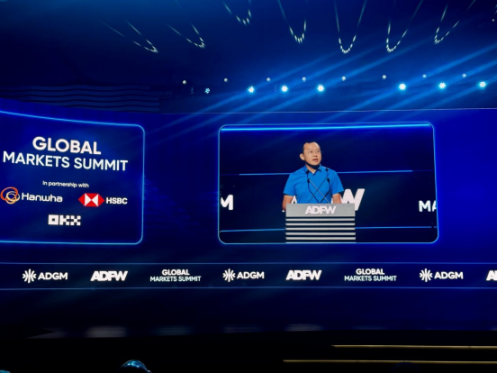
Here is the full text of Star's speech (edited):
I am deeply honored to be invited to participate in Abu Dhabi Finance Week, a globally forward-looking financial event. Today, I would like to share a concise yet bold judgment: the internet generation, which has grown alongside the internet, is creating a brand new on-chain economy; in the coming decades, approximately 50% of global economic activities will operate on blockchain. This is not a speculative prediction, but rather an inevitable demand from a new generation for financial infrastructure that fits their lifestyle in an era where digitalization, mobility, and artificial intelligence are deeply integrated.
To understand this trend, we can look back at history and explore the evolution of infrastructure paradigms that iterate every decade: the 1990s were the internet era, the 2000s were the mobile era, and the 2010s were the cloud computing era. Now, we are ushering in a grand new narrative — programmable global financial infrastructure. This is the "financial internet" designed for the internet generation, with the core vision of allowing value to flow freely, instantly, and globally, 24/7, just like information, and blockchain technology is making this vision a reality.
Behind this transformation is a comprehensive upgrade of the economic system driven by the global digital population. The reason blockchain stands out is that it breaks through many limitations of the legacy systems left by the internet era: it builds a trustless programmable storage infrastructure that supports real-time global value transfer; it reduces systemic risk by continuously enhancing transparency, creating an open and interconnected network ecosystem, and breaking the "island effect" of traditional global finance. Throughout every technological iteration cycle, more open, transparent, and efficient systems will ultimately prevail, and the new generation has always been the first to embrace change. Today, this transformation is no longer a conceptual hype but has entered a stage of large-scale development and implementation: the settlement volume of stablecoins has surpassed that of Visa, the scale of on-chain assets is approaching $3 trillion, and the number of global cryptocurrency wallets has exceeded 500 million; meanwhile, regulatory agencies in countries like the United States and Singapore are actively establishing corresponding regulatory frameworks to promote orderly industry development. The world is accelerating towards a unified global on-chain financial operating system, and the internet generation is the core driving force of this process.
It is noteworthy that the current on-chain financial infrastructure has matured and possesses the capability for large-scale applications, sufficient to meet institutional-level demands and hundreds of millions of transactions, with security standards reaching that of bank accounts. On the OKX platform, users can personally experience the convenience brought by this technological innovation: we support the Apple ecosystem account system, provide high-quality services with no GAS fees, and our performance is comparable to Web2 applications; at the same time, OKX has laid out numerous emerging blockchain networks, achieving transaction processing capabilities of millions per second, and combined with on-chain identity verification, on-chain analysis, and auditability features, we are establishing a new standard for industry transparency. It can be said that the maturity of technology, the improvement of compliance systems, and the readiness of the internet generation's demands have formed a resonance.
A clear signal has emerged: Bitcoin has become the "digital gold" of the internet generation. As the first mainstream crypto asset in history, it possesses core characteristics of transparency, decentralization, and independence from any single country's control, with the main holders being individuals under 40 years old. This generation has grown up in the era of globalization and mobile internet, and for them, digital value holds far more practical significance than physical gold. Today, an increasing number of financial institutions worldwide are incorporating Bitcoin into their balance sheets, rapidly elevating it from a fringe asset to a mainstream asset — this shift precisely indicates that the world is ready to embrace the era of programmable digital finance.
Let’s focus on the currency itself: stablecoins are rising as a new global payment channel, especially favored by young users and emerging markets. The circulation of US dollar stablecoins has reached trillions within months, and regional stablecoins like the Australian dollar and euro have also become mainstream financial tools, achieving real-time settlement and compliant transactions through programmability, gradually replacing traditional inefficient cross-border settlement models. For the internet generation, the cross-temporal and spatial transfer of funds should be as instant and convenient as sending an email.
The impact of this transformation extends far beyond the payment sector; its scale and depth have surpassed the boundaries of traditional financial systems. Today, banks, sovereign wealth funds, and various asset management institutions are entering the on-chain ecosystem, and traditional assets like funds and government bonds are gradually entering on-chain trading scenarios. These assets operate 24/7 on-chain, with liquidity and pricing being transparent and verifiable, while also incorporating robust compliance mechanisms. Thus, asset tokenization is no longer a tentative experiment but is gradually becoming the default infrastructure of modern financial markets.
Looking ahead to the next decade, this will not only be a decade of large-scale adoption of crypto assets but also a decade of intergenerational shifts in the way the global economy operates. For the internet generation, currency, markets, and identity will all be on-chain, and all financial activities will be completed within a unified underlying system. When these elements are organically integrated, a complete internet-native economic structure will officially form. Blockchain will become the true global financial internet, where everyone will have a universal on-chain identity and self-custody wallet, autonomously controlling their funds, achieving efficient interaction of assets across jurisdictions, while also possessing real-time transparency and auditability. This global financial system, tailored for a fully online population, is poised to lead the future not because it is "trendy," but because of its inherently superior systemic advantages.
Thank you all.
免责声明:本文章仅代表作者个人观点,不代表本平台的立场和观点。本文章仅供信息分享,不构成对任何人的任何投资建议。用户与作者之间的任何争议,与本平台无关。如网页中刊载的文章或图片涉及侵权,请提供相关的权利证明和身份证明发送邮件到support@aicoin.com,本平台相关工作人员将会进行核查。


